Right now, I’m about to start teaching Partial Derivatives in my multivariable calculus class. I’m going to teach them in a traditional way, to build a sense of what they are. However, I really want to create a project that has students take actual data and find something useful with it.
To take you down my train of thought, look at this applet:
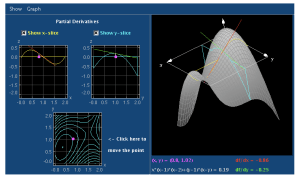
So of course we will soon relate partial derivatives to the gradient which will get us to exploring topological maps. Pretty standard stuff.
However, wouldn’t it be neat if each student could pick a place on the globe and create a topological map for it? (And then, using some simple computer tools or a protractor and ruler, come up with estimations about the steepness or flatness of the terrain at various points?) Well, I can easily make this happen! Because now GoogleMaps has a Terrain feature, and if you zoom in enough, you get to see the level curves with the height of the land marked. And you can use sites like this to calculate the distance between two points!
Here’s some random place in Alaska.

I’m thinking that having my students actually work to calculate some of these values by hand might really hammer home what these strange calculus concepts are. It’s easy to take the derivative with respect of  of
of  . It’s less easy to understand what that means, or what the gradient means, or how they are calculated.
I don’t know if I’ll have time to whip this up, but I think it could be a really great activity.
 Continuous Everywhere but Differentiable Nowhere