Daily Archives: February 5, 2009
A Quick Question about Discipline
I am calling on the collective powers of the online teacher community to see if anyone can help me out. I know it’s a long shot that anyone will respond. But hey, you might know the answer for your school, or you might not know the answer and be intrigued enough to find out the answer.
(1) What are the disciplinary infractions that get reported to colleges by your school?
(2) Does it matter when in high school the offense was committed?
(3) In your school, who makes the decision whether something gets reported to colleges or not?
The reason I’m curious is that I’m on the Student Faculty Judiciary Committee (SFJC) at my school, which is composed of 8 elected students and 3 faculty members, which hears all cases involving student misconduct. (Yeah, yeah, I know… fancy… we didn’t have anything like this in my public high school… but I think student-centered disciplinary committees are common in the private school universe…)
We’re now about to have a discussion with the administration about our current set of disciplinary responses, about infractions getting reported to colleges, about what sorts of offenses warrant the college counselors reporting them, and if it matters what grade the student is in.
If a 9th grader cheats once, should that get reported to a college? What about a 12th grader? What about if a 9th grader cheated 3 times? What if a 12th grader cheated, after being sent before the disciplinary committee for cutting 3 classes the week before? What if a student cheated in 9th grade, and then again in 12th grade?
It gets really sticky, especially with something as high stakes as college admissions, and a clear policy — or at least general guidelines — needs to be drawn up so that there aren’t gross inequities in what happens to one student and what happens to another.
So anyway, any idea of what the policy is in your school? Or if you don’t know the answer, muse a bit in the comments with your thoughts about how you would deal with this in your ideal school: what kinds of things you would say HAD to be reported, and where you would draw the line between something being reported and something not being reported.
PS. If you care, the Common Application has students fill out the following:

A crucible of emotion: A college board envelope
I’ve accidentally came across a few videos on youtube of students getting their College Board AP Scores letter and opening it live on video camera.
I know I’ve posted a bit about this, but it’s so interesting how little I remember about the emotional heights that high school brought. And that time when you know those scores are on their way, those anxious, expectant moments after you see the College Board envelope and before you open it, the rush of emotion when you see the scores inside –
wow.
It’s hard to capture it in words. But watching these videos, I got a rush of those feelings back. Words don’t do it justice, but seeing these kids’ facial expressions, their inability to comprehend, the tone of their voice changing… it’s drama at it’s purest because its a lot of emotion boiled down to a few seconds.
I wonder if people do this for SAT scores too?
What is True Love? Winplot.
I am in love. Absolutely in love…
…
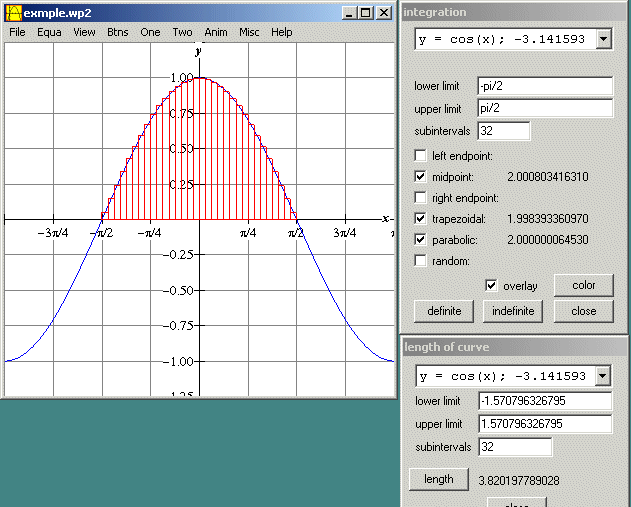
with Winplot (download it here - don’t be deceived by the ugly page). I discovered it on my hunt for a great program to make visuals for my Multivariable Calculus class. But now I’ve started using it when preparing lessons and graphs for all my classes.
The bad news: it has a pretty high learning curve. Some things are intuitive, many things aren’t. You have to, for example, type: y=root(3,x) to graph the cube root of x. But once you get the hang of it, it’s easy, breezy, beautiful.
The good news: what can’t it do?
I decided that either this weekend or next I’m going to spend 60 minutes going through
this comprehensive guide and learn all the features of this program in one go. Since the start of the year, I’ve been learning it piecemeal. I need to graph an inequality, I figure it out by looking around on the program. I need to get gridlines on my graph, I putz around until I figure it out. And in fact I thought I had a pretty good grasp on things without ever reading any documentation. However, it turns out that this program is way, way, way more powerful than I thought — because I only found out today that I can create pictures of volumes of revolution with the short click of a button! And so much more, apparently, after looking at the guide. So in my excited state, I felt compelled to write this post.
I know you’re dying for some screenshots, so I’m going to post screenshots cribbed from the guide linked to above here:
A few more pictures after the jump…