Month: March 2009

Function Transformations

On the Friday before Spring Break, I gave my Algebra II class a quiz on function transformations. It only had reflections about the x- and y-axes, and vertical and horizontal shifting.

I know, I know, you can’t believe how cruel I am, doing something in class the last day before Spring Break. 

Now that we’ve gotten that out of our system, back to the point at hand. Today, I finally got around to grading them. And I have to say that I was really pleased with the results. With the exception of one or two exams, all students did really well.

I told students they needed to memorize the eight standard functions and key points on them (the standard functions include y=x^3, y=|x|, and y=floor(x)). Key points are points I require to be correct on all graphs — after the transformations, they need to be in the right place. So, for example, I require students to know that (-2,-8), (-1,-1), (0,0), (1,1), and (2,8) on y=x^3, and then when  they were asked to graph y=-(-x+1)^3+1, they need to make sure each of those five points are in the correct place. 

A few students — as expected — mixed up translating right/left. And a few performed the reflections last (when they have to perform them before they do any translations up/down/left/right. But yeah, few and far between.

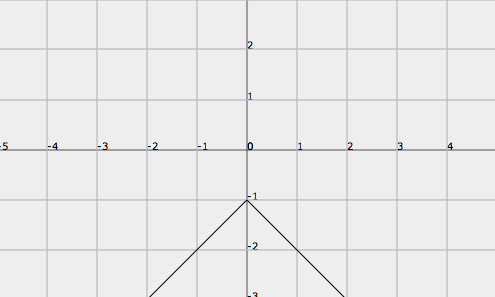
My favorite part of the exam was giving students a graph like:
picture-11

I asked my students to give me the equation describing the graph. Most students rocked that part, even though I only gave them one problem of the same sort as a warm up. I don’t know why I didn’t give them problems like this last year — they require students to really think hard about function transformations to work backwards.

The one question that students almost universally bombed, which made me want to turn myself into a sheet of paper and crumple myself up and throw myself in the wastebasket, was the “explain” problem. The question read something like “Explain in words why y=-\sqrt{x} is a reflection of y=\sqrt{x} over the x-axis. You may want to use a diagram/graph and a table of values to explain your answer.” 

What’s clear to me is that, frankly, my students still have no idea how to explain their ideas in words. I have given questions like this on each assessment, but previously we had a discussion about the concept and how one would go about answering the question. This time, I threw the question on to see if they could do it themselves. Clearly not.

Next year I am going to have to come up with a good way to integrate these “explain” questions in the course. Perhaps I’ll come up with a list of possible questions for each test and hand them out — so students can try to properly prepare their answers. And after each exam, I’ll hand out a list of possible answers and having a discussion about which are good, which are bad, and which are mediocre — and why. (In addition to verbally having the discussion in class.) I think this year I’m just not being clear enough with my expectations. 

Or maybe I’ll just have students write up good answers at home and hand them in, instead of having them on an exam. And if they aren’t satisfactory, I’ll give students the opportunity to rewrite their answers with my comments incorporated.

I don’t know what to say…

On spring break in San Francisco, one of my most favorite cities. (Hence the lack of posts.) Eaten great food. Had great coffee. Hung out with great friends. Met great new people.

Remind me again why I work in New York City?

I think the SF might be giving the NYC a run for top billing as my favorite place in the world.

Dorm Life

I have been addicted to this little web show dorm life.

picture-1

Check it out on hulu. My suggestion: watch it from the beginning of season 1. One of the best things about this show is that you grow to love the characters.  Plus there is some larger story arcs.

The worst part? The episodes are only 5-10 minutes each.

None of you know me, really, but I have to say I have one special, secret most favorite character. Guess if you want. I’ll tell you if you’re right.

A fun double integral

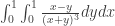
On my multivariable calculus class’s current problem set, I put a number of really challenging problems. One of them — from both the Exeter Math 5 course (here) and also in Anton — has students evaluate the following double integral, and then has students change the order of integration and then evaluate the double integral.

\int_0^1 \int_0^1 \frac{x-y}{(x+y)^3}dydx

Students expect the answers to be the same, but it turns out they are not. (Do you see why?)

Anyway, I have to say that I’m not a master integrator; it usually takes me a little longer than desired to figure out the best method to integrating. But I enjoyed the roads I took, so I thought I’d share the integral with you if you wanted a challenge.

And for those of you who know calculus, but forgot or never learned multivariable calculus, the problem reduces to you solving the following single integral: \int_0^1 \frac{a-y}{(a+y)^3}dy, where a is just a constant.

Have fun. And for what the double integrals turn out to equal, go below the jump.

(more…)

Messed up

I messed up. After what I consider a really successful unit in Algebra II on inequalities and quadratics, I was told that I had to introduce students to applications of quadratics. These include revenue problems, maximum area problems, and falling objects problems. I pilfered a list of 10 problems that the Algebra IIA class (the accelerated version of the class) used, and we went through each one of the problems.

Instead of giving a formal assessment on these three types of problems, I gave students a 3 problem “graded homework assignment” — which had two falling object problems and one maximum area problem. I told students they had to work alone, but they could use their notes.

I collected them and graded them, and the grades were atrocious. Almost all of the grades were atrocious. Which leads me to two important conclusions:

1. I really, really messed up teaching these topics.
2. I really, really messed up teaching these topics.

Now I’m not sure what to do. I honestly don’t want to revisit these topics now; we’re making good progress on function transformations and I’m not ready to lose the momentum we’ve gained. I don’t have time to re-teach the topics. And spring break is starting at 3:10pm on Friday.

Blah. The only reasonable solution I feel I have open to me is to:

1. Be direct with my students and accept responsibility for the bad teaching for those days, and have a (short) conversation with them about what made it difficult to follow. (I have a number of ideas, but I want to hear it from the horses’ mouths.)
2. Tell students that I am not going to count this assignment, since I’m taking responsibility for it.
3.  In the fourth quarter, pick one of the application types (I’m leaning to the falling objects one, because the students had the most problems with it), and just focus on teaching it well for one day.

I hate it when I mess up.

Be careful what you plot

Today in Calculus, I was waxing euphoric about why what we’re about to embark upon is amazing — how we’re eventually going to be able to find volumes and surface areas of strange figures. Not your standard spheres or cylinders or cones, but strange, exotic figures.

So I decide to open WinPlot and produce a surface created by revolving around the x-axis.

As I pressed “Enter” to generate the graph, I immediately recognized that we were going to have a problem. But it was too late.

revolution

I could have picked any number of other functions, but I decided to pick \sin x. Great.

We all had a laugh. Ah, high schoolers.

Moral: Be careful what you plot in class.
