Monthly Archives: April 2009

Thrills & Frustrations

I was frustrated and thrilled today.

I will not whine… too much… about the frustration. For those of you out there who want to know some details, let’s put it this way: when asked to do something, or when I volunteer to do something, I tend to go at it heart and soul, full force. When that effort doesn’t get reciprocal respect (note I’m not talking about reciprocal effort here… just respect)… when I feel like my time and efforts are seen as expendable… I get upset. I put on a grin and I bear it, but not happily.

With that rant over, I can now go to the thrill, which came from having a couple really great classes. My favorite class was my Algebra II class where we were doing exponential functions, and I used a self-created guided worksheet on carbon dating.

I was really pleased with the kinds of questions the students were asking, the mistakes they were making (and correcting), and the aaaah haaaa! moments they had. I could have “taught” carbon dating in 20 minutes: here’s the equation, this is why it should make sense, this is how you apply it. But I loved getting them to the point where they are on the cusp of figuring out the equation for themselves. My students aren’t experts at solving the problems yet. I know if I had taught it traditionally, in 20 minutes, they would be able to solve these problems much better than they can at this moment. But they wouldn’t get things nearly as deeply as they are now. It’s a trade off. And you know what? The time spent was worth it.

I really want to really debrief this lesson soon on this blog. Partly because I thought it went so well and thought it might be useful for others. But partly because it has raised some questions for me about Dan Meyer’s methodology — and its implementation. But for now, I’m going to be content.

My favorite book title

Here’s my favorite book title, ever. I always loved the power of the academic colon.

picture-1

For more information on the author, Wikipedia has some details. (As an aside, if I had stayed in grad school, Silvanus was going to make an appearance in my dissertation.)

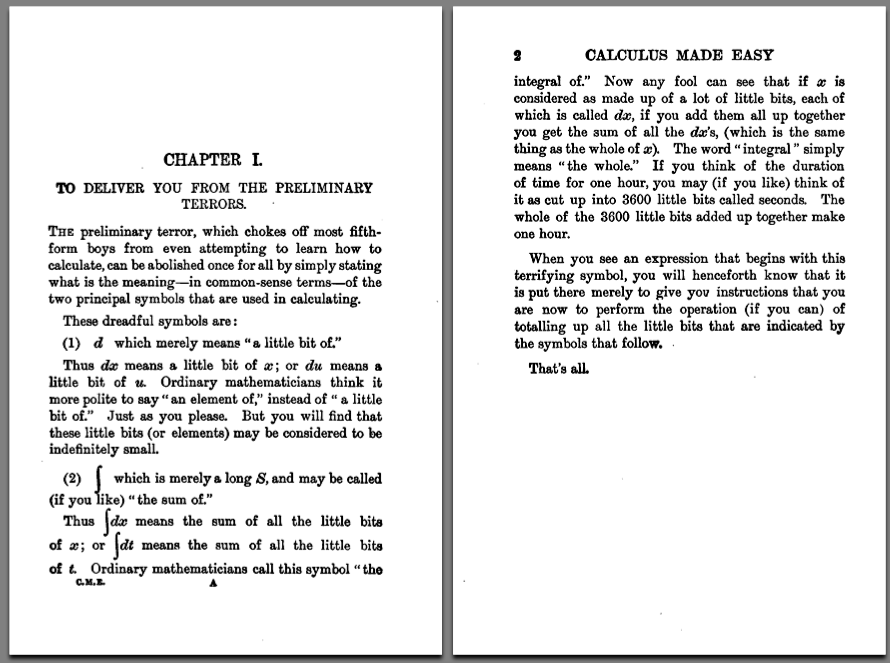
But the title is just the tip of the super awesome iceberg. You can read it on Scribd, but some of my favorite part so far is:

Prologue: Considering how many fools can calculate, it is surprising that it should be thought either a difficult or tedious task for any other fool to learn how to master the same tricks. Some calculus-tricks are quite easy. Some are enormously difficult. The fools who write the textbooks of advanced mathematics–and they are mostly clever fools–seldom take the trouble to show you how easy the calculations are. On the contrary, they seem to desire to impress you with their tremendous cleverness by going about it in the most difficult way.

And the first chapter is just two pages. Awesome.

picture-2 

This struck me especially deeply because… well, see some twitter posts I made earlier this week (read it from the bottom upwards): 

picture-10

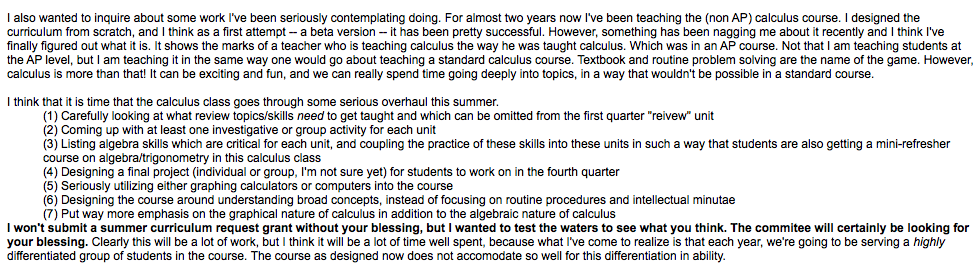
After this brief burst of histrionics, I actually did decide that I wanted to change things a lot. In a follow up fit, I whipped up an email to my department head, pretty much begging that she would support my plea for a grant to work on revamping the curriculum in the summer.

picture-11

(Turns out that revamping the calculus curriculum isn’t an immediate priority, sigh, so I will probably not get it.)

In any case, now that you’ve gone through this stream of consciousness, look back at my favorite book title and see how it all comes full circle.

Function Transformations

I just wanted a quick post to share the documents I created to teach function transformations. All documents are in .doc format. They aren’t flashy, but they really got students thinking about everything. (This is a regular Algebra II class.) They nailed the final assessment, and are now doing amazingly on transformations of exponential functions. In other words, I see my work as a success.

Function Transformations 1 BASIC INTRODUCTION (here): HW (here)
Function Transformations 2 UP! DOWN! LEFT! RIGHT! (here): HW1 (here) , HW2 (here & here)
Function Transformations 3 VERTICAL STRETCHING (here): HW (here)/ Solutions (here)
Function Transformations 3.5 PRACTICING THINGS STEP BY STEP (here)
Function Transformations 4 HORIZONTAL STRETCHING (here): HW (here) / Solution (here)

Also I handed this practice sheet out to all students to practice their 8 base functions (here).

Just so you know, I don’t always teach via handouts. But with all this graphing, I decided it made good sense.
I’m happy if you want to critique them, or make suggestions on how to improve them.

Precious Moment

Today I had one of those great moments which put an impossibly huge smile on my face. Today I had about a zillion student meetings. I had no free periods the entire day! One of the meetings had to take place while I was on “front hall duty” — manning the table where kids sign out to leave the school building for lunch. 

While I was helping this student — and if I say so myself, doing an amazing job of explaining the really conceptually hard Fundamental Theorem of Calculus Part II — one of the people who works at the school, the mother of one of my former students, passed us and then doubled back to speak to us. She said “Wow! I just had to say that this image is so great. This is such a great thing. A second semester senior and a teacher working so hard. This is amazing. I wish I had a camera.” 

I took stock of the situation, and grinned. I patted my student on the shoulder, made two fists and pumped them in the air, and said “Yeah!” 

Teaching seniors is hard. But if you set clear expectations and help them reach them, you too can be as great a teacher as I am. (Just kidding.) But yeah, my faith in my kids’ is on the upswing.

Senioritis


I am cursed[1]. I am surrounded by a sea of transmuted figures, bearing some but not a distinct likeness to their former selves. Slumped and unresponsive, stumbling through the halls of my high school with an arrested gait and in a constant stupor. Hunched over desks as if the desks themselves were magnetized and their brains were oppositely magnetized. The desk seems to call to their heads, inching them closer and closer…

Being spoken to might temporarily break the haze, and elicit a “could you repeat that” or — more tragically comic to me — “yes, definitely” as a response to “What might cause the answer to be 0?” 

There are days when these beings don’t come to school. Days, mind you, is plural. There are campus preview weekends, of course. Soon will come AP exams, where mysteriously on the day before the exam, one might be absent. Coupled with the day of the exam, and we have two more days, gone. Mental zombies.

These beings are mere shadows of what they were before.

[1] Okay, okay, I know I’m not cursed. I love my seniors. But fourth quarter is trying for me, because it is trying for them.

Out of Commission

I’m sorry I’ve been out of commission lately. We had comment writing (we write narrative comments for all our students) and I’m moving to a new apartment in two weeks and I’ve been anxious about that.

But before I forget, here are some topics I’ve been musing about posting on in the near future:

1. comment writing (obviously)
2. function transformations
3. senioritis
4. random questions about stuff i don’t fully conceptually get in the last chapter of the multivariable calculus book

I had to write them down here before I forgot about them in the hectic day-to-day that is my life.

Composition of Functions and their Inverses

In Algebra II, we have been talking about inverses, and compositions. We finally got to the point where we are asking:

what is f^{-1}(f(x)) and what is f(f^{-1}(x))?

Last year, to illustrate that both equaled x, I showed them a bunch of examples, and I pretty much said… by the property of it working out for a bunch of different examples… that it was true. However, that sort of hand-waving explanation didn’t sit well with me. Not that there are times when handwaving isn’t appropriate, but this was something that they should get. If they truly understand inverse functions, they really should understand why both compositions above should equal x.

So today in class, we started reviewed what we’ve covered about inverses… I told them it’s a “reversal”… you’re swapping every point of a function (x,y) with (y,x). That reversal graphically looks like a reflection over the line y=x. Of course, that makes sense, because we’re replacing every y with an x — and that’s the equation that does that. My kids get all this. Which is great. They even get, to some degree, that the domains and ranges of functions and their inverses get swapped because of this.

But then when I say:

f(x) means you plug in x and you get out y… but then when you plug that new y into your f^{-1}(y) you’ll be getting x out again”

their eyes glaze over and I sense fear.

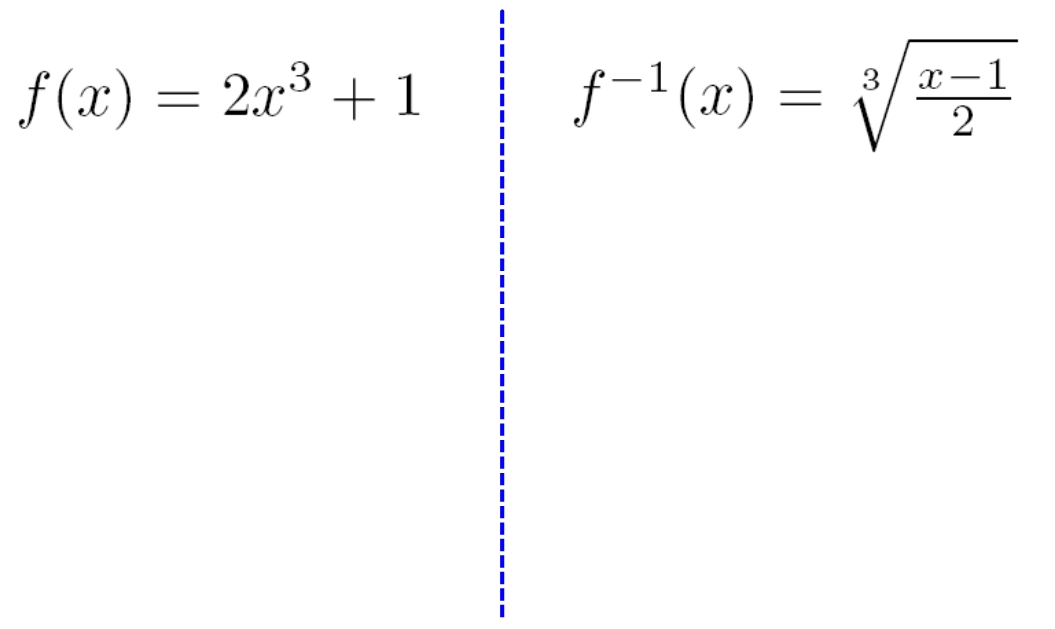
So I came up with this really great way to illustrate exactly what inverses are and how the work… on the ground. I put up the following slide and we talked about what actually we were doing when we inputted an x value into both the function and the inverse:

comp1

We came up with this:

comp2

We then talked about how we noticed that the two sides were “opposites.” Add 1, subtract 1. Multiply by 2, divide by 2. Cube, cube root. And, importantly, that they were in the opposite order.

Then we calculated f^{-1}(f(3)):

Starting with the inner function: f(3)

(1) cube: 27
(2) multiply by 2: 54
(3) add 1: 55

Then we plugged that into the outer function: f^{-1}(55)

(1) subtract 1: 54
(2) divide by 2: 27
(3) cube root: 3

This way, the students could actually see how a composition of a function and its inverse actually gives you the original input back. They could see how each step in the function was undone by the inverse function.

I don’t know… maybe this is common to how y’all teach it. But it was such a revelation for me! I loved teaching it this way because the concept became concrete.[1]

[1] I remember reading some blog some months ago that was talking about solving equations, and how each step in an attempt to get x alone was like unwrapping a present. I like that analogy, even though the particular post and blog eludes me. But in those terms, this is like wrapping a present, and then unwrapping it!

Multivariable Calculus Projects

Monday is the start of the 4th — and final — quarter at my school. I desperately want my Multivariable Calculus students to really love the end of the course. In the same spirit as the rest of the course (focusing on basic concepts and applying them to very difficult problems), I have decided to assign half as much homework and have students spend their time really investigating a hard problem, researching an interesting topic, or creating something based on what we’ve learned. Their choice.

I whipped up a draft of my expectations for their end of year project, which I’m embedding below (Go Scribd! I’ve been waiting for this feature to be WordPress.com compatible for eons!). I know this is not an ideal set of expectations. I need to clean up the redundant language, provide examples of good and bad prospectuses, as well as have on hand sample rubrics for students to use as guides when creating their own. (As an aside, if you know of any prospectuses/rubrics for me to show them, I’d very much appreciate you throwing the link down in the comments!) But my thought now is that I’ll see what happens this year, and then tweak it for future years:


I also spent a number of hours coming up with possible Multivariable Calculus projects, posted at my Multivariable Calculus resource site. I hope to add to it as ideas strike me. I’ll copy the projects that I have as of April 11, 2009, below the fold. But click the link above for a list that will hopefully be updated.

Read the rest of this entry

Take what you don’t know…

In Calculus, I sound like a broken record. Each time we learn something new, I say “take what you don’t know and turn it into what you do know.” I say that at least three times a week. I said it last week when doing integrals like:

\int \frac{1}{4x^2+1} dx

We don’t know how to deal with that, but we do know how to deal with

\int \frac{1}{x^2+1}dx

So let’s try to turn what we don’t know how to do into something we do know how to do. For those who haven’t taken calculus for a while, the integral above is \tan^{-1}(x)+C. So to do the original problem, we want to somehow get the original integral to look like \int \frac{1}{(something)^2+1}d(something) — the integral of 1 over something squared plus 1. So we rewrite the integral as \int \frac{1}{(2x)^2+1}dx. That’s much closer to what we want to get — it looks more like something we know how to deal with. Next we use u-substitution to finish this beast off (u=2x) to get \frac{1}{2} \int \frac{1}{u^2+1}du. Now we have something we know how to deal with, from something we didn’t. 

Again today, I showed my students how to solve \int_0^1 \sqrt{1-x^2}dx, and told them to solve: \int_0^1 5-3\sqrt{1-x^2}dx. At first sight, they recoiled, but again, we used the mantra of “take what you don’t know and turn it into what you do know” to solve it. If it looks scary, fine, have a moment of panic, but then ask yourself “what does this look like” and “can I turn it into that with some simple manipulation”?

I was thinking today how this actually could be my refrain in Algebra II also. Example: I could frame quadratics in that way. Students know — or quickly learn — how to solve equations like (x+1)^2=5 (hopefully). But what about something like x^2+6x+1=0? It’s not nearly as easy. But then we can talk about if there is a way to that what we don’t know (that equation) and turn it into something we do know how to solve ((x+3)^2=8). It’s not that I don’t do this already, but I am not always explicit about it. It is not my mantra.

But it should be. It’s how we solve math problems. We have something we don’t initially know how to do. And we have to figure out if we can simplify/rewrite/re-envision it to bring it to a place where we know how to do it. It seems stupid and simple and obvious, so much so, that I don’t say all the time. But if I started saying that as my refrain, if students really saw that math is simply this simple process, it might stop seeming like a huge bag of tricks that never fall together. They might see it as the art that it is — where there is creativity in deciding how to get from point A (hard problem) to point B (simple problem they know how to do). And all the specifics that we do in class are giving them the tools which they can use to chisel out a path from A to B. It might finally be us always trying to work out the puzzle: what does this look like that we know how to do, and can we get it to that place? 

In other words, we’re now talking processes instead of methods. We’re talking problem solving instead of rote memorization. And whenever a student is stumped on a problem, you can stimulate his/her thought process by saying “we’ve always taken what we don’t know how to do and turned it into something we do know how to do… what similar things does this beast remind you of?”

So yeah, it’s not a huge revelation or anything. But I’m thinking that it might be a really amazing experiment to frame my Algebra II and Calculus classes with this mantra next year. Heck, maybe even in the next few weeks when I’m teaching exponential and logarithmic functions! I mean, yeah \log(2x+1)+\log(x-1)=2 may look ugly. But is there a way to turn it into something we do know how to do? Namely something of the form \log(something)=2? Obvi.

Query for Teachers: Exponential & Logarithmic Equations

I have a question for you. In a day or two I’m going to be teaching exponential functions, followed by logarithmic functions. These are historically very difficult for our students (and I’m assuming your students too). One idea I had to making things easier is to separate “e” from the lessons totally. I’m thinking that teaching a difficult topic, and then integrating another foreign concept at the same time, has been part of the problem.

(Just like last year I taught quadratics, and when we saw the square root of negative numbers, I taught complex numbers. It arose naturally, but it was too much for my students. This year I taught complex numbers as a short mini unit before embarking on quadratics, and things went amazingly!)

I was going to teach exponential equations and logarithmic equations without “e.” Then when students had done everything, I was going to spend a few days introducing e and applying what we had learned to it.

What do you think? Do you do something similar? 

Also, if you have any good ideas on teaching these topics, or good activities, or good resources, or even good questions/problems, please leave them in the comments. I want my students to really get and appreciate the concepts this year.

Follow

Get every new post delivered to your Inbox.

Join 84 other followers