A couple o’ days ago, I posted a question about how to come up with a set of parametric equations equivalent to an implicit equation. It seemed to me like the general solution to this broad question would be like differential equations. There would be certain tools you could pull from the toolbox, once you saw what “kind” of equation you were dealing with. There isn’t a one-size-fits-all algorithm for solving differential equations (at least, not that I learned).
I got to thinking… didn’t I learn how to convert between parametric and implicit equations some time years ago? And, in fact, the answer was: yes. I took a class on algebraic geometry. The book we used (one of my favorite math textbooks when I was an undergrad) was:
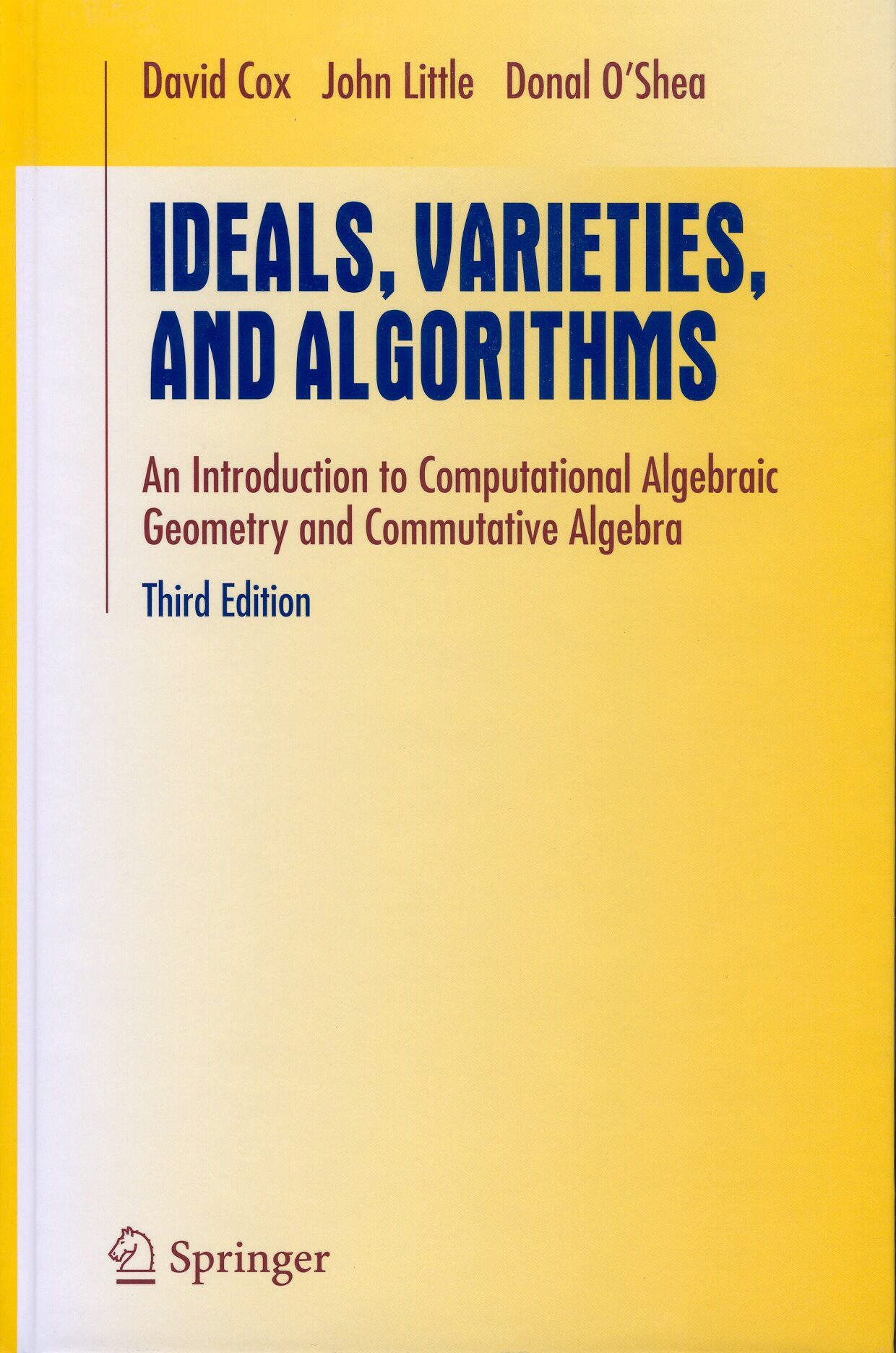
The way this course was designed (it was officially a “seminar”) was that each day, two students would “teach” a section from the book to the rest of the class. We somehow made it through the whole book. It was a great experience, having to learn a section well enough to teach it the my classmates. The class was — however — a bit of a failure. The desks were in a row, people rarely asked questions, and no one engaged with each other. (Much like most of my college math classes, actually.) For something so student-based, it was strange that I didn’t make a single friend in that class. Plus, there was no “teaching” us how to teach well. Some some of us were great teachers, but most of us sucked. I can’t say what I was, really. I don’t remember. Regardless, I remember thinking: this textbook was incredible because I pretty much had to teach myself the subject. (I have to give major kudos to the instructor because he forced me to learn an entire course by reading a textbook.)
So upon reminiscing about this class and this book, I pulled it down from my bookshelf.
I am so dumb.
I will revise: I am so dumb now.
I look at the pages, and read theorems like Theorem 9 on page 241
“Two affine varieties 

![k[V] \cong k[W]](https://s0.wp.com/latex.php?latex=k%5BV%5D+%5Ccong+k%5BW%5D&bg=ffffff&fg=333333&s=0&c=20201002)
and see words like “Nullstellensatz,” and wonder how I ever got to the point where this stuff made sense, and how I got to the point where I see a bunch of gibberish now. Seriously, it’s disturbing. I mean, I don’t expect to be able to pick up a book I learned from years ago and know everything in it, but I do expect that it is in a language I can read.
I’ve figured it out. I am Charlie in Flowers for Algernon.
I don’t know how to feel about the loss of my mathematical mind, besides sad.
Maybe I’ll try teaching myself some math again, to either prove to myself I still have it somewhere in me, or to know that my brain has truly atrophied to a giant anti-intellectual morass.
 Continuous Everywhere but Differentiable Nowhere