Hi all,
I have a question about multivariable calculus, that I need some help with. My kids and I are both slightly stumped about this.
The question we are asked — in a section thrillingly titled, replete with semicolon, “Parametric Surfaces; Surface Area” — is to find the surface area of “The portion of the sphere  between the planes
  and
and  .”
.”
In class, the formula we derived for surface area for any parametric surface  is
is
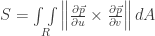 .
.
We solved this by converting the (top part) of the sphere to a parametric surface:


Then we defined  (where
  ranged between
  and
and  and
and  ranged between
  and
and  . (Those limits for come from the fact that we want the surface area of the sphere between and — which correspond to
  and
and  respectively.) [1]
So I calculate  and
and  .
.
So to use our surface area formula above, we need to find  . Calculating that out, we get it to equal
  . Phew, now we have something we can plug into the surface area formula for that “norm of the cross product” thingie.
Here’s where the question comes in. We know
 .
.
Why is it that when we finally evaluate this beast,  is not equal to our normal area element for polar, namely
  ? For the answer to come out right, we need to let equal to simply
  .
.
WHY? Why don’t we plug in the normal polar area element?
Here’s my thinking. Even though we usually use to represent an area element, in this particular surface area formula, it doesn’t represent anything more than  (for whatever parametrization gets made). The reason I think this? When I look at the derivation of the formula, it defines to be . Simple as that.
I used to think that had a fixed meaning: the area element in a particular coordinate system. However, I’m now thinking that it might mean different things in different equations? Either that or our book is being sloppy.
If anyone can follow what I’ve written here and has any help to proffer, I would be much obliged. It’s a small point — one that won’t really matter in the long run for this course — but both my kids and I would like to have this resolved once and for all.
[1] If you don’t see that, imagine you have this sphere and you make a slice at and another slice at . You want the surface area of that little curved “ring” — and if you find the shadow of that ring on the  plane, you’ll get two concentric circles with radius and . That’s the region
  that you will be integrating over.
 Continuous Everywhere but Differentiable Nowhere