A while ago, I posted some of the quirks/concrete things that I’ve developed for my class that seem to work. I think those sorts of things are SO useful. And I love getting them from other teachers. In fact, someone posted about teaching distribution as THE CLAW and I was helping a middle schooler with that today and it was so helpful. So yeah, if you have some concrete things that you use to teach specific topics, blog about ’em or if you don’t have a blog, throw ’em in the comments below.
Currently I’m teaching Riemann Sums in Calculus, and I don’t teach it rigorously. My kids don’t need to use summation notation or anything. I’m focusing on the concept. So I have them do a few problems like this (with the picture) by hand:
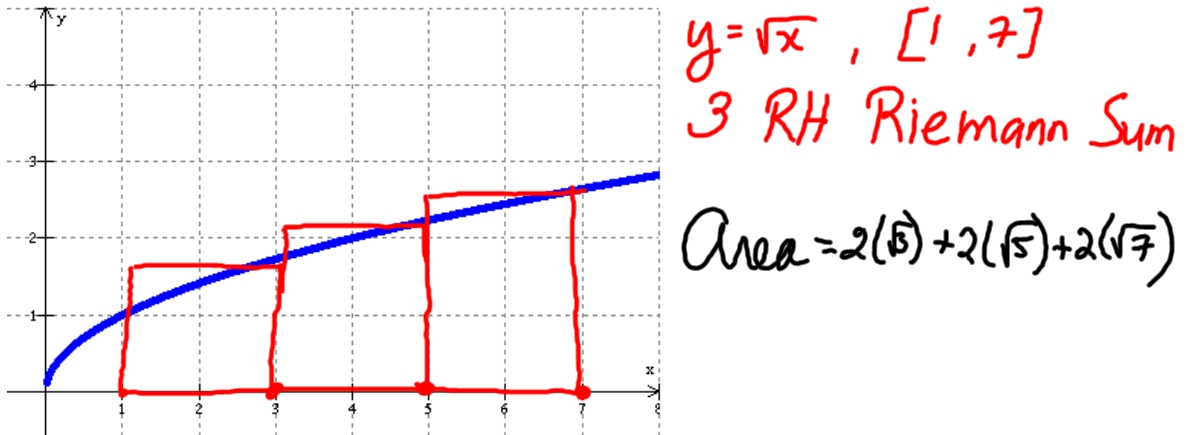
Many of them struggle with three things: the left handed vs. right handed thing, finding the endpoints of each rectangle, and being able to calculate the Riemann Sum without drawing a picture of the function.
So I created a way for them to represent the Riemann Sum so that they (a) don’t mix up the Left Handed and the Right Handed sums, and (b) they can still sort of “see” the picture. It also helps them if the interval isn’t totally nice.
Before I show it, I want to say that it isn’t innovative or ground breaking. I almost expect people to say how stupid and obvious it is in the comments — or that everyone does something similar. But heck, I don’t care. It does help my kids who have trouble organize all the information.
Note, when you’re watching the video, the difference in how I set up the left and right handed sums…
Vodpod videos no longer available.So that’s that… If you didn’t catch it, I put little tabbie things on either the left hand side or the right hand side of each rectangle base, to show which one we’re doing. That tabbie thing is there to remind students (a) that’s the side we’re looking at and (b) we’re concerned with the height of the rectangle. That’s also why I write it vertically, instead of horizontally. To show we’re talking height.
I also will probably use this setup when showing them functions that go below the x-axis. (And I will probably write the height of the rectangle under the rectangle base to highlight that the function itself is going below the x-axis.) And use that to parlay into a discussion of “signed areas.”
I can easily see this being extended in a more rigorous course to dividing the interval into 
 Continuous Everywhere but Differentiable Nowhere