So… I am in this “problem solving” group at school, and we spent today trying to come up with a lesson centered around problem solving that we could use for one of our classes.
I’ve been really hankering to make one of these hyperboloids out of skewers:
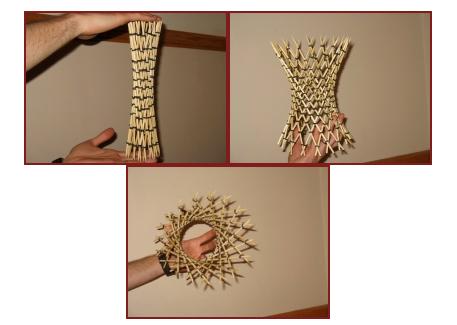
and I thought it would be a great investigation for my multivariable class to figure out if indeed that was a hyperboloid of one sheet. I figured it would take a number of days — at least one to create one of our own, and a good number to figure out how in the world we would come up with the equation to define that beast. [1]
Of course one of the things we talked about in our problem solving group is how to bring the questions down to simpler questions — and then generalize. So I immediately thought of these drawings I spent hours of my childhood making:
 [Yes, clearly my mother was happy that I found these to amuse myself with, instead of whiiiiiining “I’m so BORED… we have NOTHING to do in this house” as I did way too often.]
If you look, they define a really nice gently sloping curve.
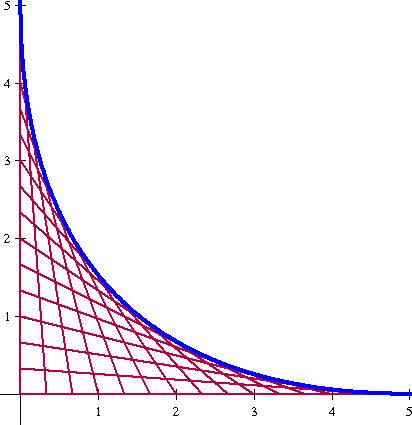
So my question is: what is the equation (written in terms of x and y) for the curve above?
The first segment goes from (0,5) to (0,0). Then another segment might go from (0,4) to (0,1). Another segment might go from (0,3.5) to (0,1.5). (So however much down you go on the y-axis, you go that much right on the x-axis.)
I haven’t solved the harder 3-d question yet, but I had a heck of a time solving this 2-d question.
Since I had so much fun, I thought I’d share the problem with you!
I’ll post my solution later, but if you want to throw your solution down in the comments and how you came up with it (or blog about it), awesome. Just like with this “circles, circles everywhere” problem where someone posted the most elegant solution EVAR.
 Continuous Everywhere but Differentiable Nowhere