In calculus today I was talking about how to find the average height of a function. Some kids just have a hard time understanding the concept. I always show them a few functions on certain intervals and I ask them what they think the average height would be. Just to initially test their intuition on the concept.
Some see it, and understand it; some don’t. All certainly have trouble articulating why they chose that value.
So I have two things that work for me, when explaining this. There’s some handwaving, but the focus is on the idea, and building intuition.
The first thing is we talk about how we would approximate the average temperature somewhere:
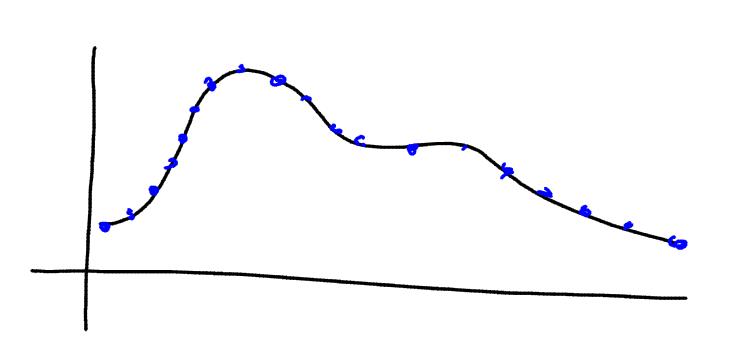
We take a bunch of temperature readings, and we add them together and divide by the number of readings.
How do you make it more accurate?
MORE READINGS!
How do you make it more accurate?
INFINITY OF READINGS!
What helps us deal with infinities and infinitessimals?
CALCULUS!
So that’s how we get started.
Then when I want them to understand the formula — 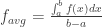
So an EVIL mathematician has an almost 2 dimensional fish tank. Really thin. Sad for the fish. Which are almost 2 D. And the mathematician likes to lay a strip of plastic on top of the water, and constrain the fish in these weird shapes.
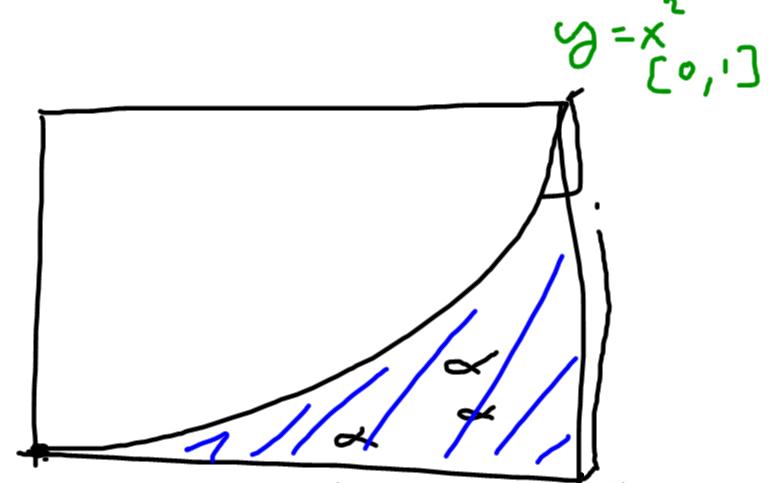
(In this case, the mathematician is constraining the fish in an 
You come along and want to GIVE THE FISH WHAT THEY WANT: a normal rectangular water to swim in.
So you yank the plastic strip away, and what happens to the water?
IT ALL LEVELS OUT!
What shape does it make?
A RECTANGLE!
Does the amount of water change?
NO!
What’s the height of the rectangle?
THE AVERAGE HEIGHT OF THE FUNCTION!
So by then, we have on the board:

And since the amount of water didn’t change, they know that the area of the red rectangle and the area of the blue rectangle are the same.
That makes sense to them.
I then threw this up and almost all of ’em got it!
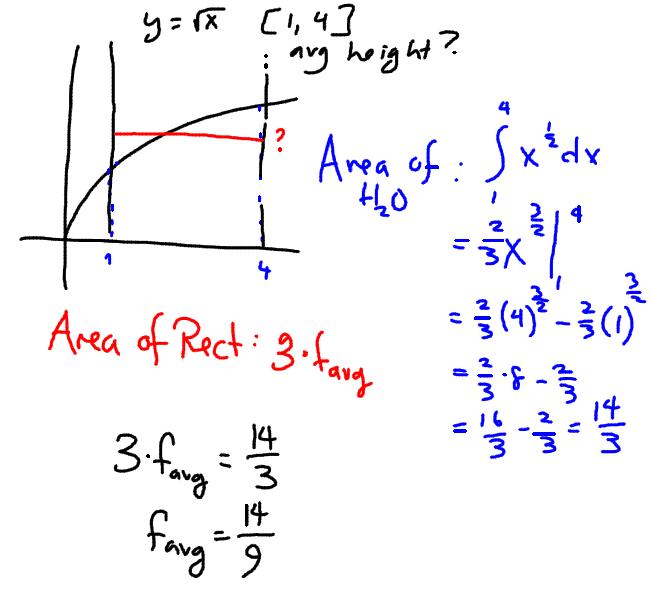
So that’s my way of building their intuition when it comes to average height of a function. It’s not like it’s hard for them to apply the formula, but I think this little thing makes it more conceptually manageable. And if they forget the formula, they can just do the “fish tank problem.”
 at a constant speed of
  . When it reaches the point
  , you know
  . Find the value of
  at that point.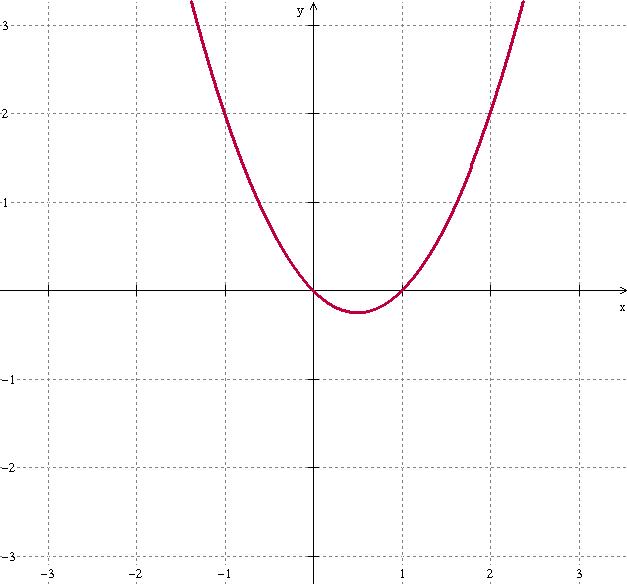
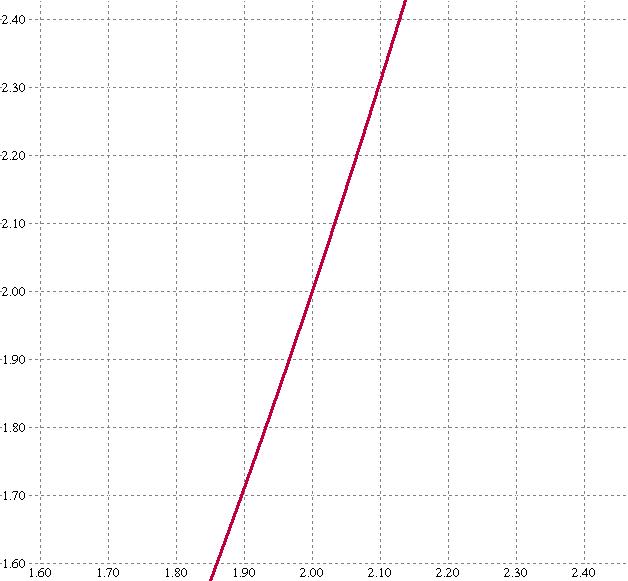
 (we found the equation of the line tangent to the original curve at the point (2,2)). So this greatly simplifies how I had to think about the problem. Where we care about things, the particle is moving in a straight line at a rate of
  .
. and
and  .
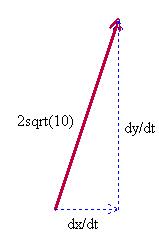
.
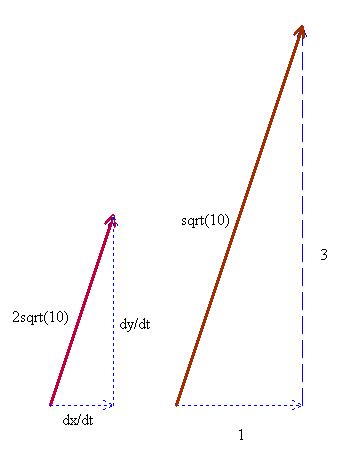
 .) Clearly we can deduce that
  .
. at a constant speed of
  , you know
  . Find the value of
  Continuous Everywhere but Differentiable Nowhere