I am in a problem solving group at my school, and I took 45 minutes of one of our sessions to lead a mock class. Not really mock, to be fair. I assumed I’d have 3 math teachers and 2 science teachers as my class, and I wanted a problem which would get them to think, work together, and also let me guide without leading (or is it lead without guiding).
The problem I chose was exactly the problem that Brent just wrote about on The Math Less Traveled: the broken weight problem.
A merchant had a forty pound measuring weight that broke into four pieces as the result of a fall. When the pieces were subsequently weighed, it was found that the weight of each piece was a whole number of pounds and that the four pieces could be used to weigh every integral weight between 1 and 40 pounds. What were the weights of the pieces? [I gave the problem with ounces.]
I have to say that I was really thrilled that I was able to get them to a solution, with very little nudging. I let them take their time. I started them out by giving them slips of paper of various sizes with corresponding weights written on them, and asked them to use those weights to be able to weigh something like 10 ozs. I helped them organize their thoughts with observations, and I helped them latch onto key ideas once they emerged. I never gave the key ideas, and I didn’t push. It was awesome to witness them work together.
It was also surprising in two other ways:
1. I had the pathway in mind that I thought they were going to take — basically a recursive approach. They did not go that way, and it was afterwards — when examining the problem once they had the solution – that they saw the recursion.
2. I had prepared two “hint cards.” They were written on origami paper and folded up — because, why not? I told ’em that if they all agreed, they could take the first hint card, and if they felt they really needed it, they could have the second hint card. They didn’t take any of ’em. I thought they would. In fact, I predicted that they would get frustrated and take the first one pretty quickly, so I put on the first hint card: “YOU CAN DO IT! Keep working at least for another 5 minutes.” It wasn’t a hint, but a “work through frustration” note. The second card had a hint leading them to recursion (saying something like “What if you only had any 2 weights… what would they be so that you can weigh the most: 1 oz? 2 ozs? 3ozs? 4 ozs? …”)
As a result of watching them operate, and places they struggled (including understanding the problem!), I wanted to challenge myself.
How could I create a formal lesson plan for this? A lesson plan that guides without leading.
Here’s my first crack at it (PDF here):
PS. Yes, I know there’s a typo in question 1.
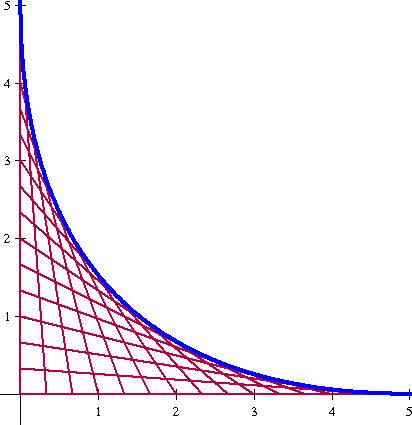
 and
and  and the other with endpoints
  and
and  .
. closer and closer to 0, these two lines are getting closer and closer to being identical. But right now,
  (any of the red lines)
 (any of the other red lines)
 s equal to each other and solving for
  , we get:

 form if we just plug in
  , so we must L’Hopital it!
 .
. coordinate is:
 mean anyway?
 business? It’s confusing. I like to think of it like a parameter! As I move
  and
and  , I am going to get out all the points on the blue curve.
 and
and  .
. .
. .
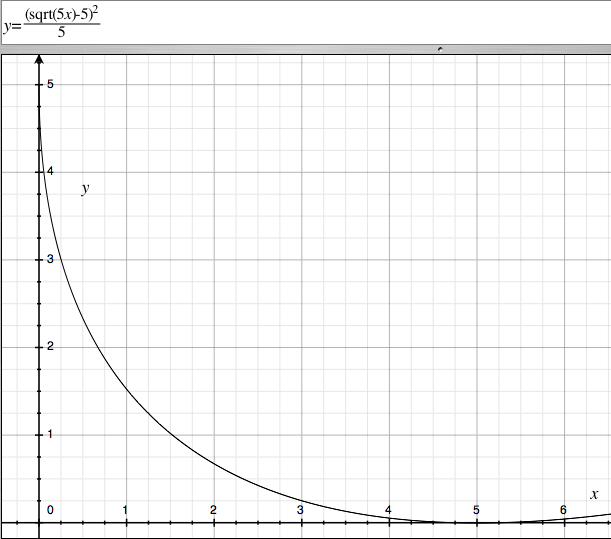
.
 Continuous Everywhere but Differentiable Nowhere