Month: July 2010

Not all of us have Soft Skills

This is my post for Riley Lark’s Virtual Conference on Soft Skills

Three. That’s how many different times I’ve started writing this blasted thing. I actually finished a two thousand word post that I almost published. It didn’t really go anywhere – but meandered with fake conversations and some overarching principles and then fizzled out right before you would expect an explosive, pee-releasing BANG.

Because – and you may find this hard to believe – I have nothing to say. Nada.

Even writing this introduction is a way to avoid saying what I have to say. Zilch.

So I’m starting over. On the date this post is due. Here’s the problem.

I have no grand philosophy. I don’t garner the respect of all my students. Some like me, some pretend to like me, some dislike me. I am not beloved. I am not universally hated. I am awkward. I am not a master of soft skills.

When I am in the hallways and I see a kid, I wave and smile and say hello. I actually do this obsessively, and from a distance. Sometimes I secretly think I resemble Miss America. On a float, hand raised high, fanning left and right, as I rumble by the crowds. Just far enough away to feel safe, just smiley enough to say “I care! From! Over! Here!” When I walk with a student, or sit down to have breakfast with a student in the Commons, or have smalltalk in homeroom, I tend to be… a little… well…

Mr. Shah: So, how’s math class going this year?
Stu: Pretty good.
Mr. Shah: I like to hear that.

(awkward silence)

(continues)

(yes, one more second here)

Mr. Shah: Watch anything interesting on TV lately?

(Sometimes that last line might say “Read any good books lately?” or “How do you like the new Justin Bieber single?”)

So first off, I’d like to say to all of you out there reading the virtual conference on Soft Skills, feeling like (a) you are sucky, (b) you don’t make every kid feel like they are one-of-a-kind-and-special, and (c) doo doo…

You probably are…

…and I’m right there with you.

At the same time, I don’t think I have to be awkward forever. I bet these “soft skills” are learnable and I’ll get there.  I’ll get to the point where kids dump Gatorade on me at the end of the year [1].

To avoid having virtual tomatoes – or real tomatoes for that matter – pelted at me, I scrounged up one concrete thing I have done in the past that might fall under the “soft skills” rubric.

It was maybe my fifth or sixth day of teaching. Ever. The Smartboard was broken and I had to improvise my Algebra II class – holy crap holy crap holy crap holy crap. Trust me, this is not one of those “and then I learned I had it in me all along” stories. I SUCKED. Not a “I wish I had said this instead of that” sucked, but a “I left my kids confused, drooling, grunting meeee do not get. brain hurt. hit me over the head with that textbook and put me out of my misery” sucked.

That night, I called my sister upset. She said “take a mulligan.” After I asked her what the heck that was (FYI: me:sports::oil:vinegar), I replied, “better yet, I’ll ask them permission to take a mulligan.”

The next class, I got on my knees – and pleaded for a second chance.  I delivered a (practiced) passionate, funny, histrionic apologia . I followed it with a killer lesson.

The following year, I was teaching quadratics, and I was running out of time. (Aren’t we always?) At the last moment I was asked to teach applications of quadratics — some crazy word problems. I came up with a plan to have students work in groups and present solutions, and it was going to be short and sweet, and then they would get an open-note take home assessment. It was a plan. It wasn’t a well-thought-out plan. Which consequently means it wasn’t a well-executed plan. On the take home assessment, my students got Cs and Ds and Fs. Like all of my students. I don’t mind when I get a bimodal distribution. But this clearly wasn’t their fault. It was my fault. I did a terrible job.

Enter mulligan. I started the next class apologizing. I told them I had screwed up royally. I told them that I thought I had a good way to teach these quadratic word problems, and it clearly wasn’t. And so I failed at my job, and in this case, I failed them. I had a conversation about what went wrong in the way I planned the lessons. I also cancelled the assessment grades.

Honestly, it didn’t feel sheepish going in front of them, admitting weakness and failure. (I thought it would.) It felt good. Real good. And my kids appreciated and accepted my honesty.

Awww, Mr. Shah is a person.

Awww, Mr. Shah makes mistakes.

Awww, Mr. Shah makes up for his mistakes instead of blaming me.

Awww, Mr. Shah is trying to do right by us.

Awww, Mr. Shah respects us.

Awww, Mr. Shah is on my side.

Now, like in golf, you can’t pull this one out of the bag of tricks all the time. But there are moments when it is can really help. And not only your relationship with your kids, but also by giving you a breather – a second chance to right some wrong.

It goes hand in hand with something I put on my course expectations.

I feel like I have a contract with these kids. I expect a lot from them, so I want them to expect a lot from me. They are accountable to me, so I am accountable to them. Not to my school, not to my department, but to them. I also never want them to feel alone – backed into a corner where they have no one to turn to. I want them to know they can always turn to me, because we’re in this boat together.

I got this philosophy from my beloved English teacher in high school. We’d get our essays back with three different colored checks on the front page, and copious amounts of feedback. One day, well into the school year, I asked him what those colored checks meant. He replied, “I read each paper three times. The first time to get a sense of the argument. The second time to give you feedback. The third time to make sure I was fair grading and wasn’t affected by a bad mood. The checks help me keep things in order.” He then followed with the thing that stuck: “I know you guys put a lot of effort and time into these. I want to make sure I do the same.” By respecting our essays, he respected us.

Now, here’s where things get hairy. I write this, and it has that “awww, shucks” ring to it. I remind my kids that I’m always on their side. I show my kids I am human and can connect with them. But remember the beginning of this post, where I started. I don’t have soft skills. Miss America on a float here, remember. I have failed.

Reminding kids that I am always on your side in words and (more importantly) in actions doesn’t always work. Sometimes I can’t reach my kids through an encouraging email, or working with them individually.

Very occasionally a kid comes with (or develops) a chip on his or her shoulder, and when presented with my teaching style – all founded on being clear, consistent, and fair – they shut down or they act out. Most of the time, they haven’t dealt with a teacher with firm expectations and firm follow through. (I don’t have a lot of wiggle room in terms of my expectations.) They’re teenagers, and they resist [2] – and I refuse to lower or change my expectations for them. There inevitably comes a battle of wills.

It’s at this point that I realize that as these students dig their heels into the ground, and as I dig my heels into the ground, I have failed. Because the mantra I am always on your side doesn’t apply. We don’t have a common goal anymore. [3]

Consequence? Neither of us win – both of us lose.

I can count these students on one hand, but they can (and have) defined the atmosphere of a class. That sucks, because who wants to have a class which you like going to less than your other classes? I don’t have a bag of tricks for these kids yet. The unreachable kid – I don’t know how to reach ‘em.

This is where I am at in terms of soft skills.

So yeah. I didn’t want to end this on a “feel good” note. I want to say that soft skills are hard, and they don’t come naturally to everyone. The fact that this was so hard for me to write shows me that it taps into some serious insecurities I have as a teacher. But they are important, because they keep you and kids on the same side. You’re a team. When you’re not on the same side, you need to ask how is it that you can be on the same side again. But this isn’t a feel-good-I’m-great post. I can’t always say I’m successful.

So to all of you who are sick of reading how awesome everyone else is – me too. But let’s make a pact. Let’s consciously work on it to make things better.

POST SCRIPT

Other things I do that might qualify as soft skills:

  1. I always keep candy on my desk, and if a student comes by (for almost any reason) I’ll offer ‘em some. I’ll often offer students I don’t teach candy too, when they come in the office and look a little down or worried or anxious.
  2. I write a single letter at the end of the year and distribute it to my seniors (but  I address each of the letters individually and print them out on school stationary and sign them and put them in school envelopes). The letters are sappy, chronicle our year, and give unsolicited advice.
  3. At the beginning of the year, I have students fill out a google form with some basic information about them, their calculator serial number, and with some questions they must answer from the course expectations. I also ask what they are most worried about. I then write, to the students who say things other than “nothing,” individual emails to these students addressing their concerns and reminding them they always can come to me if things get stressful.
  4. On the first few assessments, I’ll have a question where I have students write about what they’re feeling about the class, or about the material, or what they’re nervous about, or what they still don’t get. It’s all pretty open ended. I write short responses to each of these.


[1] I don’t remember who said that. But it’s an evocative image, no?

[2] Heck, I’m known for being resistant too. It’s not just teenagers.

[3] To be clear, it’s not like I just leave things be. I meet with these students individually a few times to see what’s going on in a non-confrontational way, I ask the student “what can I do to help things? I want us to be on the same side again.” I make our conversation a give-and-take, without lowering my expectations or giving the student things I am not willing to give every student. I bring the adviser or dean into the conversation. I engage the parents. Usually these things work to some degree. But there are those few kids where nothing I do works.

Powerful Talk by @profteacher

So I want to a session led by @profteacher today at 4:30pm. I gave a big shoutout to him on July 11th. He’s a university professor who used his sabbatical year to teach high school math in a public (urban) high school. If you didn’t check it out then, check it out now.

This was one of those emotional talks for me to listen to. And I’m not an emotional person (unless Oprah is on). It was about being a first year teacher. The defeat and the joys and simple observations. I say “talk” but it actually became a rich and compelling conversation among, I don’t know, 30 or 40 dedicated teachers — all at different levels of teaching. It was raw and honest. It wasn’t defeatest or idealist. It was real.

There were two points that were made, that sound like sound bytes. And usually, I’d just brush them off as general platitudes or something. But I know and trust these people, and in this context, these points were deep and rich and I think I’ll probably treasure them.

1. “Teaching is the connsumate act of faith — faith in what you do.” One participant said this, an experienced teacher who talked about how the emotional part of teaching evolves, and after a number of years, she started really believing in this. She continued to say that you won’t be there when a kid gets a college acceptance. You just won’t know how and with whom you made an impact. (In fact, the student might not even be able to recognize it.) That’s where faith comes in. Faith that what we do matters.

2. The presenter said his one big take away from this first year: you need to have students know and feel that they can be successful. The lessons don’t have to be exciting — they can be routine and boring. “Factoring worksheets!” he said, “they will start tearing through them because they know they can be successful.” His discipline problems disappeared when he discovered this. How to do that? Developing lessons through careful crafting and scaffolding just enough — so that students are going through “productive frustration” — where the next step is just within reach. Again, just words. Words I would ignore, if the presenter hadn’t just developed and delivered a curriculum to me for 3 weeks which embodied everything he said. Scaffolded. Carefully crafted. And there was … everyday … engaged, productive frustration.

I’ll write more about that later. But I just needed to jot these two points down in the spare 10 minutes I had before dinner.

Exasperating Problem

So a while ago, I mentioned to some of you on twitter that I was getting really frustrated with a particular problem we were presented with. I have a conjecture that I’m almost certain is true, but I can’t prove it.

Consider the unit circle x^2+y^2=1. Plot n equally spaced points on the circle starting from (1,0). Now draw the n-1 chords from (1,0) to the others. What is the product of the lengths of all of these chords?

(There is an extension problem, which is changing the unit circle to an ellipse 5x^2+y^2=5, for those who already have seen or find the original problem too easy.)
So feel free to write your own blog post with your solution, or throw your solution in the comments (just write SPOILER at the top so we know…).

What I’m interested in is if we could get a precalculus class to get the solution to this problem. Where they actually understand it. So if you had, say, 15 non-honors precalculus students and one week to work on this problem, how would you design the lesson?

I guess you have to have solved it or have seen a solution to know how to design the lesson. But even if you didn’t solve it (a la me!)… if there’s a solution you’ve read that someone posted in the comments… what would you do?

UPDATE: Mr. Ho has a great GeoGebra applet at his site; Mimi has some nice colorful diagrams and some explanation up at her site. Also, for those who want to wording for the ellipse problem… This extension I haven’t seen before, so I am citing Bowen Kerins (see comments below!) or Darryl Yong: “Take the diagram you drew in [the unit circle problem] and stretch it vertically so that the circle becomes the ellipse 5x^2+y^2=5. All the points for the chords scale too. What is the product of the lengths of all of these chords?”

Looking past teachers to teaching

Today I attended a session where three university profs — ed researchers — formed an informal panel. There was one important point that came up at the beginning, and became a riff for a few minutes. It was, as you prolly suspected from the really innovative title of this post, about the power of looking past teachers to teaching.

It’s a slight distinction, but crucial to the reorientation that I’m having about teaching.

Some points that came up in the conversation:

  • Replacing teachers won’t change things; replacing teaching methods will.
  • Focusing on teaching and not on teachers is the basis of lesson study (and the Seattle video club I talked about in the last post). It focuses the conversation on teaching/teacher moves.
  • Changing the conversation from teachers to teaching more readily implies that teaching is learnable. So we have to look past individual teachers to the methods of teaching. That being a good teacher can be taught. Another way to think about it: teaching is a complicated activity, rather that something owned by a particular person.
  • There are universal tasks to teaching that we can investigate (e.g. which ideas to privilege in a classroom).
  • It gets us away from the “I taught it but they didn’t learn it” phenomenon. That phrase doesn’t really make any sense when focusing on teaching and not the teacher.
  • The greatest untapped resource we can use in the classroom are our students and their insights. And by focusing less on the teacher and more on teaching moves, we can tap into that.
  • This outlook shifts the conversation away from teacher bashing (but one should also be cautious of going in the other direction of student bashing).

Yes, I know. There are some inconsistencies, and worse, this is all very abstract. And I HATE THAT. But this all tapped into the idea I wrote about recently, about how teaching moves are something that one can pay attention to. One can learn. One can revise. And through this process, hone the craft of teaching.

In other words, the focus on teaching instead of teachers is that it puts the emphasis on the ways teachers can do their jobs by focusing on students and learning.

So that was one part of the talk. In another part of the talk, there was a question about the constant tension between the jam-packed curricula with a zillion micro-pico-standards and getting students to really grapple with big ideas.

One speaker said that we “need more effort and courage” from teachers. I drew a sad face in my notebook next to that.

The second speaker actually spoke articulately, in defense of having common standards in theory [1]. He also said that he doesn’t see the problem as having a zillion pico standards. It’s that we go through all these little ideas that never get added up to any big ideas. His suggestion for dealing with this is to outline learning trajectories, with big ideas as the landmarks on the way. I don’t know what precisely he had in mind, but I figured that it probably involves student drawing connections by working on unfamiliar problems that force relationships among mathematical ideas (e.g. systems of equations with matrices; asymptotes for the tangent graphs and asymptotes of rational functions; absolute value equations and absolute value inequalities; etc.).

The third person then finished up speaking about the Common Core Standards — and eloquently continued the second speaker’s defense of standards.

That’s about it for the maths stuff I want to write about. (It’s late and I have lots to do tomorrow.)

On the non-math side of things, I had a wonderful night BBQing with friends and watching the sky change hughes, from orange, to light blue, to dark blue, to black. As the air got colder and the light retreated, the stars starting coming out, first slowly then quickly. As people left, conversations got less frenetic and more personal. And I left, after being regaled with a shooting star, at peace with Utah.

[1] Having these standards gets us focused on teaching. It also promotes the sharing of ideas; if someone gets it/does it right, then those lessons and approaches will be in demand.

Why I’m not Blogging

Part of me thought I would get to the Park City Math Institute and be blogging up a storm. I would sit down each night, twitching with excitement, ready to blog about all the ideas and problems and conversations I would be having.

And I am aflutter with excitement about this program.

But the problem is that I’m spending all day talking about math and teaching, and thinking and thinking and thinking, and I don’t have the motivation at the end of the day to organize my thoughts.

This is problematic. Because my memory:elephant’s memory::pebble:mountain.

So tonight I’m just going to jot down a few ideas/observations/thoughts that don’t fit into the larger posts I feel compelled to write on (a) lesson study, (b) math talk, and (c) PCMI-as-a-learning-community [1].

0. There’s a really personable, funny person at PCMI who writes a blog that I’ve been to a few times — but for some reason wasn’t in my reader. It’s awesome. From his about page: “I’m a recently tenured college professor teaching mathematics at a high school during my sabbatical leave. I’m blogging about my experiences mainly to record my successes, frustrations, thoughts and feelings.” The best part: it’s concrete and on the ground and honest. And being new to high school, he makes observations of things we don’t always notice — or that we’ve forgotten (example here). So go back through the archives and drink up! Adventures in Teaching

1. When kids are working in groups, and you want to start having them wind down without the time pressure, you ask them to hold up a 1, 2, or 3 fingers to represent how many more minutes they need. And to make sure everyone is participating, if they don’t need any more time, they hold up a fist.

2. If you’re having a problem with student attending class on time, on certain days you can give raffle tickets to students if they are in their seat before class starts. When class starts, you select a raffle ticket to win a prize. Sometimes the prizes can be lame, sometimes they should be good. (They do this with US — adults — to get to the morning session on time. It works for me.)

3. Watching videos of teachers is powerful. I would love to have DVDs of good teachers teaching. Nothing else – no text, no explanations, just the videos for me to watch and mull over.

4. A group of teachers from Seattle came for a week and presented the work they’re doing with “Complex Instruction.” Part of their work was building a supportive and hard-working community. No easy task. One of the things they do is video tape their lessons and have discussions about the tapes. When talking with one of ’em, he said that the teacher on the tapes of him was not anything like the teacher he thought he was. Powerful, and scary. I asked more about how they set up a safe space for teachers to look at the tapes, and feel supported, and not defensive, it was clear they had to do a lot of work beforehand to make sure that happened. There were stages. But what struck me the most was the norms they had when viewing the tapes. The teachers teaching weren’t individual teachers. They were any and all teachers. They said more than a few times that “it could be any of them.” To emphasize this, they only referred to the teacher as “Teacher” — not by the name of the specific teacher teaching. Everyone saw themselves as working almost as one collective, one Teacher, working towards improvement of practice through these videos and discussions. Just like we say how blogs and twitter have changed our lives when it comes to teaching, they say videos have done that. Scary, but I want to do something like this with a few teachers I feel safe with.

5. Teacher moves. This is a term I’ve picked up here. I generally hate jargon. I am a philistine. But I have come to really embrace it. Because it gives a name to something that we do all the time. We are confronted with a situation (whether it be academic, behavioral, social, blah blah blah) and we have about 2 seconds to decide how we’re going to deal with it. What I’m learning is that although we all have our own set of teacher moves — most that come naturally to us — we can work on expanding our repertoire and honing these teacher moves. How? First, by talking to (or reading blogs of!) other teachers — to see other teacher moves. Second, by thinking through hypothetical situations that might arise in the classroom and anticipating how you’re going to respond to them. For me, just giving these things a name — “teacher moves” — let’s us start having conversations about improvement.

It is letting me see the whole class as a set of discrete teacher moves. Moves I make consciously and unconsciously. But by starting to conceptualize my time in the classroom as a string of discrete teacher moves, I can start thinking about things in a somewhat more concrete way. It let’s me focus more on my actions.

6. In my classroom, as I suspect in most classrooms across the country, the teacher is the sole authority of knowledge. What’s right and what’s wrong. It makes sense, of course. But I’ve been learning that this setup might not be the only approach. One of the most important things to instill in our kids is confidence in their abilities, and the ability to take intellectual risks. The way most math classes are structured, well that’s not so conducive for risk taking. And the teacher is the arbiter of knowledge — that’s right, that’s wrong. Students look to what the teacher writes on the board and starts to believe that only the teacher can be a math authority. I have no problem with the teacher being a math authority. But I’m starting to realize that in my classes, I am the math authority. I want kids to be math authorities too, and to view each other as valuable sources of information. It might be something to think about. Because I suspect that getting at this is also getting at independent learners. And getting at math confidence.

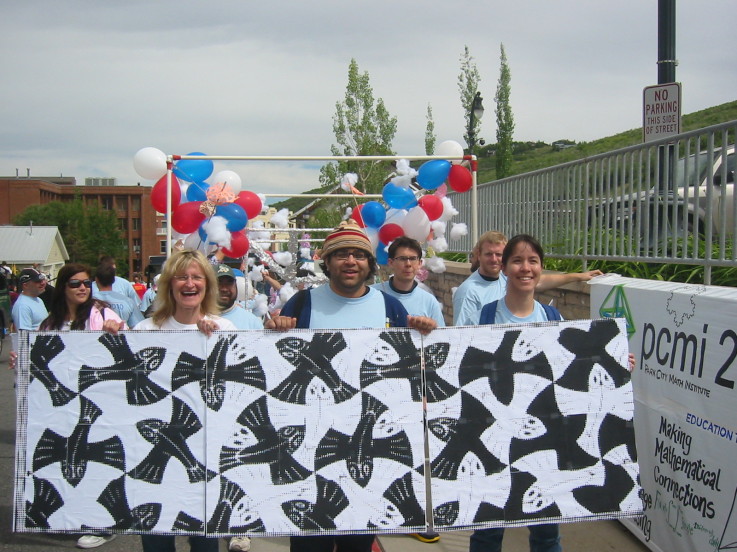
7. Me at the 4th of July parade with a bunch of math nerds! “We love math, how about you?” was the final two lines of our chant.

There are more things, but I’m tired. Sorry it isn’t so coherent.

[1] If I don’t write about these in a reasonable amount of time, feel free to harass me.