Month: August 2010

My SBG rubric

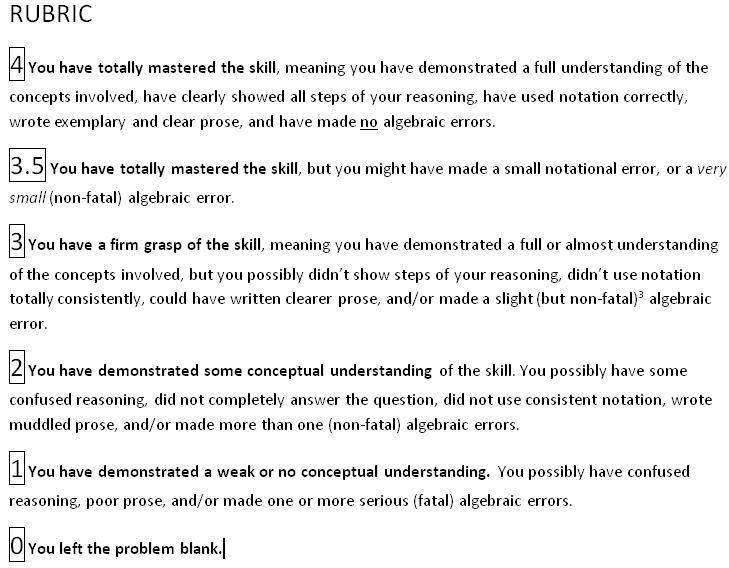
Soon-ish I will be writing and putting up my entire Standard Based Grading system, and possibly my rationale for making the choices I did (e.g. how I decided on a 4 point scale instead of a 5 point scale). For now, though, I thought if some of you were still trying to finalize your system and were looking for a rubric, I made one that I feel pretty happy about:

I wanted to create something that would work for routine plug and chug problems, some more multi-step problems, and some “explain this” problems. I also know I’m going to be doing some major “holistic” grading — in the sense that I am not going to take off this many points for this mistake, that many points for that mistake. I’m going to look at how the student performed on one or two questions testing the same skill, on the same short assessment, and give them a holistic grade for that skill. I think this rubric allows for that pretty well.

Plus, I need something I can point to, since my teaching mantra is: clear, consistent, and fair.

Without something I can point to, I would be failing on all three counts.

My advice for first year teachers

Jesse Johnson gchatted with me on August 17, asking me if I had any time management tools that would help first year teachers. Or any tools at all. Specifically:

what could first year teachers learn before they start teaching that would help them manage and organize and feel successful and love the job even as they are fumbling and learning

That’s huge. And new teachers are going to have different advice being chucked at them from all sides. If my experience as a new teacher is indicative, it’s like dodgeball but you’re taped to a flagpole. I think Jesse is onto something though: crowdsource teachers from all walks of life, and get a few concrete ideas from each about what they do to stay sane and happy in the midsts of a trial by fire.

Before my thoughts, here’s a recollection — not mine, but of @justagirl24 — of what it is like to be a first year (or student) teacher. It’s raw and honest, powerful in it’s evolution. Just so you remember what starting out is like. And while I’m on it, I remember the most powerful thing I learned my first year was learning how to separate the mountains from the molehills — something that takes time, learning the basics of your school, and asking a lot of advice.

Here we go.  Three super concrete things I would recommend to new teachers to stay sane and happy.

1. Take Saturdays off. If you’re a workaholic, like me, you’ll work hours everyday. I didn’t start doing this until last year (my third year), but I wish I started it earlier. I do not do work on Saturdays. It’s a rule.

To be totally fair, I broke that rule maybe a half dozen times, but I’m always hyper aware that I am breaking the rule, and it has to be for a good reason. A few times I had an all day (fun) thing to do on Sunday, so I did work on Saturday instead. I also allow myself a few hours of work on Saturdays when I have to write narrative comments on each of my students (twice a year). I make a treat out of it, though, and find someone to write comments with at a coffeeshop (followed by something fun), or I treat myself to heading into Manhattan to work at the (gorgeous) New York Public Library.

2. Find yourself a good crew of teacher friends at all different stages in teaching. Like, yeah, be super conscientious about this. Engineer friendships. Seriously, find people you like and are comfortable with in your school, and invite them out for coffee, or have a brunch at your place and invite them to it. Make sure you develop these friendships early on. You will soon find that if you have a teacher crew, you’re never going to be at a loss in terms of advice. You’ll have a bunch of go-to people to find out who to ask for what. You’ll be able to talk about specific students and get advice. You can explain things that aren’t going well and let others give you advice. And you can hear interesting things they do in their classrooms — and steal them.

Basically, you’ll have a bunch of math teacher blogger friends, but as real life friends. Meaning you can go to ye olde watering hole together. And

3. VENT VENT VENT!

Okay, I think venting is one of the most important thing you can do as a new teacher. You’re going to be facing a lot of things and you’re going to get frustrated. With students, with administration, with other teachers. I mean, you have to keep it professional, but you should find a few trustworthy friends (preferably new-ish teachers) and complain your heart out.

Not conventional wisdom, I know. But one of the things that happens to first year teachers is that there are periods when you get dejected. You feel like you suck. Heck, you may even suck. (I feel that way all the time, and I totally crash and burn often enough.) And kids are getting to you. Maybe one in particular. And the pressure is building up. And your systems that you so carefully thought out aren’t working. The worst thing you can do is keep all this inside. It’ll start eating you up. You’ll start crashing and burning, and feeling trapped and alone.

The best thing you can do is VENT to some close friends. Because as soon as you say it aloud, it stops being your private shame. Think about it. When something bad happens, like you go to the mall and  you try on pants and realize, oh! that size doesn’t fit you anymore. You can either internalize it, be ashamed, and go about your business obsessing over it. Or you can make a joke about it and tell your friend who you’re shopping with. (As long as your friend isn’t a judgmental jerk.) It stops being this horrible thing, and it just starts being this thing. Okay, not a terribly good analogy. But trust me on this: venting is healthy. Keeping things to yourself, going it alone, being afraid to talk about problems, is the foundation for failure, methinks.

(Just a caveat: vent with those you trust who aren’t judgmental jerks, and be somewhat professional when you vent.)

That’s all.

PCMI as a learning community

Note: This post was started in Late July, and abandoned until now in Late August

I promised three posts post-PCMI on what I’ve learned — on math talk, on lesson study, and on PCMI as a learning community. Now that it is late August, I don’t know if I can do all three, at least not immediately. So I am going to focus on the learning community formed at PCMI, via the way the program was structured.

I first found out about PCMI on twitter. I am pretty sure it went something like this:

samjshah: anyone have ideas of good summer programs for math teachers?
tweep1: PCMI
tweep2: PCMI
tweep3: PCMI & exeter
samjshah: did exeter, should check out PCMI i guess

I hadn’t heard of it. And no one really could explain to me what it was, and why it was so powerful for them. Many people on in the edublogosphere talked about going there a few summers. To me, that’s advocacy enough, because if you’re a teacher, and you attend a 3 week professional development program in Utah, and then want to do that again, well, that’s saying something to me loud and clear.

Without getting too meta or analytical or anything, I think PCMI showed us how a serious, committed learning community could look like. It mirrored what we would have wanted our school experiences to have been, and had qualities that we wished our schools had. That’s what was so powerful. We participated in this professional development around creating an engaging and effective math community, while actually participating in an engaging and effective math community.

This is how a typical day would look.

I would wake up around 6:30 and take a bath and read. Okay, that sounds like a strange way to start the day, but this was my own private heaven, because I love reading in the bathtub and I don’t get to read much during the school year. Then I would mosey on over to breakfast, where we have a daily buffet — a veritable cornucopia of muffins and eggs and cereal and soy milk and coffee and bagels and other stuffs. Over breakfast, I would generally sit with other math teachers.

You see, at this point, I’ll interrupt and say PCMI actually has a bunch of parallel programs running at the same time. Researchers have a program. Undergrads have a program. Grad students have a program. University teachers have a program. So we high school teachers are just one of a few different strands of PCMI.

Over breakfast, we’d discuss our schools, math problems, what we did the previous night, books we’re reading, TV shows we love, weekend plans, Justin Bieber, whatever! The whole three weeks definitely had a summer camp atmosphere because almost no one knew each other and so there was always lots to discover about everyone. There were about 60 teachers in the program.

Then we’d rush over to our morning problem solving session, which lasted a hair under 2 hours. There would be quick announcements, and then Morning Shorts. These are 5 minute presentations given by participants. Here’s mine. Then onto problems. We’d sit in groups of 5 or 6 (one of those people was a table leader, but they weren’t privy to any of the problems or solutions we’d be working on beforehand). We’d be given a packet of problems and then just set off to go. Nothing else. No formal lesson. Just compelling problems. Sometimes our group would work independently, sometimes we’d talk, sometimes we’d get off track (but super rarely). Connections were made, informally, independently, at our own pace.

The problems were made by Darryl Yong and Bowen Kerins, and are online here (look for the Hand-Outs section). The philosophy of the class is pretty well summed up by their “rules”:
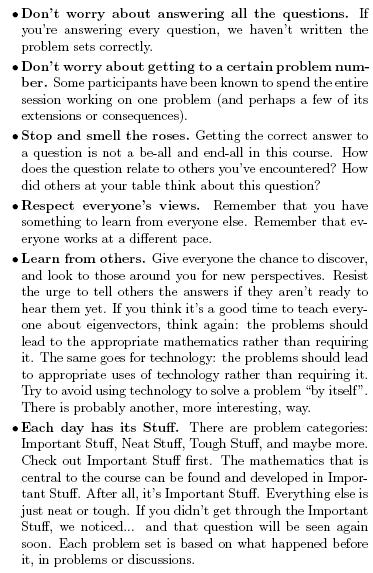
Bowen and Daryl made each subsequent problem set after watching us, and seeing where we were at. We were going, each, at our own pace. To make sure we could keep up with the course, and not fall too far behind, there was a core idea that was put at the start of each problem set — called IMPORTANT STUFF. We had to get through that (we always did), and then we could just work on whatever. But the next day’s material would only really require us to know the IMPORTANT STUFF.

The problem sets themselves were the most well-crafted set of problems I’ve ever been given, in terms of scaffolding. I don’t think you can see really how these problems are so amazingly scaffolded until you actually work through them. Because you will start seeing cycling back to old material, little hints about connections you’ll be making (no connection was ever explicitly given to us in the problem set — we had to do all that heavy lifting on our own), and a general ramping up to some really frustratingly engaging problems.

They were also really funny. With each of our names included in at least one of the problem sets — which actually gave us a nice feeling to see in print. And lots of jokes and puns.

Examples:
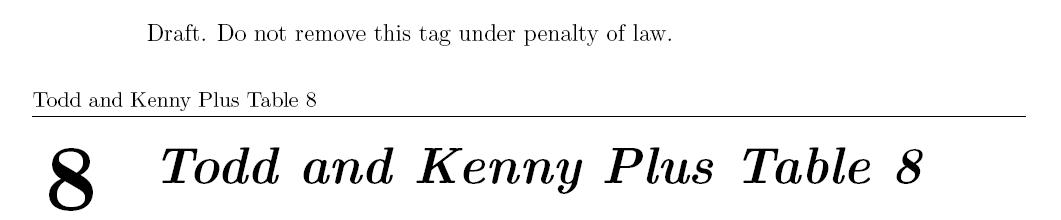
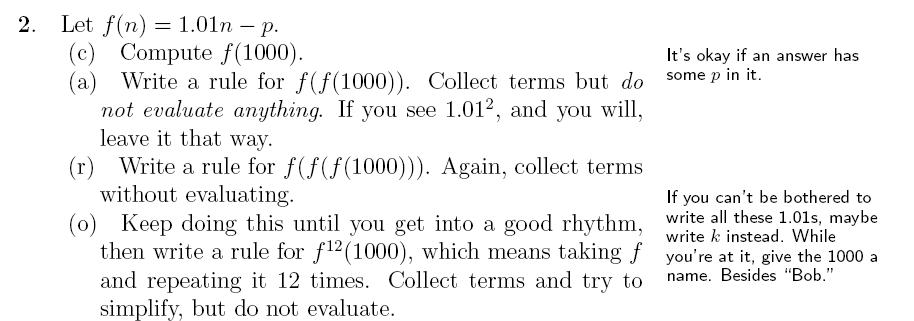
Ha, this was the title of the 8th problem set. Notice the use of our names in the problem set! (And each table had numbers, hence the Table 8 in the title.)
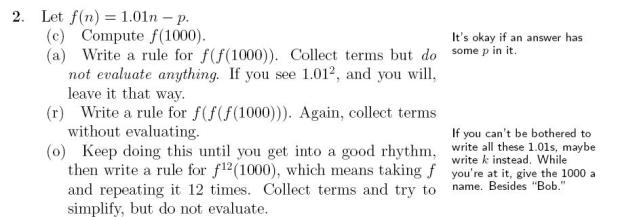
I think I got a stomach cramp laughing at the marginalia. Um, it’s okay if your answer has some p in it? Get it? Also, notice Caro(l)’s name in the problem set? (I cut off the l, but it was there, I’m sure.)
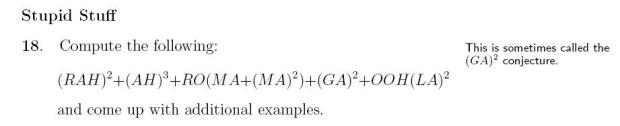
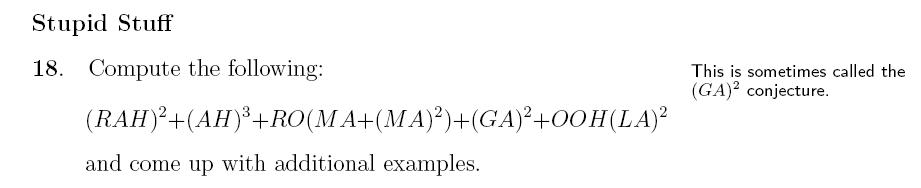
And of course the stupid  math humor I’ve come to love so much.

I would just like to point out that all these examples came from the same problem set! So imagine this, every day! Fun! Times!

Okay, so we’d work, and then in the last 15 minutes, or maybe in the middle, Bowen would talk about what people were seeing, he’d maybe throw up a Sketchpad applet he made, or a photograph of some of our work and have us explain it to the rest of the group. And then we’d move on, the next day.

There was one other thing that made this setup so well, minus the self-directed pacing, the well-crafted problem sets, the ability to collaborate. It was that we would only be with our group for 3 days. Yup, that’s it, 3 days. Then we’d be assigned a new group. The end result? After 3 weeks (15 days), we’d have been in groups with almost everyone attending.

Frequent group switching was one of the ways that I think our community was built so quickly, and so powerfully, in 3 weeks.

After some coffee and cookies (that I refrained from eating, thank you very much), we’d then go into our “Reflection on Practice: Connections to Research” groups. For these, we were put in groups of 5 or 6 again, but then we’d have  a few groups in a room instead of all of them. So instead of having all 60 of us in one room, we’d only have 15 or 20 so. We had two leaders, who led us through various exercises, reflections, video-watching and transcript-reading sessions, etc. I would write more about this part of the program, but we learned a lot about a lot of things, so it would be like trying to capture a hundred butterflies fluttering about in a room. Possible, but time-consuming.

For me, the most major theme we hit upon was “math talk” — the purposes of it, how to encourage it, how to evaluate it, and the rewards of it. That’s too big to tackle for me in this post. I’ll leave it at that, until some future time.

We switched up groups and leaders in “Reflection on Practice” session every 5 days.

Then lunch. Mostly we were allowed to sit where we wanted, while we enjoyed more (really good, really filling) meals. At least for me, most conversations were based around teaching, since we had just been given lots to think about in the morning. A few times, we were assigned lunch tables. At first the thought irked me. I’m an adult! But the point was to mix all the different programs together, so we could talk to undergrads and university teachers and everyone inbetween. It was actually fun. For the most part the conversations were enjoyable and engaging, and the few times they weren’t, they were benign and innocuous.

Finally after lunch, we’d embark on the third major part of the day: our individual project groups. There were six different groups (and within some of those groups, sub-groups!):

Reasoning from Data and Chance
Exploring Discrete Math
Investigating Geometry
Implementing Lesson Study
Visualizing Functions
Learning the Math of Image Processing

My group had 9 people in it (2 of them group leaders), and focused on Japanese Lesson Study. It was here we got to create. All groups created some final product. And dang if it isn’t fun to create with other people.

My group went through a sped up cycle of Japanese Lesson Study. We put all our work on a wiki (slightly messy, since it was used a lot), focused on achieving these three goals:

  1. Students will develop a conceptual understanding of converse, inverse, and contrapositive statements, and will be able to use multiple models (specifically Euler diagrams and sentences) to reason about these statements.
  2. Given an assumed true conditional statement, students can distinguish and clearly explain the truth values of the inverse, converse and contrapositive statements — using counterexamples to show the falsity of statements.
  3. Students will develop an appreciation for the precision of language, and usefulness of if-then statements.

We actually got to teach this lesson twice (once to other teachers, and once to real students), and revise it once. One of the most memorable and exhilarating moments at PCMI was watching the lesson that we argued and slaved and nit-picked over come to life when taught to students. The kids were engaged, and I could see them slowly come to understanding on their own. We had come up a list of possible confusions and a list of strategies to employ if they happened. Watching that unfold was… well, you could see the impressive class that results from using collaboration, backwards design, and a focus on student understanding. And seeing kids smile, and work through frustration (productive frustration!), and get that deep a ha moment, that was powerful.

It wasn’t a perfect lesson, but it was perfect enough. A thousand times better than what I can produce in my own classroom. It was an example of the type of lessons and the type of teaching I want to do, where there is less lecturing, serious math discourse, and the  teacher is merely a guide while the students are in the drivers’ seats.

I gave a little spiel about the use of Wikis in lesson study at the end of PCMI. Here is a clip:

Much like our teaching in the classroom, the nature lesson study is organic and evolving. Fundamental to the lesson study process are the dual ideas of: collaboration and continual improvement. The wikispace provides a well-suited home for this sort of work. When we meet, we never quite know what ideas will jump out, what we are going to pursue, what ideas will become central to the lesson, and what ideas will be jettisoned. But it’s important in this type of collaboration – where the creativity of multiple minds comes into play – to have a way to organize these ideas.

As I said, each working group created things which we shared with each other. And seriously, it was all amazing stuff. And then, at 3 something, we were done. That was the end of the required part of the day.

In the evenings, there were a number of fascinating lectures, informal discussion groups, formal classes — all optional, most interesting. Evenings were the social times, where we would BBQ and go into town and watch Veronica Mars and karaoke and eat at a restaurant and play RockBand and go on walks/hikes and …

And the days would repeat.

I know we had a self-selecting group, but it was a learning community at it’s finest. The program was heavily structured — as you can see, it’s a full day. And you couldn’t skip classes or arrive late. You didn’t get to choose groups (except foryour working group, kinda). But within those strict parameters, you had an informal, playful, intense, passionate atmosphere. To me the most defining features of PCMI was the group work — which had groups switch constantly (some every 3 days, some every 5 days, but our working groups stayed constant). We also had lots of different activities (we weren’t in a lecture hall all day) which broke up the time. We were given breaks and informal times to talk about what we had learned. We weren’t really lectured to at any point; it was about thinking and sharing, reflecting, and collaborating. We learned by doing, not by being talked to by Almighty Gods of Teaching. Most importantly, the program was designed for us to be engaged. Clearly. The designers made a conscious effort to be rigorous and interesting. It was differentiated, good for people at all different stages in their careers. And it worked.

If it tells you anything, I spent 3 of my 10 week summer vacation at PCMI. I am going to forego applying to the other program that I have been coveting, in hopes that I can return to Utah next summer.

I’m jumping into the SBG waters! Hope there aren’t any sharks!

Guess what, ma? It’s taken me half a year of mulling, some cajoling from the “inspiring ideological cult”, and the realization that even though I think I’m teaching responsibility, I could be doing way better. So here I am, naked, standing before you… wait, no, that’s not right at all. I have clothes on. Scout’s honor.

Here I am, standing before you, newly self-inducted member of the Standards Based Grading (SBG) cult.

I can’t roll it out for Algebra II next year, but I am plunging — head first — into standard based grading in Calculus.

I made a list of skills that I taught last year — maybe it’ll be of some use to someone out there:

This ordering and skill set probably won’t be changing much for the upcoming year. But it will definitely have to be rewritten for the SBG skill/topic list.

I wasn’t going to blog about my SBG system until it was done, but someone (forgive me, for my mind is weak, and I have forgotten who) mentioned that it might be useful to watch the process unfold. Plus, I have a bunch of questions.

Here’s what I’ve definitely figured out:

1. I am going to assess most skills/topics twice.

2. The skills/topics I won’t assess twice are mainly “explain this idea, statement, or claim (using words, diagrams, tables, graphs)” questions. (Students can reassess those questions on their own, if they want.)

3. Students will have to email me by Sunday night to be able to reassess during study hall on Tuesday, and students will have to email me by Wednesday night to be able to reassess during study hall on Friday. This way I have time to prepare for these individualized reassessments, and students won’t have to individually work on tracking me down.

4. I am not going to be including homework in their final grade.

5. Students keep a binder with all their assessments in it — so students can have them to study from, and I can ask them to see them if I need to.

Here are where I still have to make decisions:

1. Do I want my gradebook to have skills listed, or topics listed? This is a big one! David Cox says this is a false dichotomy, and I can buy that — because skills and topics are really part of the same tangled net. Or two sides of the same coin. Or some other cliched metaphor. But I guess I still think in these different terms. A list of skills, and a list of topics, seems very different to me. Skills tend to be more specific, while topics tend to be more “umbrella”-y. I am leaning towards skills, because that’s where I’m comfortable.

2. Do I want a bunch of short assessments given frequently, or regular (longer) assessments? I think I’m going to go with the shorter assessments, even though it is going to be harder for me to do because I usually have a plethora of students (read: more than 50%) with extended time. I have to figure out a way to not spend too much class time on these assessments.

3. When I give assessments, I might have a few problems testing various cases of something. For example, I might put four problems asking for the limit of rational functions at infinity. Or eight derivative problems asking to apply various skills (e.g. product, quotient, sum, difference). How do I combine these multiple problems into one score? I’m leaning towards a holistic approach, using the rubric, and a lot of feedback.

4. Do I require students to demonstrate/explain to me what they have done to fix gaps in their understanding, in order to be able to reassess? Would setting up the expectation that they need to have done something before they reassess, and then having a place on the reassessment for them to write what they’ve done to fix gaps in their knowledge, be enough?

5. A student’s grade on a topic/skill will either be the average of the last two scores they earned, or the average of the top two of the last three attempts. I’m leaning towards average of the last two scores they earned.

6. Do I allow myself to throw “old” skills on assessments? Like, if students are taking an assessment on derivatives, and I throw on a limit question, is that kosher? This rubs me the wrong way. When I did this in Algebra II in previous years, I told my kids I when I would be including older skills, and I would give them a general idea of what the problem would be on (e.g. absolute value equations and inequalities).  Does that seem like a fair compromise, or is that spoon-feeding too much? I am leaning towards including older material, but with a general warning. It just rubs me as being fair and clear. And I do want students to know that retention is important.

7. Should some skills/topics be worth more than others? I’m thinking of making almost all skills/topics worth 5 points, but I think I might highlight a few and make them worth 10 points. Specifically, I’m considering something like: “Apply the sum, difference, product, and quotient rules for derivatives.” Alternatively, I can break it into two 5 point skills, making one “Apply the sum, difference, product, and quotient rules for derivatives of basic functions” and “Apply the sum, difference, product, and quotient rules for derivatives of more complex functions.”

8. Even though I am not including homework in a grade, I do want students to keep their homework organized someplace, so we can refer to it together. I want it to be powerful — when a student doesn’t do well on a skill, and then we can look it up. If they haven’t done the problems, it will be clear what they need to do to improve. If they have, we can use that as a starting point for a discussion of why they didn’t do so well. So how do I get them to keep their homework, and keep it organized?

So there is where I am. Providing any and all advice and thoughts in the comments would be SUPER welcome!

Always,
Sam

Lost Faith

D.I.G. asked in the comments a few posts ago:

So, Sam, did anyone say what happens when you lose that faith?

People still tell me that they think I’m a good teacher, although I think it’s less and less true as time goes on. I no longer know why I do this job. I haven’t given up yet, as witnessed by the fact that I still have things like your blog in my feed reader.

I’ve been at this career for 20+ years. On some level, I still think I’m probably better in my position than some random person who might be hired to take my place if I left — I have no doubt that I’m basically competent, and not everyone is — but that doesn’t make it much easier to keep going. Did anyone address how to get back to feeling like what you do matters when you’ve lost the faith?

We hadn’t talked about this, and considering where I am in my career (read: early), I had no worthy advice to bestow. so I emailed Peg Cagle, the person at PCMI who talked about faith. She’s been teaching a while. Although she has been busy all summer, she took the time to jot down a few “non-linear musings.”

1.) Faith of any sort demands courage. Courage to believe in something for which there is little if any substantiating evidence let alone proof. Unfortunately, I have no particular insight into the creation of personal courage.
2.) Faith of any sort needs to be nourished. People with religious faith feed it by spending time with other like-minded people discussing and studying their beliefs. The same is true for faith in the work of teaching. Beyond the tools that I gain from attending conferences, talking with colleagues or reading independently, I also renew my belief that teaching is a worthy intellectual endeavor and that by engaging in the work of teaching, I make a difference.
3.) Faith of any sort can be strengthened through challenge. Don’t be afraid to profess your beliefs about public education. While you may not be supporting a popular viewpoint, standing up to a modicum of contrary perspective can re-affirm your own values.
4.) Faith allows for forgiveness. Everyone has weaknesses and doubts during a lifetime of beliefs and don’t beat up on yourself for sometimes thinking that you are delusional for believing that teaching makes a difference. At the same time that you need to remember that our work is an investment in the future, don’t expect to see the long term pay-offs. Focus on the small victories; they exist. And they can get you through another semester, another day or perhaps just another class period.

Thank you Peg, and I hope you find your lost faith, D.I.G.

Personally, I’m not at the place yet where I have started to develop that deep faith in what I do, but I’m sure it will be powerful when (if) it happens.