Month: February 2011

fnInt reprise

My last post was about how the TI-83/84 calculates integrals (how fnInt works), and how it messes up for when you have large intervals.

I just came from my Multivariable Calculus class, where each student had done some thinking about it. One investigated the Gauss-Kronrod quadrature. A couple others played around with fnInt and came up with some bounds for when fnInt was good and when fnInt was bad for our function f(x)=e^{-x^2}.

What we did today was to start investigating fnInt in a different way. (Yeah, my goal was to start triple integrals today… but this was way more exciting in the moment…)

We looked at \int_1^{\infty} \frac{1}{x^2}dx and used fnInt to calculate it.

It turns out that fnInt goes crazy and fails to be a good estimator at a particular large interval.

So we continued looking at \frac{1}{x^3}\frac{1}{x^4}\frac{1}{x^5}, etc. We looked at where fnInt broke down.

This is what we found out:

The left column is the exponent in \frac{1}{x^n}. The right column is the last integer you can integrate (using fnInt) to so that doesn’t give a terrible estimation of the area. (Recall we’re integrating from 1 onwards, not from 0.)

My kids are going to go home and see what they can make of this data. We hope we can use it to come up with a prediction for where fnInt will go awry for estimating the area for something like \frac{1}{x^{43}}? And maybe it’ll also work for non-integral values, like \frac{1}{x^{3.23}}? We’ll see.

…Hopefully we’ll start on triple integrals soon, though…

TI-83/84 Question

Today in multivariable calculus, we were talking generally about \int_{-\infty}^{\infty} e^{-x^2} dx. Before we embark on evaluating this integral, I wanted kids to guesstimate using their calculators what the value is.

The calculator image showed:

They had a conjecture as to what was going wrong when we expanded the interval… the calculator might be doing a finite number of Riemann Sums, then the width of each rectangle would be large andthe height (especially near the hump near 0) would be small.

Okay I’m describing it terribly… maybe a terrible picture will help.

Good conjecture. Great conjecture, in fact. But I doubted that the TI-83/84 uses Riemann Sums to do fnInt.

It was the end of class, so I sent my kids off with this one charge: investigate how the TI-83/84 calculates integrals, and see if you can’t explain why we’re getting funky answers for a large interval.

I figured I’d pose the question to you, if any of you are calculator saavy…

I wonder if it has to do with the fact that the calculator can only store so many (is it 15?) digits — as part of it?

PS. My very limited research has led me to the fact that the calculator does something called Gauss-Kronrod quadrature, which is a lot of gobbly gook to me right now.

The AMC is done! PHEW!

Today was the AMC 10/12 B contest. Another teacher and I in the department organized it … and we got 123 kids to take it!


This is a t-shirt that the math club leaders designed and ordered. The math clubbers all wore them today! SOLIDARITY!

If you recall, my school isn’t really a math contest-y school. I have been working slowly behind the scenes to make a culture change. I figure culture change of this level takes at least 3 years before it takes effect. I brought in the New York Math League two years ago. That year I also did a ton of work to push for kids to take the AMC 10/12. And from a dozen kids two years ago, we went up to 116 kids last year. And this year we had 123 kids. (It would have been higher, but there were mandatory sports and musical practices.)

More than anything, I love the fact that 123 kids thought about math for 75 minutes after school. My favorite moment from today was watching kids discuss problems after the contest ended. I mean: if they did that, then they cared.

Going through this AMC push a second year in a row also reminds me how hard it is to organize something well. I’d say that I spent between 10 and 20 hours making sure that this one contest was successful.

Part I of a self-inflicted challenge: The Line of Best Fit

Here’s my challenge, created by me, for me. I want to explain where the line of best fit comes from. Not just the algorithm to find it, but conceptually how it is found. My intended audience: students in Algebra II. Where the derivation comes from? Multivariable calculus.

So here we go.

Let’s say we have a set of 5 points: (1,1), (3,5), (4, 5), (6, 8), (8,8)


We want a “line of best fit.” It’s tricky because we don’t exactly know what that might mean, quite yet, but we do know that we want a line that will pass near a lot of the points. We want the line to “model” the points. So the line and the points should be close together. In other words, even without knowing what exactly a “line of best fit” is, we can say pretty certainly that it is not:

Instead, we know it probably looks like one of the following lines:

LINE A: y=1.1x

or

LINE B: y=0.9x+1

Of course it doesn’t have to be either of those lines… but we can be pretty sure it will look similar to one of them. You should notice the lines are slightly different. The y-intercepts are different and the slopes are different. But both actually lie fairly close to the points. So is Line A or Line B a better model for the data? And an even more important question: might there be another line that is an even better model for the data?

In other words, our key question is now:

How are we going to be able to choose one line, out of all the possible lines I could draw, that seems like it fits the data well? (One line to rule them all…)

Another way to think of this question: is there a way to measure the “closeness” of the data to the line, so we can decide if Line A or Line B is a better fit for the data? And more importantly, is there an even better line (besides Line A or Line B) that fits the data?

(Part II to come…)

UPDATE: Part II here

Multiple Integrals! Jigga Wha?!

In Multivariable Calculus today, I let my kids loose. We are starting our chapter on multiple integrals, and I generally start out just dryly explaining what integration in higher dimensions might look like. But today, I decided to scrap that and have my kids try to see if they could generalize things themselves and come up with an idea of what integration in multivariable calculus would look like.

It was awesome. They immediately picked up on the fact that it would give you (signed) volume. That was great. They realized the xy-plane was equivalent to the x-axis. With some prompting, they understood we weren’t integrating over a 1D line (like between x=2 and x=5 on the x-axis), but now on a 2D region. (Of course, a little later, I explained that they could integrate over a line, but they’d get an area.)

Here’s the final list we generated.
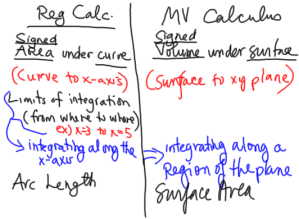
It was nice, because students were coming up with some pretty complicated ideas on their own. They were motivating things we were going to be learning. Nice.

After we went through this thought exercise, still not looking at a single equation, I then threw the following up on the board:
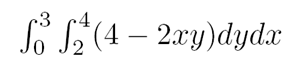
I wanted to see if they could use our discussion to suss out some information about the notation, and the meaning behind it. They actually got that the limits 2/4 correspond with y and the 0/3 correspond with the x. And that the region we’re integrating over is a rectangle. And the surface we’re using is 4-2xy. I mean, they got it.

I then showed them how to evaluate this double integral, briefly. I tried to get the why this works across to them, but we ran out of time and I slightly confused myself and got my explanation garbled. I promised that by the next class, I would fix things so they would totally get it.

Although not perfect (but good enough for me, for now), I whipped up this worksheet which I think attempts to make clear what is going on mathematically.

I strongly believe, however, that this will drive home the concept way better than I ever have done before. If you teach double integrals, this might come in handy.

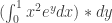
PS. I, a la Silvanus P. Thompson in Calculus Made Easy, talk about dx and dy as “a little bit of x” and “a little bit of y.” So if you’re wondering what I’m looking for question 2 on p.2, I want students to say dy. Then the answer to A is (\int_{0}^{1} x^2 e^y dx)*dy. That’s the volume of one infinitely thin slice. Now for B, we have to add an infinity of these slices up, all the way from y=0 to y=2. Well, we know an integral sign is simply a fancy sign for summation, we so just have \int_{0}^{2} (\int_{0}^{1} x^2 e^y dx)dy
Calculus Mottos

There is one motto I like to bring up in calculus:

Take what you don’t know, and turn it into what you do know.

We also have a few extra mottos floating around:

Calculus above all.

Don’t be a hero.

(The last one refers to doing all the calculation in a problem at once, in one line of work. Too much room for horrible horrible error, they aren’t communicating their ideas, and a million other problems.)

On their midterm, I gave two easy bonus questions. I do this as a way to give a little “error correction” to my grading… With midterms, I have to grade a lot of long tests with a lot of questions, and I suspect that I probably make a small error on one or two of the tests. I figure giving a little bonus boost to everyone helps me feel better about any inadvertent errors.

This year the questions were:

A. Make up a new calculus motto and give examples of using it in this course.
B. Draw a picture of Mr. Shah. Make it snazzy.

I loved these bonuses. Reading them after grading the midterm (which kids did awesome on, b.t.dubs) was hilarious.

I am going to share the mottos with you:

  • Calculus is not just math, it’s a way of life.
  • Use yourself, then some others. After that, calculus won’t be a bother.
  • Practice makes perfect!
  • Take what your friends know, and turn it into what you know!
  • “Crazy for Calculus!”
  • Calculus: I find its commentary insightful and would like to subscribe to its newsletter.
  • Calculus: I promise it’s not as hard as you think it is
  • D.A.N.C.E. — Derive Awesome Nifty Calculus Equations
  • Build the basement before you shingle the roof.
  • Don’t forget the old skills from 1st semester or you won’t be able to register.
  • Calculus is life, life is calculus.
  • History repeats itself: Even if you won’t be tested on a skill, the concepts will come up later on.
  • Don’t freak out.
  • Break it down to its most basic form, to understand it.
  • Go to your limits, reach for infinity, and always aim for the other side of the curve!
  • Write it right and you’ll get it right.
  • “Zero is okay when you’re at the top, but terrible when you are at the bottom.” [re: dividing by zero]
  • (Almost) anything can be simplified in calculus.
  • Calculus above all, and even above senioritis!

Loves me some mottos. Their descriptions of them using it were priceless and spot on. Wondering if I should be ordering some new buttons soon? #methinkso!