I just finished teaching Riemann Sums, using the patented Shah Technique. I’ve always had my kids enter a program in their calculator which automatically does Left Handed and Right Handed Riemann Sums (actually it also can do midpoint!). And last year we used this program to estimate how the number of rectangles was related to the error to the true area. (That came out of me just playing around.)
The program we enter is here:
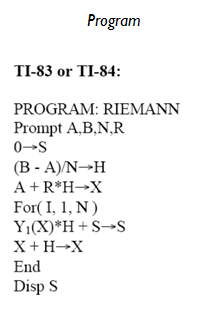
(If you want to use this, this is what you need to know. If you want the Riemann Sum of 20 left handed rectangles of 
This year I decided to not go into the whole error thing like I did last year. This year I wanted students to really and more fully understand how the program worked. I always explained it, but I never really was convinced that they got it. Me up there lecturing how the program worked wasn’t really effective. So I whipped up this worksheet.
I tried to do less talking and them do more thinking (in pairs). I felt like there were a number of students who had this “OMG!” and “this is crazy” moments. Some were awed that the program worked and it gave them the answers we had been calculating by hand. Some had this amazing moment when they figured out what the variable S stood for — and how it actually calculated the Riemann Sum. And my favorite was when a couple students figured out how the R variable worked — and why R=0 gave left handed rectangles, and R=1 gave right handed rectangles.
I really enjoyed this. I think the worksheet could be tweaked to be clearer, but it’s something I see myself doing again. Well, I guess I will be doing it again tomorrow with the other calculus class. But I mean: next year.
 Continuous Everywhere but Differentiable Nowhere