Month: July 2011

“Sticky” Notes

This past week, I attended a less-than-inspiring AP conference for AP Calc, as I am teaching the course for the first time come September. Though some parts were helpful, the presenter spent almost all of the 8 hours every day just lecturing about Calculus and going through mediocre worksheets with us. He was a perfectly warm and friendly guy, but he was also sloppy, disorganized and often slightly incorrect, not to mention not creative at all. I was pretty disappointed. [Disclaimer: People have given me far better reviews about AP conferences in the past… I think it depends on the presenter organizing].

But, while watching the Calculus curriculum being presented methodically on the board (without any distractions because my wireless wasn’t working), I was struck by how confusing it must be to stare up at a mess of disorganized mathematical notation. I decided to brainstorm ways to improve the taking-notes-from-the-board aspect of my own course – to make my notes more “sticky” in my students mind and to make them more useful for the problem solving. We can all inspire some day to have a completely student centered, inquiry based, problem solving classroom, but even in those there is certainly room for (and a need for) teacher directed instruction… and that can always get better too.

Inspired by Square Root of Negative One Teach Math’s loop to convert logs to exponents to logs and Sam’s Riemann Sum setup, I tried to think of ways to use visual ways to connect conceptual math with notation (which is probably the biggest hangup with my students), to basically create a sort of intermediate form to help make the abstraction make more sense. Here are a few ideas I had… keep in mind I haven’t tried any of these with my students.

1. A Beefier Number Line for Graph Sketching
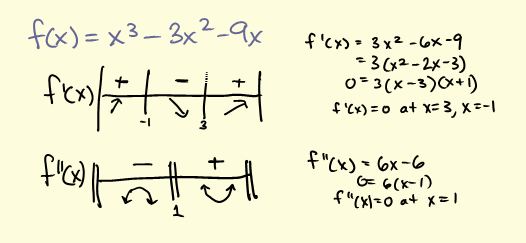
Problem: One of the things I noticed this past year is that my students would dutifully make number lines to test the derivatives but would sometimes totally forget what they were doing in the process. Also, many would mix up the first and second derivative.
Solution: Have the students immediately interpret their results with visual indications of increasing/decreasing and concave up/concave down. Make the separations on the second derivative number line be double lines instead of one to reflect the double prime part of the second derivative notation.

2. A Point-Slope Picture for Point-Slope Form
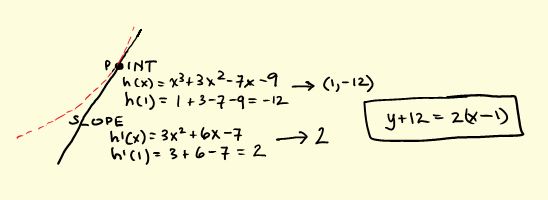
Problem: Anytime there are multi-step problems, many students either try to memorize algorithms or get completely overwhelmed calculating one thing that they lose other parts in their work.
Solution: Draw a picture of a tangent line and let the point be the O in POINT and the line be part of the L in slope. Then, finding these two items gets you everything you need to find the tangent line. Maybe arranging them vertically and carrying the final part of each step out to the side might keep students more organized. The bonus is that this is a picture that fits with the math and not just a forced acronym.

3. Enhancing Volume Integrals With Pictures of Cross Sections
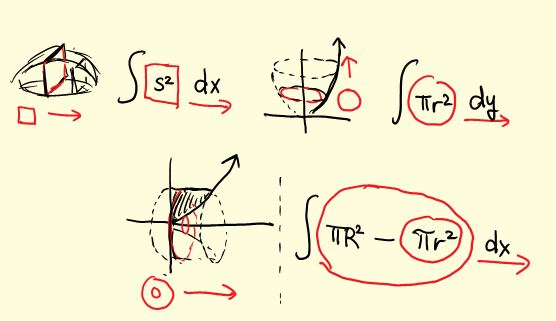
Problem: The hardest part of figuring out the volume of solids is setting up the integral. Students have trouble figuring out what area equation to integrate and then which variable to use when integrating (i.e. which way to go).
Solution: Draw the cross-section near the solid and an arrow in the direction in which you are accumulating cross sections (or on the problem words if you skip the picture). Then draw the same shape next to the integral sign and an arrow. Inside the shape of the integral write the area equation as you would see it in geometry, and above the arrow write a d-whichever-way-the-other-arrow-goes. Then replace the area equation with something else that is in terms of the whatever in d-whatever. Works for the disk and washer methods in volumes of revolution too.

Okay, so maybe those aren’t all THAT helpful, but I personally prefer thinking about small changes when I have so much on my mind about the school year. Though these are obviously not replacements for deeper understanding, maybe they could be crutches to help students go from something that might make sense to them to the abstraction of notation. Main point: I’m going to pledge to sit down and try to think about how to make notes more “sticky” before every unit.

from @bowmanimal
MV Calculus Projects 2010-2011

One class that I think I am pretty free about, and we have some fun in and get to explore and go through a lot of productive frustration, is my multivariable calculus class. I had 5 students in it last year. (*As he ducks from the rotten vegetables hurled his way, and collective groan from the crowd.*) Sadly, next year, there will be no students eligible so I won’t be teaching it.

My favorite thing from this course is the fourth quarter projects that all students do. We don’t have problem sets, we don’t have any tests or quizzes. Just this thing.

At the beginning of the year, I tell students to write down random things that pique their interests, whet their appetites, for the fourth quarter project. Whether it be higher dimensions, to the notion of curvature and what that might mean for surfaces, to the use of optimization problems in various fields, to whatever. As the class goes on, I’ll mention some interesting tidbit here or there and sometimes they’ll add it to the list in the back of their notebook. And then comes the fourth quarter, where they basically get to pick anything they want, they write their own project prospectus, they write their own rubric, and they just go at it. I give them some options, but they don’t always go that way.

I meet with them once a week or every other week (or more if they need it) and provide guidance and support, sometimes needed, sometimes not.

This year I had some excellent projects. I can’t believe I didn’t outline them for you when we finished the year, so I will outline them now. What was great is that some parents got to come to the final presentations, and so did my department head, the head up of the upper school, and some math teachers. Different days had different audiences.

1. The first project involved constructing 5 intersecting tetrahedra out of origami and figuring out the “optimal strut width” (the width of the “beam” of each edge of the tetrahedra) so the tetrahedra just sit beautifully within each other without having them wiggle around (too small) or bend to fit together (too large).

This problem involves multivariable calculus, believe it or not, but also involved some really beautiful precalculus work meshed with 3D (basically, using roots of unity and some right triangle trigonometry) to find the vertices of a dodecahedron.  I also have to say that making the darn thing was totally hellish and the student who did it is a super rockstar. She also wrote a really comprehensive final paper explaining the calculations. Color me impressed.

2. Another student, who is a nationally recognized runner, wanted to investigate the following question: if you have a random surface with a local maximum, and you put yourself on that surface, and you wanted to get to the maximum, how would you get there? Instead of taking the shortest path (which would follow the gradient), the student conjectured that if you ran along the least steep path you will run faster, and if you run along the most steep path you will run slower. So there is a tradeoff, and there will be a path to run in between those two choices which will be optimal. So the student and I constructed a function to model the velocity of this runner. Although together we couldn’t actually get a general answer, or even a specific answer for a specific surface and point we chose, we had fun struggling through it. The student also created an accurate model of a one surface that the runner would be running on (the one that he did his calculations for).

3. Another student, for an earlier problem set where they were asked to write their own problems, studied the idea of marginal utility in economics and related that to Lagrange multipliers. This student was one of those kids who is interested in everything and he really loved studying marginal utility, and wanted to extend it and see how else multivariable calculus was used in economics. So he pretty much devoured this book on his own. Although he didn’t find too much multivariable calculus, he became enamored with the idea of the utility function, and decided to make a 50 minute class lesson on economics and calculus with an emphasis on the utility function. It was so well thought out, and so well delivered, that I think that teaching and simplifying ideas might be this kid’s calling. He also wrote an amazing paper outlining everything from the presentation (and more that he couldn’t fit in), and a problem set for students to work on after the presentation.

4. Say you have a blob drawn on graph paper, and you wanted to measure the area. What if I said: there is a mechanical device that if you drag it along the perimeter of the blob, it would calculate and tell you the area? True story, this exists, and when I described this to a student struggling to find a project… a project he was insistent he wanted to make with his hands… he was hooked. The device is called a planimeter. It sort of makes sense that something like this could exist… I mean:

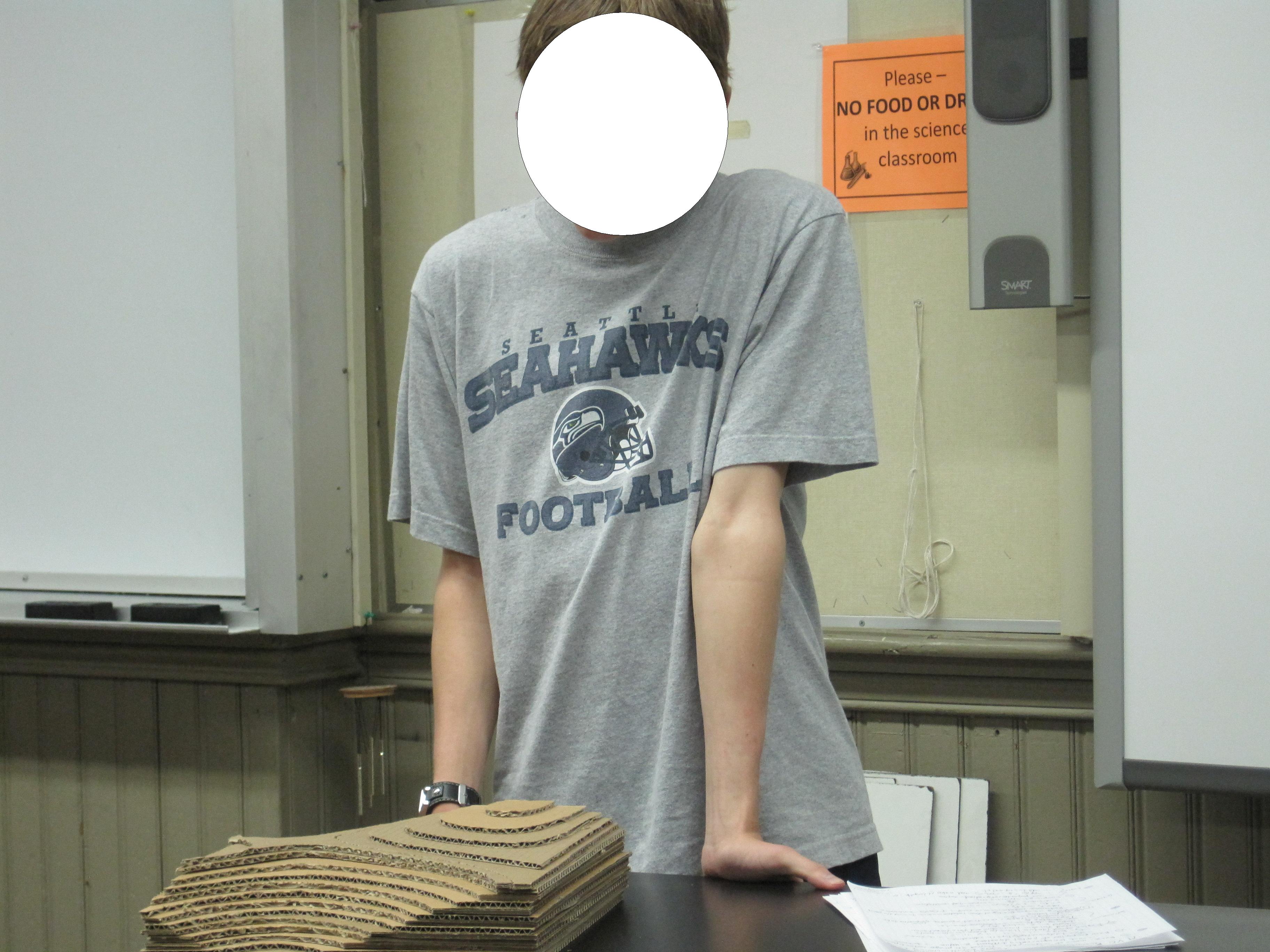
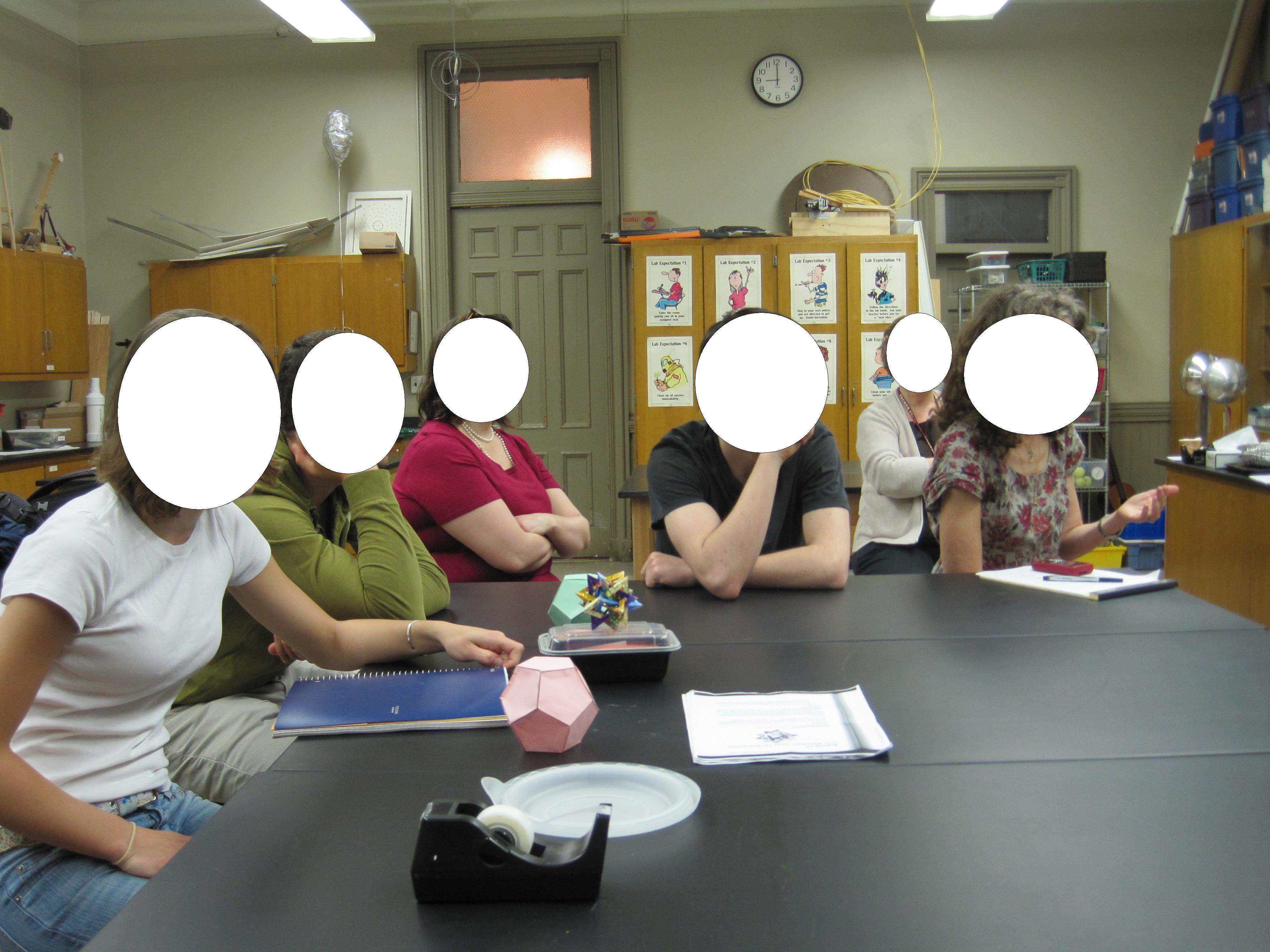
(that’s Green’s theorem). So this mechanically minded student first built a trial version of a planimeter, using pencils, binder clips, and a bottle cap. And it worked fairly well. So then he built a giant and much more sturdy one. You can see this student holding his “draft” version and on the table is his professional version.

This student did almost all the work without me (which is good because I have no idea how to work with things mechanically). I basically only helped him understand some of the math behind how the mechanical device worked. The end result was that the professional device worked fairly well, but I think given another week, it could have been tenfold more accurate. Time is always the sticking point with these end of year presentations.

5. The final project was one of my favorites, because it involved me really going back and learning some simple partial differential equations. How this project happened involved me showing this student the following video:

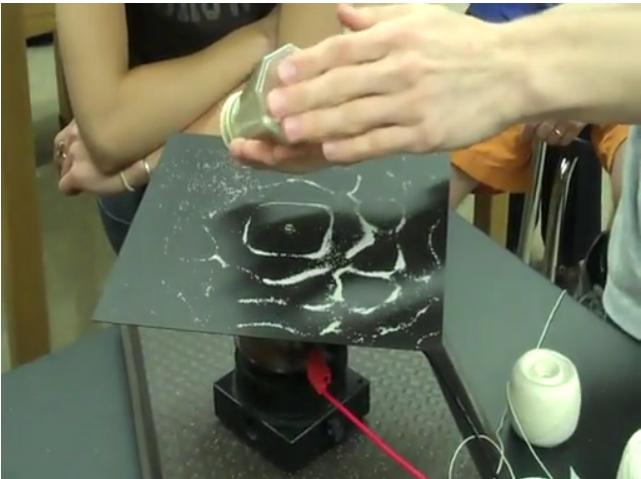
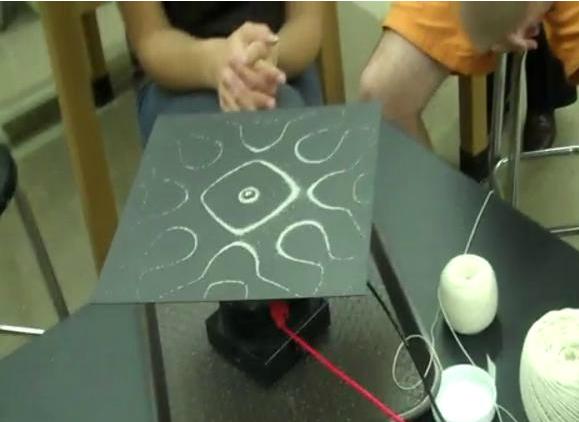
Of course this video can’t but help stir the imagination. So this student wanted to build the device (called a Chaldni plate) and study the math behind it. It turned out that building the device was a bit beyond our capabilities, so we enlisted the help of the science department chair who super generously ordered a chaldni plate (he had the driver already) and helped get him set that up. I, on the other hand, did some research on what causes those beautiful patterns. Together, that student and I spent hours upon hours tearing through a paper — me doing a little lecture, him reading and asking questions, and so on and so on. And at the end, this student wrote his own paper based on our reading — explaining the math behind the designs. Although I don’t think he fully understood everything (we had not nearly enough time to make that possible), I loved that he got a touch of all these small things in higher level math. Orthogonal functions and Fourier series. 2D and 3D waves. Boundary conditions and time-dependent partial differential questions.

And his Chaldni plate worked.

PS. Apparently, I didn’t do a good job of blogging about my projects from previous years. Two years ago, here is what my kids did. And last year, I didn’t really write about it. Yikes! One student did a wonderful investigation on higher spatial dimensions, and how to extend what we’ve done into them — focusing on actually visualizing these dimensions (she really really really wanted to see them). The other extended a 2D project on center of mass that someone worked on the previous year, and I wrote about it obliquely here.

I’m alive, I’m alive

I’m alive, I’m alive // And I’m sinking in.

Acknowledgements

First off, thank you very much to Bowman for his amazing, thoughtful, well-written guest blog posts. I told you he was a tour-de-force and I can only say that I hope you’re finding his ideas as inspiring as I have. I’m stealing everything I can from him. I hope you are doing the same. I’m all about the concrete, and he gives me the concrete. Inspirational, he is.

Personal Update

So I’m now back in New York City. Home. I attended 5 weeks of professional development. Two weeks at the Klingenstein Summer Institute in Lawrenceville, New Jersey, followed almost immediately by three weeks at the Secondary School Teacher’s Program at the Park City Math Institute in Park City, Utah.

Yes, I’ve gone from this to this:

Current Status of My Thoughts

I have to say: I am burned out. Five weeks is a long time. I am also inspired, and hope to soon sort through all that I’ve taken away to make some serious changes in my classroom. And next year, I am only teaching two preps (Algebra II and Calculus, but not the AP Curriculum). So I will have the breathing room to make changes, I hope.The changes will involve intentional group work and formative assessments, coupled with much more intentional atmosphere building of a place where mathematical thinking (right or wrong) is valued and errors are celebrated and not something to be feared.

Yeah, I know. These are small changes and you think I need to be more ambitious.

JK. I know these are huge. It will take a lot of thinking to figure out how concretely to enact them. It’s easy to say these ideas, but it’s way harder to actually visualize them happening, if I close my eyes. I have some ideas, but not nearly enough.

I’m also worried about finishing the curriculum (especially in Algebra II) next year I try to go for depth and misconceptions and mathematical thinking, rather than try to go at those things but then succumb to the expediency of the moment and don’t allow time for grappling and productive struggling and discussion. But I’m less worried than in previous years, for some reason, and I’m ready to just go for it and see what happens. I suppose it’s because I’ve taken a vow to not underestimate my kids and their thinking abilities. Which I think I’ve done, unintentionally, and now I have to correct that. So if any of you have experiences of making the transition from teaching procedures to teaching thinking, any want to share any advice, puh-leese help me out here in the comments. (I don’t only teach procedures, to be fair to myself, but if I had to put myself in a camp, I would put myself more in a procedural camp than the thinking camp.)

I promise I’ll share my thoughts about changes I’m going to make in the classroom next year, as I sort through things, just like I did with my maybe-too-extensive blogging about standards based grading last summer.(That being said, I also suppose I have to talk about how I’m going to revise SBG for next year in calculus. Which means I have to figure out how I’m going to revise SBG first. Hu-uh. Feeling daunted now.)

Last year I was timid about making changes. I did Standards Based Gradings, and I felt that was “enough.” I think that was a good start. But it was like a bandaid on a bigger problem. I need to work on my craft in the classroom, and SBG didn’t change that too much. And so this year: I’m going for a sea change. No more glacial change, I’m jumping in whole hog, and mixing metaphors like similes are to analogies. Or something.

Contradictions

I praised Bowman for being specific and concrete, and look at me here, being all musing. Sorry. It almost feels like I’m trying to psyche myself up for next year, and committing myself to change by announcing it publicly. Yes, I suppose that that’s exactly what this is.

I hope to be more concrete soon. It’s just that, well, this here blog has always been for me, partly to archive what I do (the concrete) and partly for me to sort through what I’m thinking and get some ideas down… because when they slosh around in my head: 1. I can’t sleep 2. I get a headache 3. I get paralyzed with the overwhelming sense that I need to do something but I don’t know what. It’s the paralysis that I hate the most. So I’m hoping to avoid that by starting to put thoughts to page. But I know: I hate reading these kinds of posts too. So if you got to this point: sorry.

Frankensongs and Frankenfunctions: Using Mashups to Teach Piecewise-Defined Functions

After a riveting session about brain science at the summer program I attended (where I met Sam!), I wanted to read a little bit more about epistemology. I chose a few books that the presenter suggested: I just finished reading “Made to Stick” by Chip and Dan Heath (about why some ideas stick in our mind better than others and how to turn your ideas into some of those better ones) and am about halfway through “Brain Rules” by John Medina (twelve basic rules about how the brain works). Both were fascinating and will absolutely influence my teaching.

One thing that I have really latched onto is the idea of working with students’ previous knowledge about everything and anything in order to guide and improve learning (both books kind of harp on this). Take this example from Made to Stick where they define a Pomelo (an example which the lecturer also talked about at the summer program):

A pomelo is the largest citrus fruit. The rind is very thick, but soft and easy to peel away. The resulting fruit has a light yellow to coral pink flesh and can vary from juicy to slightly dry and from seductively spicy-sweet to tangy and tart.

If you already know what a pomelo is, that should make sense, and if you don’t, you can still get a pretty good picture of what’s going on. But compare that definition to this one:

A pomelo is basically an oversized grapefruit with a very thick and soft rind.

Both define a pomelo, but the second one uses the crazy ideas in your head to build new knowledge, making a much more descriptive and much stickier idea – not only is it easier to learn what a pomelo is, you will remember it much better. AAAND, the big bonus, it’s more efficient! [Here is a picture of a pomelo, by the way, if you need one. They’re kind of gross, but I am still partial to pomelos – in Arabic, pomelo is “bomaly,” and at first the guards at school couldn’t understand my weird sounding name (“Booooowman”), so they chose to hear the closest familiar thing, and started calling me “bomaly.” The origin of one of my many nicknames.]

Using Schemas in Math Education

I was thinking back to my year to see if I used anything like this in to teach math. I thought of one example, which I wanted to share, and then decided to put out a call for others. Can you think of a specific instance where you used anything from students’ prior knowledge to effectively and efficiently make a mathematical concept stick?

Piecewise-Defined Functions and Music Mashups

When reviewing at the beginning of the year in my Calculus class, I found that a lot of students were surprisingly stymied by the idea of piecewise-defined functions, which kind of blew my mind (this was in my first two weeks teaching math, and I was not expecting this to be a tricky concept for seniors in high school). It dawned on me that piecewise functions (which I call “Frankenfunctions”) are a lot of like Music Mashups, like this awesome mashup of the Top 25 songs from 2009 by DJ Earworm:

I played the song for the class and before connecting it to math, we broke down what we were hearing – like, actually had a brief conversation about what a mashup is (basically, one song constructed from segments of many others, though we went into more detail). Then we talked about the piecewise functions with this context:

  • A piecewise-defined function is one function made up of pieces of many others.
  • Each segment on a piecewise function is just a little part of a much bigger function.
  • The segments are broken down into intervals based on the x-axis (or time axis).
  • In piecewise functions, only one “song” can be playing at a time for it to be a function.
  • Piecewise functions can capture more interesting situations where the relationships between the variables in play changes.
I still got some of the craziest graphs I have ever seen on the following quiz, but the metaphor gave me a way to talk through their mistakes with them and hopefully gave them a way to connect something that is easily comprehensible to the slightly more abstract idea here. Now, this maybe isn’t the best example because it feels a bit cheap and may not get at deep understanding of some of the “whys,” so I will repeat my call again…  Can you think of a specific instance where you used anything from students’ prior knowledge to effectively and efficiently make a mathematical concept stick?

from @bowmanimal 
How I Grade Tests to Mine Learning Data [quickly]

For my first year using Standards Based Grading, I was an SBG-hybrid teacher. The standards that I used made up about 30-40% of students’ overall grades (the category weights changed over the course of the year) and I still included the traditional categories of Tests, Quizzes, Homework etc. This is for two reasons: I was really hesitant to change everything all in one year and I also felt compelled to fit with our departmental grading policy. Next year will probably be the same, almost entirely because of the latter pressure. I got into a little bit of hot water because I didn’t really explain what was doing very clearly at the beginning of the year – anyone else have the same problem?

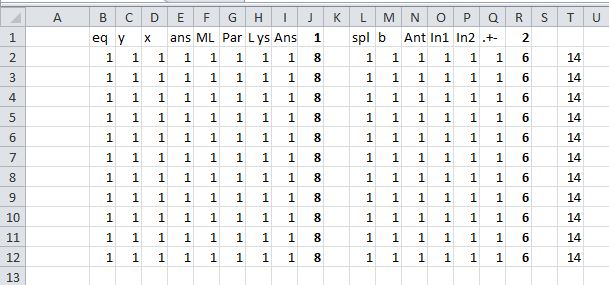
But traditional “summative” assessments can, of course, still provide data you can use to guide your teaching and student learning. When I first started grading tests I would try to eyeball which problem students were getting wrong and then try to remember at the end of grading what skills or concepts they were struggling with. I felt like I definitely would pick out the major ones, but also felt like I was missing a lot. So I brainstormed a way to solve this problem and began grading all of my tests with Excel spreadsheets. Now I see something like this when I grade a test:

That might be a bit hard to see, but basically it’s a breakdown of what percentage of my students got each individual part of each problem correct on a test from this past spring (the actual spreadsheet goes a few more columns over to have the overall score too). I found that this gave me two main benefits:

  • Surprisingly faster grading (even with compiling all the data) with less totaling points mistakes
  • Extraordinary amount of data about specific parts of test problems that I could use to guide learning and to revise assessments from year to year

–> Example of a completed test grading spreadsheet

So how does this work?

1. The Setup
(this takes me about 10 minutes now, though took longer at first)

  • First, I start by placing the breakdown of the points for each question in the second row. This all depends on how you grade tests, but I generally have 6-7 questions on a test that are all broken down into a bunch of individual points for various items like “splitting up the area into a few parts,” “setting up the integral,” “simplifying the expression” and “correct answer.” This forces me to decide beforehand what is important in each problem and how I’m going to grade it. I put little notes above each point for me to remember what each point is for (and again, these force me to award points for specific things rather than a 6/10 for an “almost got it” answer).Then, using a summation (this is important), sum up all of the points into a total for the question and place this under the question number.

  • Then sum up all of the question totals to make the total number of points on the test. 
  • Last, using that row you created, fill down as many rows as you need for as many students as you have (plus one row that you can keep at the top to remind you of what each question is worth and the totals). If you use the fill function, the equations that you created in the previous step will stick with you.

    Now you’re ready for the actual grading process.

2. The Actual Grading

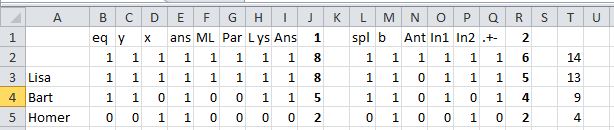
  • Pull out a student test and enter that student’s name in the first column next to their row of points. You can either grade page-by-page/question-by-question or student-by-student, but if you do page-by-page (which I prefer) just keep the tests in the same order. Then, when a student misses something, just enter a 0 in the space for that point. So if Bart correctly identified that the y values are needed in a Riemann Sum as the height of the rectangles, but used the wrong x’s to calculate them, you can leave the 1 in the y column but change the column about the x’s to 0. Notice that it automatically totals how many points he earned both for the question and for the whole test.
    Continue doing this until you have graded all the tests. This is the part that I find makes everything faster. The spreadsheet automatically totals everything so you can concentrate on making helpful remarks on the test instead of totaling points.

3. Reflection
(the powerful part)

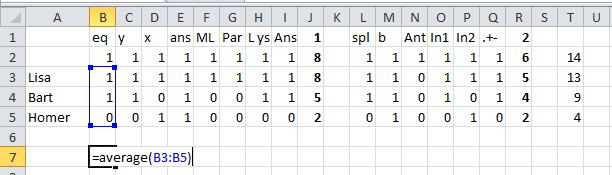
  • Okay, so all of that is nice, but wouldn’t be all that worth it considering hand adding works fine (math teachers = good at mental math). But here’s the powerful part – now with one click of a button, you can see how the whole class did on specific parts of specific problems. Just average the responses for a specific question by averaging the column.
     ………
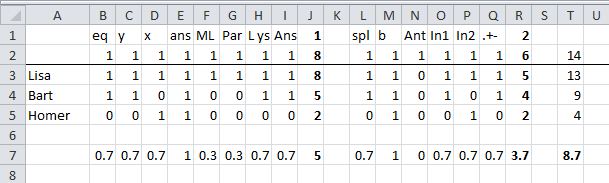
  • Then fill the equation all the way from the left to the right covering all the individual parts on each question, the question totals themselves and the test total itself. You automatically have averages for everything now.
     .
  • So check this out: The students did overall mediocre-ly (I love making up words) on both questions, but now we can see that they totally understand specific parts on both questions and totally bombed others. I often color code it with the “Conditional Formatting” tool to make this even more visual (only works if everything is out of 1 or you scale everything to be a percent of the total points offered):
     .
  • Now when you go to review, remediate and revisit, you can ignore the green items and focus much more on the reds and oranges. You could even try to judge if the part that NOBODY got right was even a fair question in the first place and use this datum to analyze your assessment.
  • You can also use a lot of other Excel features to quickly or do a lot of things like order the students to see grade distribution, curve your test in creative ways if you do that (or see what a bunch of different curves would do), hide the individual points columns to leave the question totals so you can switch between a macro and micro view, and if you input the students’ names in the same order as your gradebook, you can just copy paste right into your gradebook.

I also tend to do a lot of color coding and separate questions by colored bars. This is unnecessary, but makes it easier for me to look at (along with freezing the first column so I can always see the students’ names) Here is my –> example of a completed test grading spreadsheet (same as above).

The Best Part?

One of my favorite things to do though is to compare my data from the Standards to the data from the test. Comparing my formative assessments and my summative assessments. If the Standards are telling me that 92% of the class is rocking the Quotient Rule, but the test problem indicates that only 45% of people can solve a test problem involving the Quotient Rule, what does that mean? Do I need to alter my standards assessments? Was I lulled into a false sense of security by the high marks so I didn’t bother doing any review, or didn’t bother effectively integrating this concept into later material? Did the question I asked on the test line up with the type of thing I had been asking previously, and should it have? Had I been assessing algorithms previously instead of understanding? Lots of grrrrreat questions it raises for me every time.

The Second Best Part

I save all of these files for the next year. This (theoretically) allows me to focus my curriculum revisions on things that weren’t particularly sticky the first time around, and gives me concrete data to compare different approaches used in different classes (if I use some of the same exam questions).

Anyone else do something like this?

from @bowmanimal 

Make it Better: Memory Modeling

“A monk weighing 170 lbs begins a fast to protest a war. His weight after t days is given by W = 170e^(-0.008t). When the war ends 20 days later, how much does the monk weigh? At what rate is the monk losing weight after 20 days (before any food is consumed)?” <– That’s an actual problem from our Calculus book, which I find very amusing. Though it doesn’t really fit Dan Meyer’s definition of psuedocontext, I just get a kick out my mental picture of a monk sitting in a dark room taking a break from protesting the war to scribble away on a notepad trying to make predictions with an exponential model… There are so many word problems that force “real-life” situations into the convenient framework of whatever math topic is being presented in that section. I guess these are supposed to demonstrate to students how useful and relevant math is, but I think we all know that students just find them to be tricky and unyielding disguises to math that they generally know how to do.

There was one word problem that fit an exponential decay model to someone forgetting information, so I decided that instead of just doing the word problem, we would test the model by recreating the experiment. The day after we had a midterm exam, instead of handing back their corrected test, I put them in groups and gave them the following list of 50 three-letter syllables that I generated with a random number generator:

SOQ XAC DOB NEB BAR JYS ZYW GEK TUD ZEM GAK KUR BEN XOQ DUX BYR NIT WAP ZIJ HOG HIQ DUW CUD SAM BIM LIH JEV VEZ QEM GUL ZIQ SEQ JYV GUT XYM XAX BIQ DOJ ROM ZIV QEW JEH CYS ZEM FOM KEG DUC GYK WYQ POD

I gave them 15 minutes to memorize as many as they could and then tested them by having them write down all that they remembered. Then, I handed out the midterms and we started going over them. About 5 minutes later, I had them write down as many of the syllables as they could again. Then, we went over a few problems on the midterm… then another memory test…. then more midterm… then another memory test. They had absolutely no idea why we were doing this, so each time they groaned and complained. And they groaned even more when I opened class the next day with another trial. And then again two days after that… And then a last time a week and a half later. All without studying the list after the original 15 minutes.

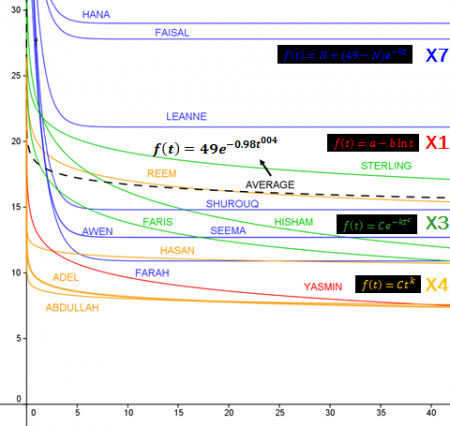
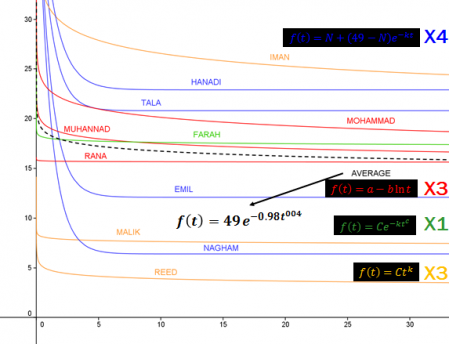
Finally, I revealed the purpose of the whole experiment. We collected data and used GeoGebra to fit various models to their data. There were four different mathematical models to choose from that I found from various psychological studies (which I had loaded into a GeoGebra file with sliders so that they could move the various models around to fit their data). Each student picked the one that they thought fit their data best (a function to calculate how many words they would remember over time), took the derivative of that to calculate their “forgetting function” (a function that tells them how fast they are forgetting words at any given time), and then used both to calculate how many words they will remember in a few weeks and how fast they will be forgetting them at the point.

We graphed all of their functions on the same axes (y-axis = number of words remembered, x-axis = time in hours) to analyze which model was best and analyze how their memories compared to their classmates. The results are below. The different colors correspond to the model that each student chose.

        CLASS 1 –

        CLASS 2 –

Now, the clean final result of that graph hides how messy the model fitting part was. Though some students’ data fit well, some didn’t, at all, which was actually really nice. They really struggled trying to fit the model and hopefully realized that a lot of these models that we are dealing with in cooked textbook problems aren’t as powerful as they purport to be. If I could do it again, I would have them use more mathematically sound ways of fitting the models than just eyeballing it (I hadn’t really considered this and realize now that, though it would be an investment in time, it would make the whole thing much better).

But besides doing some authentic math that was individually tailored to each student, my favorite part of the experiment was the followup meta-cognitive discussion. We ended up having a really great conversation on how best to memorize these random things, which then led to a great discussion about how to learn and study best (especially how you should go about studying math). We talked about how some people put the words in context by using a story, some people made patterns by grouping similar items together, and the ones that didn’t do very well talked about how they just tried to memorize these random unconnected things by rote memorization. Many also noticed that throughout the closely connected trials on the first day, their number memorized actually went up, so we talked about how assessment can actually help you learn something too (in addition, of course, to regular practice).

Make it Better.

I have one simple question this time: the thing that I really didn’t like about this experiment was that it was entirely teacher centered. They were in the dark about what was going on (for experimental purposes) until the day that we collected data, fit models and did some quick calculations. How can I make this more student-centered and add elements of inquiry? I have a few ideas, but I wanted to see what other people thought.

Files:

  1. Word document with list of random words
  2. Excel spreadsheet for collecting data
  3. GeoGebra file with various forgetting models, ready to drop data in
from @bowmanimal 
Make it Better: Drawing with GeoGebra

Hello! Though Sam may refer to me as Kiki, don’t be fooled. My name is Bowman and I’m an American dude teaching MATH at a 9-12 co-ed boarding school in Amman, Jordan. I teach mostly Jordanian kids, though we teach an American-style curriculum in English, with sort of international school type outlook. For the past two years I have taught Physics, then last year I picked up Calculus, and next year I’m dropping the Physics to pick up AP Calculus AB. All of my friends can’t really understand why I’m so pumped about this because they think I’m the only person in the world that gets giddy about Calculus. False.

I love the math blogging community and am excited to be delving into it. Though I already have an “I-don’t-live-in-America” type blog about my time in Jordan, I have relied heavily on edublogs to develop as a teacher and I’m looking forward to repaying my debt. And probably like you, Sam’s blog is my fave, so I’m honored that he would give me some airtime. If you ever get a chance to meet him in person, consider yourself lucky. Since the thing that first drew me here was the wealth of practical lesson planning ideas in his Virtual Filing Cabinet (which I check pretty consistently before I plan a unit), I thought I’d begin repaying my debt by sharing some of the creative ideas I have used to present specific material this past year. Acknowledging my youth and paucity of teaching experience, I’m going to title these posts “Make It Better” to indicate that while I think these ideas have a lot of potential, I’m looking for ways to improve them. Enough introduction… on to the math!

Drawing with GeoGebra

For anyone who has not discovered the magic of GeoGebra yet, download it right now and then spend some time this summer playing around with it. It has a nice mix of geometric and algebraic capabilities, with fancy looking sliders and animations to help students visualize or experiment with mathematical concepts. These can be used in front of the class or on individual students’ computers. I ended up using it so much throughout the year in student directed learning that when we did end-of-the-year individualized projects, a majority of my students pulled out GeoGebra on their own to graph something or fit a model to some data. Sweet.

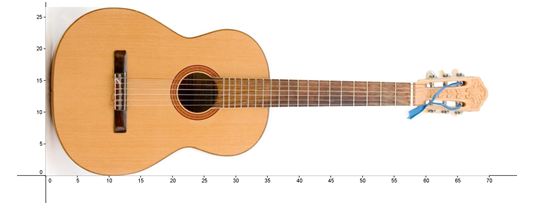
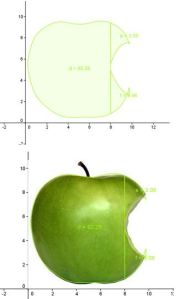
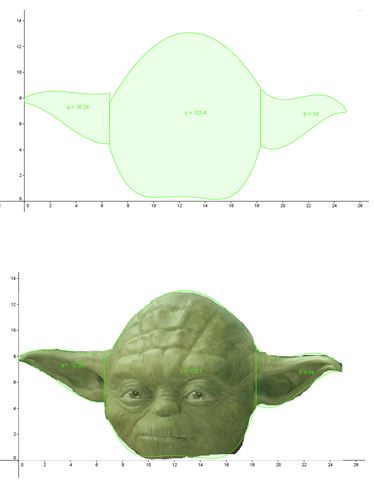
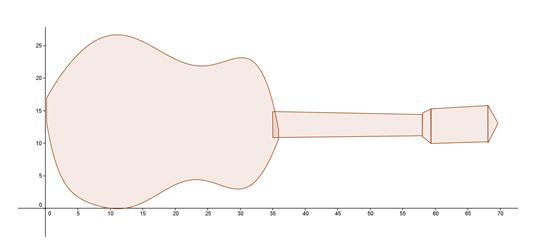
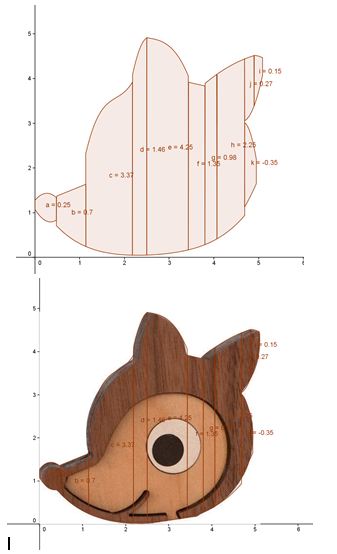
One of my favorite GeoGebra exploits this year was a “drawing” project, where students converted an actual picture into a mathematical picture by fitting functions around the outlines and then using integrals to shade in the area between. For example, they could a picture of a guitar and turn it into a sexy mathematical image, like this:

 >>>   
Basic steps (more detailed procedure below):

  1. Upload a picture into GeoGebra and scale the axes to the right scale.
  2. Place points around all the outlines making sure to hit critical points
  3. Fit functions to the outlines.
  4. Use integrals to shade in the areas between the outlines. The basic syntax looks like this…
    which means the integral between the [top function f, and the bottom function g, from x=1, to x=4].
So I conceptualized this project as a low-key but conceptually rich thing to do during the craziness of APs, and as something that the kids who were going to miss many days of class could do on their own. But it turned out to have some other really cool benefits too. Here are some things I really liked about it…
  • The hardest part about integrals is setting them up and that’s all students practiced in this project. They did absolutely no calculation. (In the age of Wolfram Alpha and TI’s could that be sooomewhat a thing of the past?)
  • The visual nature of the project gave immediate feedback to wrong inputs. If a student chose the wrong endpoints or the wrong functions, the wrong integral that they typed in would show up. They could see what was wrong about it to hopefully figure out how to correct their input, and correct their misconception. The tinkering aspect was maybe my favorite part because they often don’t understand that just by trying something to solve a math problem,  it can point you in the right direction to solve the problem even if it’s “wrong.”
  • It unearthed deep misconceptions about integration. Some students were conceptualizing integration diagonally, some would choose endpoints at completely wrong spots and some couldn’t conceptualize what areas they were trying to “color in” in the first place. I had lots of great conversations to address misconceptions that were at the same time a bit scary because we had already been integrating for a few weeks by that point.
  • Everybody’s problem was different. Each student was forced to visualize what he or she needed to do and had to attack a rather large problem by breaking it up into much smaller pieces.
  • The whole thing was kinda fun. Sometimes I pretend I’m above this, but each student chose a picture they were interested in and then we hung them up in the classroom at the end. And you can color the integrals whatever color you want. Pretty!
Here are some things that I didn’t like about it…
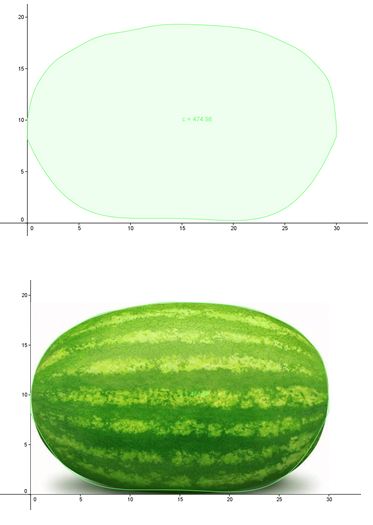
  • Some students totally copped out and chose really easy picture. I wasn’t very clear with my expectations (well, I actually didn’t know what to expect) and as a result a few students chose dumb things. One student did a watermelon… uncut…. like, a whole green watermelon. Or other students didn’t know what would be a “good” picture and chose something that ended up being way too hard, or uninteresting.
  • The function fitting part was a bit ridiculous. You can go really high with the degrees of the polynomials for the function fitting so people would just put points along a really curvy surface and then pick a 73rd degree polynomial that nicely fit the whole thing. I don’t know if this is actually bad, but it felt weird to me.
  • The problem was slightly meaningless. I had them add up the integrals at the end to find the total area, but this was a bit meaningless unless they had chose a flat object.

I can picture something like this being done for lower levels too. The concepts that come to mind immediately to me are piecewise functions and transformations. Instead of having them fit functions to points, you could give them a basic set of functions and force them to manipulate them with various transformations to fit outlines (and then ignore the coloring in part). There are easy ways to limit the domains of functions in GeoGebra. Below are GeoGebra instructions for the various steps and waaaay below are some more examples of student work.

But first, the whole point of this post…
Make it Better.
What do you think? What would you do differently? Do you think this holds educational value even though the problem is contrived? How could I make this more meaningful (i.e. make the result, the integral, not just the picture, actually hold value itself)? Should I give them a set of predetermined images for them to choose from to avoid “bad” choices? How else could I avoid “bad” choices? With what other material could something like this work? Would you use this in your classroom?

from @bowmanimal 
The procedural instructions for the various tasks:

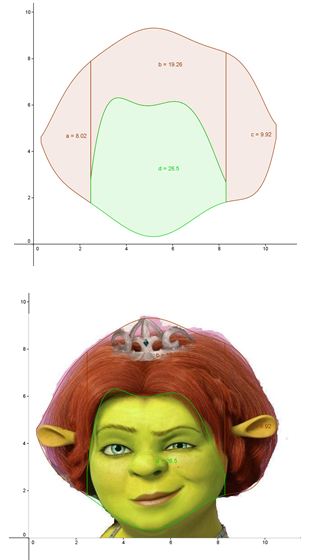
Examples of student work (I had to include the watermelon because I mentioned it):