I participated in a great twitter conversation the other day where we brainstormed a few strategies to help make our courses more accessible to English Language Learners (we used the hashtag #ELLmath, the approximate transcript is here if you are interested). It was a great start to what needs to be a running dialogue for me, as I teach almost 100% students for whom English is not their first language. If anyone has any ideas about #ELLmath, I would love to hear them in the comments. The conversation reminded me of a little idea I had last year, playing the game Math Taboo to help students expand “definitions” to actual understandings of concepts. Now, I’m sure other people do this, and a quick Google search leads me to believe it’s not all that novel, but while discussing #ELLmath, it struck me as a particularly good exercise for ELL students.
The idea of the real game is to get your partner to guess a word by describing without using any of the five taboo words, which are usually the first words that anyone would go to in a description. So the obvious math equivalent is to pick a term that you are throwing around in your class and get students to describe it without using their go-to math descriptors.
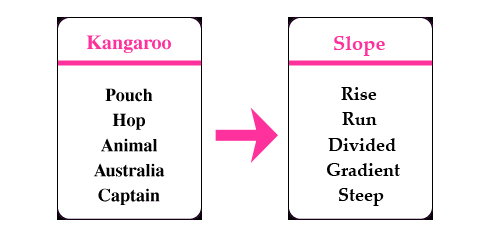 We played during beginning-of-the-year-review as a class, with the word to guess already known to everyone, and I gave students a chance to take a stab at verbalizing a definition without using the taboo words, one at a time until we got an acceptable description. However, this could easily be adapted to be a much more interactive activity (though its creation might take just a bit of time).
So why play this?
Whenever working one on one with students, I found myself trying to diagnose why they were not understanding a problem. I would ask them things like, “Well, what is a derivative anyway?” and they would often answer with something that I found acceptable, but perhaps could have been just something that they had figured out should be said as the “correct” answer. Even if they weren’t saying book definitions (which would actually be easier to deal with), many times they were using my informal definitions – words that they had internalized about the concept that might not actually display a deep understanding, but that I had been mistakenly accepting as evidence of learning. Definitions are important, but assuming that those are indicators of deep understanding is, of course, very problematic, no matter where those definitions come from.
So, this Taboo game serves a two-fold purpose: learning for the students (by forcing them to think deeply about a mathematical concept; by having them trade in math jargon for conceptual understanding; and by hearing classmates describe something in more accessible vernacular) and learning for me (by seeing how well students actually understand a concept; and by seeing what language students use to talk math in the hopes that my mathematical narrative can better reflect theirs in the future).
Alternative game: In how few words can you express this definition?
I have never tried this game I’m about to describe, but the idea is to start out with a long definition from a math textbook and see how few words you can use to express the same idea. Delving into the Twitter world this summer I have realized how wordy I am, and the process of editing my tweets down has made me realize how many words I use that are unnecessary. Twitter forces me to think about what is the core of my idea, which led me to think up this exercise. This could be done competitively (give groups 5 minutes to brainstorm), or you could do it countdown style, trying to lower the number of words by one each time. This could get students to really consider what is important about a mathematical concept and to get them to realize that the thing itself is more important the words you use to express it.
 Continuous Everywhere but Differentiable Nowhere