It’s Monday night and the first day of classes is Wednesday. I am teaching only two preps this year — the first time since I started teaching! I have a couple Algebra II classes and a couple Calculus classes. Also for the first time ever, I’m in a single classroom for all of my classes. It’s not a pretty classroom, really, and it is one of two rooms in the entire school with chalkboards (ugh! chalk!), but it’s mine! And I share it with another math teacher. So go me.
The past few days have gotten me to school, doing lots of logistical things. Like making minor revisions to my course expectations (here they are from two years ago, and not too much has changed) and my calculus SBG rubric (a 5-point scale, now, taken almost wholesale from @cheesemonkeysf), and photocopying them.
I made a few small changes to how I’m grading in calculus: now 80% of a student’s grade will be their SBG score, and 20% will be projects/problem sets/groupwork. Basically it’s an “other” category which will involve synthesis, problem solving, and less-routine-thinking. Although 20% might not seem like too much, I don’t have all these things lined up (I do plan on doing a lot of Bowman’s activities tho!), and I didn’t want to overwhelm myself this year by having to create all this new stuff. After much deliberation I decided not to grade homework, even though students last year clamored for it in their evaluations.
In Algebra II, the grading will be pretty much the same as in previous years, except we are integrating problem sets into the mix. So we are having 70% formal assessments, 10% binder checks, 10% home enjoyment (“homework”), and 10% problem sets. More about the problem sets as they develop, but I think they’re going to be heavily related to the habits of mind work that the Park School of Baltimore engages in. I honestly think that when their curriculum is finally published (I’ve gotten to see a bunch of it), it’s going to change how so many of us teach.
I figure I’d share a few concrete things I plan on doing throughout the year, with my emphasis on formative feedback, growth mindset, and habits of mind.
(1) To gauge where students are at, I created these pretty cards which I will use to get feedback and how kids are feeling about the material. So after maybe I have them do a sample problem, or do a think-pair-share, I’ll have ’em throw up a card to lemme know where they’re at — and from that I’ll know whether to move on, whether to switch partners for the remainder of the class (pairing someone who gets it with someone who doesn’t), or something else.
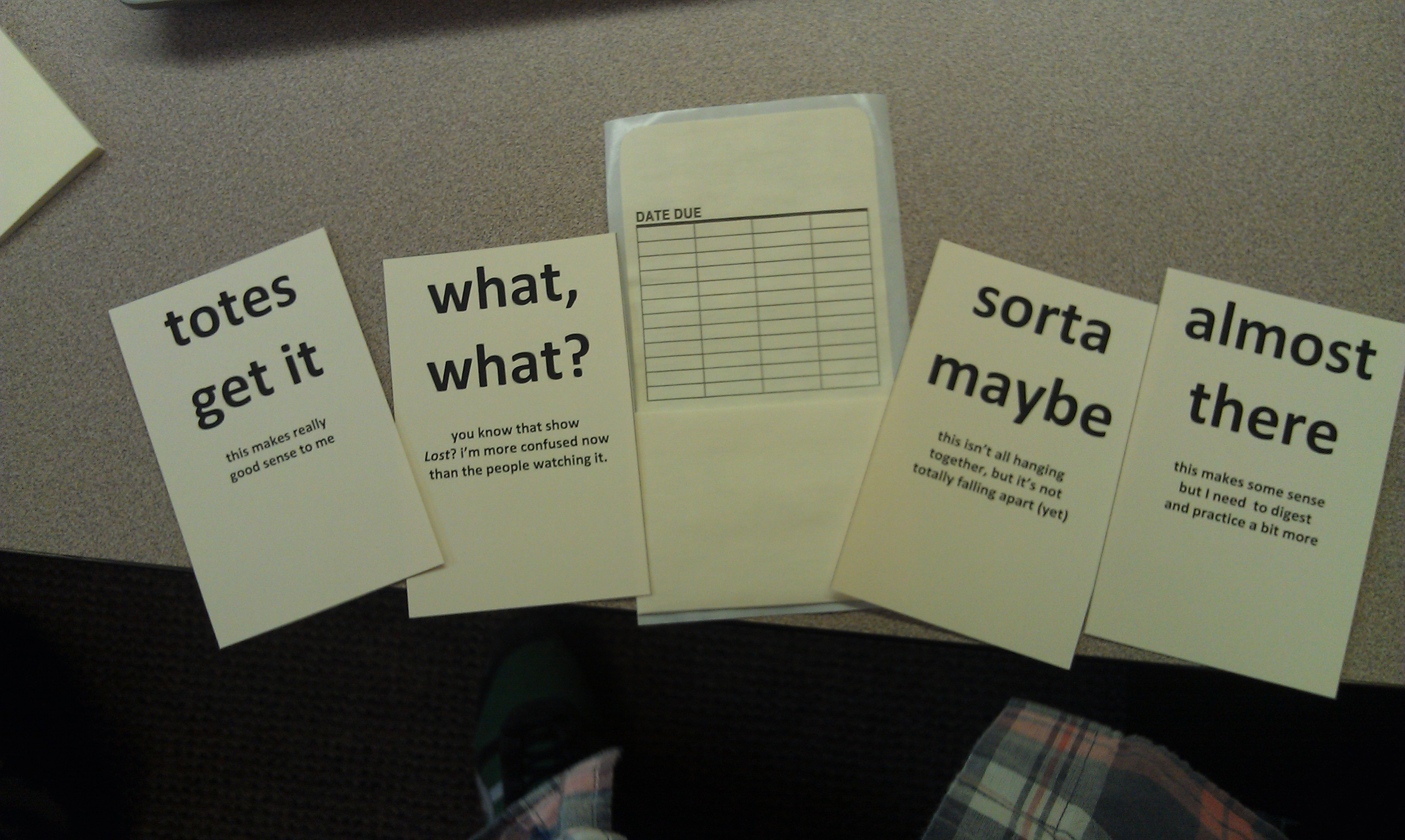
(2) But it would be crazy to have these cards, and not make them even more useful.

So these are the backs of the same cards. And so I can throw up a multiple choice question on the board, and have kids hold up their answers. Or anything that involves choices. If you’re going to do this, just know you shouldn’t write As on the backs of all the “totes get it” and Bs on the backs of all the “almost there” etc., because you don’t want anyone influenced by what other’s have up.
And yes, these were partially inspired by the fantastical Kate Nowak, and I’m really excited about them.
(3) @mythagon has an amazing way to get kids to start talking at the start of class: what’s the question? I can see it being really fun, get kids talking, and amazing for activating prior knowledge. I’m so doing this.
(4) Kate Nowak trying to instigate fights in her classroom by using good questions. I am going to try to instigate fights! FIIIIIIGGGGHHTTT!
(5) I have miniwhiteboards, but I’ve never really used them except occasionally and poorly in my seventh grade class in my first year of teaching. I want to use them, but want your advice on things that work. I was going to have kids do “check yo’self before you wreck yo’self” questions (math questions directly related to something we covered in class, right after we cover it in class) on them — and hold them up and I can walk around and see where we’re at. But there’s gotta be more and better uses.
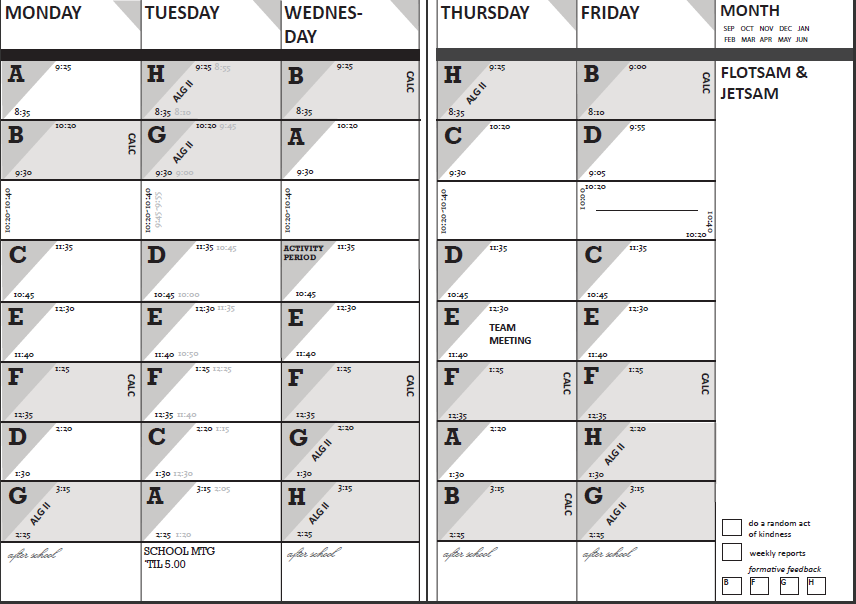
(6) I designed my planner (as I do every year) (and yes it’s beautiful and coveted by many)… and this year because of my emphasis on formative feedback, I made a small checkbox at the bottom which will help me see if at least once a week I either gave kids feedback (non-graded), or if I got (non-graded) feedback from my kids to help see where we go next.

(7) I hope to use exit slips this year at least once a week, either to check my kids’ understanding of the material we’ve been learning or to check in on my teaching. One idea I had was to have a coordinate plane, where the x-axis goes from booooring to engaging and the y-axis goes from no idea what’s going on to this is all coming up roses, and having kids mark down where they are.
(8) I historically tend not to do a lot of group work. Mainly partner work. This year I’m going to try to get more voices into the mix, and have students do things in 3s and 4s occasionally. But kids don’t know how to work in groups, and what it means to be working together effectively. And that’s because they’re not really taught. Which is why I love the idea of participation quizzes.
(9) I hope to put up a short agenda and a goal or two for the day, on the board, everyday. Where we go and what we do shouldn’t be a mystery. I always think it should — we’re unfurling mathematics, and in the unfurling we get the beauty — but that’s not how someone learning the material thinks or how they can organize information. They want a destination and to know how we’re getting there. I get that. When I’m in a class, I want that. I only want things unfurling in very special cases.
That’s about all I got for ya now. More to come as the year gets underway.
 Continuous Everywhere but Differentiable Nowhere