Month: February 2012

Two crazy good Do Nows

Recently, I’ve been trying to be super duper conscientious of every part of my lesson. For example, I wrote out comprehensive solutions to some calculus homework, paired my kids up, handed each pair a single solution set, and had them discuss their own work/the places they got stuck/the solutions. I actually had made enough copies for each person, but I very intentionally gave each pair a single solution set. It got kids talking. (Afterwards, I told them I actually had copies for each of them.) That’s what I’m talking about — the craft of teaching. I don’t always think this deeply about my actions, but when I do, the classes always go so much better.

In that vein, of super thoughtful intentional stuffs, I wanted to share two crazy good “do nows” from last week. Not because they’re deep, but because they were so thought-out.

For one calculus class, I needed my kids to remember how to solve 5\ln(x)+1=0 (that equation was going to pop up later in the lesson and they were going to have to know how to solve it). I also know my kids are terrified of logs, but they actually do know how to solve them.

I threw the slide below up, I gave them 2 minutes, and by the end, all my kids knew how to solve it. I didn’t say a word to them. Most didn’t say a word to anyone else.

How I got them to remember how to solve that in 120 seconds, without any talking, when they are terrified of logarithms and haven’t seen them in a looong while?

I can’t quite articulate it, but I’m more proud of this single slide than a lot of other things I’ve made as a teacher. (Which is pretty much everything.)  Not deep, I know. It’s not teaching logs or getting at the underlying concept, I know. But for what I intended to do, recall prior knowledge, this was utter perfection. The flow from each problem to the next… it’s subtle. To me, anyway, it was a thing of perfection and beauty.

The second slide is below, and I threw it up before we started talking about absolute maximums/minimum in calculus.

As you can imagine, we had some good conversations. We talked about (again) whether 0.9999999… is equal to 1 or not (it is). We talked about a property of the real numbers that between any two numbers you can always find another number (dense!). I even mentioned the idea of nonstandard analysis and hyperreal numbers.

So I know it isn’t anything “special” but I was proud of these and wanted to share.

Infection Points: The Shape of a Graph

Everyone here knows that I think Bowman Dickson is the bee’s knees, the cat’s pajamas, ovaltine! Recently he posted about how he introduces inflections points in his calculus class… and just a couple days later, I was about to introduce how we use calculus to find out what a function looks like.

Usually, I introduce this in a really unengaging lecture-format. But he inspired me to … copy him. And so I did, extending some of his work, and I have had an amazing few days in calculus. So I thought I’d share it with you.

The Main Point of this Post: By creating the need for a word to talk about inflection points on graphs, we actually saw the math arise naturally. And through interrogating inflection points, we were able to articulate a general understanding of concavity. In other words… the activity we did motivated the need for more general mathematical concepts.

First, definitely read Bowman’s post. All I did was formalize it, and extend it in a few ways, by making a worksheet. I put my kids in pairs and I had them work on it (.docx):

What naturally will happen when students generate their graphs is they will get a logistic function. (Which has a beautiful inflection point! But they don’t know the word… they just see the graph.)

So here we are. The students have a graph, and they’ve been asked to explain their graph for (a) the layperson and (b) the mathematician. Most get some of it done with their partners, and then they take it home to finish individually.

The next day, at the start of class, I assign students to work in groups of 3 (with different people than their partners the previous day). They are asked to take a giant whiteboard and:

(Now I want to give credit where credit is due. I have really been struggling with using the giant whiteboards well, and having students present their work effectively and efficiently. My dear friend Susanna, when I told her about this activity, suggested the groups, the underlining of the mathy words, etc.)

This worked splendedly.

(click to enlarge)

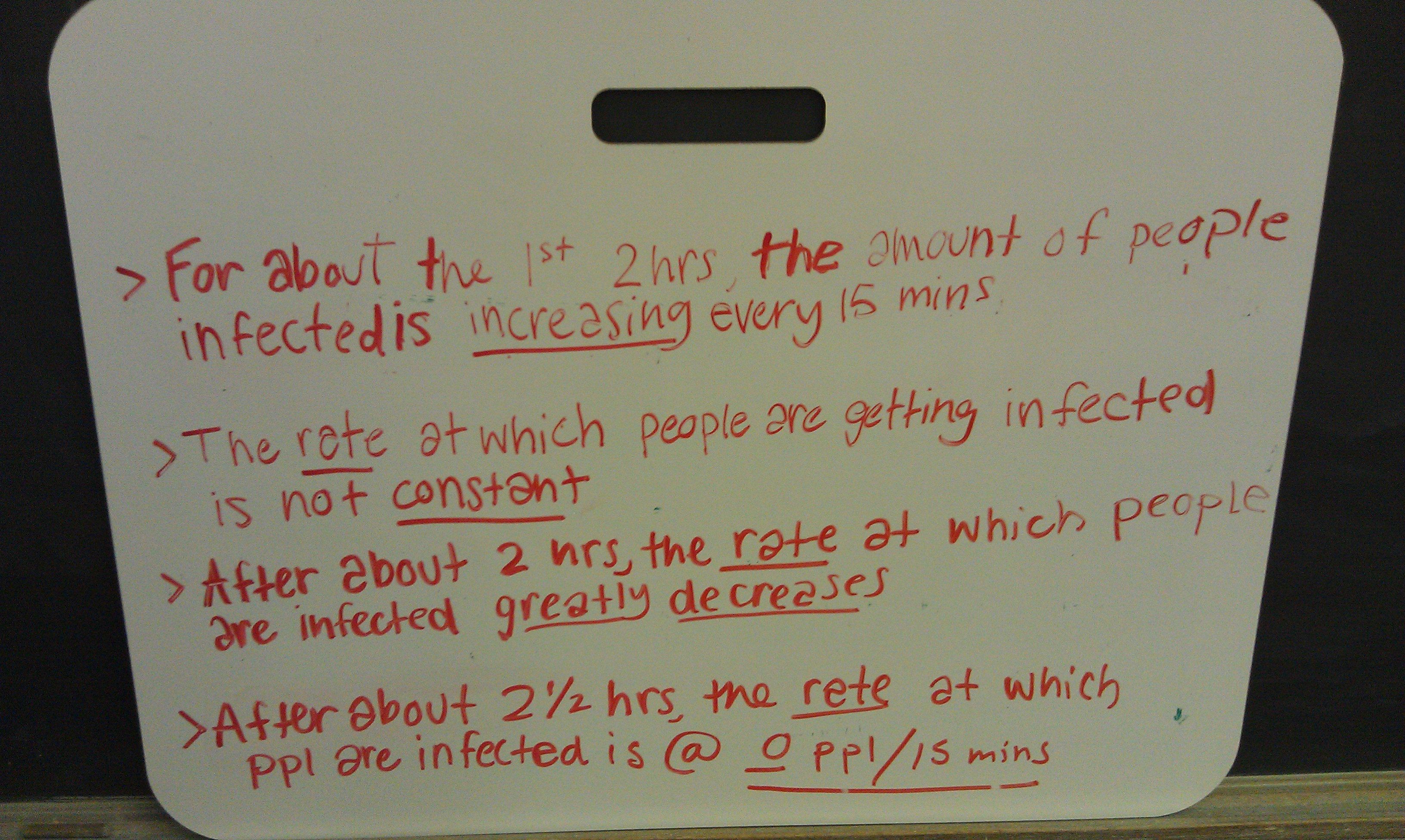
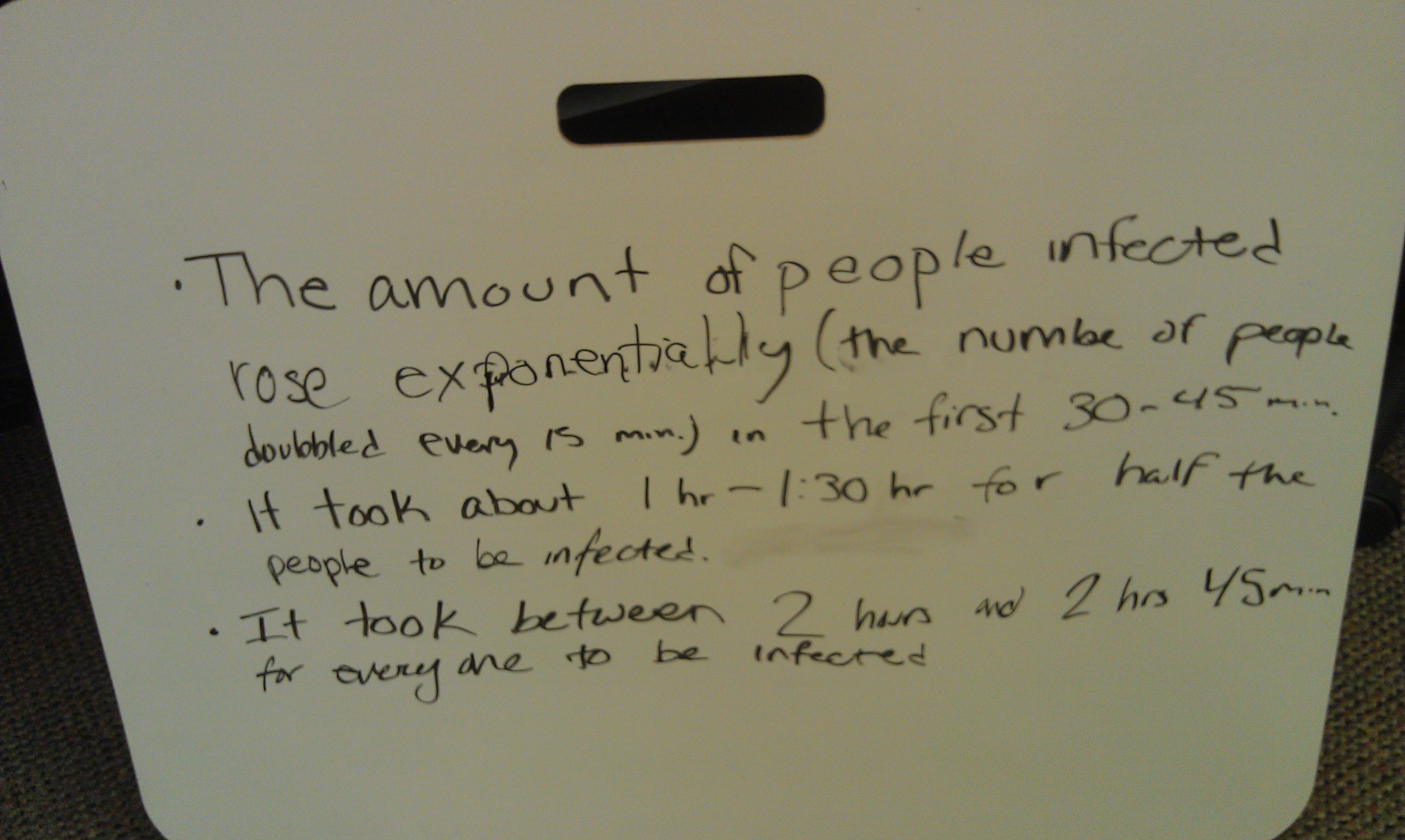
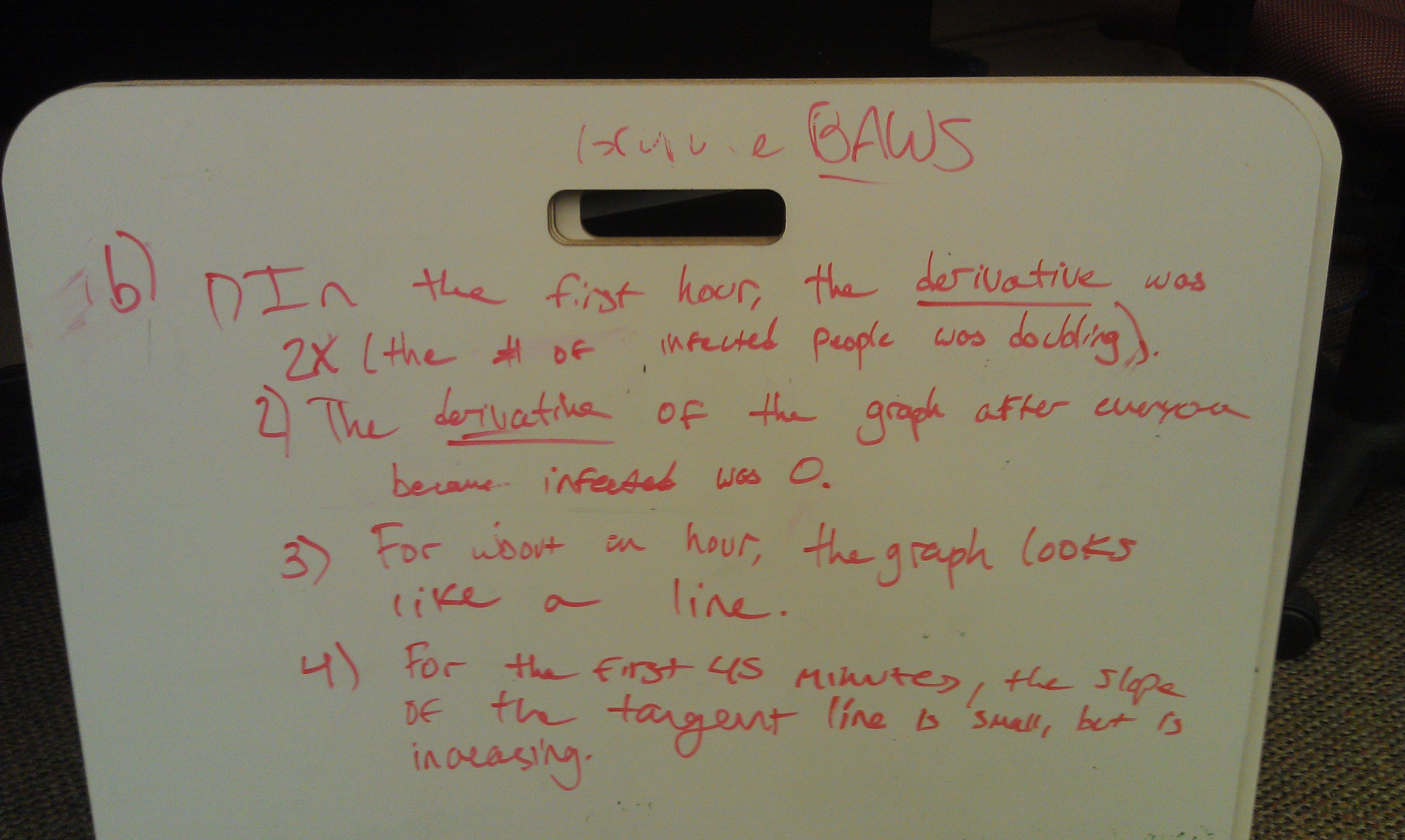
And they had such great observations. Some groups picked up on that change where the function was increasing in one way to increasing a different way. Others talked about how the rate of change (of infected over time) was greatest. Others talked about how the function was “exponential” for the first thing, seemingly linear for the middle third, and “something else” for the last third.

Those gave rise to good short discussions, and we came up with the language for inflection points (which I call INFECTION POINTS!!! GET IT!?!) and concave up/down.

After they had a sense what those words meant, I had students work in partners on the following (.docx):

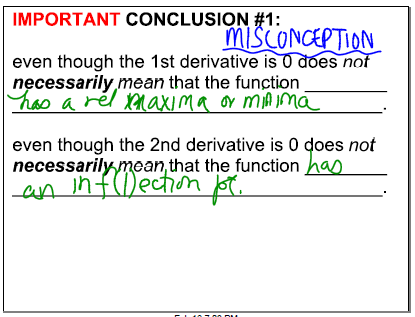
The point was to get students comfortable with the ideas before we delve into the heavy mathematical lifting. It was powerful. Especially the last page, which got students thinking about patterns, exceptions, and ways to generalize. Our big conclusions:

And with that, I’m too exhausted to type more. But that’s the general sense of what went on in an attempt to teach how to use calculus to analyze the shape of a function.

An important question: how do you plan?

I don’t think I’ve seen this asked before, and … well, I need to crowdsource something.

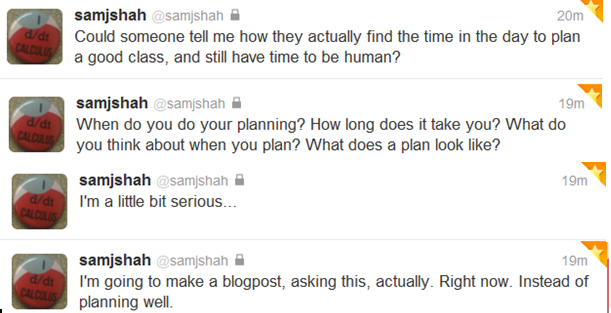
Tonight, on twitter, I asked:

For the past few weeks, I feel like my teaching hasn’t been that good. It’s okay, but not near the level of goodness I know I could achieve. My big limiting factor is time and energy — I’m overextended with commitments. But I also think I could be doing better if my planning process were better. If it were more efficient, and I reoriented the way I thought of how I plan…

So I’m wondering from y’all, on a regular basis for a normal class

… and before you answer, this is a judgment free zone! If you wing it and don’t plan most days, just say that! I just want to get a sense of what people do to see if I can’t steal some great ideas and be a more effective planner … and I guess I’m also just plain plum curious!

(1) How do you plan? Like… um… what’s your process (if you have a formal one), or what do you do (if you just sort of do something)?

(Things like: what sort of things do you think about when you’re planning? Do you pre-script questions? Do you pick specific problems? Do you design some conceptual walk-through for the kids? Do you always build in formative feedback? Do you always try to switch what kids do 2 or 3 times a class? Do you start with a unit or week-long plan and then go down to the individual class level, or vice versa?, etc.)

(2) What does your completed plan look like? Is it written on paper, or a SmartBoard file, or a computer file, or in your head, or something else — and what sorts of things are on it? Questions? Objectives? Problems?

(3) How much time does it take you (again, for a normal class, on a normal day) to make a plan for a single day’s class?

(4) Other stuff that didn’t get caught in the net of the first three questions, but you wanted to say?

Throw your answers in the comments! Help me out!