Month: March 2012

Spring Break 2012

As this Spring Break comes to a close (it’s Friday, school starts on Monday) I am a little wistful — thinking about all that I could have done, and all that’s still on my plate to do. But I do that to myself. I don’t take time to appreciate all that I do and stop looking for what’s next. So in this post, I’m going to recount some awesome things about this Spring Break.

I know I don’t use this blog to talk about my non-school life, but that’s only because it’s only about 1% of my life.
So at the start of this spring break, I did something I’ve been dreaming about for years. You see, when I was in college I had a bout of insomnia so I started to listening to Supreme Court oral arguments to focus my mind on something boooooring so I could fall asleep. Little did I know I would become a Supreme Court junkie. And so I went with a friend (who teaches history and constitutional law at my school) to Washington DC where I had a glorious time. The night before the oral argument, I invited @rdkpickle to dinner and didn’t get psychopathkilledtodeath. You’ll all be pleased to know that she’s just as personable in person as she is online.

The following day I got to Supreme Court
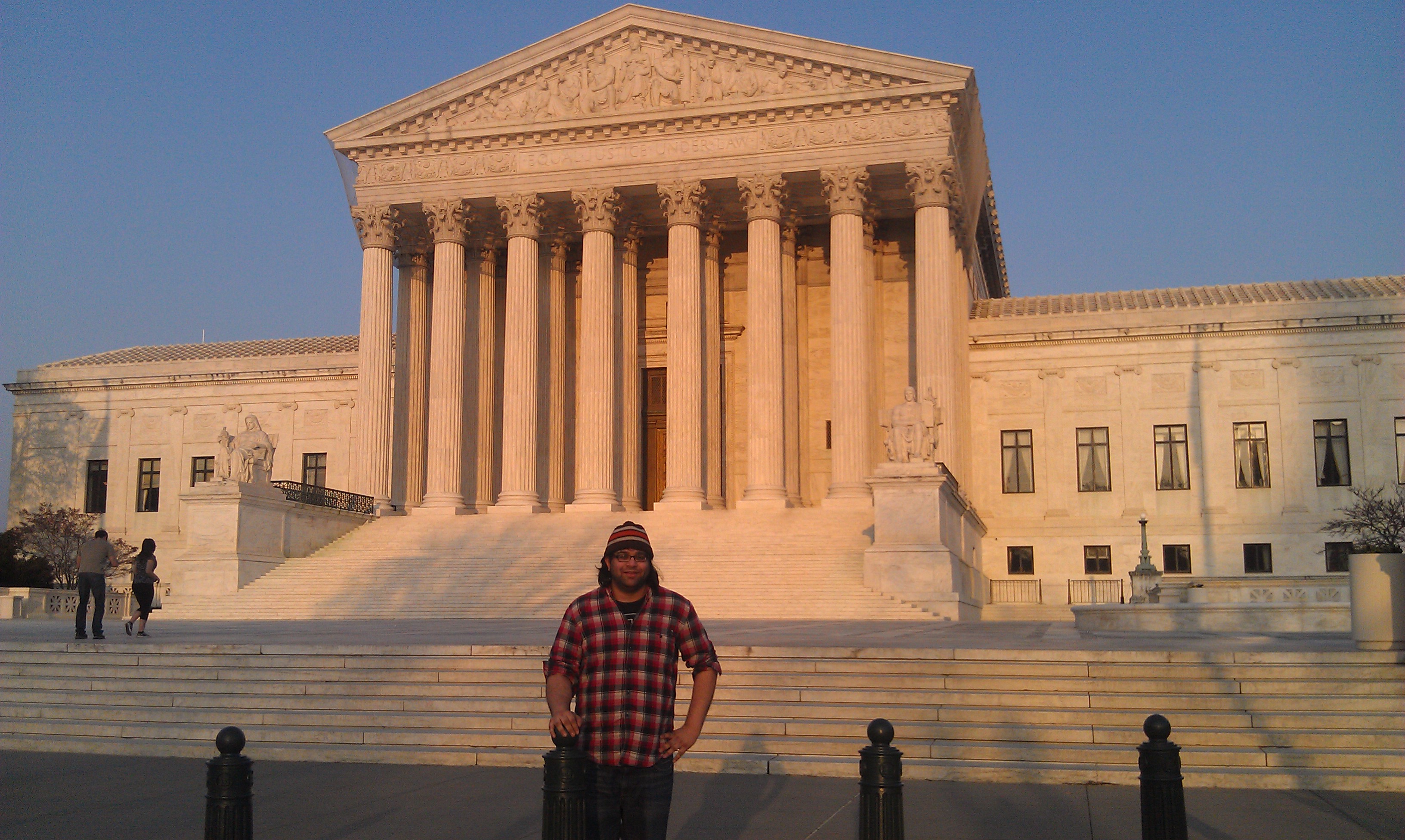
early enough that we got tickets to hear the arguments. It was similar to what I expected in terms of the argument, and also nothing like I expected in terms of the room. It wasn’t as grandiose as I imagined — I imagined the justices to be higher up, the room to be wider, and the seating for the visitors to be nicer (we were like sardines put on very cramped wooden chairs). The two cases we heard were Astrue v. Capato and Southern Union Company v. United States, both fascinating. (And for those of you who are dying to know, yes, I took off my hat in the courtroom.)

In DC, I also got to meet up with two dear old friends who I hadn’t seen in ages, and just in time, because they are moving to Korea for two years, soon. And one high school friend who I consider one of my besties even though we never see each other or keep in touch. He’s that kinda guy.

In addition to my trip to DC, I had my sister in NYC for a day, where we ate delicious food, traipsed around a lot, walked the high line, read a bit in Bryant Park, went shopping at the Strand (I didn’t buy anything!), and then met my parents and family friends for dinner. It was a full and lovely day.

Then I scampered to San Francisco for a whirlwind trip. I got to see a ton of high school and college friends, do a bunch of shopping, eat delicious food, watch the Hunger Games, and throw a party! That’s right — one of my best friends from high school just moved back and I convinced her throw a house party — and I invited all my friends.

Additionally, and this is going to make all of you jealous, I got to hang out and have dinner with the following math twitter people at Bar Tartine: @woutgeo, @btwnthenumbers, @cheesemonkeysf, @ddmeyer, and @suevanhattum. I only wish we had started earlier. It was totes amazing (@cheesemonkeysf wrote about it). And again, I didn’t get psychokillerkilled. Although when I talked smack about ed researchers, I thought the towering Dan Meyer was going to kill me with his laser stare! But he is too much of a Good Guy Greg for that.

And then I got back, and have basically been doing nothing but watching bad TV and thinking (but not doing anything) about all the work I have to do but haven’t done. I even finished the two seasons of Party Down (amazing, btdubs), and the season of Summer Heights High (also amazing, btdubs). Go me!

So even though I felt like that I could have done, all those roads not taken and all that, I think I’ll always feel that way. It’s just the way I am. And I have to learn to appreciate all that I have done, instead of focus on all that I could have done. In fact, that’s probably a lesson for me in teaching. There you go — I have a sickness. Everything is about teaching. 

With that, I’m out.

PS. I would love to have shown more photos, but I feel weird using photos of people who might care if their photo is out in the world. Dan, he’s probably okay with it. He has a TED talk and all that.

Optimization: An Introductory Activity & Project

I switched things around with optimization in calculus this year, and I realized if I had the time, I would spend a month on it. [1] I wonder if this shouldn’t be a crux of the class. Not the stupid “maximization and minimization” problems but finding some real good ones — in economics, physics, chemistry, ordinary situations. There have got to be tons of non-crappy ones!

Anyway, I wanted to share with you two things.

First, how I introduced the idea of optimization to my kids. Instead of going for the algebra/calculus approach, I wanted them to toy with the idea of maxima and minima, so I had them spend 35-40 minutes working on this in class:

[doc]

I thought it was pretty cool to see my kids engaged. I rarely do things like this, but I did it (I was being videotaped during this lesson… and I had never done it before… and I had the idea to create it the night before…). It was fun! And although I cut the debrief the next day short (ugh, why?), I enjoyed seeing kids engaged in problem solving through various strategies. And there was a healthy level of competition. (The winners for the 1st and 2nd tasks got a package of jelly beans, but they were so gross I threw them out! One student gave them to his rabbit who likes jelly beans, and even the rabbit didn’t like them!) But when it came down to it, it drove home the idea that optimization was something that trial and error is good for, sometimes we do it intuitively, sometimes our intuition is terrible and sometimes it is good, and sometimes we get an answer but we don’t know how to prove there isn’t a better answer (e.g. in problem #3). Some kids liked that this felt more “real world” than this world of algebra and graphing that we’ve been meandering in.

Second, I have allotted a few days for students to work on this project during class (it’s the week before Spring Break and kids are overburdened, so I didn’t want to have them do something which involved a lot of at-home time). They’ve been working on it this week, and I’ve heard some good conversations thus far. (They’re doing this in pairs, and I have one group of three.) The fundamental question is: with a given surface area, what are the dimensions of a cylinder with maximal volume?

[.doc]

Now I don’t quite know how their posters will turn out yet, or whether students will have truly gotten a lot of “mathematical” knowledge out of it. But each day, I’ve had a couple kids say things that indicate that this isn’t a terrible project. (I don’t do projects, so that’s why I’m very conscientious about it.) A few said something equivalent to “Wow, the companies could be giving me x% more creamed corn!” or how they like doing artsy-crafty things. At the very least, I can pretty much be assured that students — if I ask them if there is any question that calculus can answer at the grocery store — will be able to say yes.

Next year I will probably add the reverse component (for a given volume of liquid you want to contain, how can we package it in a cylinder to minimize cost… what about a rectangular prism… what about a cube… what about a sphere… etc.?).

[1] The one thing I found in this book my friend gave me (on science and calculus) was an experiment where you shoot a laser at some height at some angle into an aquarium, so that it hits a penny at the bottom (remember the laser beam will “change” angles as it hits the water) to minimize the time it takes for the photon to travel from the laser to the penny. I almost did it, but deciding to do it was too last minue.

Recent Quadratics Stuffs from Algebra II

I am just finishing up my quadratics unit in Algebra II. We spend a lot of time on quadratics, doing everything from factoring, to completing the square, to the quadratic formula, to all sorts of graphing, the discriminant, 1D and 2D quadratic inequalities, quadratic linear systems, systems of inequalities, etc. Tons. And we didn’t even get to do the project I enjoy involving pendulums and quadratic regressions. Le sigh.

I’ve posted much of my quadratics materials before, but I thought I’d share some new/updated ones. I’m a bit exhausted, so forgive the shortness of my descriptions.

1. My Vertex Form worksheet was motivated by my frustration with students just memorizing that y=(x-2)^2+3 has a vertex of (2,3) because you “switch the sign of the -2 and keep the 3.” Barf. (FYI: we haven’t done function transformations yet.) So I created this sheet to “guide” students to a deeper understanding of vertex form.

[.doc]

2. My Angry Birds activity was inspired by Sean Sweeney, but modified. I had taught students how to graph (by hand) quadratics of the form y=x^2+bx+c and y=-x^2+bx+c. Students also had been exposed to the vertex form of these basic quadratics. But they hadn’t been exposed to quadratics where the coefficient in front of the x^2 term wasn’t “nice.” So all I did was give them four geogebra files, and had them play around. By the end of the activity, students recognized how critical the “a” coefficient was to the shape of the parabola, they started conjecturing that if you had the “a” value and the vertex and whether the parabola opens up/down that you could graph any parabola, and one pair of kids were able to convert a crazy angrybirds quadratic (with a really nasty “a”‘ value) to vertex form.

[.doc] [files]

If I’m teaching Algebra II next year, I want to ask if I can get rid of quadratic inequalities or some of the other more technical things we do, and make an entire unit/investigation on using geogebra and algebra and angrybirds to investigate quadratics.

3. My discriminant worksheet is below. It worked okay, but students still didn’t quite understand the difference between y=ax^2+bx+c and 0=ax^2+bx+c, which was the goal of the sheet. So it needs some refinement.

[

[doc]

4. Finally, below are my attempts to get students to better understand quadratic inequalities. I started with a general sheet on “visualizing function inequalities,” and then I made a guided sheet to bring more detail to things. I found out that students didn’t quite understand the meaning of the schematic diagram we drew, nor did they understand why to solve 0<x^2-4x+3 we have to draw a 2D graph. Well, to be more specific, students could do the process but didn’t fully grasp why we graph y=x^2-4x+3. I changed up this worksheet this year, but maybe I should go back to last year’s worksheet.

[doc]

[doc]

C’est tout. With that, I’m exhausted and going to bed.

A Time Capsule

I had this idea, and I wanted to throw it down before I lost it. It may be nothing, or it may be something awesome.

I have been mulling over if I should do a project in calculus in the fourth quarter. And I had a thought. I have been really trying to focus on the fundamental underlying ideas in calculus, and shooing away the algebraic gobblygunk. Why? Because my kids aren’t taking AP Calculus. Most won’t be taking math in college. So I want my kids to leave calculus saying: “Yes, I understood the ideas. Calculus is about ideas.”

I wonder if a good final project, which would force them to grapple with the Big Ideas, might be having students create a collective time capsule, which will be stored in some deep underground facility, and will be the only remnants of “Calculus” that may exist after some horribly apocalyptic disaster.

I’m not sure what would go in the capsule, but I like the idea that all students would be asked to contribute a few items. Maybe we’d break the course into chunks, and each student would be responsible for writing an accessible explanation of each chunk — and we bind these together into a book? And each student would create set of drawings/graphs/photograph/images that (for them) represent the Big Ideas of Calculus, and they have to explain each one of them… What’s the idea, and why is it so important?

In addition to these required items, students could have their choice of what else to contribute… Things like:

1) A video of the student explaining the weirdnesses/paradoxes/strange ideas of (or relating to) calculus
2) A short research paper on the history of calculus
3) A letter to the future explaining why calculus is an important swath of knowledge that shouldn’t be forgotten (including uses / applications of calculus)
4) A challenging calculus problem, and it’s solution
5) A “concept map” for calculus
6) Audio recordings of students reading quotations about calculus that resonated with them, and then students explaining why it resonted with them.
7) Designing a cover to the collective calculus book we bound together, and on the back cover, an explanation of how the cover exemplifies the course

Or other things?

I don’t know. It felt like a cool idea when it jumped in my head a few minutes ago, but now that I’m writing it, I can’t quite picture it … yet. Any ideas of how to take this idea and turn it into something good? Throw it in the comments!

