The New York Times has an article about mirrors, which had a few passages which blew me away. I think of mirrors as relatively simple entities, until they get curved and start flipping images upsidedown… depending on where you are looking at the mirror from. But no, mirrors are interesting as simple, flat creatures too:
In a series of studies, Dr. Bertamini and his colleagues have interviewed scores of people about what they think the mirror shows them. They have asked questions like, Imagine you are standing in front of a bathroom mirror; how big do you think the image of your face is on the surface? And what would happen to the size of that image if you were to step steadily backward, away from the glass?
People overwhelmingly give the same answers. To the first question they say, well, the outline of my face on the mirror would be pretty much the size of my face. As for the second question, that’s obvious: if I move away from the mirror, the size of my image will shrink with each step.
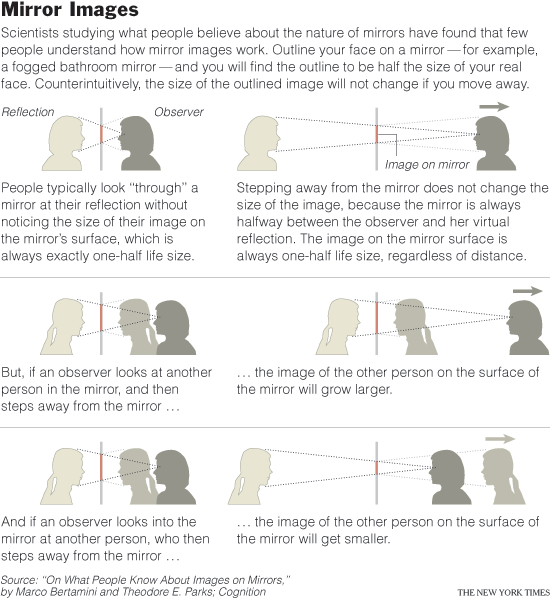
Both answers, it turns out, are wrong. Outline your face on a mirror, and you will find it to be exactly half the size of your real face. Step back as much as you please, and the size of that outlined oval will not change: it will remain half the size of your face (or half the size of whatever part of your body you are looking at), even as the background scene reflected in the mirror steadily changes. Importantly, this half-size rule does not apply to the image of someone else moving about the room. If you sit still by the mirror, and a friend approaches or moves away, the size of the person’s image in the mirror will grow or shrink as our innate sense says it should.
What is it about our reflected self that it plays by such counterintuitive rules? The important point is that no matter how close or far we are from the looking glass, the mirror is always halfway between our physical selves and our projected selves in the virtual world inside the mirror, and so the captured image in the mirror is half our true size.
Rebecca Lawson, who collaborates with Dr. Bertamini at the University of Liverpool, suggests imagining that you had an identical twin, that you were both six feet tall and that you were standing in a room with a movable partition between you. How tall would a window in the partition have to be to allow you to see all six feet of your twin?
The window needs to allow light from the top of your twin’s head and from the bottom of your twin’s feet to reach you, Dr. Lawson said. These two light sources start six feet apart and converge at your eye. If the partition is close to your twin, the upper and lower light points have just begun to converge, so the opening has to be nearly six feet tall to allow you a full-body view. If the partition is close to you, the light has nearly finished converging, so the window can be quite small. If the partition were halfway between you and your twin, the aperture would have to be — three feet tall. Optically, a mirror is similar, Dr. Lawson said, “except that instead of lighting coming from your twin directly through a window, you see yourself in the mirror with light from your head and your feet being reflected off the mirror into your eye.”
This is one partition whose position we cannot change. When we gaze into a mirror, we are all of us Narcissus, tethered eternally to our doppelgänger on the other side.
What a great thing to know… NYT graphic below:


children with loaded water pistols and has them standing in an open field with no three of them in a straight line, such that the distances between pairs of them are distinct. At a given signal, each child shoots the closest other child with water. Show that if

 Continuous Everywhere but Differentiable Nowhere