One day a few weeks ago I had a day to kill with one of my two multivariable calculus students. So I decided to talk a bit about something which intrigued me when I first learned about it.
If you have any linear polynomial (


If you have any quadratic polynomial (

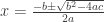
What about the cubic? quartic? quintic? higher?
I had my student take out his laptop and we used SAGE online to see what we got. We entered something like this:
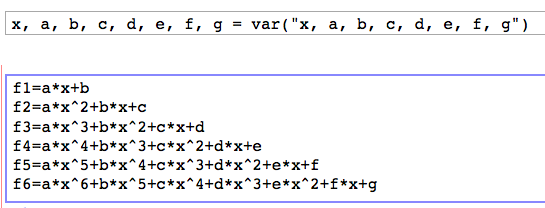
I then asked if we could, for any coefficients, find all zeros (real or complex) to the polynomials.
Before pulling out the laptops, we had already answered the first two. Which we confirmed with SAGE:
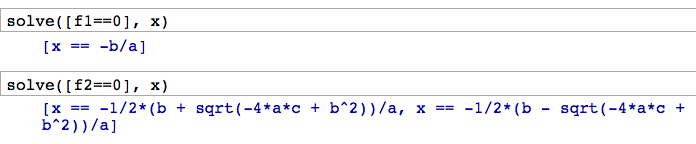
Then I asked about the cubic.
He said he knew how to find the solutions to some cubics. Like he could graph them and if they hit the x-axis three times, he could get the solutions. Not good enough. We wanted formulas for the solutions. For any coefficients. Without graphing. Like we had for the quadratic.
He (naturally) said he didn’t know.
So we turned to SAGE and found:
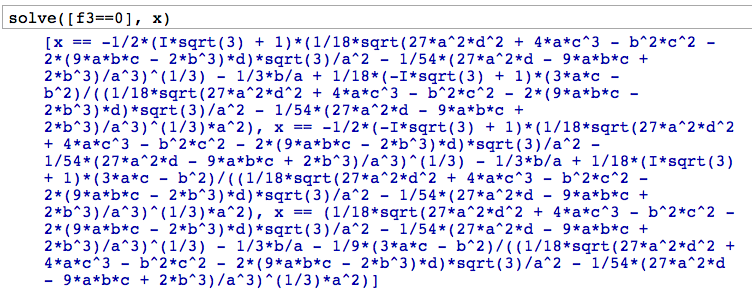
So there is a formula. And it’s messier than the quadratic, which is messier than the linear [1].
So we checked the quartic.
And indeed, SAGE found a solution. I’m only copying the first few lines here since it goes on forever.
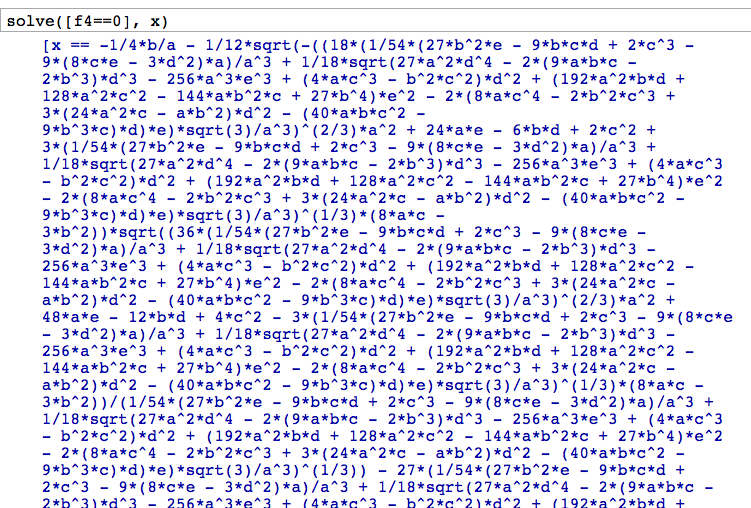
So here we are, and there’s a pretty good chance things will continue — there’ll be a solution but it’ll be more and more complicated as the polynomial degree gets higher and higher.
But when we try the quintic and the sixth-degree polynomials, we get:
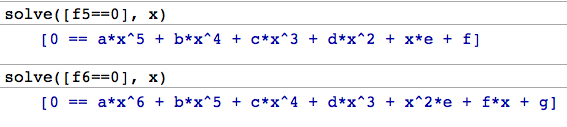
Um… it won’t solve it for us? Is SAGE just not powerful enough to help us? Do the solutions get *that* much harder?
Could be.
But it isn’t that SAGE was broken. It turns out there is no “formula” to get the zeros of any given quintic or higher polynomial. Sure, you can solve some quintic polynomials. Heck, they might even be factorable to 
No.
And the reason I wanted to show my student that is because it was learning that fact in high school, the insolvability of the quintic, that got me even more interested in math. It raised the huge question: what broke down after 4? Why is 5 the magic number? Is it truly impossible for any degree polynomial greater than 5? How can anyone show that a degree 1021 polynomial won’t have a “formula” solution for its zeros? No one could explain it to me, but my math teacher swore it was true.
It seemed so crazy to me! Heck, it still does. Interesting tidbits like that lit a fire under my feet [2] to take college level algebra (Abstract Algebra) to help me understand it. It was one of the most glorious days of college when in our Abstract Algebra class we finally got to tackle and solve this problem.
Do I remember how we did it?
Sigh. No. I have Flowers For Algernon syndrome.
But I at least know that the solution is out there, and given enough time and patience, I can understand it once again.
I doubt my student got out of it the same level of “WHAT THE HECK?!” as I did, nor do I think it lit the curiosity fire under his feet. But heck if I didn’t show him that our intuition breaks down without cause sometimes, and there are answers to be found. Maybe not in our class, but in some other class if he ever wants to solve the mystery.
[1] Well, when I was in high school, I had my dad’s worn, cover-falling-off CRC Book of Mathematical Tables and Formulae. In it was the solution of how to solve any cubic, and how there is indeed a formula (like the quadratic) for the cubic. (You can see it nicely typed here.) I suspect it also had a paragraph or two about the Cardano/Tartaglia dispute.
[2] Godel’s incompleteness theorem was another one.

 Continuous Everywhere but Differentiable Nowhere