Central to who I am as a teacher is the notion that I have clear, consistent, and fair expectations [1]. The teacher I admire most at my school showed me that it can work, if done right. I’m sure at some point I’ll write about that when I craft my current philosophy of teaching. Which is, well, not now.
Now, I want to share with you something my department head does with her classes, and this year I’ve stolen it for my Algebra II and Calculus classes.
Topic Lists.
These are lists of everything students are expected to know going into an assessment. I write them up and distribute them on our review days. Here’s an example of one I handed out in Algebra II:
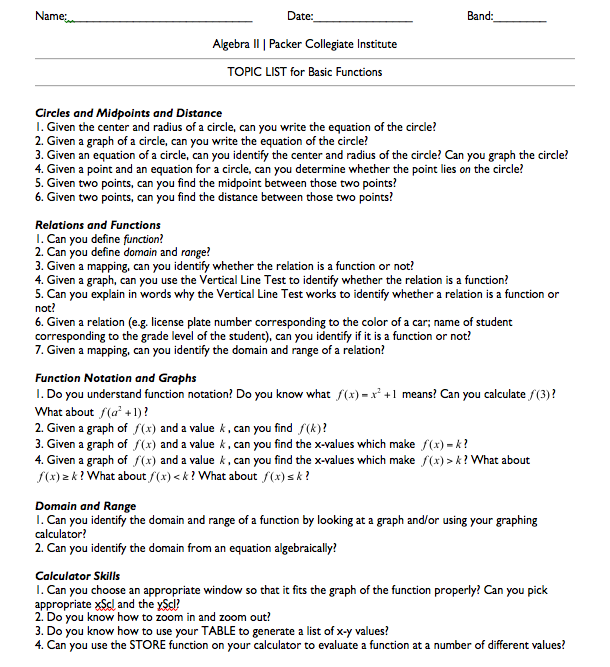
And here’s one from Calculus:
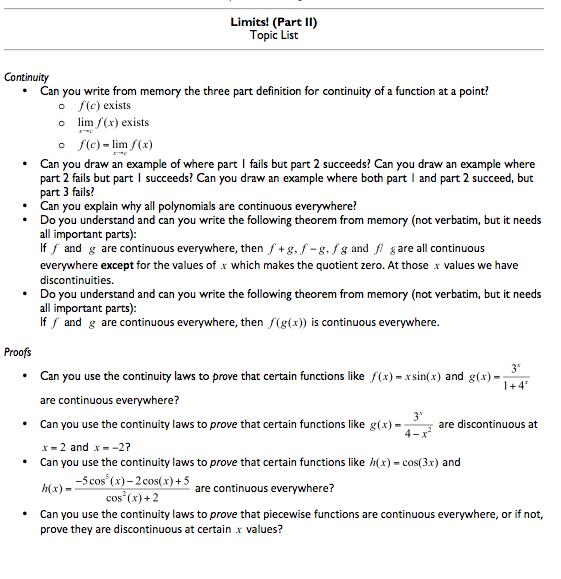
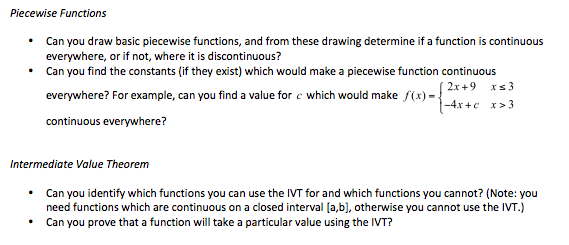
I will admit that at first, I was against doing this. I think it is the students’ responsibility to learn how to study in my class. To learn how to organize the information we’ve learned and create his or her own study plan. And my first thought: HANDHOLDING! CODDLING! PSHAW!
But you know what? I teach the non-accelerated classes. My kids don’t know yet how to organize all that we’ve learned. And things are much harder because I don’t teach out of the textbook. I use the book as a supplement, and (at least in Algebra II) I jump around in it a lot. A LOT. A LOT A LOT A LOT. And I use a lot of my own worksheets, and only assign textbook homework about half the time. So the course is necessarily confusing because the information isn’t all in one place.
For that reason, I feel comfortable giving them these topic lists.
What I like about them is that students know if they’re ready to take an assessment. The can just go through the list, topic by topic, and see if they know how to do that sort of problem. I always tell my kids that the assessment will have no surprises. They know what’s going to be on it. And heck, they SHOULD know what’s going to be on it. With these topic lists, I’m giving clear, consistent, and fair expectations. You know what’s remarkable about it? KID’S LOVE IT. They love organized teachers who are clear and consistent about what they want. [2]
Hey, I know, I know. It’s nothing like the “skills based assessment” that Dan Meyer and his offspring have adopted. But having a list of skills for my students to look at when preparing for my regular assessments is helpful for them. Heck, it’s going to be super useful for me because next year to see exactly what I taught this year, in some sort of codified and consistent form.
[1] The expectations have to also be reasonable and I have to provide the resources to achieve them.
[2] I don’t know if I would give topic lists to my kids if I were teaching the accelerated tracks. I feel if you’re in an accelerated track, I expect you to know how to study. Also, topic lists would probably be less useful because the problems I’d probably include on exams would be ones that force students to think a little outside of the box, and to synthesize information in a slightly different way than they’ve seen before. The topic lists couldn’t account for those kinds of questions, without giving them away.

 Continuous Everywhere but Differentiable Nowhere