In multivariable calculus today, we were talking about the scalar triple product. It blows my mind that if you have three vectors:


I mean, it makes sense that it’s symmetric in terms of 


So we worked on proving that fact, with what we know about vectors.
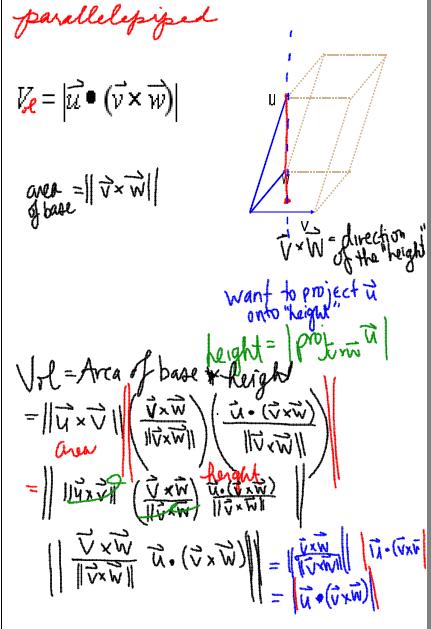
There are two hard parts to this proof. One is understanding that the volume of the parallelepiped is the same as the area of the base times the height. (And teasing out what the “height” actually meant.) At this point, I whipped out Cavalieri’s Principle.
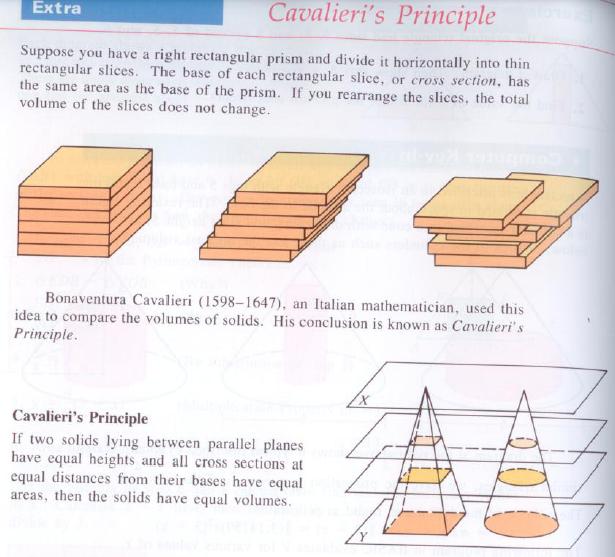
It was in this discussion that one of my kids said the most awesome thing. When talking about Cavalieri’s Principle, he said: it’s like if you had 10 reams of paper all stacked up to make a cube. That has a certain volume. Then you push the stack so it leans — maybe so it’s a little curved. What’s the volume of the new stack of paper? The same.
So we understood what the “height” of the parallelepiped actually referred to.
The very last question: how do we find that? And in fact, my kids actually figured that part out without any help. They noticed it involved the projection of one vector onto another.
The rest? Just algebra.
It was lovely. And a different student exclaimed: “You should go around to the various precalculus classes, sharing that what you learn there actually will show up later in life!” (He was referring to vectors, determinants, and even parametric equations.)
Now to the title of this post. I was then transitioning to talking about straight lines in 3D. And I wanted to highlight that you just need a point and a vector to uniquely determine a line in 3D. Somehow, I got it in my head that I should explain it in metaphor. So…
I said that — suppose you are riding a horse. I mean unicorn. That can fly. But only in the direction of it’s horn. And you are told to go to a particular planet and wait there. At the starting gun, the magic, flying unicorn takes off, flying in the direction of its horn.
I am 99% sure this didn’t help kids “get” it. It was pretty obvious to them that a point and a direction (vector) uniquely determine a line. But I really enjoyed talking about the flying unicorn. I liked it enough that I think the flying unicorn may be our mascot for the year.
Plus, I like sparkles. And unicorns have sparkles coming out the…
 Continuous Everywhere but Differentiable Nowhere