Okay, so the title gotcha! What I’m talking about is: preparing for midterms and finals. My school asks us to spend 3 days of class time to review with our kids. (Of course, because we had a snowday today, that number goes down to 2 days!)
 (found here)
I constantly am torn between various models of studying. The three standard ones are:
A. Prepare a giant packet and have kids do it in class (requiring — or recommending — certain pages be done on certain nights). The packet covers the entire course.
B. Prepare review games.
C. Let kids study on their own, focusing on what they need to work on. They have all their assessments (and reassessments), their skill lists, handouts, and home enjoyments (our corny word for homework). Let them sift through their material, organize it in a way that makes sense to them, and let the teacher know what they’d like to cover. The teacher prepares some (optional) mini-lectures, but pretty much lets students use the class time on their own.
I’ve tried A and B, but I’ve found them lacking. The big issue is that each kid has different areas they need to target with their studying. Games — though fun! — end up being less about learning and more about letting students know they don’t know something. They don’t really give students the time to remediate. Also, a game can only cover so much material.
The packet thing feels a bit coddling to me. I want students to learn to study without everything being so spoon fed. But a small voice always seems to be squeaking: am I railing against that because I don’t want to take the time to write a giant packet? And am I afraid that the students, even though I tell them otherwise, will feel like doing the packet is enough?
So I’ve tended to do C. I let my kids spend the class time any way they want. I give them a list of topics (or because I’m doing SBG in calculus, I give them a list of skills) and ask them to classify them as “know” “kinda know” and “don’t know”
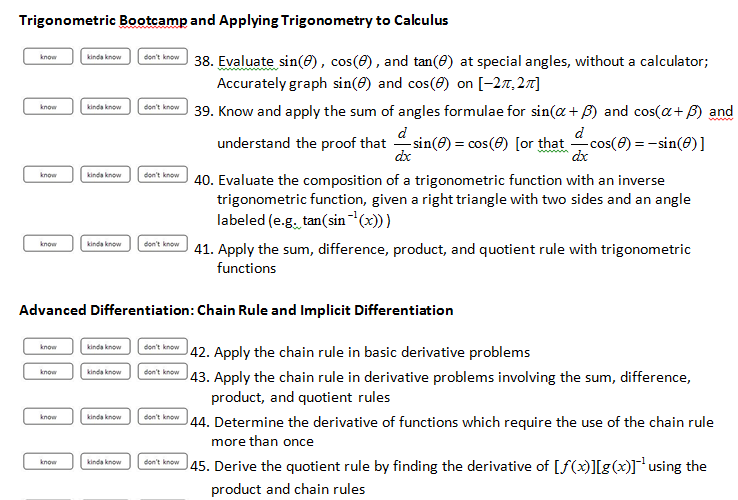
I then have them make a concrete plan of action, to show them that reviewing everything is manageable. Finally, I have them pick 3-5 they most want me to give a “mini lesson” on. I compile the data, figure out the most requested topics, and prepare short lessons on each topic. During class, my kids can listen to the mini lectures they are interested in, or work alone or with a partner on whatever math skill they want to work on.
The point is: I want kids to spend their time on what they feel they need to work on.
Other things I do/have done:
1. Have students each write their own study guide for a topic, complete with problems and solutions. These get put online electronically for others to use.
2. Have students make a general outline of the course, so they can see what we’ve done in a big picture flow-chart-type-thing.
I guess what I’m wondering from you is: What do you do to review for midterms and finals, and why? And does it work? I’m just not totally happy with anything I’ve done. I want the most kids to get the most out of a short amount of time. I feel I’m not there yet.
 . And then, then, *shudder*:
  because, you know Mr. Shah, you can just cancel the
  .
. Continuous Everywhere but Differentiable Nowhere