So as I wrote before, I had a dickens of a time getting the courage (courage, as they say in French… not that different) to share my teaching video with others. But I did it, and here are my general thoughts based on my feedback — thoughts reinforced by what y’all commented:
(1) To do video analysis, there needs to be some sort of safe space for teachers to share. This was terrifying for me, because I felt like I was going to be exposed as a fraud — someone who can’t teach. And more importantly, I was afraid that people who lose any respect they had for me. I think teachers who are participating in video analysis need to have someone help them deal with the emotional aspects of this. The thing that helped me, personally, was realizing that I would be a pretty sucky teacher if I never learned to grow. So I had to change my outlook about sharing the video: from a vulnerable place where we feel we’re exposing ourselves to a cruel world, to an exciting but challenging opportunity to really improve my practice through the help of friends. It’s like with our kids… we don’t want them to see our class as an unsafe space to make mistakes and grow from them… we want them to see our class as a place to learn and grow and be excited about what they do.
(2) I sent out the 50 minute video and asked my friends to look at it without any directions. Basically because I hadn’t learned how people actually analyze videos. I got a diverse set of responses — each focusing on different things.
EXCERPT ONE
–Wow, great way to respond to a kid asking a question that was just asked. I’ve never thought of having kid 1 respond for me and will be stealing that for next year.
–Thank you for using the word ‘exemplar’
–I wonder what other students would have done if you had written what [STU] had originally said at 9:15; 10x vs 10^x.
–You use the phrasing “will you..” when intro-ing the problems on the board. Sounds like kids have the option not to.
–I like your use of ‘crazy’. A lot of your side-comments to the students are super-similar to mine and it’s just nice to hear that I am not the only teacher that talks like that.
–I like how at 14:20 you have her point to things on the page instead of doing it for her.
EXCERPT TWO
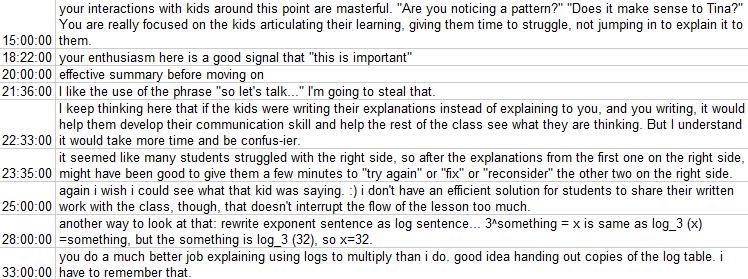
EXCERPT THREE

EXCERPT FOUR

There were a lot of things that I didn’t notice, or acknowledge, about my own teaching that came through in these. Especially the things the reviewer liked. I also really appreciated when I was given a suggestion for an alternative thing I could have done (e.g. “I keep thinking here that if the kids were writing their explanations instead of explaining to you, and you writing, it would help them develop their communication skill and help the rest of the class see what they are thinking”).
(3) Of the various ways I got feedback, I think the third one (+, delta, ?/notes) made the most sense for me. I would love for it to also have had approx times on the video (like in the second one) so I could go to the video and look at that particular point of the video without having to do a lot of skipping around.
(4) I don’t know if sharing 50 minutes (a whole class) was worth everyone’s time. I wonder if picking a 10-15 minute clip and having the reviewers focus on three things (e.g. my questioning, my body movements, the students engagement) would have worked better. It’s hard to know exactly what to do with all the feedback I got, because it’s not targeted. It would make sense to have some particular things I want to work on, and get feedback just on those. Also, making explicit what I need to work on makes the notion of getting negative feedback less nervousmaking, because I already have admitted to everyone “I suck at these.”
(5) I wonder about doing this in person vs. doing this virtually. One thing about doing this virtually is that people can do it on their own time, and it might feel safer for everyone. At the same time, there isn’t any discussion about the clip. If there were three reviewers and the presenter together, it could generate some fantastic discussions.
Thanks for those who helped me with the video analysis! I appreciate the time you took and the comments you gave me!
UPDATE: One reviewer writes about her process.
 Continuous Everywhere but Differentiable Nowhere