Today in Multivariable Calculus I was supposed to teach my students how to find the plane tangent to a surface at a point.

The book, however, was not clear how to do this. They had an equation involving the gradient of a function, but the equation was derived via local linear approximations. Fine and dandy, but I didn’t like it. I didn’t “see” it or grasp what was going on.
What’s clear is that to find the equation for the plane — for any plane — we need a point and a vector pointed in the direction normal to the plane. We are given the point, but we need to find the direction normal to the plane. That’s the same as the direction normal to the surface!
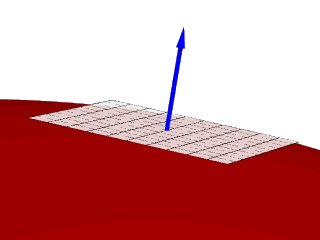
So I set my class up with the task of doing this on their own. They’re still working on it.
But honestly, I’m not quite there yet. I don’t want to just give them the equation and method on how to apply it, but I don’t think I can explain it in any good way. I’m almost there, at a conceptual tipping point, but I need one last shove over the edge. Anyone out there ready to help?
First of all, I decided that working with surfaces is silly and I’d reduce the problem to curves. So let’s start simple.
Let’s say we have the graph of 


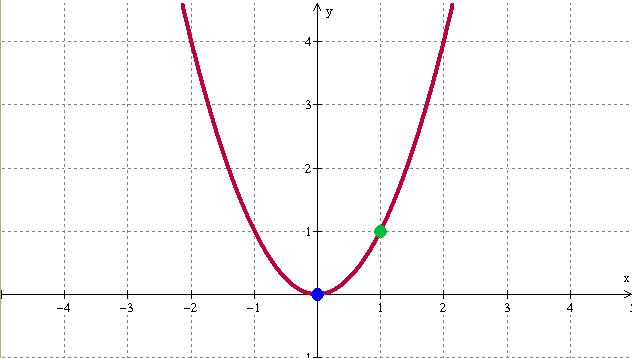
Well, traditionally, we’d be crazy and parametrize the parabola by creating the vector-valued function 


But trust me, this is an awful amount of work, and 
And it can. And this is where I need your help.
Instead of considering the plain old boring function 

The function 

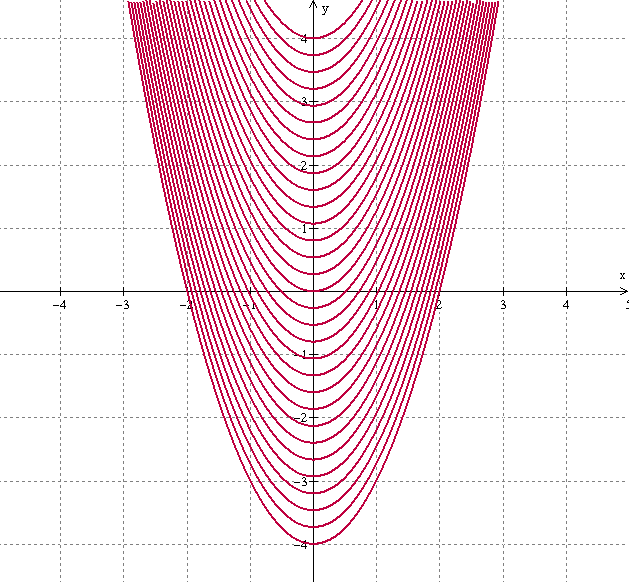
Remember that one important (perhaps the most important) property of the gradient is that the gradient of a function points in the direction of maximum of steepness on a graph of level curves.
Let’s look at the points we’re interested in!
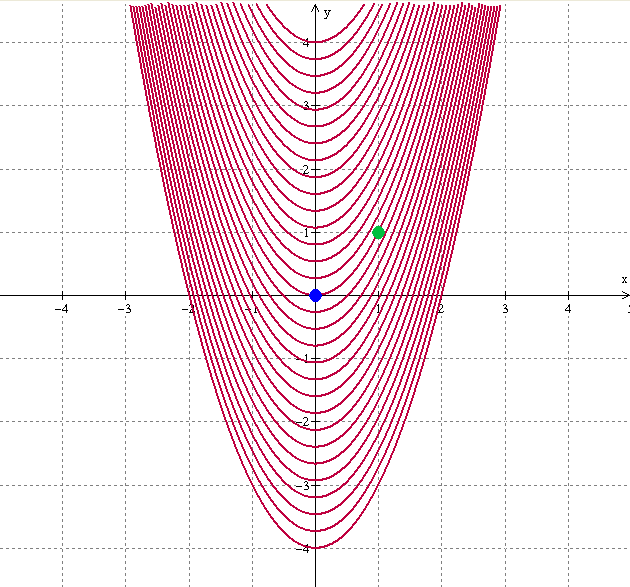
Just looking at the graph shows we’re onto something. Look at the blue dot. Which direction is the steepest, if you were standing at the blue dot and wanted to walk in the steepest direction? Well, clearly it would be directly north. (You want to walk the shortest distance to get to the next level curve. Since the change in heights between level curves is constant, you want to minimize the distance you’ve walked to get to the next height to have the steepest slope.) What about the green dot? Clearly, northwest.
And actually calculating the gradient of 
At the blue dot, we get 
At the green dot, we get 
I’m plotting them below.

And without all the pesky level curves to distract us.

Clearly this method works. We take the original function
The questions I have after doing this:
(1) Why did we have to change our nice curve
(2) How can we understand that the vector normal to the curve somehow is “magically” the gradient of the surface we created — one of whose level curves is the curve we’re interested in.
(3) Extending this analysis to problems where we want to find the normal vector to a surface like an ellipsoid (like 

(For a picture of some level surfaces, check it out here.)
Anyway, this is just my musings, my way of thinking through this. I’m not quite there. Any help you can give, great. If not, that’s cool too.
[1] I guess to make things simpler, we could simply calculate the direction of the normal vector and not worry about making it a unit normal vector, so we could simply calculate $\vec{T}'(t)$ only. We’re not concerned about the magnitude of the normal vector, only the fact that it’s normal.

 Continuous Everywhere but Differentiable Nowhere