I’ve been a bit incommunicado lately. Nothing bad has happened! I’m not working harder than normal! I don’t know why but I haven’t been moved to post anything. And you know my feeling about blogging — it can’t be a chore, so don’t force it.
That being said, I wanted to share something we’ve been diverted by in multivariable calculus recently:
I gotta say, I love this class and I love working with these kids. They remind me how when you find the right thing, exploration is captivating.
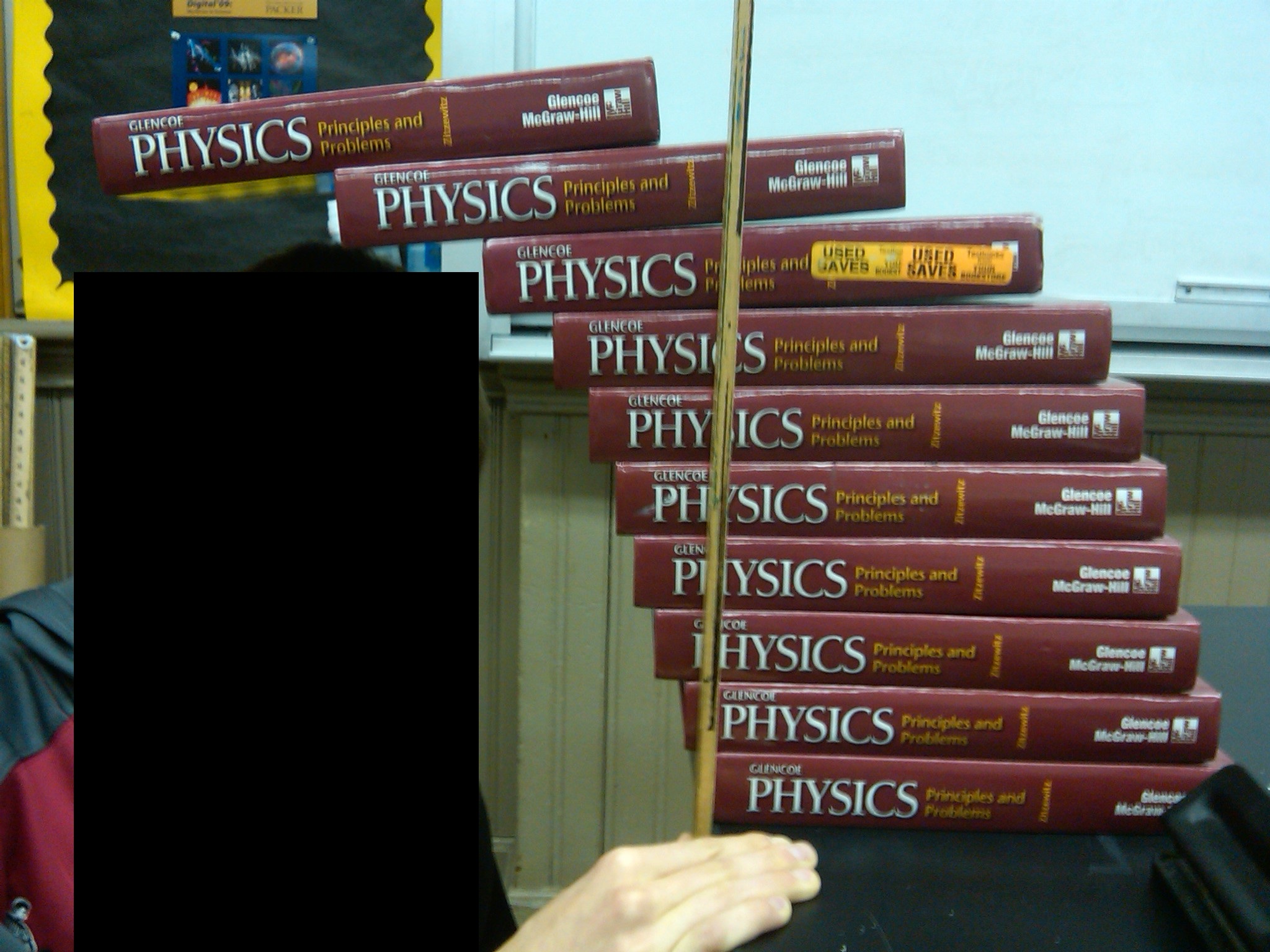
This is the “book overhang problem.” The question we dealt with was: can you stack books at the edge of a table so that the top book is off the table completely (meaning if you’re looking down on the stack of the books, the top book doesn’t lie over the table at all)?
We haven’t yet found the optimal solution, but we’re going to be discussing our musings on Friday — what the best 3, 4, and 5 book configuration might be, and if we can generalize it.
It’s only Monday, but I’m wiped. For some reason, my kids were exhausted today also — zombies! This week is going to be rough, methinks. I have to come to school early every day, and I have to stay late (until 8:30pm tomorrow!) a few other days. But we endeavor, right?
In any case, I wanted to share a few things I did in my classes recently – a schmorgashborg of this and that, bric and brac.
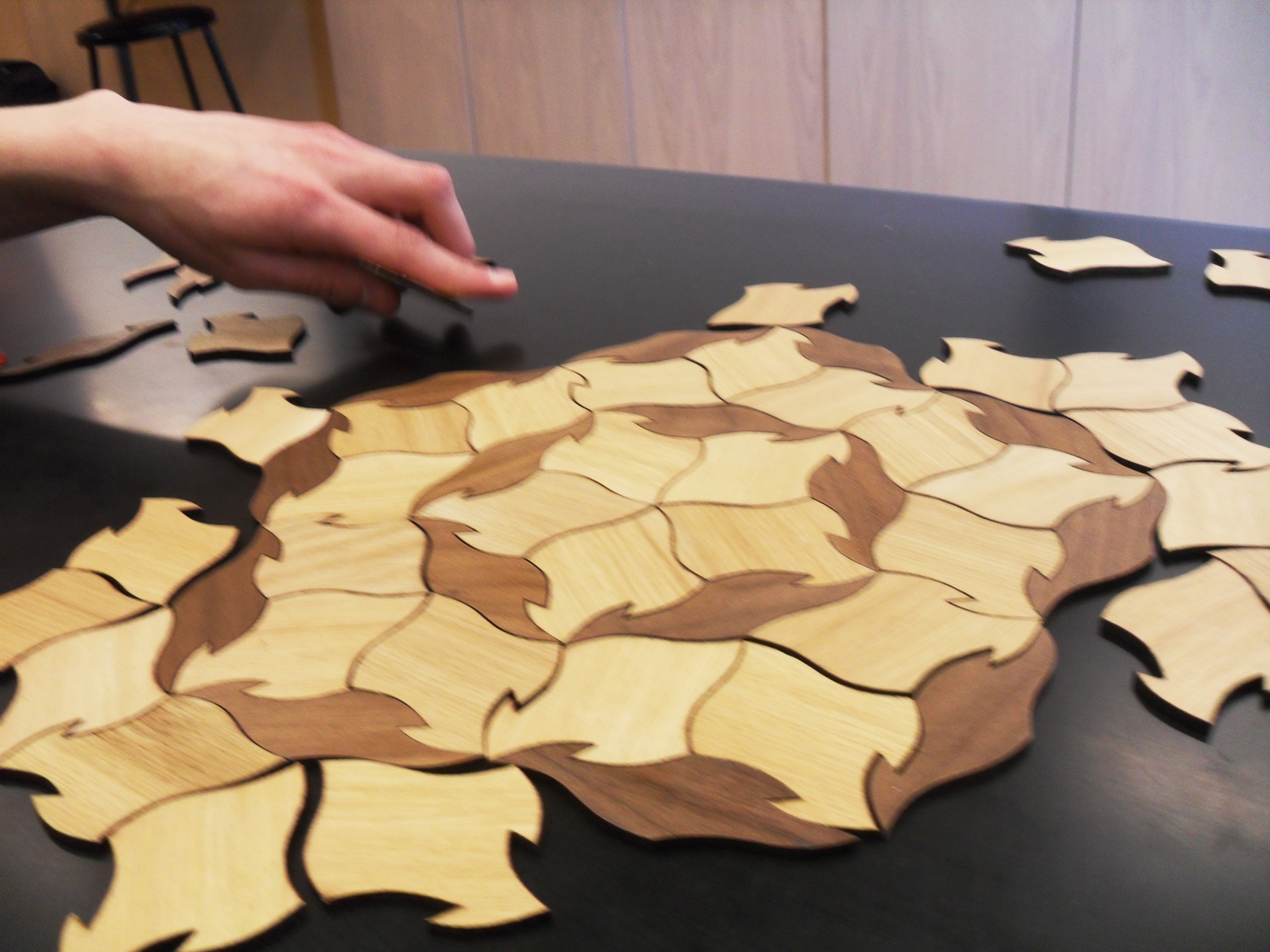
1. A while back, I had Edmund Harriss (@gelada on twitter) come speak to a few of my classes about what real mathematicians do. He had them play with infinite tilings of the plane, by actually having them do tilings! But with weird tiles (including the Penrose Tiles), which made it all the cooler.
Fun times. I liked having something out of the ordinary for my Calculus and Algebra II kids. I think they’ll remember him coming to visit more than how to find the solution to 1D quadratic inequalities or how to find the concavity of a function.
2. With another teacher and two students, I went to the Museum of Mathematics first Math Encounters lecture titled The Geometry of Origami, from Science to Sculpture, given by MIT professor Eric Demaine on origami and math. I have seen a few talks on origami and math (in person or on video), and this was the best. I’ve already signed up for the next two lectures.
3. I needed to prepare a review for my Algebra II kids for advanced quadratics topics. If we have a review at all, I usually just whip up 8 problems and give my kids the entire class period to work on them — from the “most difficult” to the “least difficult.” I have a set of solutions that I keep at the front of the room, so students can check their work. However, I decided to try to mix things up. I wanted to use Sue Van Hattum’s Risk game… it forces students to ask themselves: what do I know and how confident am I in what I know? (It’s meta-cognitive like that).
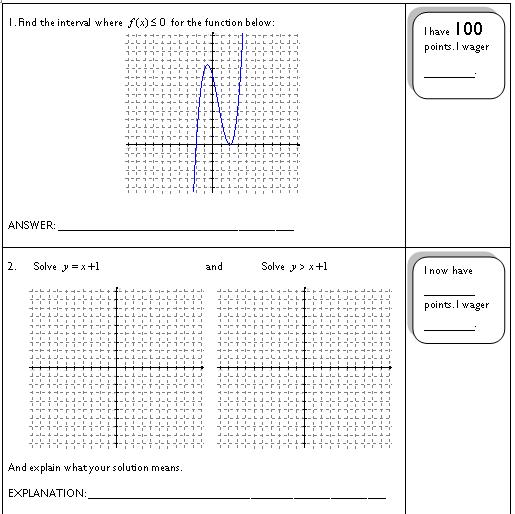
To set it up, I talked to my kids explicitly about how the purpose of the exercise was to review, but also to be hyper-conscious about what you actually know (versus what you think you know). I put kids in pre-chosen pairs. And each pair got a booklet of the Quadratics and Inequalities Review Game (each page was cut in half and stapled). Below are the first two questions from the game.
Each group started with 100 points to wager — and they lost the points if they got the question wrong, and the gained the points if they got the question right.
Some possible game trajectories:
100 –> 150 –> 250 –> 490 etc.
100 –> 10 –> 15 –> 30 etc.
Anyway, what was great was that the game really got students engaged and talking. Each student tended to work on the problem individually, and then when they were done, they would compare with their partner.
(If you try this, you have to make sure that students know NOT to skip ahead… everyone is working on one problem at a time. Then you go over the problem, and THEN everyone starts the next problem.)
Since I don’t like review games with a time-pressure element, I also gave out a page of problems on older first quarter topics. Getting those questions correct were each worth 20 points.
I am definitely going to use this review activity again.
4. I used Maria Andersen’s Anti-Derivative Block game today (it’s like tic tac toe, where you need to get 4 in a row, and uses calculus). I didn’t teach my kids antiderivative tricks. I just told them what an antiderivative was and had them play the game. I’m currently trying to teach intuition regarding antiderivatives (many students have trouble reversing their thinking) and so I spend a day or two just working on this intuition.
5. When completing the square, another teacher in the department shared with me a great mnemonic that helps student remember what to do. She does a funny little thing recalling BOP IT. If you know BOP IT, then you know if you say it in that BOP IT voice: Halve it! Square it! Add it!
Of course this comes AFTER they can explain to you why you’re halving it, squaring it, and adding it. They have to know WHY these are part of the completing the square process, but once they do…
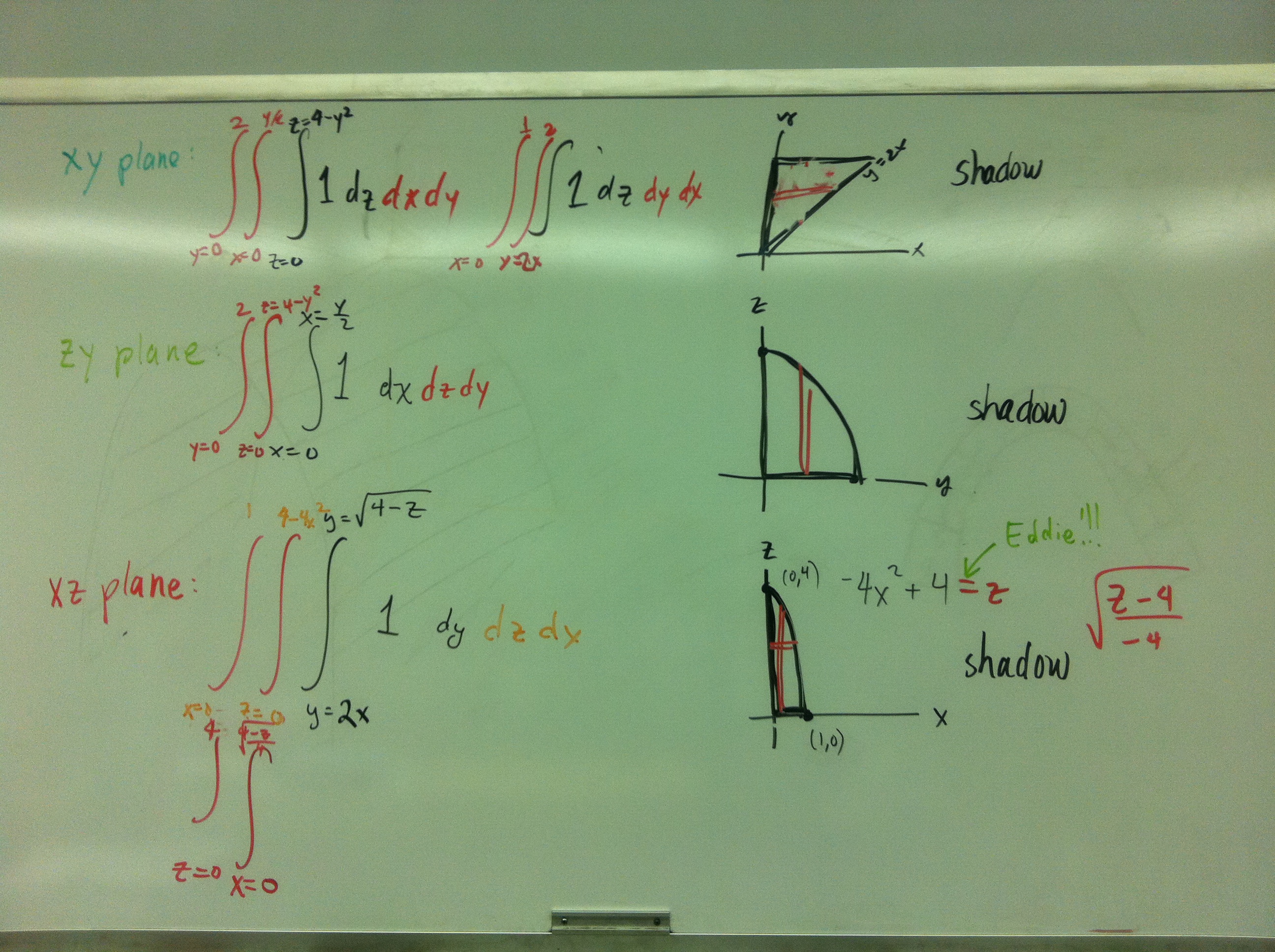
6. Three of my multivariable calculus students — one with an iPhone, a blackberry, and a droid — wanted to decide which one took the best picture. So each captured our triple integral lesson on their phone, and me and another teacher picked the best. The winner:


 Continuous Everywhere but Differentiable Nowhere