Month: June 2020

Gratuitous and a distraction

Today made me happy. Today the Supreme Court said that part of the Civil Rights Act of 1964 that applies to sex discrimination encompasses discrimination based on sexual orientation and gender identity.

Today Brett Bigham shared this thread on twitter about his experience being a gay math teacher. He won Teacher of the Year in 2014 and that same year he experienced … a lot. I entreat you to read it all.


We are in the math education community, and we are not immune from homophobia. Even from our own kin.

For the past couple of years, I debated sharing a story of my own. A very small story, compared to Brett. And not a story I’ve ever shared in full to anyone but one or two people.

In 2018, I submitted a short article to a respected math teacher journal on a prompt asking why we teach, and why we continue to teach. For me, it was an article about identity, and how math teaching can be a bridge allowing us to form lasting and meaningful connections with each other, no matter how different we may be.

Here’s the opening paragraph. The opening sentence was meant to be jarring because of what came after. Obviously the sentences that follow, my life trajectory, the things about me that make me unique, different, contradict the opening sentence.

I’m not so different from you. First generation kid of immigrants from India. Had only a single friend for most of my childhood. Lived in an extended family household of nine for junior high and high school. Switched high schools after freshman year when my dad got transferred to a different state. Studied math in college. Came out as gay at age 19. Studied history of science in graduate school for four years before deciding academia wasn’t for me. I just turned 37 and am starting my twelfth year of teaching.

The article is framed around the idea of identity, and my search for belonging when for many years I never felt like I ever truly fit in. And for me, one place I found that sense of belonging was with math teachers who connected online. I wrote:

I started to belong. Even though I had very little experience, people showed me that my voice mattered and I actually did have something to contribute to the world of math education. I was accepted from the start – this awkward, neophyte, math-obsessed, showtunes-loving blogger. Over time, people in the community turned from icons and handles on the computer screen to friends, and now they are a chosen family. I’m not capable in words of expressing how I feel about these people in my heart. From times when I was the most down, when I felt worthless and wanted to leave the profession, they kept my spirits up. They saw me in a way I couldn’t see myself. They continue to help me be my best teacher self. When my mother was in the hospital with complications from chemo, they called and wrote and visited. They celebrated me when I shared a cool project one of my kids had done or I shared part of a nice card a student wrote me. And they come running up to me hugging me at conferences and make me feel loved. Yes, this online community of math educators changed my classroom, but they also gave me something more precious: acceptance and unconditional support and love. This community has become a place of support not only for the classroom but for the heart.

You see, I told you. I told you! I’m not so different than you! Because although our journeys are wildly incongruous, they each led us to a place where we can connect. You and me, we both relish our time working with budding mathematicians. Our hearts beat faster when we’re hearing their exhortations of delight when something clicks, or we see in slow motion the face of a kid morph into a toothy grin when we hand back particularly good test, or we see a spontaneous high five when a group conquers a seemingly-impossible problem. And no one else – not even someone freakishly just like me but who decided on a different profession – could ever get that part of me. They have to have experienced that racing heart. You have lived and breathed it. And starting from there, we can build a bridge between us.

I received news that the article was accepted provisionally. They wanted to publish it, but they only had room for a shorter version. And they mentioned that as they put together the journal, there was a chance the shorter version might not be published because of space.

Understood.

I cut it down. I sent it back. And I got this email in return:

Thanks, Sameer.  You neglected to add your signature.  We need name, email, school affiliation and location and date of the letter.

We will be taking out the sentence about your coming out; it is gratuitous and does not help the letter.  This decision was made above me, but I agree with it.  Such statements, while they are certainly important to you, don’t really belong in the journal.

If you still want us to publish the letter, please get me the signature info asap.  Thanks for turning this around so quickly.  For what it’s worth, it seems stronger to me in this form.

Let me remind you of the entire first paragraph, and highlight the one thing that was asked to be excised from it:

I’m not so different from you. First generation kid of immigrants from India. Had only a single friend for most of my childhood. Lived in an extended family household of nine for junior high and high school. Switched high schools after freshman year when my dad got transferred to a different state. Studied math in college. Came out as gay at age 19. Studied history of science in graduate school for four years before deciding academia wasn’t for me. I just turned 37 and am starting my twelfth year of teaching.

I received their email when I was at school. I felt so many things. Anger. Confusion. Defensiveness. Shame. My stomach was churning. I wrote this back before going to teach my next class:

I think coming out to be as important a part of my identity as my extended family and moving from one place to another — if not more. And the fact is this is a piece about identity and connection, and finding commonalities when none might seem apparent.  The fact that this is the one thing the higher up editor felt important to communicate about what needs to be cut is problematic for me. I am fine withdrawing this article from consideration for [Journal]

The reply:

I will try again but remember, this is an academic journal.  Your coming out may be important to you, but I see it as a distraction to our readers

I couldn’t focus on anything but the words gratuitous and distraction. I didn’t understand what being an academic journal had to do with this. The piece wasn’t about a project using algebra tiles, it was centered around the idea of identity. Soon after, I replied:

I am sorry, but I do not agree. I think asking for this one erasure — of this one thing that you want to take out but not mentioning any of the other things about me (moved, extended family, first generation) — is problematic. I don’t know why it feels more “gratuitous” than anything else in the first paragraph. And I certainly don’t see it as a distraction for readers. For this one piece to be singled out over all the others, and having it be called a “distraction” and “gratuitous,” doesn’t sit right with me. Especially for a piece that centers around the notions of identity and connection.

I know [organization] has been working hard on diversity and equity issues. In my eyes, the fact that this has even come up means that [organization] has a lot more work to do to live its mission.

I’m sorry I wasn’t clear. I am withdrawing this article from publication by [Journal].

After a few more back and forths with false pleasantries, the conversation ended.

My article was withdrawn.

I was still feeling all the things.

When the school day ended, I went to talk to a teacher friend who often gives me wise counsel. In my head, I could hear a voice saying “it’s just one sentence.” Deep down, I knew she wouldn’t ever say that but I was worried that she’d think that. I was feeling defensive, like I wasn’t certain that my feelings were valid and that what had just happened to me was wrong, full stop. I remember trying to explain to her the situation and giving her so much context. If I explain it just right, maybe she’d understand and agree? I made her read the article to understand. I gave her some of the background. I let her read the email exchange.

Credit to her, she got it right away and helped me see I wasn’t overreacting. She too, when she got to the word “gratuitous,” flipped out, and again at the word “distraction.” Her own righteous anger validated all my feelings.

My biggest fear when approaching her is her thinking “you’re making a mountain out of a molehill.” I actually fear that now. Like people won’t understand when reading this post how this was homophobia–period. Like people won’t get how being told that being gay is “gratuitous” and a “distraction” is like being told that part of you is invalid. Like people won’t understand why this is an episode in my life that I will get past but never be able to let go. That email exchange and that day — thinking of all the emails and all the days in my life that I forget — stick with me. My hands were actually shaking when I was opening the email thread to re-read it to write this post. It brings back a lot.

I think that’s why I wanted to share this. Partly to show people that homophobia still exists in the math education community. But I think it goes further. I wanted to recount this to remind myself and others that concepts of identity can seem academic, but when we talk about erasing and denigrating parts of people, it is anything but academic. It’s not just one sentence. It’s one part of me that you don’t like. It’s one part of me that you find uncomfortable. It’s one part of me that you wanted to excise. But it’s one part of me that makes me who I am, that I want to be proud of, that you are diminishing and making me feel ashamed about. 

Maybe that wasn’t the intent. I know I’ll never know the intent. But that was the impact.


PS. Because I did not want something like this to happen to anyone else, I did contact someone high up in the organization who was immersed in diversity and inclusion work, and huge props to them. They recognized how problematic this was and did not sweep it under the rug.

PPS. Even as I am about to publish this, I’m terrified about getting an angry email in my inbox from the editor who emailed me. If you are somehow reading this, please don’t email me. I don’t want an email from you. This post isn’t about you.
It’s Tuesday evening.

It’s Tuesday evening. A faculty meeting just ended. I am sitting here with lots of thoughts I need to process. For some reason, I feel less fearful about sharing my thoughts recently. I don’t know if anyone else is going through similar things, but I’m sharing this post to hold myself accountable to this work, but also in case others can see glimpses of themselves and their thinking and feelings in my experiences. Here it goes. Stream of consciousness. No editing. Just writing.

Thought 1: I ended my classes this week. Our last classes were held on Monday and Tuesday. I didn’t know how to end them. I wanted to close the year with some solemnity and definitely not frivolity. I know when I’m feeling the most dark and depressed about the state of the world, I hold two things close. First, the starfish story. Second, it’s showing gratitude to others. Sharing with someone how they’ve affected you, thanking someone for some specific action they took or some role they’ve been in your lives, for helping you grow, or showing you grace. So I talked about these things. And I had students read the starfish story to themselves, and then write an email to: (1) a teacher who you want to thank for their work in online teaching, because students often can miss the humanity of teachers (just as teachers can miss the humanity of students), (2) a person who they haven’t been in contact much during quarantine but they appreciate and want to reach out to and tell them so, (3) someone who called them out and pushed them but helped them grow, or (4) someone in math class who made them feel validated and seen. I wanted to end the year by thinking about community and gratitude. Now that it’s over, I wonder if I did the right thing. I debating having more conversations on recent events (in two of my classes on Friday, we talked… you can read about that here…), but it didn’t feel like a way to bring closure to the year. But after my last classes, it just didn’t feel like closure to me. It wasn’t what the kids needed. And I had the even more horrifying and insidious thought. Maybe kids left with a message I never intended to send but also never specifically disavowed: “when the world feels dark and hopeless, the way to fix things is just to simply be kind.” Since I’ve had this thought, it’s been like an anchor weighing me down. I spent a long time trying to figure out what to do for the last class — and I still don’t know what I should have done instead — but this maybe wasn’t it. Or maybe I’m overthinking things. It just felt off. But then again, everything about the last few months in school has felt off.

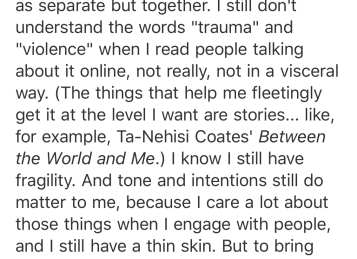
Thought 2: Last night I had a revelation/insight which I wrote down and shared with some friends: “The anxiety and inability to have heart stop beating so fast. The repeated pain that Twitter and the news brings me. The tears and exhaustion. The past week has done a number on me. I’m going to try to say something openly and imperfectly. I remember saying a few years ago that I could intellectually understand when I heard poc talk about ‘trauma’ but I knew it was only intellectual and I was never going to be a strong ally until I could understand the word more deeply–because it’s a strong word and it wouldn’t be used without a lot behind it. I think for the first time I’m finally getting there. The weight of oppression feels — not intellectually, academically, but viscerally — heavy. Terrifying. All encompassing. Repeated. Relentless. I’m not saying I’m feeling trauma or know what it’s like to be a black poc. A student today in a discussion used the phrase “radical empathy.” I hope this discomfort and general awfulness I feel stays with me — though I hate it — because it’s allowing me to finally experience radical empathy. <don’t mean to center me-just trying to archive this insight.>”

After typing that out, I remembered I had written this sentiment down a year ago as I was thinking about this work and where I was when trying to grow:

pic

This was in a much longer email to my friend Hema when we were planning last year’s Virtual Conference on Humanizing Mathematics. It took me over a year from recognizing this deficit of mine to actually being able to say I finally get it… I think. And that deficit was truly understanding one word.

Thought 3: I feel like I don’t neatly fit into a category when my school has conversations around race. I’m not white. I’m not black. I’m Indian, and first-generation American. My parents tried to Americanize my sister and me. I don’t find myself aware of daily slings and arrows, not a thousand cuts, not in overt ways, not often. I have a few examples that I can bring up, but not a whole bank of incidents. Because of the privilege I have had through most of my life, I often feel it’s easier to identify as white than a person of color.

I’m also not introspective — probably because it shines a light on things I don’t want to think about. I find it truly challenging to do identity work. I can think deeply about my teaching and my core values and my students, but somehow I’ve gotten away with not doing a lot of deep self-examination in my life. I know I’ve been deeply affected by the way I was viewed by society growing up, and I’m certain racism had a lot to do with it — but I’ve never done the work to think about myself through that lens. I literally only had one friend at school until late junior high. Surprise, surprise: he was also a student of color. I think maybe we were the only two students of color in our grade. I literally don’t think I ever put that together until now. That’s how little introspection I’ve done. I never got invited to birthday parties. But since that wasn’t a thing in my life, I never knew I should be missing them. I was bullied in junior high. I just didn’t know it was bullying because it was so normalized in my life by that time. I honestly wasn’t a sad kid. I just didn’t know any different, so instead of friends, I read books. I know I’m scared to do the identity work to see the ways that structural and insidious forms of racism and homophobia have played a role in my life. I’m a first-generation gay Indian living in America. How could they have not? I’ve clearly had a lot of privilege which has allowed me to get to this point without doing this identity work. But at the end of the day, doing this work, this introspection, forces me to contend with the inner core of who I am and how I see myself. To revise my own definition of myself. It’s easier to just… not.

Thought 4: I recently came off of a zoom meeting with all our school’s faculty (we’re a K-12 school). The anxiety I wrote about above hit me this afternoon. My heart was racing again and I had to lie down in my bed and take a nap. I woke up not feeling any calmer. For the first time, I turned my video off in a zoom meeting. At the start, I heard so many words. Kind words. Sympathetic words. And… I am so tired of words. And so as I heard everything all I could feel was cynical and angry. Give me time and space. Just cancel things. You want to help? Take writing narrative comments off my plate so I can work on healing. I don’t want to know that you know we’re grieving and how things aren’t normal. Just give me something concrete. Just give me something. And at that moment, I realized two things. I wanted them to fix me. I’m broken, and I just wanted someone to wave a magic wand, and I knew they don’t have the power to fix me. I also deeply understood, again at a visceral level, the repeated call that black people have had that sounds like: <<stop talking. stop talking. STOP TALKING. I’m so tired of all the nice sounding talking. So so so tired.>>

I also heard a lot of anger and white people calling for immediate change. Accountability. Demands that we all revise our curriculum this summer. I’m for that also. But I felt such cynicism. Because I just kept thinking “is this performative? is this virtue signaling?” You’re ready and now want everything to change immediately because you feel moved? What about all the people who were at the party demanding change before now? Their voices had been ignored and lost.

And the horrifying thing about my own cynicism is that it’s not like I’ve been one of the people demanding this kind of change for myself or for the school. I’ve been moving along in my personal diversity work, content with doing some work but never getting to the point where I was centering the work. I felt cynical and frustrated listening to people making these statements, even though I have no right to feel cynical and frustrated.

Although I mentioned I often feel white, it was at this moment that I realized all these things I was feeling were what those advocating, crying for anti-racist humanizing curricula, had been feeling for ages. Again, I don’t have any right to those feelings, but in the moment, I had those feelings of frustration and cynicism. I’m grateful — because even though I don’t deserve to have those feelings — I had access to something I hadn’t had before. I was hearing the well-intentioned words that people were saying but from a different perspective, through a different lens, a lens I didn’t have before.

I also was nervous that in the fervor, in the tidal wave of support and sometimes hope that we were going to turn our school into a shining-palace-of-anti-racist-work-so-show-up-teachers-or-get-out, that we were going to do harm. Yesterday I read a tweet that said something to the effect of “if you’ve never talked about black issues in your classroom before, just don’t just come into class tomorrow and bring up George Floyd. Just don’t.” The fear is that if we don’t do this work right, if we rush into things without being strategic and thoughtful, we can do way more harm to students. White saviorism wasn’t really mentioned, but I was thinking about it. Others were probably thinking it. A colleague brought this up, articulated it better than I could have, and I was grateful.

Thought 5: I wanted to reach out to this colleague who brought it up. I wavered and went back and forth on whether to send an email. I wanted to say thank you and I support what you had to say. (I did chime in, in the chat). I wavered because I’m hyperconscious of people who have been doing continual anti-racist work saying they’re tired of words. They’ve been given words over and over. Instead of signaling support, show your support by acting. I wavered but decided to send the email anyway. After writing it, I checked myself. I wanted to show solidarity and that my colleague was heard. But I realized what I wrote boiled down to “thank you” and “I heard you.” I wanted to do better. Without that, the email would have been more about me and virtue signaling. I wanted to demonstrate I really did listen and hear, and I am grateful. So I wrote down what I heard them say, specifically. I still don’t know if I did the right thing by sending the email. But I know I’m now asking the right question: how much of sending the email was about me, and how much about sending the email was about the person I was sending it to? In the weighing, I think I had my answer, and so I sent it.

Thought 6: I am broken. I am tired. I can’t stop thinking about what this all means for me this summer, when all I want to do is heal from this school year. We’re going to be required to do online professional development on remote/blended learning. I’m going to be writing 22 college letters of recommendation. And now I suspect there will be anti-racist readings and professional developments that we’re going to be asked to do, in addition to submitting ways we’re going to alter our curricula. I’m can’t tell you how intellectually and emotionally and physically tired I am. Writing narrative comments on all my students in the next week is a mountain I have to climb but carrying an anchor. But what comes after? That feels impossible.”

Thought 7: I think it’s time to end this post now. Believe it or not, I initially was intending to make this blogpost a list of actions I have started taking, plan on taking, or ideas I have and want to think through before I implement. In other words, concrete ways I’m going to do The Work. I fear that when all these immediate feelings fade away and I’m not being bombarded day and night on twitter and facebook and the news, I may just “opt out.” So I wanted to type some things down to be public in my work and accountable. Maybe I’ll do that post tomorrow. But for today, I’ll have to settle for writing about of my feelings and thoughts, so a month from now, I can try to come back here to a place where I feel destroyed… but ironically because of that, motivated.