I’m going to be teaching a mini-course (7 days) on math-art in this upcoming school year. In my work on that course this summer, I started thinking about how I can have kids work with embroidery hoops and floss. And unrelated, this morning, I was thinking about a quilt my high school friend made for me and gave me yesterday. What a special gift from a truly special friend!

When thinking about the quilt, I started thinking about Truchet tiles and how those could create some beautiful patterns for quilts. And then the pictures of Truchet tiles reminded me of a series of posts that come on my feed regularly by the Hitomezashi Bot on Bluesky, created by Alien_Sunset.


So I went to that bot, which led me to the creator’s website (which is here), and finally I found the Hitomezashi page here. That page led me to this Numberphile video with Ayilean (a creator who I adore):
And also to this paper by Katherine A Seaton and Carol Hayes on the mathematics behind these figures. In that paper, the authors wrote:
A method of specifying hitomezashi designs in shorthand form using binary strings was employed by the first author when she proposed an activity for the Math Art Challenge organized by Annie Perkins (Perkins, Citation2020). The premise of the Challenge was to provide, each day for 100 days, an activity which could be done during lockdown or remote learning with materials on hand. Hence it was suggested that hitomezashi designs could be drawn on graph paper, if sewing materials were not available; some participants chose to render them using their preferred software. Three ways to choose the binary strings were suggested: to intentionally create regular patterns by repetition (which we explore in this paper), by flipping a coin (thus making aleotoric art) or as a form of steganography (e.g. by using the ascii representation of letters).
The Math Art Challenge hitomezashi activity created a lot of interest on Twitter; subsequently, a Numberphile video featuring Ayliean MacDonald took the drawing idea to an even wider audience and explored the steganographic and aleotoric aspects (Haran, Citation2021). This video came to the attention of Defant and Kravitz (Citation2022), who have subsequently proved a number of results about arbitrary hitomezashi designs…
And FULL CIRCLE! When I got here, my heart was twitterpated because the authors talked about Annie Perkins and her 100 Day math-art challenge. I KNOW ANNIE! And I love Annie’s work so much! And so I found her math-art challenge from Day 14.
Just from googling “hitomezashi math” there are a ton of hits. I love seeing how the simple setup of the hitomezashi activity can lead to some really interesting patterns, observations, and questions/conjectures.
So what did I do? I HAD TO MAKE ONE MYSELF!
I made 16 horizontal lines, and 16 vertical lines, on my linen — just using a ruler and pencil.
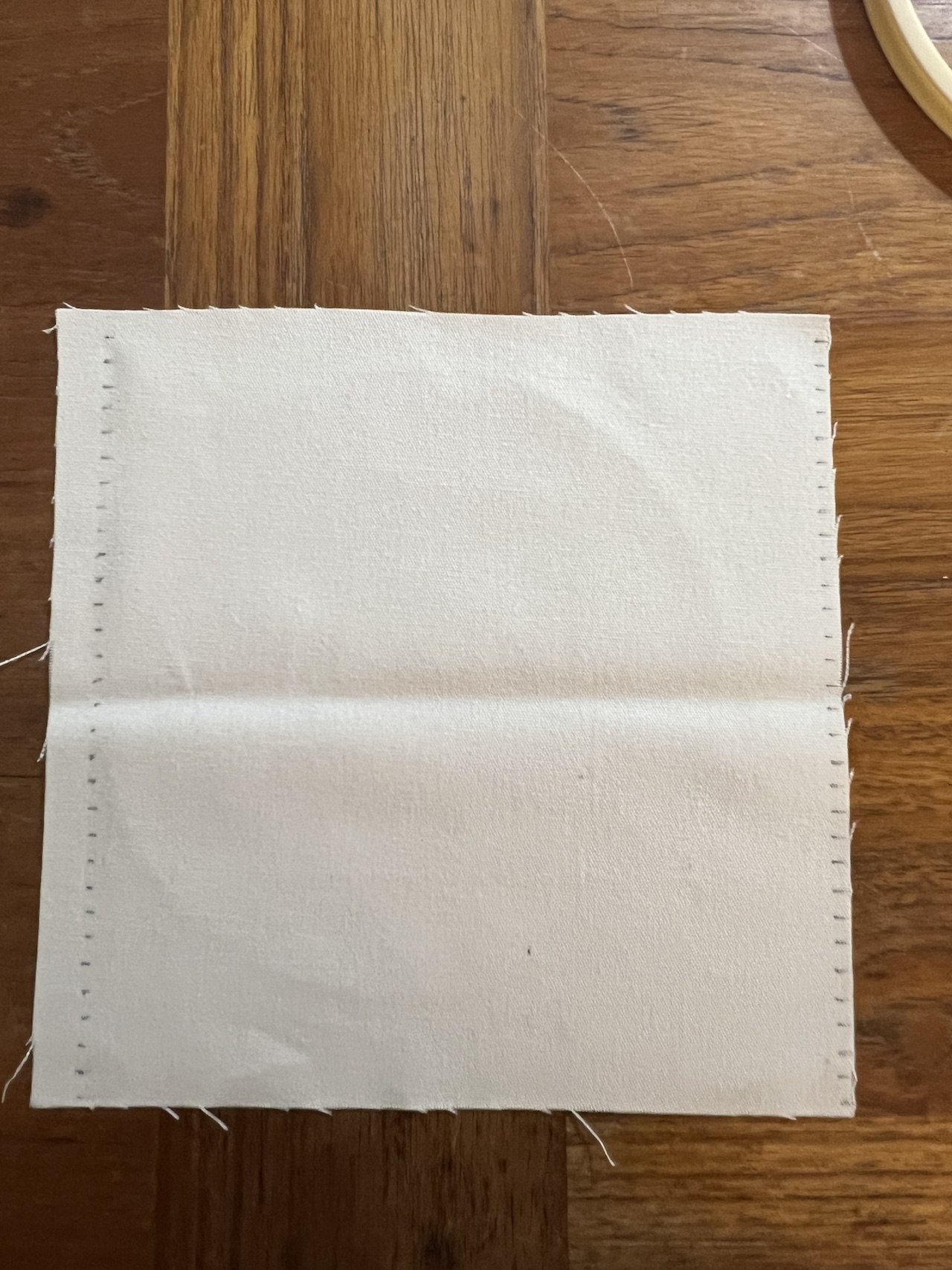

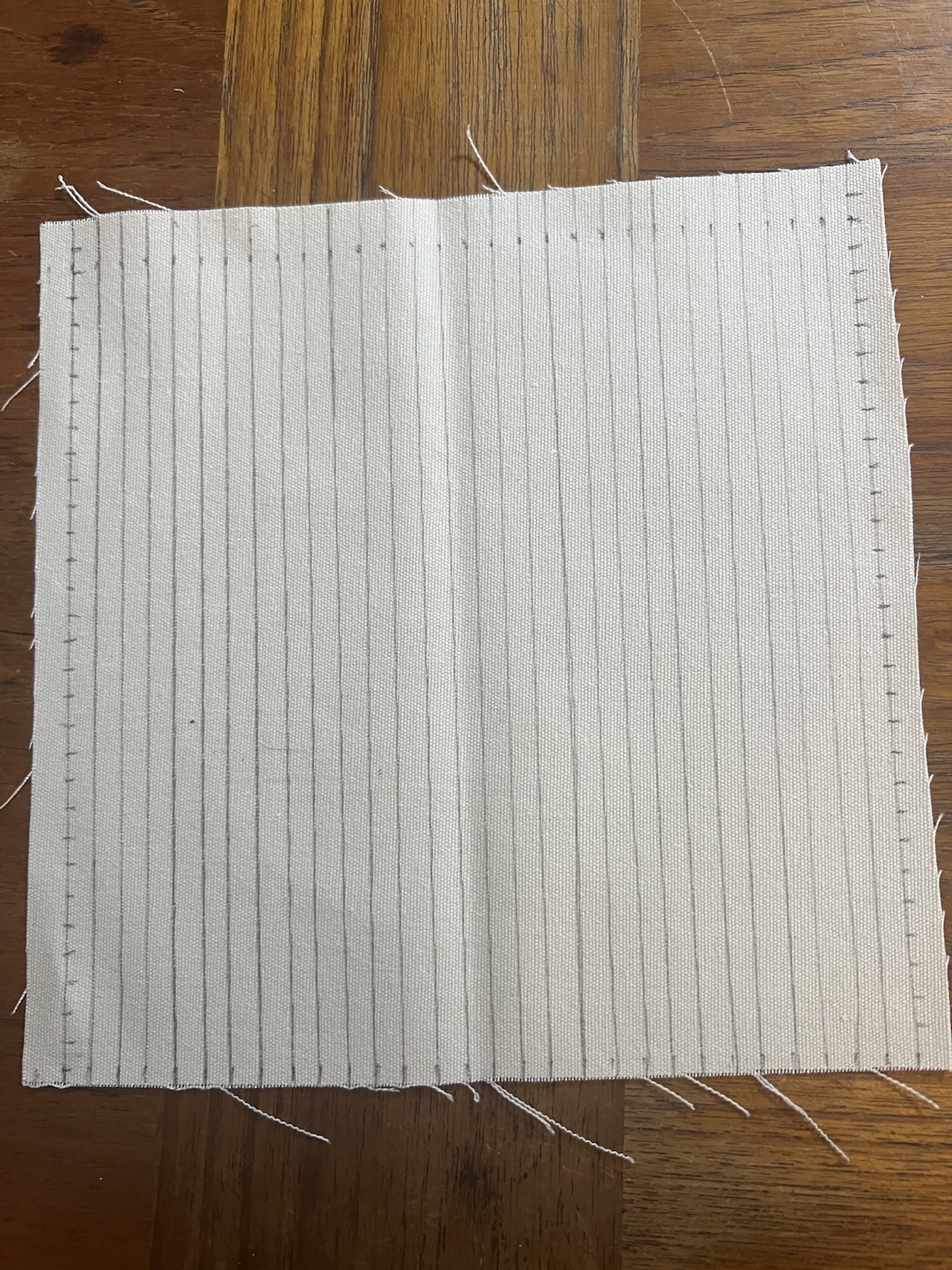
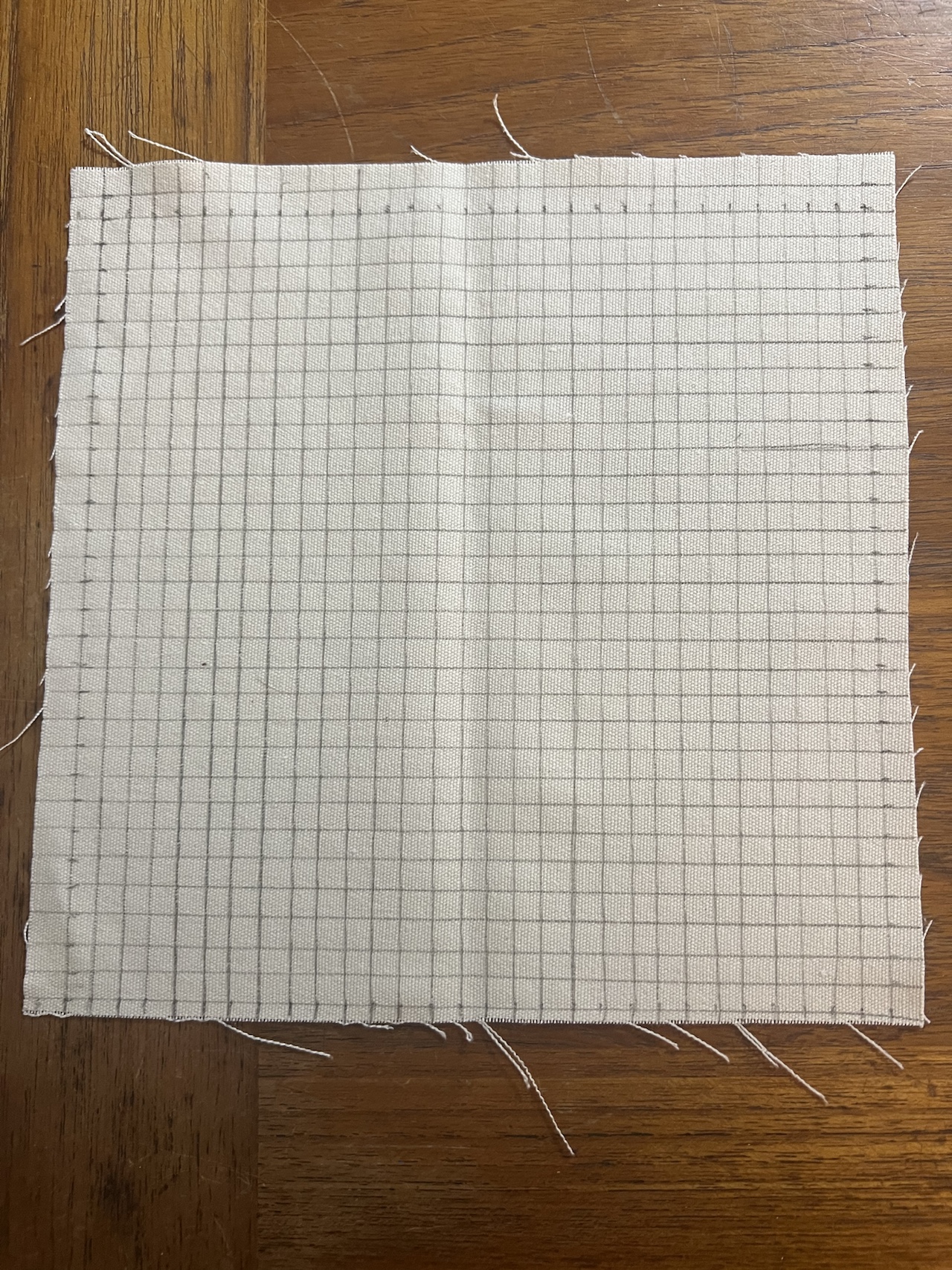
To decide the way I would stitch the horizontal lines, I chose to do what Ayilean did in her Numberphile video and encode a phrase:
MATHISJOYFULART!
0100100100101000 [every consonent is a 0, every vowel is a 1]
And vertically, I used rainbow dice given to me by a math-teacher-friend-and-colleague to generate 16 numbers and I got:1011110100111001 [every even roll is a 0, every odd is a 1]

And then I had to sew! I was basically figuring this out on the fly. How to tie knots, how to end a row of stitches, how to efficiently thread the needle, how to avoid knots. And I knew I wanted the back of the embroidering to look nice too!


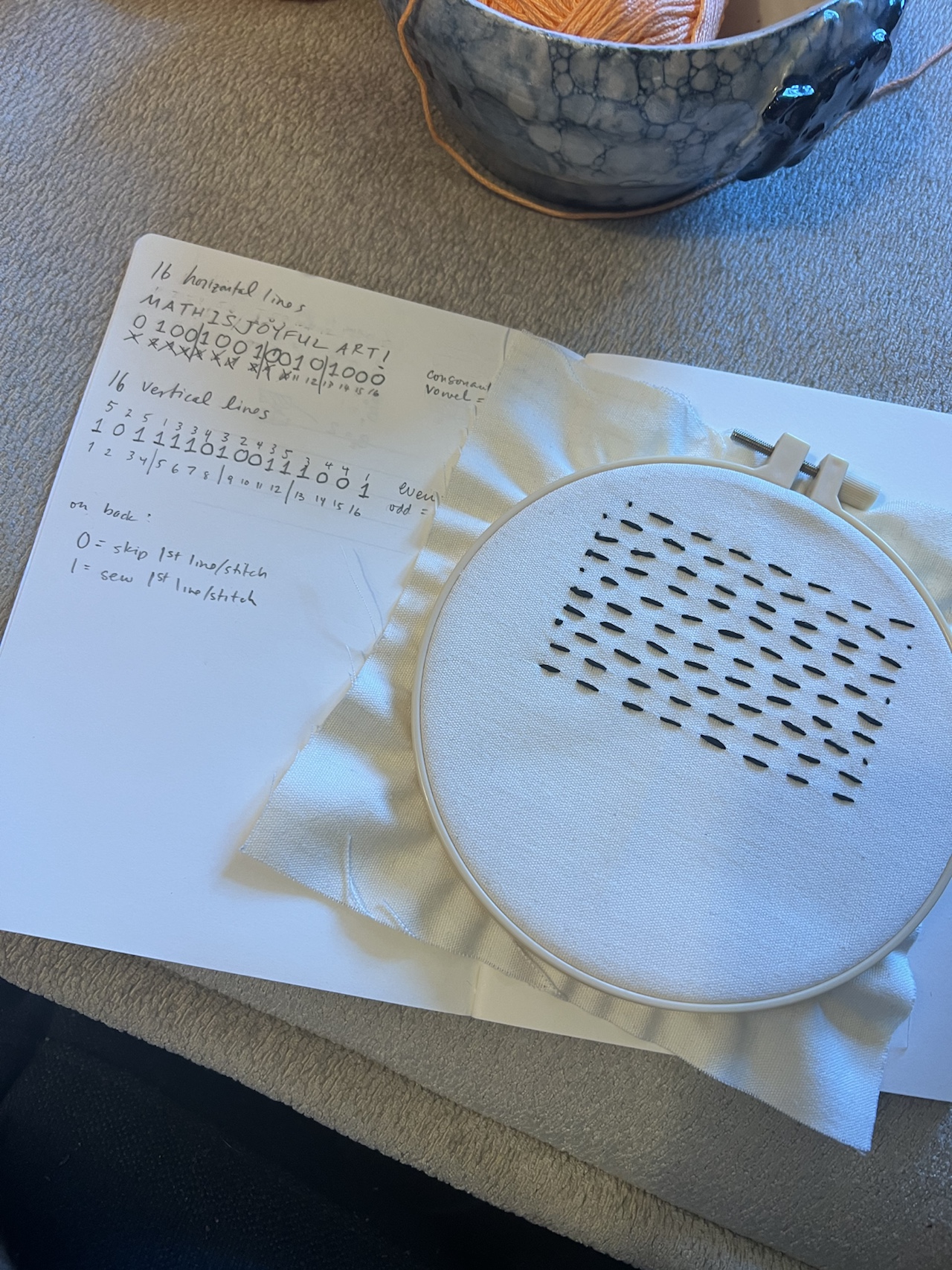


And then we get to the end! The final product!
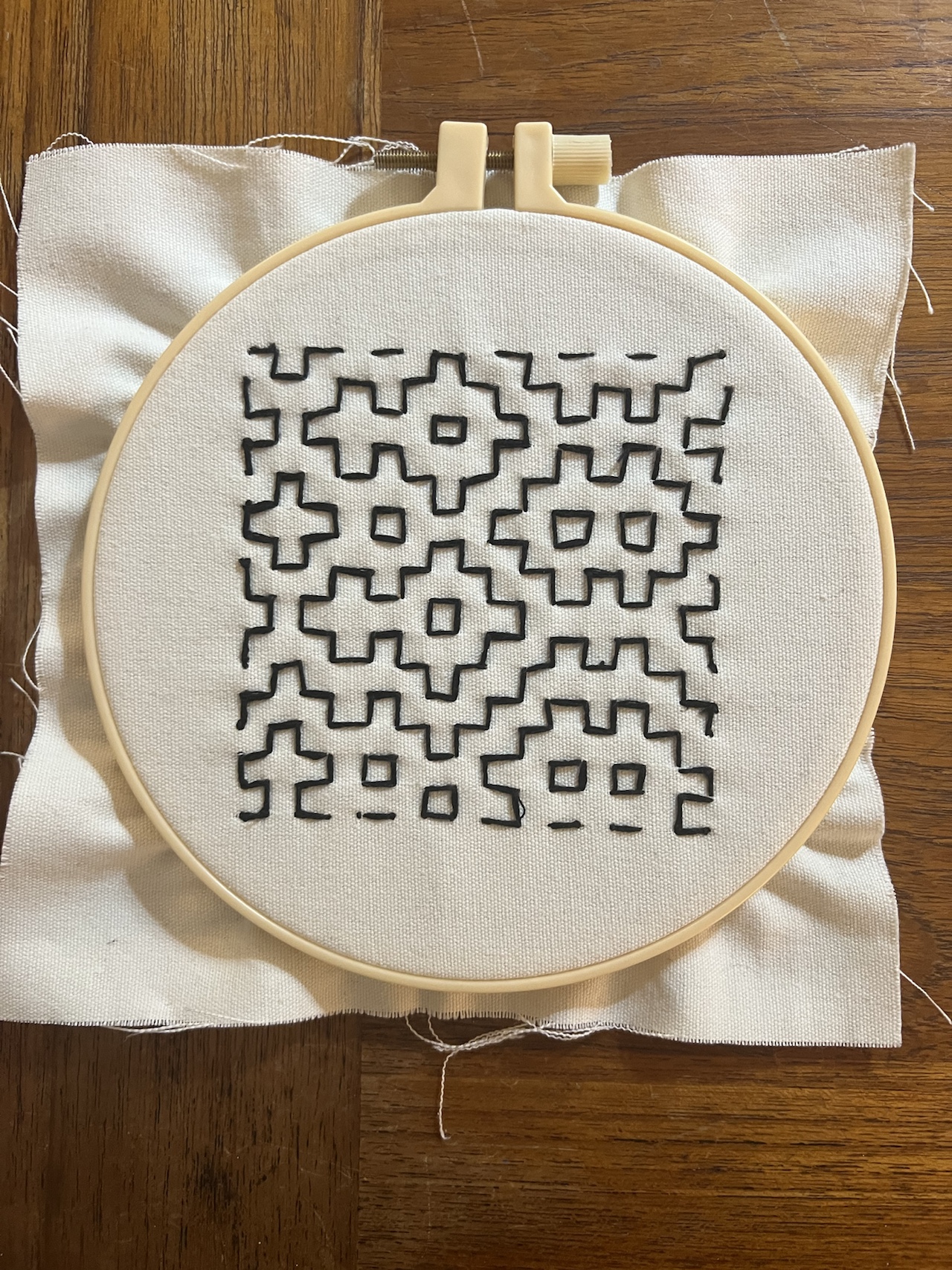

Clearly I’m not amazing at making my stitches yet. And I think I might want to use a thicker floss or even some cotton yarn next time. I saw some patterns made with light string on dark cloth, and I think those looked beuatiful too. But I’m really proud of how I just decided “hey, can I do this? I think I can!” and just made it happen!
From thinking about quilts to Truchet tiles to hitomezashi, my mathematical life today was very full.
Update with some links I want to save:
I found this link to coloring in Hitomezashi patterns: https://openprocessing.org/sketch/871770
A Hitomezashi generator (regular and isometric): https://hitomezashi.com/
A Hitomezashi generator where you enter words (like in the Numberphile video) to generate the pattern: https://public.tableau.com/app/profile/rincon/viz/HitomezashiMakeArtwithMaths/Hitomezashi
A Hitomezashi generator where you can enter binary strings: https://www.forresto.com/sashiko
[I like this because then you can see what the front and back are by changing the strings to their dual]
 Continuous Everywhere but Differentiable Nowhere