So late after school one day last week, I was talking with the anthropology teacher. She was teaching about feuds, and was talking about how feuds within a close knit society look one way, but feuds between culturally and locationally different societies look differently. Because there’s no leader to mediate, or common culture to talk with, or some yadda yadda yadda culture society language blah blah blah.
And so she talked about her class, and if there was a feud (different anthropological camps, I suppose), it would take on one form, but if they had a feud with say Mr. Shah’s class, it would take on a different form.
When she told me that, I immediately responded: “LET’S DO THIS!”
The premise of our feud: After school one day, I told the anthropology teacher that what she taught was a soft science, and hence way less important and good than mathematics.
***
The next day, while we were talking about trigonometry and calculus, first period, I hear screaming outside my door.
All day, all week, occupy math geeks! All day, all weeks, occupy math geeks!
EXCUSE ME? OH NOES THEY DIDN’T!
The whole anthropology class barged in, and their teacher picked a fight with me. Soon I was screaming at the teacher, her students were screaming at me, and all sorts of hilarious arguments about the importance of our disciplines were being flung about. The kids in my class were sitting there, stunned, while bedlam surrounded them.
At one point, and I was so involved with my argument with a student and teacher (and being all histrionic) that I failed to notice, that some of the anthropology students were trying to steal one of my students! They kept calling her a “cow.” HA! As if that was going to somehow convince her to join them. (A cow, in the culture they were studying, was a valuable object — so this was actually a compliment!)
Did I neglect to mention that about 1/3 of these anthropology kids are in my OTHER calculus class? No, not awkward at all, thank you very much.
Later, they left. Parting words?
Anthropology teacher: I’m keeping my eyes on you.
Me: Because I’m so stunningly beautiful.
My class sat there dumbfounded, and one kid simply said “what WAS that?”
I explained that we were now in feud mode, and we need to figure out how to retaliate. (Drone strikes?) Although I personally was all about pitchforks and raids, one of my students said “do nothing.” Of course I had to keep it going, so I suggested we write a “thank you” while still showing our moral high ground, and a few small jabs. Which we did:
Dear Ms. [Teacher] and her anthropology students,
After discussion among our tribe, we felt it important to acknowledge what went on in class today. We would like to thank you for bringing up some interesting issues about the hierarchy of the sciences and social sciences. Even though it’s clear to us that mathematics is important to our everyday lives (whether we ourselves are using it or not), we can understand why you might feel that isn’t the case for you. Perhaps you would enjoy a world without computers, cell phones, GPS, microwaves, etc., and we are happy for you if you decide to go forth and live that sort of austere life.
Although we might not have appreciated the interruption to our learning, and especially the aggressive way your tribe approached our tribe, we do appreciate that you felt us important enough to engage with us. We believe our work is important, and we’re glad that you acknowledge that.
Thank you for your time,
Mr. Shah and his calculus students
They responded to us:
Dear Mr. Shah and his calculus B band students:
Thank you for your email. While we anthropologists recognize that our methods are perhaps a bit unorthodox for Packer, a covert and aggressive raid is common in our part of the world and was the best way to respond to what we perceived as an insult to our tribe and its honor. Although we recognize the value of advanced mathematics, even if many of us don’t use it in our daily lives (or we can hire someone to use it for us), we feel that our disciplinary focus – even as a ‘softer’ social science – is crucial to helping individuals navigate relationships in a culturally diverse world. It has quotidian application for each and every one of us; in fact, one of our tribe members brought up a real life example of kinship relationships in our post-raid class discussion this morning.
As a result, we hope that you and your students can recognize our value and treat us with the amount of respect that we feel we deserve. We are willing to reciprocate that respect, as well. Please understand, though, that we will not hesitate to defend ourselves and our reputation in the future.
Regards,
Ms. [Teacher] and her anthropology tribe
So fun.
So today, today, I decided to take it up a notch. I told my kids that I was a little nervous about their allegiance to calculus, and that after that horrific raid, who knew what was up. I reminded them they had free will, but I was going to ask them each individually if they were on TEAM CALCULUS. And if they were, they would get a badge representing that, that they needed to wear proudly.

MUAH HAHAHAHA.
I went around, student by student: “Do you think calculus is better than anthropology?” All of them took it. [1] This is a totem. A calculus totem.
I don’t know where this will lead, but there’s something exciting about the unknown. I haven’t read C.P. Snow’s The Two Cultures, but I thought it would be appropriate to use. So the Anthropology teacher and I both are going to read the lecture-version of this book this weekend. We’ll see if we can come up with some sort of activity around it.
For now, though, I’m just enjoying feuding! GO TEAM CALCULUS!
[1] A few of them were hesitant, so I had to soften the statement to “Do you think anthropology is a soft science?” (because that’s what started the feud, and I didn’t want any kids to go without our totem).


 . This sheet also helped me talk with kids individually about that.)
 is
is  has a graph that looks like:
 , and the graph looks like:
 (obviously).
 . But the graphs are different.
 .
. . This was a good reminder for us.


 and asked to find
  , they know that they have to distribute and then take the derivative. [We don’t know the product rule yet.]
 . And my kids wanted to go over this together in class. So when we worked it all out, we got
  . And then someone noticed that was the same as
  which looked like the power rule! Like if we had
  , the derivative would be
  , so similarly since we have
  .
.


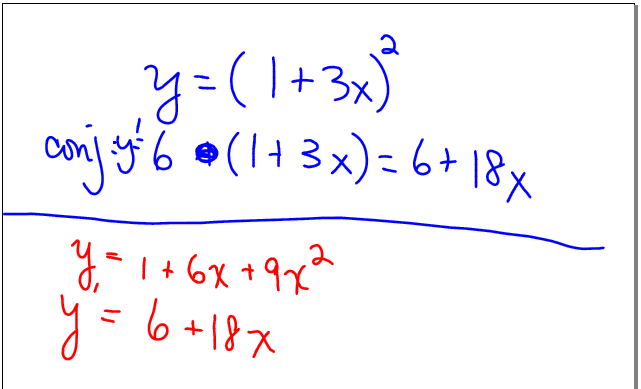

 , and I asked them: would it work to the third power? would it work to the nth power? And I left it as an exercise for their home enjoyment (our corny term for homework). I’m really curious to see who gets how far on this!
 Continuous Everywhere but Differentiable Nowhere