Author: samjshah

MEAN (grrr) value of a function!

In calculus today I was talking about how to find the average height of a function. Some kids just have a hard time understanding the concept. I always show them a few functions on certain intervals and I ask them what they think the average height would be. Just to initially test their intuition on the concept.

Some see it, and understand it; some don’t. All certainly have trouble articulating why they chose that value.

So I have two things that work for me, when explaining this. There’s some handwaving, but the focus is on the idea, and building intuition.

The first thing is we talk about how we would approximate the average temperature somewhere:
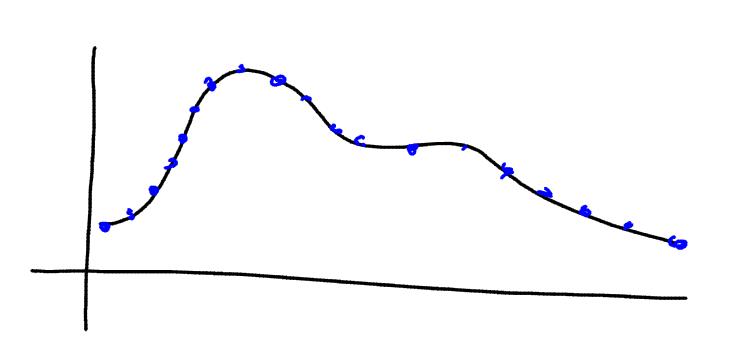
We take a bunch of temperature readings, and we add them together and divide by the number of readings.

How do you make it more accurate?

MORE READINGS!

How do you make it more accurate?

INFINITY OF READINGS!

What helps us deal with infinities and infinitessimals?

CALCULUS!

So that’s how we get started.

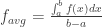
Then when I want them to understand the formula — f_{avg}=\frac{\int_a^b f(x)dx}{b-a} — I give them a little dumb, cute story.
So an EVIL mathematician has an almost 2 dimensional fish tank. Really thin. Sad for the fish. Which are almost 2 D. And the mathematician likes to lay a strip of plastic on top of the water,  and constrain the fish in these weird shapes.
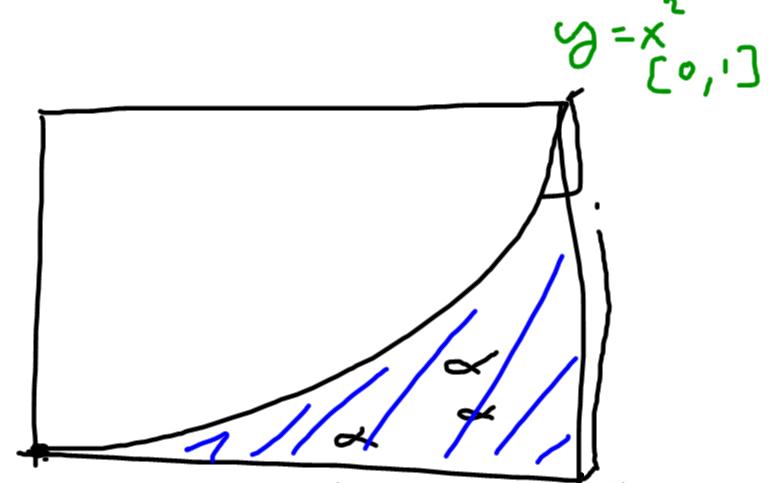
(In this case, the mathematician is constraining the fish in an x^2 from [0,1].)

You come along and want to GIVE THE FISH WHAT THEY WANT: a normal rectangular water to swim in.

So you yank the plastic strip away, and what happens to the water?

IT ALL LEVELS OUT!

What shape does it make?

A RECTANGLE!

Does the amount of water change?

NO!

What’s the height of the rectangle?

THE AVERAGE HEIGHT OF THE FUNCTION!

So by then, we have on the board:

And since the amount of water didn’t change, they know that the area of the red rectangle and the area of the blue rectangle are the same.

That makes sense to them.

I then threw this up and almost all of ’em got it!
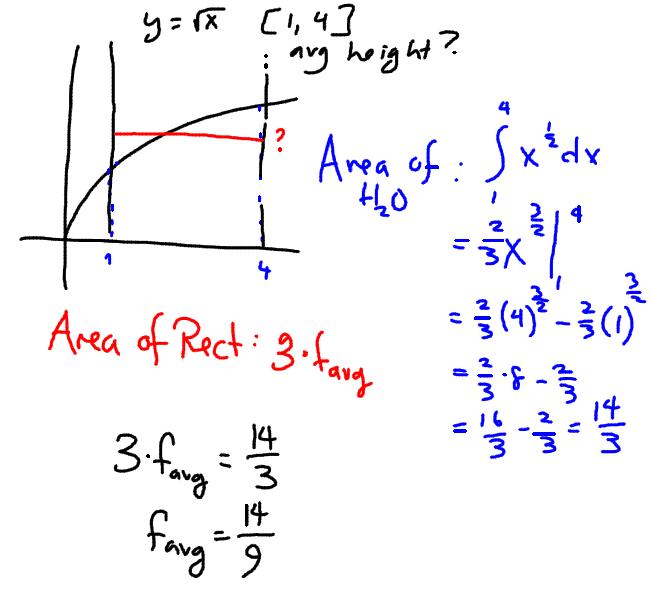
So that’s my way of building their intuition when it comes to average height of a function. It’s not like it’s hard for them to apply the formula, but I think this little thing makes it more conceptually manageable. And if they forget the formula, they can just do the “fish tank problem.”

Solutions to parabola problem

I’m going to post the way I worked out the two recent problems that I posted. Today I’m going to focus on the second problem first.  Other people had different solutions they threw in the comments to the original posts, so you can look there too.

FIRST PROBLEM:

Statement: A particle is moving along the curve y=x^2-x at a constant speed of 2\sqrt{10}. When it reaches the point (2,2), you know \frac{dx}{dt}>0. Find the value of \frac{dy}{dt} at that point.

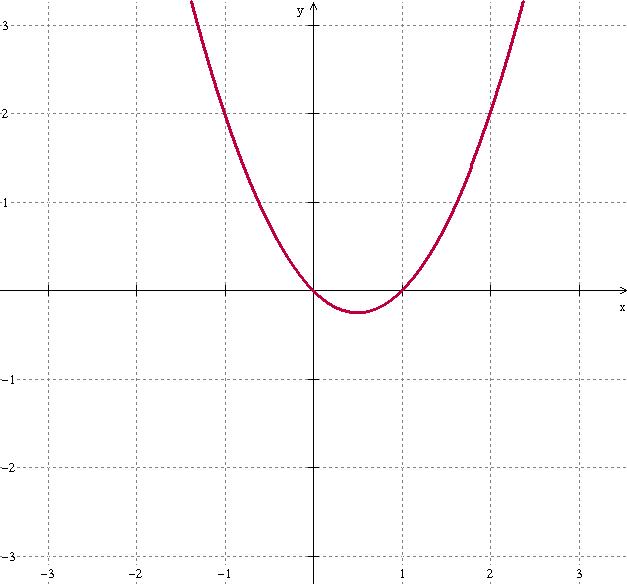
Solution: I imagined the particle moving along the curve, and it being played on a film. The particle follows this path and is going at a constant speed:

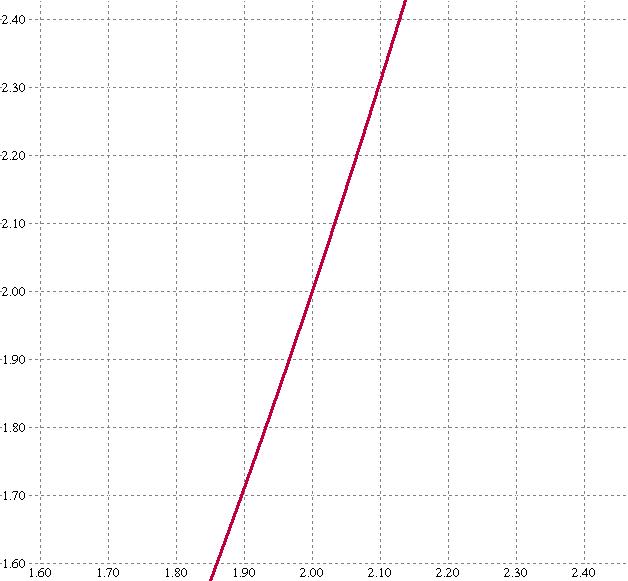
So then I said: we only care about the particle around (2,2), so I mentally zoomed in near that point:

So we don’t care about the rest of the picture. The particle is actually moving in a straight line in the area we care about, and this line is y=3x-4 (we found the equation of the line tangent to the original curve at the point (2,2)). So this greatly simplifies how I had to think about the problem. Where we care about things, the particle is moving in a straight line at a rate of 2\sqrt{10}.

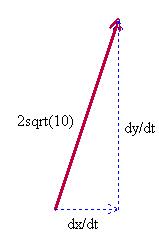
So then I thought about the velocity vector for the particle — moving in the direction of the line at a rate of 2\sqrt{10}. And this vector is composed of the velocity in the x-direction and the velocity in the y-direction: \frac{dx}{dt} and \frac{dy}{dt}.

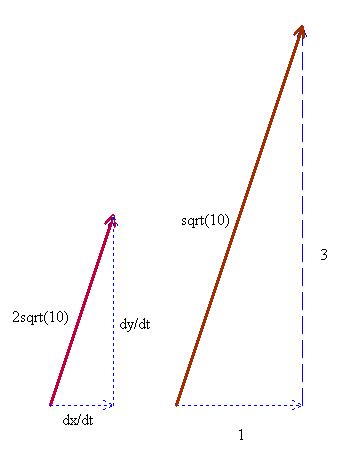
And we just have to use the last piece of information that we haven’t used… That the ratio of height/length of this triangle is 3 (the slope of the line — the direction of velocity — is 3). So we can solve this with a bunch of different ways, but I found the easiest to just make similar triangles and solve:

(I calculated that the hypotenuse of the second triangle was \sqrt{10}.) Clearly we can deduce that dy/dt=6.

In essence, this is the exact same method that other people used to solve it, but it took me to actually zoom in and picture what was going on with the particle to figure this problem out so that I conceptually had mastered it.

The way I approached the second problem comes later.

Parametrization, Parabolas, Calculus, OH MY!

Okay, so a second problem in a row! This one is a straight up calculus one, from the 2008 AP Calculus BC exam — multiple choice section. The teacher of that class asked me if I could work this problem — and I admit I struggled. She showed me her solution, and then I left thinking “it couldn’t be that hard…”

When trying to fall asleep today, I started thinking of it and I was able to solve it in a different way.

Without any more preamble, if you care to try your hand at this:

A particle is moving along the curve y=x^2-x at a constant speed of 2\sqrt{10}. When it reaches the point (2,2), you know \frac{dx}{dt}>0. Find the value of \frac{dy}{dt} at that point.

As usual, feel free to throw your thoughts, solutions, etc. in the comments below, if you want. I bet for many of you this will be super easy, but for the few of you who struggle through it (sigh) like me, you might find it actually frustratingly enjoyable.

Oh, and also throw down there if you get stuck and care to see my solution… It’ll motivate me to actually type it up in a timely fashion.

A good problem solving problem

So… I am in this “problem solving” group at school, and we spent today trying to come up with a lesson centered around problem solving that we could use for one of our classes.

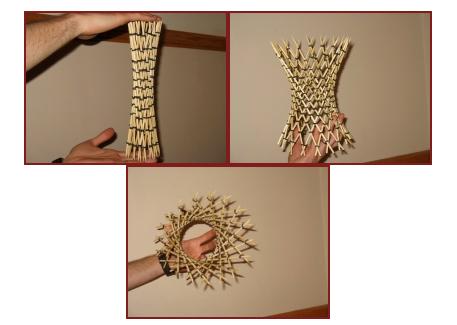
I’ve been really hankering to make one of these hyperboloids out of skewers:

and I thought it would be a great investigation for my multivariable class to figure out if indeed that was a hyperboloid of one sheet. I figured it would take a number of days — at least one to create one of our own, and a good number to figure out how in the world we would come up with the equation to define that beast. [1]

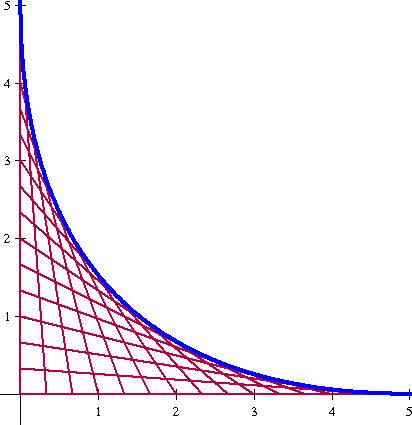
Of course one of the things we talked about in our problem solving group is how to bring the questions down to simpler questions — and then generalize. So I immediately thought of these drawings I spent hours of my childhood making:

[Yes, clearly my mother was happy that I found these to amuse myself with, instead of whiiiiiining “I’m so BORED… we have NOTHING to do in this house” as I did way too often.]

If you look, they define a really nice gently sloping curve.

So my question is: what is the equation (written in terms of x and y) for the curve above?

The first segment goes from (0,5) to (0,0). Then another segment might go from (0,4) to (0,1). Another segment might go from (0,3.5) to (0,1.5). (So however much down you go on the y-axis, you go that much right on the x-axis.)

I haven’t solved the harder 3-d question yet, but I had a heck of a time solving this 2-d question.

Since I had so much fun, I thought I’d share the problem with you!

I’ll post my solution later, but if you want to throw your solution down in the comments and how you came up with it (or blog about it), awesome. Just like with this “circles, circles everywhere” problem where someone posted the most elegant solution EVAR.

Fourth Quarter in Multivariable Calculus

We’ve just started the fourth quarter of school, and I’m starting to see some of my kids slip away from me, getting farther and farther out to sea — little bobbing dots in the distance.

In multivariable calculus, I’ve designed the course to prevent that from happening. I have a serious fourth quarter project for them — totally designed and executed by them. (They have to make a prospectus, they come up with a concrete and reasonable timeline, they troubleshoot problems that arise, and they even come up with the grading rubric.)

But I do something else to change things up, which actually is pretty neat.

We watch videos.

These multivariable kids will soon be off to college and will likely take tough, lecture-based math classes, where you don’t get the individualized attention you get in high school. My kids have never been exposed to college lectures, have never learned to taking solid math lecture notes, and have never learned to work through the difficulties that the lectures might pose.

So in the fourth quarter, I teach about 1/3 of the final unit… and then I hand the class over to Denis Auroux of MIT. Yup, I download a bunch of MIT OpenCourseWare 18.02 lectures and we watch them together in class.

Today, we watched Lecture 19 on vector fields and line integrals in the plane.

After we get to harder lectures, we’ll get in the habit of spending a day watching a lecture, followed by spending a day going over questions, tying the lecture to the book, and doing problems.

I feel like part of me is lying to ’em, though, because Denis Auroux is such a clear expositor with amazing board technique. Not standard, by any means. (But why burst their bubble now?)

If you were teaching an AP Calculus course, I would definitely have my kids watch an 18.01 (single variable calculus) lecture at least a few times after the AP test.

PS. I should really show them something like this — which I got exposed two a few times as an undergrad. Not horrible, but you really have to be focused.

BetterLesson featured teacher!

So BetterLesson asked me to upload some material that I had been meaning to upload anyway. And then they sent me a set of questions about

MEEEEEEEEEEE! (Yup, you got a total narcissist here.)

So yeah, despite Dan Meyer’s (valid) criticism of these “featured teachers” posts, I’m going to plug my very own featured teacher post!

So if you want to know my favorite movie/TV/cartoon teacher, or what my caffeinated beverage of choice is, or the process I go through when I create lessons, click on below!

Soliciting Senioritis Solutions

So I teach three classes of seniors. This year, the senioritis has set in early, and hard. I have kids who are already starting to check out. And instead of finding a positive way to bring them back into the fold, I have just gotten slightly sour, slightly annoyed, and scornful. I don’t like when I do that (though I know sometimes it is necessary). The senioritis isn’t yet in full swing, but at least for one class, it’s impacting the fun and enjoyment I have teaching (and consequently, that the kids might have learning).

So for any of y’all out there, do you have any CONCRETE advice on how to deal with senioritis?

Do you have a come to jesus talk?
Do you get all draconian up in their grill?
Do you collect and grade homework daily?
Do you have a class discussion about the frustration? What would that look like?
Do you have weekly quizzes to make sure stay on the ball and focused?
Do you have an explicit reward system? (If I only have to remind you at most 3 times, we can have a team math contest with a special prize!)
Do you do a project?
Do you make things more group centered — where students work as a team?

In other words, what have you done that works? For the past two years, I’ve talked with my students about how I never lower expectations in the fourth quarter, that I care about them learning the fun stuff at the end of the course, and that they simply need to stay on the ball. But although that generally works for a majority of the kids, I still feel like more kids than I would like have their grades (and understanding) drop in the fourth quarter.  I want to keep all of my kids (not just some of my kids) with me until the end of the year.

I will soon bring out a new class motto. It used to be “take what you don’t know and turn it into what you do know.” It is now going to be “BE ALL THERE.” I think I will get posters made and hang them in my classrooms, and point to them aperiodically.

UPDATE: I made my poster and hung it up in my classrooms