Author: samjshah

A fun double integral

On my multivariable calculus class’s current problem set, I put a number of really challenging problems. One of them — from both the Exeter Math 5 course (here) and also in Anton — has students evaluate the following double integral, and then has students change the order of integration and then evaluate the double integral.

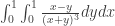
\int_0^1 \int_0^1 \frac{x-y}{(x+y)^3}dydx

Students expect the answers to be the same, but it turns out they are not. (Do you see why?)

Anyway, I have to say that I’m not a master integrator; it usually takes me a little longer than desired to figure out the best method to integrating. But I enjoyed the roads I took, so I thought I’d share the integral with you if you wanted a challenge.

And for those of you who know calculus, but forgot or never learned multivariable calculus, the problem reduces to you solving the following single integral: \int_0^1 \frac{a-y}{(a+y)^3}dy, where a is just a constant.

Have fun. And for what the double integrals turn out to equal, go below the jump.

(more…)

Messed up

I messed up. After what I consider a really successful unit in Algebra II on inequalities and quadratics, I was told that I had to introduce students to applications of quadratics. These include revenue problems, maximum area problems, and falling objects problems. I pilfered a list of 10 problems that the Algebra IIA class (the accelerated version of the class) used, and we went through each one of the problems.

Instead of giving a formal assessment on these three types of problems, I gave students a 3 problem “graded homework assignment” — which had two falling object problems and one maximum area problem. I told students they had to work alone, but they could use their notes.

I collected them and graded them, and the grades were atrocious. Almost all of the grades were atrocious. Which leads me to two important conclusions:

1. I really, really messed up teaching these topics.
2. I really, really messed up teaching these topics.

Now I’m not sure what to do. I honestly don’t want to revisit these topics now; we’re making good progress on function transformations and I’m not ready to lose the momentum we’ve gained. I don’t have time to re-teach the topics. And spring break is starting at 3:10pm on Friday.

Blah. The only reasonable solution I feel I have open to me is to:

1. Be direct with my students and accept responsibility for the bad teaching for those days, and have a (short) conversation with them about what made it difficult to follow. (I have a number of ideas, but I want to hear it from the horses’ mouths.)
2. Tell students that I am not going to count this assignment, since I’m taking responsibility for it.
3.  In the fourth quarter, pick one of the application types (I’m leaning to the falling objects one, because the students had the most problems with it), and just focus on teaching it well for one day.

I hate it when I mess up.

Be careful what you plot

Today in Calculus, I was waxing euphoric about why what we’re about to embark upon is amazing — how we’re eventually going to be able to find volumes and surface areas of strange figures. Not your standard spheres or cylinders or cones, but strange, exotic figures.

So I decide to open WinPlot and produce a surface created by revolving around the x-axis.

As I pressed “Enter” to generate the graph, I immediately recognized that we were going to have a problem. But it was too late.

revolution

I could have picked any number of other functions, but I decided to pick \sin x. Great.

We all had a laugh. Ah, high schoolers.

Moral: Be careful what you plot in class.

Reprise on Integration

Recently, I posted a bit asking people how they introduce integrals. And I got a ton of different responses, which was wonderful. I am going to copy a few bits of comments here, but I really recommend that if you teach calculus, you take a moment to read them all in their entirety.

David P.: I sometimes use the physics of displacement/velocity/acceleration to introduce antiderivatives. […] I am only in my 3rd year teaching, so I’ve not found a “best” way yet. I really like the “surprise” of the FTC that areas and slopes seem like they should have no connection whatsoever, but that they’re almost as related at + and -. So, sometimes I even just say, “ok, we’re done with that section, let’s move on to something else” and then try to surprise them when we get to the connection.

Andy: I usually teach anti-derivatives as part of my derivatives unit. […] I also show how it applies to the position, velocity, acceleration problems. Then I transition to my integration unit. I don’t even tell them about integration and anti-differentiation being related. I just talk about area and then when we get the the fundamental theorem, I am able to drop the crazy idea on them that integration and differentiation are related. I enjoy their reactions to that.

Nick H.: Generally, I like the ask questions first teach skills later approach.

TwoPi: I usually start off with velocity examples, and in each case link the displacement calculation (or approximation) to the geometry of computing the area under the graph of velocity versus time. So start with constant velocity, then linear velocity (and sometimes nice quick applications involving stopping distances for cars at various initial velocities).

This year I focused on anti-derivatives. On the first day, I just said: the derivative of x^2 is 2x, so the antiderivative of 2x is x^2. That’s all. The rest of the class had students struggle through finding simple antiderivatives (PDF and PDF). On the second day, I gave students a method to solving antiderivatives, a method which builds their intuition (PDF). And on the third day, I had students just practice, practice, practice.

Then I gave them a quiz — 17 questions asking for the antiderivatives of functions from x\sqrt{2x^2+1} to \frac{e^\sqrt{x}}{\sqrt{x}} to \frac{\cos x}{\sin^2 x}. Moreover, I didn’t give partial credit. If a negative sign was missing, or a constant was incorrect, I took off full credit for the problem.

The average grade for both sections was an A-.

So I have to say that my approach this year worked. I’ll deal with u-substitution and all that nonsense later. But the fact is, my students will be able to soon integrate some pretty hard stuff without resorting to u-substitution.

Many of the comments talked about working with position, velocity, and acceleration graphs to start out. I think after I teach the area under curves and Riemann sums, I will go into this topic. Honestly, I was hesitant to start integration with position/velocity/acceleration because anything physics related tends to make my students convulse. They are scared of physics. I wanted to make sure that they didn’t shut down completely before we even start.

(However, I am excited to derive h(t)=\frac{1}{2}g_{const}t^2+v_0 t+h_0 from first principles. I hope to hear lots of oohs and aahs.)

I almost broke my own rule…

During the school year, I have very little social life. This is because I have 3 preps this year (like last year!) and I haven’t been able to recycle much (any) material from last year. Which adds up to me not being able to go out on weekdays — because I’m at home making lesson plans, writing up packets, grading this that and the other, and doing all the other little things which add up. My time is like a grocery store receipt. When I go to the local Key Foods, I buy a bunch of small but necessary items (many on sale) and I go to check out. Nothing exceeds $5, but the total somehow reaches $8o or $100. I’m always perplexed how that happens. And this, coming from a math teacher! But yeah, that’s how I feel about my time also.

I have a rule that I don’t work on Saturdays. I have broken that rule — when I have a long commitment on Sunday or if comments are due — but rarely. I need this rule to set boundaries so that school doesn’t consume my life. As much as being a teacher has become central to my identity, I don’t want it to be my entire identity.

So this weekend I had a lot of work to do — grading Calculus tests, grading Algebra II homeworks, entering a ton of things in my gradebook, emailing a number of students, and creating my three lesson plans for Monday. And I almost started work on Saturday. To get a head start on the week.

But I said NO. 

Standing with defiance , I vowed to be a complete bum on Saturday, and catch up on a lot of terrible TV and Movies. (I even enlisted the help/company of a friend.) It was heaven. And on Sunday, I put on a bunch of things in the background when doing my work.

1. MOVIE: What Happens in Vegas
2. MOVIE: Made of Honor
3. MOVIE: P.S. I Love You
4. MOVIE: Definitely, Maybe
5. TV: Battlestar Galactica
6. TV: The Office
7. TV: Dollhouse
8. TV: 30 Rock
9. TV: House
10. TV: The Daily Show

Congratulations Mr. Shah. You’ve officially earned that PhD in Sloth that I always knew you were capable in achieving.

Ennui

I don’t really have the energy to give a true update, and I don’t want to complain. I just feel like in the past few days, I’ve been struck with a sense of lingering ennui, and I’m hoping that Spring Break rejuvinates me. It appears that students are really stressed out this week, and it’s being reflected in the way they’re acting. And honestly, it’s a bit of a cycle, because the way the students are feeling is affecting the way I’m feeling, which is affecting the way that students react to me, and so on and so forth.

For short updates on my three preps, read on.

1. In Multivariable Calculus, we’ve been working very slowly on our current chapter. I thought we’d be able to finish it before the quarter ends, but now I’m skeptical. We’re going to have to work pretty darn hard. The current problem set that I’ve given them is pretty tough, but we’re doing this one even more collaboratively than the others, so I’m glad about that. Recently, in class, we had to solve \int \cos^4(x) dx and I forgot how to even go about it. We found a nice, but convoluted solution, because we were working with nice limits of integration. But I have to tell you… I forgot how to do a lot of these less straightforward integrals. The good news is that we came up with ideas and found the solution using symmetry arguments and trig identities. Awesome. At first I feared this was a waste a time, but then I realized: this is what this course is about. Problem solving. You have something you don’t know, and you don’t have a formula for it. Work it out.

2. In Algebra II, I’m a bit behind the other teacher. We’re teaching function transformations, after a pretty arduous — but I’d say successful — unit on inequalities and quadratics. I don’t have a great way to introduce function translations, other than students doing some graphing by hand and noticing some patterns. (“Oh! The graph is the same as the other graph, but moved up one unit!” or “Oh, why is the graph the same as the other one, but moved to the left?”) I’m repressing the name now, but some math blogger posted a Logarithm Bingo game. I think that once I finish the functions transformations unit, I’m going to design and play Function Transformation Bingo!

3. In Calculus, we’ve been working more on the anti-derivative. It’s funny how different my students are. Some have the intuition like *that* while others are struggling to figure out what’s going on. But honestly the only way to do these problems is to really struggle through them. My favorite problem from last night’s homework was to find the antiderivative of x^{1/3}(2-x)^2. Almost all students got it wrong, because they didn’t see that if you expand everything out, the problem reduces to something much easier: finding the antiderivative of 4x^{1/3}-4x^{4/3}+x^{7/3}. Well, them not seeing that it is easily expanded causes me less chagrin than a student saying, “so you must first multiply the x^{1/3} by each term in the 2-x expression, and then square it?” YEARGH!

That’s all folks.

How do you introduce integrals?

I’m putting a call out to calculus teachers and calculus aficionados out there. I want to know how you transition to teaching integration, and why you cho0se to do it that way. And if you have any activities, investigations, etc., that you can send me, I’d love to have them (and post them here for other calculus teachers).

I’m not super pleased with, but I don’t hate, what I’m going to be doing tomorrow.

Here’s the deal. I just gave my last test on differentiation today, and tomorrow I’m transitioning to teach integration. I teach a regular (non AP) calculus class, so we can take our time. At the moment, I’m grappling with two things: (1) whether to teach anti-differentiation first and the notion of “area under the curve” second, or vice versa, and (2) how to make integration intuitive.

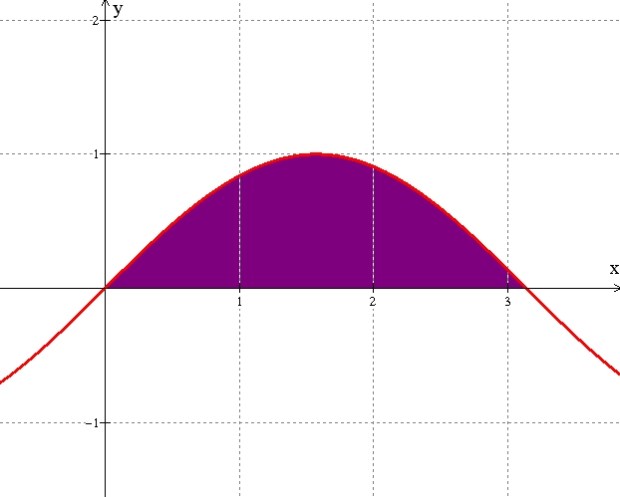
Last year, I transitioned by giving students a graph of y=\sin(x) and told them to find the shaded area. Those were my only instructions.
sine

Some students made triangles, some students guestimated, some students made rectangles. I don’t remember all the different approaches. But then we had a discussion about how they estimated their areas, which then led to me transitioning to Riemann sums and a general introduction to the whole new unit. The thing I emphasized: “In all your previous math classes, you only learned how to find areas and volumes of silly little figures, like squares and cubes and maybe you remember a nonagon or cone. But what about crazy, strange, weird areas? Volumes of crazy, strange, weird figures? Did you ever wonder where the formula for the volume of a sphere come from? Calculus not only can answer questions about position, velocity, and acceleration, and how to maximize and minimize quantities, but it can do all this other stuff too.

This year I’m not going to talk about areas under curves (yet). I’m going to start with two days of practicing antidifferentiation. I’m not going to say much to transition to this new material except to say that derivatives were the first part of the course and antiderivatives will be the second. And that we’ll soon be able to do a lot with them, like we found out we could with differentiation… Then I’m going to introduce the idea of the “opposite of differentiation” and spend the entire period having students build their intuition.

First, they’re going to do a matching game in pairs (PDF). We’ll then quickly debrief, but not really go into depth about any question.

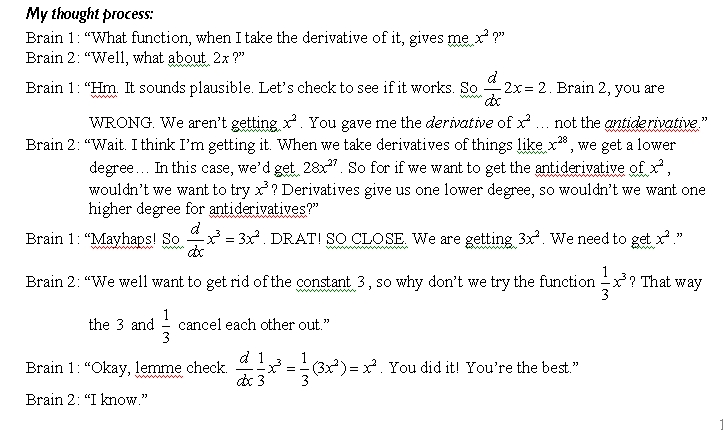
Second, they’re going to work in a different set of pairs on just playing around with finding the antiderivative, by intuition and guess and check. I want them to learn to think through a problem. So I typed up what goes through my head when I try to do an antiderivative.
thoughtprocess

And then I’m letting them loose on a set of problems which should hopefully introduce them to some basic integration rules (PDF). I think it’ll take the whole period. And we’ll spend the next day debriefing. I want them to struggle through integration now. I want them to see why \int x^2 dx=\frac{x^3}{3}+C instead of memorize the power rule. I anticipate it to be kind of hellish for them; they — like most students — want formulaic ways to do calculus.

But just as I struggled to hone my students intuition (see my previous blog post) for differention, I wanted to make something similar for integration.

We’ll see what happens tomorrow.