Author: samjshah

You know it’s a bad sign…

You know you’re a bit rusty from the summer when a teacher asks you to — without using L’Hopital — to prove that:

\lim_{x \rightarrow \infty} \frac{\ln(2x)}{\ln(3x)}=1

And you are like, oh, that’s easy.

And then — after two false starts — it takes you 3 minutes to figure out.

Just remember: you are a calculus teacher.

I’m going to say it again: you are a calculus teacher.

Maybe if I say it enough times, it will be true.

(more…)

I don’t wears rose-tinted glasses

Every so often, I get a reminder of how completely different this independent school world is to the rest of the universe of schools out there. I guess after my first year in this microcosm, the shock and infinitude of differences have become so naturalized that I fail to recognize the weirdness, except when something jars me out of this strange reality.

Then you’ll usually hear me mutter “back when I was in school…”

And Sarah and Jackie’s comments to my last post did exactly that. I spoke about letting students out of my classes a few (not many) minutes early, if they finished and checked over a quiz. How is that even possible?

Let me paint a scene for you.

A school where there are no hall passes, no late passes, no detentions, no bathroom passes [1]. Students, when they have a free period or two, can sign out and leave the building. To get lunch, to get coffee, to enjoy some fresh New York air. Sometimes students sign out three our four times a day. We send our official attendance to the main office only once daily — after homeroom — and then teachers are responsible for keeping track of their classes attendance. Students are trusted that they’ll be where they need to be.

Not that there aren’t the occasional breaches of trust. A substitute comes and a student sneaks out of class. A student skips out on a gradewide meeting. Students who aren’t allowed to sign out — because of being late to school too many times or being put on academic probation — sometimes do sneak out. (Not on my watch, mind you.)

But they are occasional, and definitely the exception.

Right now, as I type, I’m sitting with my laptop at the sign out table in the front entrance. Students come by to say hi as they walk to Chipotle for lunch. I often get to have really nice conversations with teachers who walk by.

It’s a different world from what I grew up in, where our bathroom passes were toilet seat covers spraypainted in neon colors, where we had official pink hall passes, and where there were detentions for being late to class too many times. I guess that’s my “back when I was in school…” moment.

There are amazing benefits to working at my New York City independent school. And, as you would suspect even though I don’t write about them here, there are problems too. I don’t see my school through rose-tinted glasses. Seriously, I don’t. Still, I have a lot of admiration for this community that has been cultivated over the past hundred and some years. This school does something right… a lot of somethings right.

The mathematical key

I gave my first official quiz today in my Algebra II class. Since so many of my students have 50% extra time accommodations, I designed a 30-35 minute quiz and let the class take the entire 50 minutes. Usually there are a number of students who finish early.

Before students turn in their quiz, I tend to say “are you absolutely, absolutely sure you want to turn this in? Once it’s in my hands, I won’t hand it back, and it tends to be exactly 1 second after students hand in a quiz that they realized they made a mistake and want to check over the test again.” Except for those with some sense of usually false bravado, they wisely go back and check over their work.

But I’ve come up with a good way to keep students occupied once they’ve finished their test. I put up a problem — somewhat based on what we’ve been doing but *just* different enough that students will be forced to make a new conceptual leap on their own. If they show me the right answer, with correct work, I let them leave class a few minutes early. A luxury, for sure. The solution to the problem becomes their key out of my class.

Today in Algebra II, we had a quiz that covered — among other topics — inequalities. Students learned simple linear inequalities and how to solve them. So, for the challenge problem, I put:

Find and write in interval notation where: x^2+4x+3 \leq 0.

Two of them got it. Most of the rest of the class wanted to get it. I liked them thinking about problems that are just beyond what we’ve done.

Learning styles in our faculty meeting

Today we had our upper school faculty meeting (read: high school teachers meeting). The topic: learning styles. It was led by our really wonderful — and capable — and amazing learning specialists.

In the meeting were two activities I want to talk about.

One is we had a panel of students (mainly seniors) come in and give us — without using any teachers’ names — their opinion of what works for them in a class. Some things they noted were that doing problems over and over (drill practice) worked for them in math. And having teachers pause every so often for students to spend two minutes (no more!) doing a “check in” problem, or discuss a new concept, was useful. They also discussed the importance of pacing, and having a really explicit lesson plan (“by the end of today, you will be able to …”).

I thought having students give their perspective was so much more powerful than anything else we could have done for this meeting. (See this previous post for more: A letter sent back in time.) I would have actually loved a bit of a Q&A with them. (I really wanted their candid perspectives of group work; what goes through their head when the teacher says its time for groupwork, and how the dynamic actually works out in most of their classes.)

The second activity was less impressive, and actually a little frustrating. It was an activity where we had to answer questions, and walk around the room, to determine what kind of learner we are: kinesthetic, auditory, or visual. And even though it was mentioned that these categories had gradations, and that no one fits perfectly in any of these categories, we were asked to discuss how our own learning style affected the way we teach.

The problem is, I had watched this video that had been circulating through the blogosphere in August, and I I really buy into the message.

(Read the comments at Eduwonkette for some good stuff.)

So I’m not sure how to deal with the concept of learning styles. And according to the video, I’m not sure that should really be the central focus of how I plan my lessons.

Monday Math Madness 15

My favorite* online math puzzle contest — Monday Math Madness — has decided to use a problem that I submitted for a previous contest.

CHECK IT OUT HERE!

*It’s really the only one that I know. But that shouldn’t be taken disparagingly; the problems are just hard enough that you have to make one really rewarding conceptual leap, and just easy enough that with enough perseverance you know you can conquer it.

Somewhere, over the rainbow

I was watching the TV show MONK this weekend, and the latest episode featured a double rainbow.

I got excited, because last year one of my calculus students did a mini-project on rainbows and I learned what caused double rainbows. One thing I learned while helping this student is that when you have a double rainbow, the colors of the “top” rainbow are reversed.

When I noticed that the colors on this rainbow weren’t reversed, I was like… “hmmm… this is a crucial clue to the mystery.” Turns out, however, that it was just a rainbow badly superimposed by someone who doesn’t know about rainbows.

A double rainbow actually looks like this (notice the reversed colors):

If you care to learn about the mathematics behind rainbows, I suggest reading this very accessible paper.

One thing I didn’t know about rainbows is that they are actually circular; from the ground, we are just privy to part of them. But from air, we could see the whole thing!

Pretty cool, huh.

Cross Products

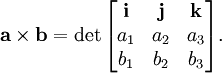
So I was teaching the cross product in my multivariable calc class on Friday. For those who are a bit rusty, \vec{a} \times \vec{b} is the notation for the cross product between 3-dimensional vectors \vec{a} and \vec{b}. It is defined as:

Prompted by a question from a student, I was struck with two related questions. One is: why does \vec{a} \times \vec{b} yield a vector orthogonal to both \vec{a} and \vec{b}? That question doesn’t mean I want a proof: I can do that. But I want some intuitive sense of why it works.

The second question is: can we find cross products in other coordinate systems, in the same way? How generalizable is this whole “take the determinant of a 3×3 matrix”? Would finding a cross product using a determinant work in, say, spherical or cylindrical coordinate — where instead of putting \vec{i}\vec{j}\vec{k} as the top row of the matrix, you put the fundamental unit “direction” vectors in these other coordinate systems? I haven’t played around with these coordinate systems in a long time, but I suspect the answer is no. (And to see that, I’d just have to do a simple test case, which wouldn’t work out… and that ought to be good enough.) I have to run to a picnic now, so maybe I’ll try this out later.

Hm, this looks like it could be turned into a good question for the next problem set, or even a good project for the multivariable students.

This train of thought also got me musing on the “what are the origins of vector analysis?” question. I haven’t had time to do any serious research, but it appears that one important book on this question is A History of Vector Analysis by Michael Crowe.