The Students Are Watching || A Review

Although school is over for my students, it isn’t over for me. I am doing what I have come to affectionately term “New Teacher Boot Camp.” Its official title is “Collegiate School Teaching Institute” and is a two week program (weekends included!) which focuses on skills for new teachers, as well as getting new teachers acclimated with aspects of teaching particular to independent schools (such as comment writing, for example).

Before attending the boot camp, each of the participants was asked to read and review Theodore R. Sizer and Nancy Faust Sizer’s book The Students are Watching: Schools and the Moral Contract. My review — surely still with typos and needing a good proofreading — is below the fold, for anyone who is interested. The one thing I didn’t put in the review, but which I couldn’t help but notice as I was reading this book, was how well my school conforms to the Sizers’ view of a good school. The thoughtful and reflective community (we often — sometimes to my chagrin because we do it too much or badly — talk about the core values of the school and how we can enact them), the attention to making each student feel like they are part of the community and respected, the emphasis on community norms and collective decision making (such as having a student-faculty judiciary committee or inviting students to be on hiring committees), the knowledge that each student has an individual learning style (the learning specialists are central to the running of the school and not a peripheral department; we write narrative comments on each student twice a year), and so on and so forth. No one would claim that it is a perfect school. But at least in terms of how the Sizer’s see things, I think they wouldn’t bite their thumbs at us.

Again, review after the jump. My opinion of the book below is very likely (read: almost certainly) going to change after I get to discuss this with the other participants in the program.

(more…)

Graduation!

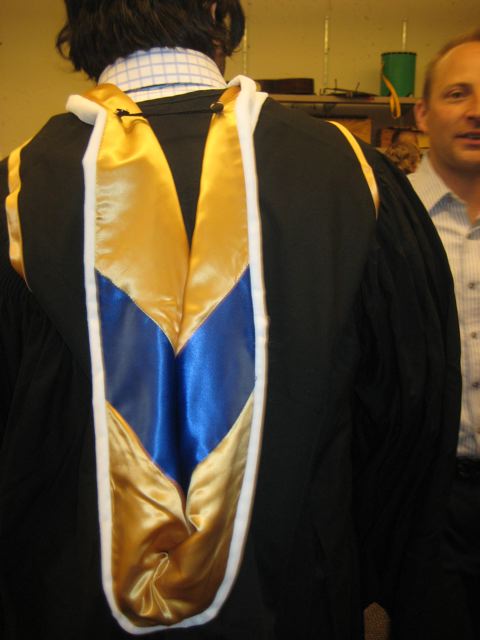
Graduation was on Thursday — as you can see from the picture of me wearing my hood above. My merry band of seniors graduated, and that’s the end of them. Yeah, one of them might stop to write an email here and again, or pop by the school when they’re back in town, but let’s face it. They’re gone. And am I okay with that?

Surprisingly, yes. I honestly don’t know why, but I am. Not that I won’t miss them — they might be the standard by which I judge all future calculus classes — but I honestly think I’m okay with the “they come into your life, they go out of your life” revolving door aspect of teaching.

Picturesque and poignant defined the ceremony. It was held outside, with our 1851 Hogwartian brick building acting as our backdrop, light streaming through leaves as the sun slowly started setting, with a gentle breeze punctuating the warmth and a few butterflies fluttering around. Students sang, surprisingly mature speeches had us laughing, and then like the end of a really good chapter in my life, it was over.

While the seniors graduated, I also thought about all the colleagues who I’ve come to respect and truly like who are leaving; they also are graduating. And from that, my mind moved on… Graduation was the first time I was able to take a moment away from the hustle and bustle of the End Of Year Things To Do, and I finally really realized I too had graduated. I finished my first year teaching, and I loved it.

Congratulations, me!

Electoral Math and Computer Science Rocks!

I wish I taught a computer science course so I could introduce this problem.

How many unique ways are there to acquire at least 270 electoral votes without any excess?

For example, one combination would be to win California, Connecticut, the District of Columbia, Hawaii, Illinois, Maine, Massachusetts, Michigan, Minnesota, New Hampshire, New Jersey, New York, Ohio, Oregon, Pennsylvania, Rhode Island, Vermont, Washington and Wisconsin. That would be equal to 272 electoral votes (not coincidentally, these are the John Kerry states plus Ohio).

Note that there are no excess electoral votes in this combination: if you remove one of the states with three electoral votes, the number falls to 269, which is below the 270-EV cut-off. So winning all of these states plus North Dakota would not qualify, since the candidate has superfluous electoral votes. On the other hand, replacing Vermont with North Dakota would make for a unique combination.

Not only is an awesome math/computer science problem, but I have to say that I totally love the response that it generated in the comments. (Plus, Isabel Lugo’s solution is just so damn sleek.) Minus a minor spat in the comments, this is totally one heck of a sick blog post.

Best. Comic. Ever. (For real this time.)

So previously I touted this as being the best comic ever. (Click link to see.) However xkcd has outdone itself with this one.

Although the funding structures have altered this in recent decades (where anybody knows where once physics was on top after WWII, now biology is on top), I still admit this overarching bias in my thinking. Math reigns supreme, lording over all other sciences, which are mere derivative structures, polluted more and more as you descend down each rung on the ladder of knowledge. Ka-chow!

Seventh Grade Reactions To My Teaching

This year was my first year teaching, period. But it was also my first year teaching seventh grade, which I was not trained to do, nor did I anticipate liking. Junior high was a mess for me. I didn’t do terribly well, and I had almost no friends, and I’ve honestly blocked it out of my memory. I can’t remember my teacher’s names or anything that I did. I took the job in spite of this class — because I liked the school that much. And in fact, I ended up loving teaching my seventh graders. They are so sweet and awesome! But still, not knowing what I was doing with this age level, I had to improvise how I acted with them.

Oh Thursday last week, while I was at my college reunion, I had them write comments for me (flipping things around… in my school, teachers write narrative comments on each of their students twice a year… I thought I’d give them a chance to reverse that). The feedback was very positive overall (huzzah!).

A quick and dirty analysis of things that srtuck me below [things in quotation marks are direct quotations]:

  • A common refrain was “your teaching style is great, but different.” A few said that something to the effect that “it took me a while to get used to you and your teaching style [but then I loved it]” I actually am surprised by this, because I didn’t think I taught differently than any other middle school teachers! I wonder what makes me different.
  • A couple of the students thought I could “explain subjects a little more” and that one student “didn’t understand what you were explaining in class till the day before the test.” Yikes! But to mitigate, many others said the class was at the right level for them.
  • A number commented on how they loved how I ended each class wishing them a “Marvelous Monday, Wonderful Wednesday, Terrific Thursday, or Fabulous Friday” and a few wished me a “Super Summer.” (And one wished me a “Stupendous Summer.”) Interestingly, I didn’t know they really paid attention to this quirk of mine, that I picked up from my dad when I was younger, but it stuck with them!
  • Many students (even the ones who got really good grades) found the course pretty challenging and fast paced. And this actually made me happy, because that was explicitly the goal. In seventh grade, I’ve noticed, they can pick things up really quickly! When their minds are this moldable, it’s great to get a lot in there. We did some extraordinarily hard stuff (find the volume of an equilateral tetrahedron knowing only the side length) which messed with their minds. And the best part is: they got the hard stuff. Not barely got it or grasped onto it, but they *got* it.
  • In concert with the last point, the students seem pretty conscious that I hold them to a high standard: “I also learned that you had very high expectations of us that were achievable but we were not of expecting them.”
  • Almost universally, the students commented on my  “enthusiastic attitude” and energy level. Which I think translates into one student saying that I’ve taught her to “have so much more confidence in my math because you know I could do it and I did.”
  • A few said that the other teacher held review sessions, and I should have done that, instead of sending my kids to her sessions, because she taught things slightly differently. I buy that. And a few wanted more personal one-on-one help. The difficulty with that is that I teach in the upper school, so it’s hard to have a solid presence in the middle school. But to deal with that, I always sat in the lunchroom on Wednesdays to answer questions. And I always met with students when they emailed me for help. The students who commented that I didn’t provide personal help never asked for it! They never came to my lunch table on Wednesdays either. Maybe it’s my fault, and that in the middle school, I should be the one asking them if they need help? But maybe not.
And that’s the rundown of my feedback from my seventh grade class.

Final Exam Grading Marathon is Over!

I went to my college reunion this weekend [1].

Hanging over my head was returning to school to grade my final exams. Out of my four classes, I only had to give finals to two classes (my seventh grade class and my senior class both don’t get finals). But I dread grading. It’s horrible. And even though it went quickly, it was pure torture.

The funny part is, the actual physical act of grading wasn’t hard. It’s easy to see where students went wrong. And I had such a tight rubric, I knew just how many points to give for each problem before I started grading.

The hard part was seeing what I got my kids (on the whole) to retain throughout the year. And the answer: not too much. Oh yeah, they picked up a few things here or there, but when it came down to it, it was not nearly as much as I thought. I had a few As, but for the most part, the kids were getting Bs and Cs.

Which doesn’t sound so terrible. But the exam was designed to be extraordinarily easy, focusing on basic skills, so easy in fact, that I went into my grading frenzy expecting a spate of As and Bs, with only an occasional C.

How fleeting it is the stuff we teach them! I’m going to think over the summer about redesigning the cours putting an emphasis on retention. This will probably include pop quizzes and spiraling and assigning review homework each night in addition to homework on the new topics. I love dy/dan’s method of assessment, and maybe I’ll come up with a slightly modified procedure for my classes, but one thing his method doesn’t do is account for retention. Once a student passes a topic, he or she is done with it. Chances are that by the end of the year, it has been forgotten.

Perhaps what I’ll do is make a list basic skill topics that all students must master, and allow re-testing on those a la dy/dan. And then give tests and quizzes on more difficult topics which ask for synthesis and application. And then weigh the two types of knowledge in some fair way — like 50/50 or 60/40.

But let’s celebrate! My grading is over, I’ve calculated final grades, I’ve entered them in The System, and now I’m ready to close up shop! Just finishing up this week and I’m done.

UPDATE: Coffee & Graph Paper just posted about his experience doing just what I was talking about. Read Part I and Part II here.

[1]  It was a bit of an alterna-reunion because I didn’t *do* any of the reunion activities. I just met up with my crew and we hung out. Of course I got to see a bunch of other people I knew, but honestly, awkward conversations that get repeated ad infinitum aren’t my cup o’ tea. I got to see the new physics building, which blew my mind. (I would have been a physics major if I had that building to work in!) I got to go to a house party which got shut down. I got to go to a birthday party of a fraternity brother which turned out to be a surprise wedding that not even the bridge and groom’s parents knew about. It was all good times.

Math 55: The Hardest Freshman Course in the Country

Harvard apparently has this notoriously difficult math course that the really advanced frosh students take. Like, the ones who have already taken advanced classes (and I’m not talking about the more fundamental multivariable calc, differential equations, and linear algebra). It has a whole “mystique” surrounding it. It’s called “Math 55.” Apparently you’re supposed to “oohhhh” and swoon when you hear that, or at least go “Oh my god! Isn’t that insane?” And then make some comment about it being the hardest freshman course in the country. At least, that’s what the Harvard math department touts it as on their webpage.

I’m surprised I had never heard of it. I only first heard about it by reading this article recently, excerpt below:

Later that first night, the first problem set is released online: 13 questions, each consisting of multiple sections to make a total of 47 parts. While nearly everyone is alarmed by the amount of work, Litt says he’s not too concerned. The class can’t stay this hard for this long, right?

“I figure he’s just trying to get people to drop the class,” Litt says.

He figured wrong. As class attendance steadily thins, the workload does not. The first few problem sets each take about 40 hours to complete. The work burden is reason enough for many extraordinarily gifted students to drop.

Case in point: Ameya A. Velingker ’10 took Advanced Placement calculus his freshman year and ranked in the top 12 for the USA Math Olympiad the year after that. “It was a tough decision to drop,” Velingker says. “You’re around all these people who are beasts at math. But I realized it was not going to work out.”

I don’t doubt that it’s insane.

I can’t help but be struck by the cult that’s grown up around it. The article analogizes it to be like a fraternity. (Of math geeks.) There’s also a lot of working together, burning the midnight oil.

It harks back my own “tough freshman math class.” I certainly was not Math 55 caliber. But freshman year I took 18.100B, the theoretical version of real analysis. We used a slim, blue, and terse book. Yup. The slim, blue, and terse book. And from my perspective, that book had been forged in the depths of hell. And given a $150+ price tag. [see update below]

I didn’t struggle in high school math. But let me tell you, putting myself in a class freshman year where I wasn’t yet mathematically sophisticated was not wise. Everything in class made sense. Well, everything in the first five minutes. Then came a bunch of notes and symbols, discussion about compactness and limit points, and then I left dazed, bumping into random people and pillars on my way to the library to curl up with the book, struggle, and be frustrated at my brain for not being able to “see” “it”.

We had weekly quizzes. I think I usually got a 0, 1, 2, or 3 points on them. Out of 10. My mind didn’t work that way. But I endeavored. I don’t know why. Pride? The belief that I could do it? Not wanting to admit that I couldn’t? And at my school, I thought it was rare that anyone went to talk with the Great Professors and ask for help. I was a freshman. I didn’t know anything.

And so I continued studying like no one’s business. And when the final came around (worth 40% or 100% of my course grade, whichever is more beneficial) I literally lived and breathed that blue book for days before. The final was hard — I think only 4 or 5 questions — and I left depressed. But I nailed it.

I don’t know what the point of this post was, except to recall one of two math courses which kicked my butt. Many of my students go through that struggle and frustration in high school. They study a long time and they still don’t get the grades they want. But I can identify with their frustration. It just came later for me. [1]

For those who want more information, besides the article above:

1. A forum talking about the course.

2. The Harvard math department website discussing Math 55. (Scroll down to Math 55.)

3. A few Math 55 course webpages throughout the ages: Fall 2005, Fall 2002.

[1] I know two main differences though. My students think that somehow their grade should be based on effort, and not merit. That didn’t cross my mind in college. I thought you should get grades based on whether you could work the problems or not. The second difference is that many of my students believe that there is a magic bullet that will help them, like meeting with me on the day before a test. I also knew at that point that there is no royal road to mathematics, no panacea that will force understanding.

Update: A funny comic about that dang book here.