Nomination for Best Open PD for Edublogs

It surpassed everybody’s expectations. I am a curmudgeon when it comes to professional development, and I want my time valued. This conference was the most powerful professional development experience I have been to. And that is why I would like to nominate it for an Edublog Award for Best Open PD.

It was Twitter Math Camp 2012, or fondly known by all of us as TMC. I waxed poetic on it on a previous blog post which is a better nomination than anything I could come up with now. I said:

It was like we were on 40C2 first dates, which felt our 40C2 fiftieth-gazillion dates. Because we all KNEW each other. We knew about each others’s schools, kids, husbands/wives/bfs/gfs, movie and music preferences, deepest fears (SPIDERS!!!)… and still wanted to meet. I think the highest praise I can give is that the overwhelming feeling of nostalgia I had after leaving from this four day conference.

Every session that I attended was great. (But of course the best session was the one I led!) I learned about interactive notebooks and foldables, about the concept of “flow” in the classroom and how to disrupt the hidden pedagogical contract that schools have with kids, and about teasing kids with motivating questions and problems…This, in itself, is powerful. There were concrete and useful takeaways for my classroom practice. But what made it all the more powerful for me is that I was getting these ideas from teachers I knew personally and trusted. Everything was vetted. And anytime I need more information, or resources, or have questions, I can just send an email, tweet, or comment on a blog. And I can give back by sharing my experience with the things I take from others. Our community is dynamic and responsive and open to ideas and change, and we’re all on equal footing. And that only comes from us being friends…

But the sessions were only part of it, and I would argue, the less important part. We broke bread together while rehashing old memories together, as old friends do. If anyone felt that what we had wasn’t real, watching me give @approx_normal a piggyback ride at the Budweiser Brewery Tour, seeing @jreulbach excitedly show us and an entire movie theater how to cheerlead-dance before a showing of Magic Mike, seeing the almost English-teacher-level of hugging that was happening in the last few days [2], would change anyone’s mind. My favorite thing at the conference was the laughter.

I still get a glow-y feeling when I think about those four days. Because it was the culmination of something that had been brewing for years: friendship that we developed through a common passion (and through the common trials and tribulations) of teaching math. You want to see how awesome it was? Lisa Henry links to 21 different blog posts recapping the conference, all pretty much saying the same thing: aaahhh-may-zing! 

In fact, Education Week blogger Justin Reich said:

Math Camp and similar events tell a story of teachers leading the march towards better instruction, better outcomes for students, and more meaningful learning by pooling their shared experience and working together to create better classrooms and schools. In an age of a soul-crushing standardization and the reduction of teaching to poorly-designed tests and improperly used value-added scores, we need to celebrate our teachers’ incredible commitment to students embodied in an event like Math Camp (and the hundreds of other unconferences and teacher-led guerilla PD events happening around the world).

One of the ways that teachers can take back control of the narrative in education is to take the lead in improving the profession. Unions should be at the very front of this effort, but teachers everywhere should be organizing to form communities, improve their craft, and have a ton of fun doing it. Lisa echoes what I hear from so many educators who pursue this form of professional development: “Quite simply, TMC12 was the most rich professional development experience I have ever taken part in.”

We had guest stars come give keynotes at the conference (Shawn Cornally of Think Thank Thunk fame skyped in; Karim Kai Ani of Mathalicious fame graced us in person). We problem solved in the morning. We gave each other ideas and resources. We shared ideas and led sessions for each other. And these were sessions that were all the more powerful because they were continuations of conversations we had been having online for months or longer! The program is below:

We came out of the conference stronger as a community. It was a conference made by us, for us (under the leadership and hard work of Shelli Temple and Lisa Henry). And hopefully, based on the positive responses and the conversations that have been happening lately, it is probably just the inaugural one!
Will the fish bite?

Today at the end of Precalculus today I asked if any kids had any questions/topics they wanted a quick review on for an assessment we’re having tomorrow. (We lost a week due to Hurricane Sandy, so it’s been a while since they’ve worked on some of the topics.) One of the topics was inverse functions, so I gave a quick 3 minute lecture on them, and then we solved a simple “Here is a function. Find the inverse function.” question. They then wanted an example of a more challenging one, so I made up a function:

And then we went through and solved for y. And we found that …

… the function is it’s own inverse. Yup, when you go through and solve it, you’ll find that is true. (Do it!)

I said: “WAIT! Don’t think this always happens! This is just random! Really! This is random!”

But I just had the thought that this might be good to capitalize on. So I sent my kids the following email:

I don’t know if anyone will bite, but I hope that someone decides to take me up on it. I already have a few ideas on how to have them explore this! (Namely, first exploring \frac{x-b}{x-d} and then exploring \frac{ax-b}{cx-d}.)

We’ll see… I’m trying to capitalize on something random from class. I hope it pans out.

A biology question that is actually a probability question

Now that the hurricane issues are slowly dissipating, I made it back to Brooklyn today, back to the place I spend most of my time… my school… I suppose you could call it home.

I’m doing some work here before turning to my apartment, and I ran into a science teacher who asked me a question:

Let’s say you have a sequence of 3 billion nucleotides. What is the probability that there is a sequence of 20 nucleotides that repeats somewhere in the sequence? You may assume that there are 4 nucleotides (A, C, T, G) and when coming up with the 3 billion nucleotide sequence, they are all equally likely to appear.

I liked the question, but I haaaave to work on my own work and not this problem at this moment. So I thought I’d throw it to you.

A. What’s the answer to this question?

B. How would you explain it to this biology teacher (who knows basic math stuffs)?

and for the bonus…

C. How would you design a lesson that would make a student understand the process and your answer. You can assume that the student understands combinations and permutations.

If I get some work done today, I may think through this problem as a treat. If none of you beat me to the punch. But I’d rather you beat me to the punch.

PS. I might as well throw in the additional question of: “how long does the length of the sequence have to be before you are guaranteed a repetition of a sequence of 20 nucleotides?”

UPDATE: My friend Jason Lang sent me his solution, which is amazingly written and cogent.

What does it mean to be going 58 mph at 2:03pm?

That’s the question I asked myself when I was trying to prepare a particular lesson in calculus. What does it mean to be going 58 mph at 2:03pm? More specifically, what does that 58 mean?

You see, here’s the issue I was having… You could talk about saying “well, if you went at that speed for an hour, you’d go 58 miles.” But that’s an if. It answers the question, but it feels like a lame answer, because I only have that information for a moment. That “if” really bothered me. Fundamentally, here’s the question: how can you even talk about a rate of change at a moment, when rate of change implies something is changing. But you have a moment. A snapshot. A photograph. Not enough to talk about rates of change.

And that, I realized, is precisely what I needed to make my lesson about. Because calculus is all about describing a rate of change at a moment. This gets to the heart of calculus.

I realized I needed to problematize something that students find familiar and understandable and obvious. I wanted to problematize that sentence “What does it mean to be going 58 mph at 2:03pm?”

And so that’s what I did. I posed the question in class, and we talked. To be clear, this is before we talked about average or instantaneous rates of change. This turned out to be just the question to prime them into thinking about these concepts.

Then after this discussion, where we didn’t really get a good answer, I gave them this sheet and had them work in their groups on it:

I have to say that this sheet generated some awesome discussions. The first question had some kids calculate the average rate of change for the trip while others were saying “you can’t know how fast the car is moving at noon! you just can’t!” I loved it, because most groups identified their own issue: they were assuming that the car was traveling at a constant speed which was not a given. (They also without much guidance from me discovered the mean value theorem which I threw in randomly for part (b) and (c)… which rocked my socks off!)

As they went along and did the back side of the sheet, they started recognizing that the average rate of change (something that wasn’t named, but that they were calculating) felt like it would be a more accurate prediction of what’s truly going on in the car when you have a shorter time period.

In case this isn’t clear to you because you aren’t working on the sheet: think about if you knew the start time and stop time for a 360 mile trip that started at 2pm and ended a 8pm. Would you have confidence that at 4pm you were traveling around 60 mph? I’d say probably not. You could be stopping for gas or an early dinner, you might not be on a highway, whatever. But you don’t really have a good sense of what’s going on at any given moment between 2pm and 8pm. But if I said that if you had a 1 mile trip that started at 2pm and ended at 2:01pm, you might start to have more confidence that at around 2pm you were going about 60 mph. You wouldn’t be certain, but your gut would tell you that you might feel more confident in that estimate than in the first scenario. And finally if I said that you had a 0.2 mile trip that started at 2pm and ended at 2:01:02pm, you would feel more confident that you were going around 72mph at 2pm.

And here’s the key… Why does your confidence in the prediction you made (using the average rate of change) increase as your time interval decreases? What is the logic behind that intuition?

And almost all groups were hitting on the key point… that as your time interval goes down, the car has less time to fluctuate its speed dramatically. In six hours, a car can change up it’s speed a lot. But in a second, it is less likely to change up it’s speed a lot. Is it certain that it won’t? Absolutely not. You never have total certainty. But you are more confident in your predictions.

Conclusion: You gain more certainty about how fast the car is moving at a particular moment in time as you reduce the time interval you use to estimate it.

The more general mathematical conclusion: If you are estimating a rate of change of a function (for the general nice functions we deal with in calculus), if you decrease a time interval enough, the function will look less like a squiggly mess changing around a lot, and more and more like a line. Or another way to think about it: if you zoom into a function at a particular point enough, it will stop looking like a squiggly mess and more and more like a line. Thus your estimation is more accurate, because you are estimating how fast something is going when it’s graph is almost exactly a line (indicating a constant rate of change) rather than a squiggly mess.

I liked the first day of this. The discussions were great, kids seemed to get into it. After that, I explicitly introduced the idea of average rate of change, and had them do some more formulaic work (this sheet, book problems). And then  finally, I tried exploiting the reverse of the initial sheet. I gave students an instantaneous rate of change, and then had them make predictions in the future.

It went well, but you could tell that the kids were tired of thinking about this. The discussions lagged, even though the kids actually did see the relationships I wanted them to see.

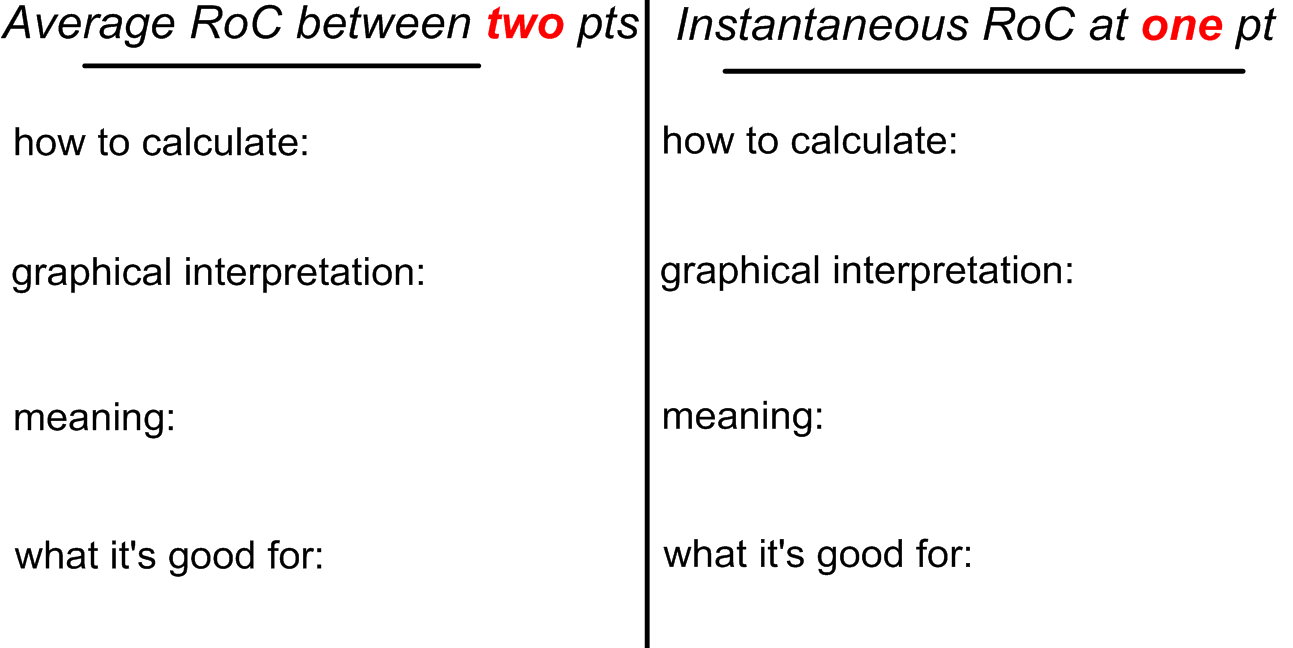
My Concluding Thoughts: I came up with this idea of the first sheet the night before I was going to teach it. It wasn’t super well thought out — I was throwing it out there. It was a success. It got kids to think about some major ideas but I didn’t have to teach them these ideas. Heck, it totally reoriented the way I think about average and instantaneous rate of change. I usually have thought of it visually, like

But now I have a way better sense of the conceptual undergirding to this visual, and more depth/nuance. Anyway, my kids were able to start grappling with these big ideas on their own. However, I dragged out things too long. We spent too long talking about why we have to use a lot of average rates of changes of smaller and smaller time intervals to approximate the instantaneous rate of changes, instead of just one average rate of change over a super duper small time interval. The reverse sheet (given the instantaneous rate of change) felt tedious for kids, and the discussion felt very similar. It would have been way better to use it (after some tweaking) to introduce linear approximations a little bit later, after a break. There were too much concept work all at once, for too long a period of time.

The good news is that after some more work, we finally took the time to tie these ideas all together, which kids said they found super helpful.

A Day In The Life, Math Teacher 2012 Edition

For anyone out there — I’m fine here in New York City. I spent the hurricane  [2] at a friend’s place in the city, and we have power and all good things. When I was trying to pass the time, I decided to do one productive thing.

I would like to present to you the start of a one day blogging initiative.

We are busy. We do a lot. We are professionals. And you know what happens when we talk about what we do… most people who don’t teach just don’t get it. That’s why we go to each other for support — either in real life by unwinding over a glass of wine (or a mocktail) at a local watering hole, or by talking with each other virtually using blogs, twitter, email, or something else.

But I think that needs to change. Three years ago, my school got me a sub for a day and I shadowed a tenth grade student. I met up with her before homeroom, and I went from class to class until 3:15. I sat through various lessons (I even answered some questions in French!), I took a chemistry exam (D+, but it would have been a C if I had remembered the conversion from Celsius to Kelvin!), and I ran from room to room seeing what it was like to go from teacher to teacher with differing expectations, to see if the passing period was enough time to get from point A to point B, what a student was to do if they had no lunch period (like the student I shadowed… answer: eat yogurt and string cheese during class), etc. The real shame was that I didn’t shadow the student after school. Balancing extracurriculars and the work assigned to see what a true full day was like. The experience was golden. I got to be a student again. (Plus the student I shadowed and I got to make up a rad handshake… the shadower-shadowee handshake.)

I believe that others out there can know what it is like to be a math educator, at least for one day, from start to finish. I think we can explain to them about what we don’t and not leave the conversation saying “yeah, they don’t get it.” What are the big things we do, and more importantly, all those little things we think about and deal with? Not only am I beyond curious what a day in the life is like for all y’all, but I would like to take up the challenge of trying to get across what it’s like to be a teacher to someone who isn’t a teacher. Verbal explanations — even to my parents who are interested and care — hasn’t quite done the trick.

Thus, Tina — the author of Drawing On Math — and I have decided that we’re going to post about one of our days — from start to finish — during the week starting on November 12, 2012. Personally, I don’t know what I’m going to do. Maybe I”ll have some video, some photos, to accompany words. Maybe I’ll just write. Maybe I”ll have a timeline. Maybe it’ll be accounting of things, maybe it’ll be an accounting of thoughts. Who knows — but I am going to try to get across the big and the small of my day. [1]

Here’s the thing: we’re professionals. Let me say that again: we. are. professionals. There are many of us, which maybe makes what we do undervalued. There is this disturbing cultural war on teachers which is disheartening and just sucks to bear witness to. And there is this hidden side to teaching that everyone who has had teachers, but never been a teacher, doesn’t know about. And so I’m hoping that this might help people understand.

We’d love for you to join. Do a day in the life from any day in the week of November 12. Post about it on your blog. And maybe by the end, we’ll have a collection of some good things to share with someone who just doesn’t get it. If you write about it on twitter, use the hashtag #DITLife … Throw your blogpost link down in the comments on this post or in the comments of Tina’s post, Submit your form on this handy dandy form that Tina created, and Tina will compile them in one of her mathemes

I suspect there will be various banners for this floating about. You can take the one from the top of this post, or if you don’t like the pastel flowers, you can take this one below. Or any of the others that are oot and aboot (Tina’s are here).

And if you’re not a math educator, and want to do this, have I got two banners for you. Yup, they look almost identical. Yup, I’m lazy. Deal with it.

[1] Of course, we have to be careful to make the post about us. There are issues of kids privacy, and sensitive things we deal with, that we can’t explicitly write about. That’s probably why I haven’t done this before… because I don’t yet have a good way to get around this and still give an honest accounting of what happened. But that’s a lame excuse, and I will come up with a good way to give an honest picture of a day in the life, while still respecting my school, colleagues, and students.

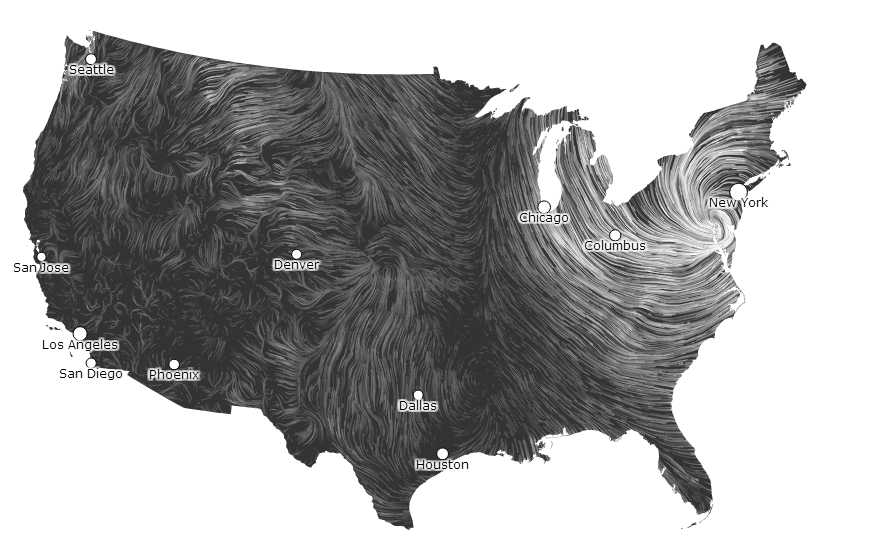
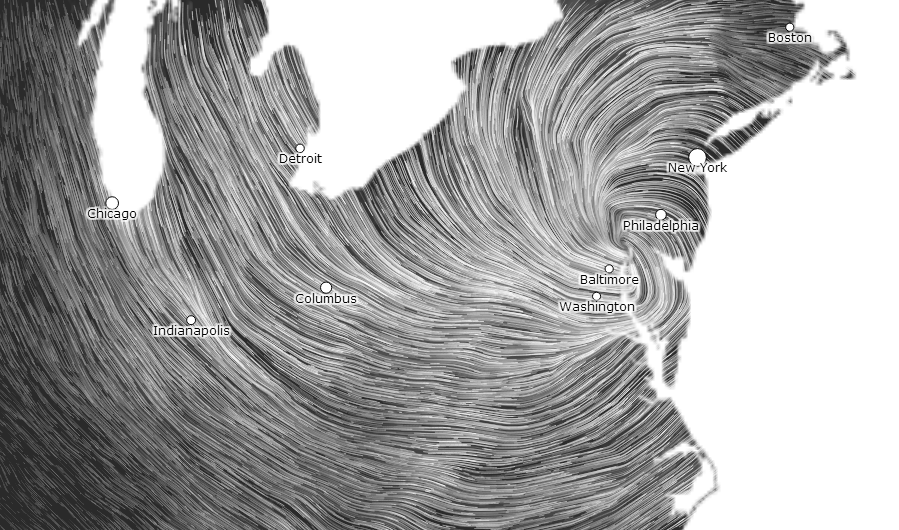
[2] Want to see a vector valued function related to the hurricane? (I’m teaching about vector valued functions in multivariable calculus… so this resonated.) This is a live wind map. And here are some screenshots from around 1am last night:

Approximating the Instantaneous Rate of Change in Calculus

I’ve been trying something new this year in calculus… really having students grapple with the concepts of what they can definitively know, what they can definitively not know, and what they can know with some certainty (but not total certainty) when they are given some information about a car trip. I’m hammering home the conceptual underpinnings of average and instantaneous rates of change. And I’ll blog about that soon I hope. But today’s post comes from where we went with this…

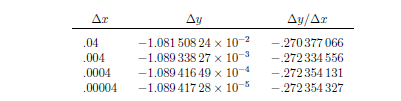
This week, we got to the point where we were estimating the instantaneous rate of change of a function at a point by using the average rate of change for a small interval near the point. And we’re used to seeing things like this in a textbook:

We’re getting our interval smaller and smaller and seeing the average rate of change get closer to some value. This value it is getting closer and closer to is the instantaneous rate of change.

That’s a deep and important thing. And we all know that.

But when we were generating a table like this, one of my students asked “Why do we have to do this? Why can’t we just pick two points really really close together instead of doing this horrible calculation like 4 times? Like super close together. Then we only have to do it once if we’re just trying to estimate the instantaneous rate of change.”

Brilliant!

Because who wants to do that horrible calculation like 4 times? It’s tedious, even with a calculator. I wasn’t ready to talk about the derivative but I did want to answer his question. Why do we have to do so many calculations instead of just one?

Unfortunately, I fumbled through it.

And as always is the case, a genius idea strikes me right after class ends. So I decided to use it for my other section.

In that section, I have them think about what the use is of doing this calculation for smaller and smaller intervals, instead of just one interval… one student came up with the idea that “it gives us more certainty… more data to work with…” but that was ambiguously stated. More certainty about what?

So here’s where the idea came in. I had each student individually use only one small interval of their choice (instead of four) to estimate the instantaneous rate of change of y=sin(921,364x) at x=0.

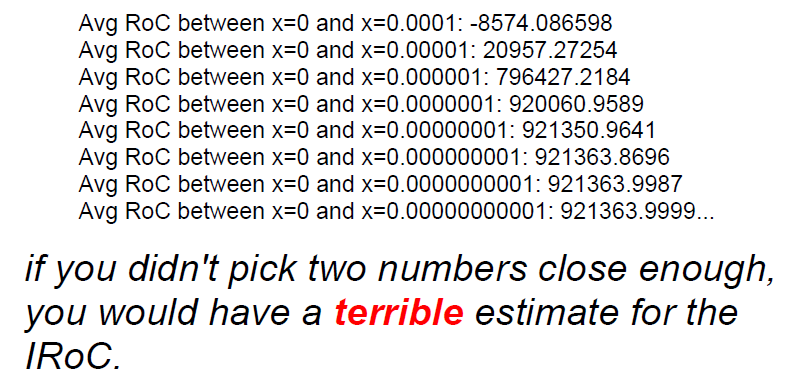
What was great is that some students picked intervals like [0,0.0001] and others [0,0.00001]. Were they similar? Different? WHOA they were very different. Students got VERY VERY different estimates even though everyone used really small intervals. So what’s going on?

When we looked at the average rate of changes for various intervals, we saw this:

So yeah, if you happened to choose two numbers really close to each other, they might not be close enough! You just don’t know. Even if they’re really close. So doing a series of smaller and smaller intervals indeed gives us more certainty that we have a good estimation.

This was just sort of thrown into my lesson, so I don’t know exactly how much they got out of it. But I hope that next year either I use it as a do now, a new conceptual skill that I add to my calculus Standards Based Grading skill list, and make it a little more formalized [1]. Maybe after doing this next year, have a sheet with a few different functions, some which are wildly erratic and fluctuate a lot and some which are nice — and have students pick out merely from the graph and the point I want to estimate the average rate of change, if they can make do with two points “pretty close together” to estimate the instantaneous rate of change, or if they truly do need two points “very very close together.” That would be a good check to see if they understood the conceptual underpinnings of what’s going on.

[1] Idea. Have a sheet with two columns. On the left column, the function y=x^2. On the right column y=\sin(921,364x). Have them use the interval [0,0.001] to estimate the instantaneous rate of change at x=0. Then say: “You have $5 to bet on which one is closest to the true instantaneous rate of change. What are you going to bet on, and why?” Have groups whiteboard their ideas/thoughts for 5 minutes and present. Then show the graphs of the functions. Have then talk for 2 minutes to see if the graphs change their thoughts. Finish up student discussion.

I’m alive, I’m alive, but I’m sinking in! No Drama / Drama!

The worst thing ever is when I look back at when I last posted, and it’s over a month ago. Shame on me. After spending all that time trying to inspire others to post semi-regularly, I have fallen amiss. I only feign busyness. Lots and lots of busyness. The reason? I’m teaching a new course. And I’m collaborating with teachers this year. And I’m exhausted all the time.

But I do have some things to write about! Today I’m going to write about something the other calculus teacher and I spent a while emphasizing. It’s the idea of holes and vertical asymptotes in rational functions. There is something about how formulaic students learn about holes and vertical asymptotes in precalculus. And they memorize rules — and not why.

No Drama, no more no more drama! (Holes)

In class I throw up the following slide and have half the kids fill in the top table, and half the kids fill up the bottom table.

It’s a race (those that fill in the top function win!)! And of course, they start filling it in and see that the top function has all y-values are 1 (except for the one y-value that does not exist)… And the bottom one, they start seeing that the y-coordinate is always one less than the x-coordinate. (I sometimes have to do a little prodding.) I ask them why those things were happening, and we have a big discussion.

I forbid the use of the word “cancel.” It is like “Voldemort.” Verboten.

For things like \frac{(3)(2)}{(3)}, I have all kids say “the 3s divide out to equal 1.” Why? Because kids don’t really know what cancelling is, and by “crossing” terms out in the numerator and denominator, they don’t think about what it is they are doing.

Also, they think that \frac{x-1}{x-1} is the same as 1. Which is not true. So they learn to say \frac{x-1}{x-1} is the same as 1 except for when x=1.

What’s nice is once they get that distinction down, we look at the graphs and see that we have a missing point. Which is simply the one point where the function is undefined. So when I ask them why the graph of y=\frac{(x-2)(x-1)}{(x-2)} looks like the line y=x-1, they can say that they can rewrite y=\frac{x-2}{x-2} \cdot \frac{x-1}{1}, and they can say that for all x values except for x=2, the function is essentially y=1\cdot \frac{x-1}{1}. And at x=2, the function simply is undefined (why? because \frac{x-2}{x-2} is undefined at that single value).

So since for almost all x values, the expression \frac{x-2}{x-2} is just 1, and 1 times anything is itself. So the presence of this term doesn’t cause any drama. Just that one undefined point.

It’s no drama.

Drama! (Vertical Asymptotes)

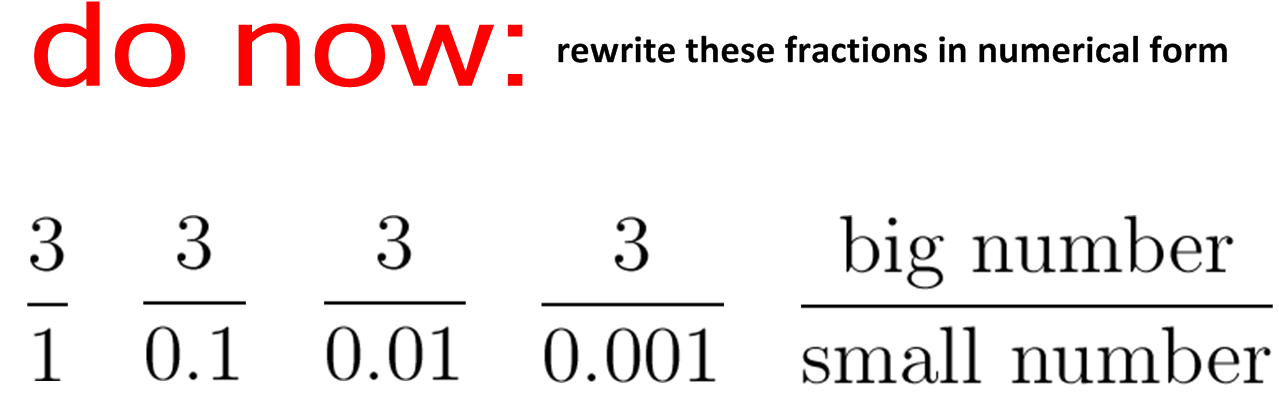
Very early on in the algebra bootcamp for limits, I threw this on as a do now:

And they saw (and we talked about) why a big number (compared to the bottom number) divided by a small number is a huuuuge number.

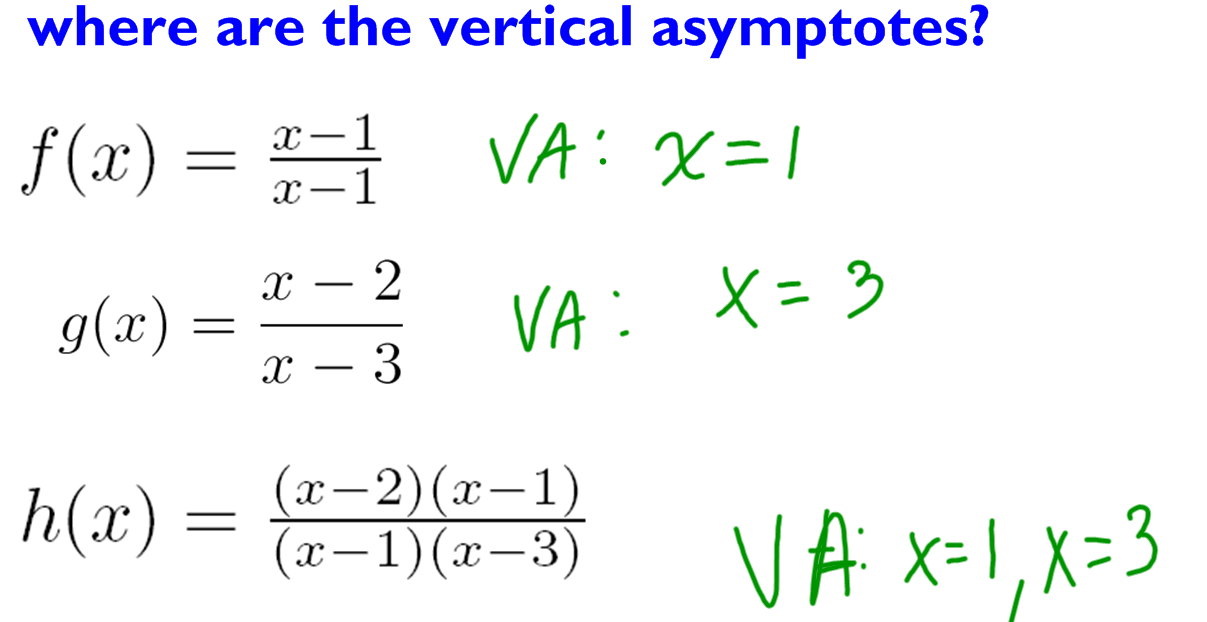
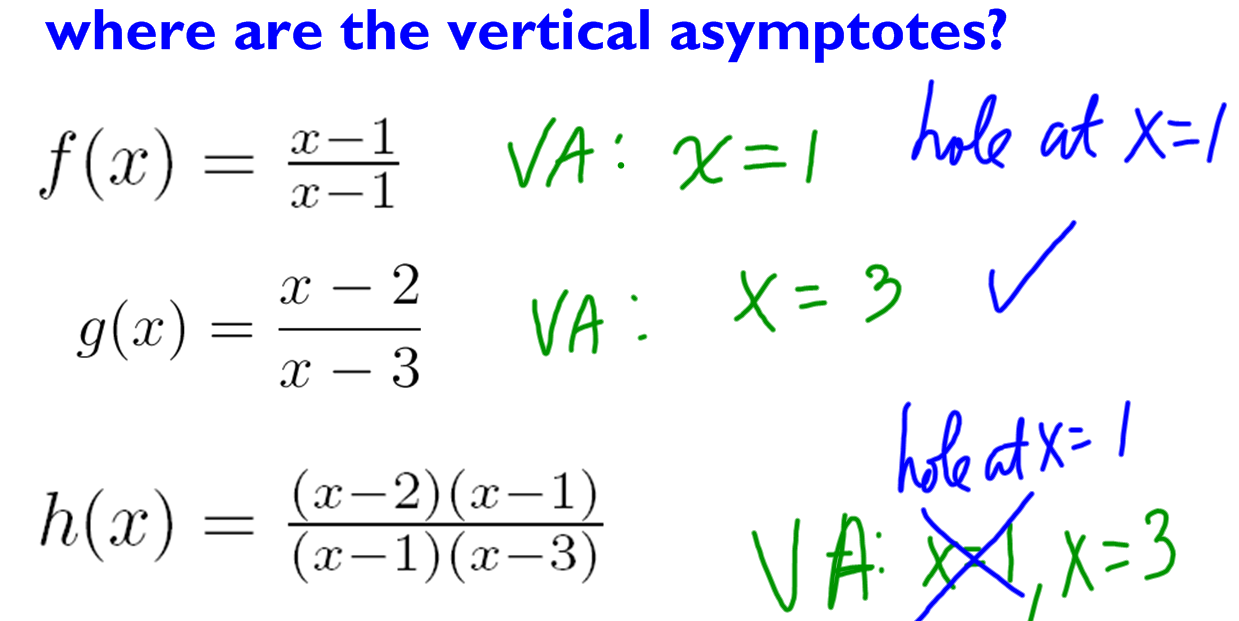
Later in the class, I asked them what they remembered about vertical asymptotes. Someone inevitably said “they occur when the denominator of a rational function is zero!” I go “ooooooh, right, okay!” and I throw this up and ask them where the vertical asymptotes are…

… and they respond with what I wrote about. Never have I had a class say “oh there might be a hole!” (even though we had previously talked about them… sometimes during the same class!). But I really lead them on, and I give positive affirmation.

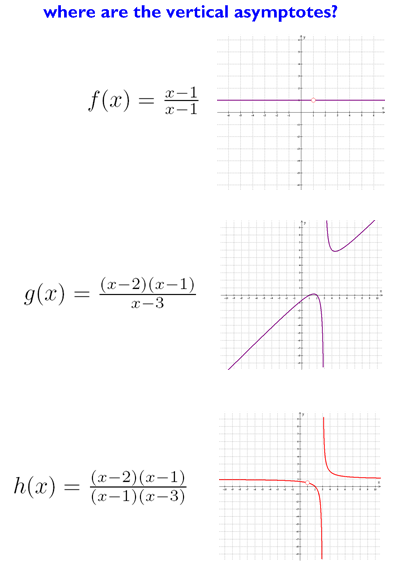
Then I throw up the pictures of the graphs, and we see if we were correct.

And so we saw that that wasn’t right. And they go “oh, right, the holes!”… so we modify our page…

… and talk about how it is not sufficient to say that vertical asymptotes occur when the denominator is zero. 

From this, I really emphasize the importance of truly understanding what a vertical asymptote is, what a hole is, and gaining deep conceptual understanding as to what is going on. Memorization equals death.

Finally, to talk about vertical asymptotes, I show y=\frac{1}{x-2} and talk about why a vertical asymptote occurs at x=2. And we relate this to the original do now.

The simple argument goes that for values near x=2, the denominator gets close to zero. And we see that 1 divided by a number very close to zero is going to be very very very large (the function is blowing up!) or very very very negative (the function is blowing down!). Thus, we can clearly see as we get x values closer and closer to 2, the function is getting closer and closer to positive or negative infinity.

Thus, we have drama. Tons and tons of drama — especially near x=2. Thus, vertical asymptotes are the consequence of a term that provides high drama.

(I also throw up y=\frac{1}{x^2+1} and we talk about whether this has any vertical asymptotes and why.)

So we get that. Finally, I encourage students to rewrite rational equations to see all the drama and no drama parts so when they analyze a rational equation, they can understand why certain things are happening…

For example m(x)=\frac{(x-1)(x+2)}{(x-1)(x+5)(x^2+3)} can be rewritten m(x)=\frac{x-1}{x-1}\cdot\frac{1}{x+5}\cdot\frac{1}{x^2+3}\cdot\frac{x+2}{1}. And then they can analyze each part separately to get a sense of how it contributes to the whole function.

That’s all. Nothing special. But I really like the idea of no dramadrama. The other calc teacher and I came up with that idea. The rewriting came out of that approach, and I really like it! I think I’m going to make it more formalized / have specific practice with rational functions based around this approach next year. This year it sort of came into being, so it as clear as I really wanted it to be to my students. But they, for the most part, got it.