Next Semester

You know my philosophy about blogging… blog only when you want to blog. If you put pressure on yourself, it becomes a chore. And why would I make myself do a chore? More than that, it would be like a chore I created just to make my life harder. Like: every day, make sure you windex the windows to your apartment. (FYI: I have never windexed the windows to my apartment since moving in two and a half years ago.) (That’s what rain is for.) (And curtains.)

However, now that it’s been over a month since I’ve blogged, I wonder what’s going on?

We did have two weeks off, so it’s not like I could blog about school stuff when we didn’t even have school…

True. But that’s me rationalizing. Or how about…

I don’t have time because I’m just so busy…

I think. But this year I’m no busier than previous years. In fact, I might be less busy with school stuff. (However, I should say that I’m making good on my school year motto this year: “I’m doing me.“)

Actually, I think that is the problem. I wonder if I’ve gone stale, like that moldy bread in the back of my fridge? I only think it’s moldy, actually. I keep on putting things in front of it, because I’m scared to take it out, but I don’t want to look at it. It’s like smelling milk that might have gone bad. I don’t do it. I just throw it out, because the mere thought of smelling rancid milk makes me want to puke. Where was I going… oh yes, feeling stale. I’ve grown accustomed to having my SmartBoards that I slaved over years ago, and my worksheets and packets that I created ages ago. I’m tweaking. I’m not inventing. Or really even reinventing. I don’t have much to post because I haven’t been doing a lot of creation. And that’s always when I feel excited about posting. Invigorated about what I’m doing. 

Now that I know this, I have an easy fix. Recreate. Invent. Reinvent. I’m also meeting with my department head on Friday to talk about course assignments for next year, and I’m going to ask to teach a course that will be new for me next year.

With all this mind, I’m going to keep a list (that I will update) with possible ideas/goals for next semester, which will be starting in a little over a week.

  • In Algebra II, remember to do group work, and do more “participation quizzes” during that group work.  I did a bunch in the first quarter, and then the groupwork dropped off in the second quarter. Booooo, me! Keep it going, and strong!
  • In Algebra II, remember to utilize the Park School of Baltimore curriculum, especially when working on Quadratics, Transformations, and Exponential Functions. It didn’t quite fit in with our 2nd quarter material, but it will align with our 3rd and 4th quarters.
  • In Algebra II — since we don’t have a midterm for students to see a broad view and get a review of all the 1st and 2nd quarter’s material — have the 3rd and 4th quarter problem sets include “review problems” from topics from the first semester. Or if not, have review problem assignments, in addition to the problem sets.
  • In Algebra II, do a written “final exam study guide” project again, to continue having kids work on their writing skills. Provide feedback, and an opportunity to do revisions, and fix errors. (Video study guides from years ago, paper study guides more recently.)
  • Create this “pencils and eraser” station for kids who forget pencils.
  • In Calculus, continue having kids work in groups on challenging problems every so often.
  • In Calculus, do problem sets in the 3rd and 4th quarters, but make them shorter and give less class time than the 2nd quarter. Continue to make the problem sets have a “group” component and an “individual” component.
  • In Calculus, consider creating a “reading group” where students are asked to read chapters from books, or watch videos that I find online, dealing with calculus (from Charles Seife’s Zero, from David Foster Wallace’s Everything and More, from … well, I have think of the resources!), and we discuss them every other Friday in the 3rd and 4th quarters. I’m not sure how this would work. The point would be to add a more “cultural” component to the class, and a lot of my kids love reading and learning about tangents. But I don’t know how to make it interesting enough that kids will actually do it. (At my school, kids are so busy that they don’t really do things that won’t impact their grades, and I don’t want grades to be a threat to make kids do this… I need to come up with a way that they will do it because it interests them. One thing that’s buzzing around is having kids do the reading, but if they come to class not having done the reading/viewing the video, they don’t get to participate in the discussion/activity, and they have to do something else that’s calculus related and not busywork, but much more boring than whatever we’re doing.)I don’t know. This is tricky for me, because I don’t have a vision for it yet. That has to be clear to me first: the vision, the purpose, and then how to achieve that comes next. I don’t want to do it just because it “seems cool.” I want kids to buy in. Maybe I give them a choice: book/video club, an independent final project, or regular class?
  • I finally got large whiteboards for my students. I’m struggling to use them. So in the 2nd semester: use them. Even if it doesn’t go well, I need to keep using them. I need to have some practice and experience with them, even if to show me what works and what doesn’t work.
  • Now that we’re starting the 2nd semester, have built in time to review the course expectations, and collaboration guidelines for all of my classes.
  • Consider making changes with my Binder Checks in Algebra II? More frequent? Have kids leave their binders in class, and have time set aside for them to organize themselves? This year their binders are not improving much. It may be that I need to baby them. Some things might include: putting “correct the home enjoyment that we went over today” each day on the course conference (the place where I post the nightly work), having binder checks every two weeks instead of every five weeks (or random “homework correction checks” in addition to the five week binder checks), making test corrections a homework assignment (instead of just telling them they need to have it done by the binder check date), and showing kids how to create their own “checklist” to make sure they have everything in the binder done. I am a little surprised that sophomores and juniors are still finding this so challenging.

Some things I need to do regarding this blog:

  • Blog about problem sets in Calculus and Algebra II
  • Blog (briefly) about the change I made to Standards Based Grading in Calculus (scale is now out of 5). And also how this year is going compared to last year (read: better). And what still feels like it’s missing…
  • Blog about talking about Early Action/Decision with my seniors
  • Blog about achieving my goal from last new year’s… to read 52 books. And how I did it (short answer: I don’t know. It feels kind of miraculous.)
  • Make a new Favorite Tweets (even though I haven’t been on twitter lately so it will be short)
  • Update the Virtual Filing Cabinet

That is all.
A Feud

So late after school one day last week, I was talking with the anthropology teacher. She was teaching about feuds, and was talking about how feuds within a close knit society look one way, but feuds between culturally and locationally different societies look differently. Because there’s no leader to mediate, or common culture to talk with, or some yadda yadda yadda culture society language blah blah blah.

And so she talked about her class, and if there was a feud (different anthropological camps, I suppose), it would take on one form, but if they had a feud with say Mr. Shah’s class, it would take on a different form.

When she told me that, I immediately responded: “LET’S DO THIS!”

The premise of our feud: After school one day, I told the anthropology teacher that what she taught was a soft science, and hence way less important and good than mathematics.

***

The next day, while we were talking about trigonometry and calculus, first period, I hear screaming outside my door.

All day, all week, occupy math geeks! All day, all weeks, occupy math geeks!

EXCUSE ME?  OH NOES THEY DIDN’T!

The whole anthropology class barged in, and their teacher picked a fight with me. Soon I was screaming at the teacher, her students were screaming at me, and all sorts of hilarious arguments about the importance of our disciplines were being flung about. The kids in my class were sitting there, stunned, while bedlam surrounded them.

At one point, and I was so involved with my argument with a student and teacher (and being all histrionic) that I failed to notice, that some of the anthropology students were trying to steal one of my students! They kept calling her a “cow.” HA! As if that was going to somehow convince her to join them. (A cow, in the culture they were studying, was a valuable object — so this was actually a compliment!)

Did I neglect to mention that about 1/3 of these anthropology kids are in my OTHER calculus class? No, not awkward at all, thank you very much.

Later, they left. Parting words?

Anthropology teacher: I’m keeping my eyes on you.
Me: Because I’m so stunningly beautiful.

My class sat there dumbfounded, and one kid simply said “what WAS that?”

I explained that we were now in feud mode, and we need to figure out how to retaliate. (Drone strikes?) Although I personally was all about pitchforks and raids, one of my students said “do nothing.” Of course I had to keep it going, so I suggested we write a “thank you” while still showing our moral high ground, and a few small jabs. Which we did:

Dear Ms. [Teacher] and her anthropology students,

After discussion among our tribe, we felt it important to acknowledge what went on in class today. We would like to thank you for bringing up some interesting issues about the hierarchy of the sciences and social sciences. Even though it’s clear to us that mathematics is important to our everyday lives (whether we ourselves are using it or not), we can understand why you might feel that isn’t the case for you. Perhaps you would enjoy a world without computers, cell phones, GPS, microwaves, etc., and we are happy for you if you decide to go forth and live that sort of austere life.

Although we might not have appreciated the interruption to our learning, and especially the aggressive way your tribe approached our tribe, we do appreciate that you felt us important enough to engage with us. We believe our work is important, and we’re glad that you acknowledge that.

Thank you for your time,
Mr. Shah and his calculus students

They responded to us:

Dear Mr. Shah and his calculus B band students:

Thank you for your email. While we anthropologists recognize that our methods are perhaps a bit unorthodox for Packer, a covert and aggressive raid is common in our part of the world and was the best way to respond to what we perceived as an insult to our tribe and its honor. Although we recognize the value of advanced mathematics, even if many of us don’t use it in our daily lives (or we can hire someone to use it for us), we feel that our disciplinary focus – even as a ‘softer’ social science – is crucial to helping individuals navigate relationships in a culturally diverse world. It has quotidian application for each and every one of us; in fact, one of our tribe members brought up a real life example of kinship relationships in our post-raid class discussion this morning.

As a result, we hope that you and your students can recognize our value and treat us with the amount of respect that we feel we deserve. We are willing to reciprocate that respect, as well. Please understand, though, that we will not hesitate to defend ourselves and our reputation in the future.

Regards,
Ms. [Teacher] and her anthropology tribe

So fun.

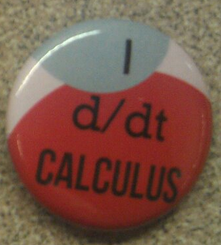
So today, today, I decided to take it up a notch. I told my kids that I was a little nervous about their allegiance to calculus, and that after that horrific raid, who knew what was up. I reminded them they had free will, but I was going to ask them each individually if they were on TEAM CALCULUS. And if they were, they would get a badge representing that, that they needed to wear proudly.

MUAH HAHAHAHA.

I went around, student by student: “Do you think calculus is better than anthropology?” All of them took it. [1] This is a totem. A calculus totem.

I don’t know where this will lead, but there’s something exciting about the unknown. I haven’t read C.P. Snow’s The Two Cultures, but I thought it would be appropriate to use. So the Anthropology teacher and I both are going to read the lecture-version of this book this weekend. We’ll see if we can come up with some sort of activity around it.

For now, though, I’m just enjoying feuding! GO TEAM CALCULUS!

[1] A few of them were hesitant, so I had to soften the statement to “Do you think anthropology is a soft science?” (because that’s what started the feud, and I didn’t want any kids to go without our totem).

Guest Post: Looking for NYC Math Mentors

Below is a guest post written by Dan Zaharopol, who is awesome. At the least, you’ll learn about something awesome he’s been working on, and at the very best, you might end up working with him!

***

When I was in middle school, I participated in a national math competition called MathCounts. In MathCounts, your school forms a team which participates at the local level. If you do well, you advance to the state level, and if you do really well, you advance to nationals. My school, a public high school in upstate New York, had about 350 students in each year, and about 5-10 in each year would have done decently well at the local level in MathCounts.

Last year, I ran a summer program for seventeen awesome kids from New York City. They all go to schools where 75% or more of the students receive free or reduced-price lunch. They were the best math students at their schools. And yet, although they were the best out of over 1000 seventh-graders, not one of them was really ready for MathCounts before the program.

These kids are talented kids who like doing math. Some of them love doing math. Their schools work really hard to help every student succeed, but they don’t have the resources that my school had to help the kids who can really do more. That’s where the Summer Program in Mathematical Problem Solving came in, giving the kids a full-on camp experience learning intense, deep mathematics. But now that the kids are done with the summer program, what will they do next?

This guest blog is a call to action. We’re looking for volunteer mentors who can meet with the kids every 1-2 weeks and talk to them about math and about the opportunities that they want to pursue. If you’re interested, please fill out this application and help these kids reach the next level.

Thank you!

Taking a Moment… in Calculus

In calculus, I’ve historically asked kids to take the derivative of:

f(x)=\frac{2x^2+\sqrt{x}}{\sqrt{x}}

and students will immediately go to the quotient rule. OBVIOUSLY! There’s a numerator and denominator. Duh. So go at it!

Unfortunately, this is VERY UNWISE because it leads to a lot more work. And I was sick of my kids not taking a moment to think: what are my options, and what might be the best option available? Also, kids generally found it hard to deal when we started mixing the derivative rules up!

So I came up with a sheet to address this and paired kids to work on it.

(I’ve also had kids think they can do some crazy algebra with g(x)=\frac{x^2+1}{x+1}. This sheet also helped me talk with kids individually about that.)

For a little context, my kids have only learned the power rule, the product rule, the quotient rule, and that the derivative of e^x is e^x. They have not yet been formally exposed to the chain rule.

Without further ado…

[.pdf, .doc]

Believe it or not… a log question which was briefly stumping us

Hi all,

A teacher approached me with the following question.

The function \ln(x^{-2}) has a graph that looks like:

It makes sense that the function exists for all negative x values, because when you raise a negative number to the -2 power, you’re going to get a positive number. And you can take the natural log of a positive number.

Then the teacher said to consider the following function: -2 \ln(x), and the graph looks like:

Notice that you can’t input negative x values, because the domain of natural log doesn’t allow for it.

Here’s the question.

According to the log rules/properties, we know that:

\ln(a^b)=b\ln(a) (obviously).

So \ln(x^{-2})=-2\ln(x). But the graphs are different.

We went a little crazy trying to figure out what’s going on… For about 3 minutes, we were having a great conversation. But we quickly converged on the little text that accompanies the log rules in any textbook… and this text says that these rules work but are only valid for a>0.

I kinda love this as an in-class exercise (I’ll probably forget this when I get to logarithms, but maybe posting it here will prevent me from forgetting it). Because it will force kids to (a) be confuzzled, (b) talk through ideas, (c) go back to the definition and qualifications for the log rules, and (d) see that these rules are indeed valid (we didn’t break math), but they are a bit more restrictive that we might have thought.

What I love is that \ln(x^{-2})=-2\ln(x) isn’t actually an identity. But we are so used to using the rules blindly, robotically, that we never think about it. But for it to be a good mathematical statement, you need to qualify it! You need to say this is only an equivalence for x>0. This was a good reminder for us.

Review Activity for Rational Equations

Last year, I did a review game that I got from Sue Van Hattum. I wrote that:

[this game] forces students to ask themselves: what do I know and how confident am I in what I know? (It’s meta-cognitive like that).

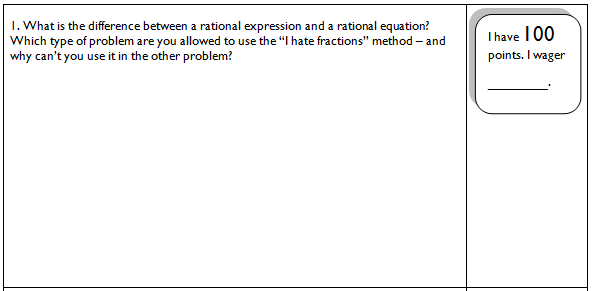
I set kids up in pre-chosen pairs, and they are asked to work together. In fact, I gave kids their new seats for the quarter, so this was their introduction to their new seat partner! They then are given a booklet with problems — and each pair is asked to work only on ONE problem at a time. (For those who finish a problem before others, I have alternative problems for them to work on.) When I see almost all pairs are done, I’ll give a one minute warning… Then I ask all students to put their pencils down and pick up a pen. We go over each problem, kids correct their own work, and using the honor system, they figure out how many points they have. (Scoring below.)

You can see three sample questions from our review game below…

[The .pdf and .doc file of the 6 questions are linked.]

I explained in my last post how scoring worked…

Each group started with 100 points to wager — and they lost the points if they got the question wrong, and the gained the points if they got the question right.

Some possible game trajectories:

100 –> 150 –> 250 –> 490 etc.

100 –> 10 –> 15 –> 30 etc.

Anyway, what was great was that the game really got students engaged and talking. Each student tended to work on the problem individually, and then when they were done, they would compare with their partner.

(If you try this, you have to make sure that students know NOT to skip ahead… everyone is working on one problem at a time. Then you go over the problem, and THEN everyone starts the next problem.)

So there you go… I don’t do reviews a lot, but for rational expressions, rational equations, and circuit problems, I figured we’d need a day to tie things up. And since this is one review I think works amazingly, I figure I’d share it a second time! Thanks Sue!