Digressions! Hints of the Chain Rule via the Power Rule.

In calculus today, I went off the beaten path a bit and it was a lovely digression. I think this works so well with my kids not only because they’re awesome, but because quite a few of them like to notice patterns and explore.

So far we’ve learned and proved the power rule for derivatives, and we’ve been practicing using it. So if students are given y=\sqrt{x}(1+x) and asked to find y', they know that they have to distribute and then take the derivative. [We don’t know the product rule yet.]

So… for their work due today, they were asked to find the derivative of y=(1+x)^3. And my kids wanted to go over this together in class. So when we worked it all out, we got y'=3x^2+6x+3. And then someone noticed that was the same as y'=3(1+x)^2 which looked like the power rule! Like if we had y=x^3, the derivative would be y'=3x^2, so similarly since we have y=(1+x)^3, it’s makes sense that the derivative was y=3(1+x)^2.

At this point, I decided I wanted to capitalize on this. So I said: okay, neat observation. Does it always hold?

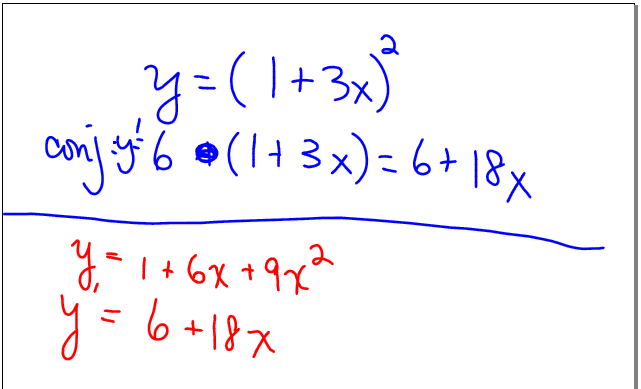
And I threw this up…

and had students — using the rule they observed — make a conjecture as to what the derivative would be (without calculating things out). They got (working in pairs, and then sharing as a class):

And then they checked…

… and saw it was wrong. So based on this, I had them revise their conjecture, and take a stab at:

which they did… and they came up with (and worked out):

So they believed they had something that always worked… so I had them prove it. Which they did.

And it worked out!!!

So now we had proved something about the derivative of y=(1+ax)^2, and I asked them: would it work to the third power? would it work to the nth power? And I left it as an exercise for their home enjoyment (our corny term for homework). I’m really curious to see who gets how far on this!

It’s cool. They’re getting whiffs of the chain rule. I’m not going to give it to ’em or do anything else with this. We’ll wait a while. But I really like how this digression took 15 minutes, but it capitalized on something they were curious about. And we’ll see the connection later.

I felt strongly enough about how this worked out that I engineered this discussion to happen in my second calculus class. I treated it like a big surprise. What a strange observation. Instead of forging forward in class, let’s take a digression. I loved that it worked a second time too.

Another “How To Fix Math Education” Article

One of my students sent me a Slate article, yet another piece of tripe with an attention-grabbing, gag-inducing headline: “How To Fix Math Education in High School and College.” Barf.

And the article is short and doesn’t really say how to fix math education in high school and college. So there ya go. But my student asked me for my thoughts. And I gave myself 20 minutes to compose a response. I had to give myself a time limit because I know myself. I’d obsess, second guess, and then think: well, that’s not precisely right, and then get diverted to go into this or that tangent, and never actually send it. And if I did, I wouldn’t be happy with it and it would be maybe 5 pages of things I wouldn’t be happy with.

So I did it under time constraints. And I figured I’d share it here. It is not precisely what I believe, and it is a lot of broad strokes. And it certainly is choppy (because I didn’t having time to proof). But here you go…

Hi [Stu],

I think this article brings up a lot of good points, and I know at all the math conferences I attend and all the conversations I have with math teachers (at Packer and around the country), these are the discussions we are having.

When it gets down to it, there are two claims that I think are worth discussing.

First, that our kids are being pushed on a “calculus” track, while the real action and usefulness is elsewhere. I do think that there is this standardized curriculum in high schools, where kids are being put on a track where calculus is the pinnacle of their math studies. It’s not just Packer, but everywhere in the US. And I think that is not always the appropriate track — and we could come up with alternatives. We could have multiple tracks, culminating is statistics, discrete math and number theory, alternative geometries, or something interdisciplinary. Of course there are about a zillion things in the way, including staffing (who would teach these courses, how would they get paid, when would they have time to write the curriculum which would have to be something untraditional) and colleges (which look for calculus on a transcript, or so I’ve been told… I don’t really know much about that world). But I think most math teachers would say that calculus is just one possible, and not always the best, ending to a high school math career (depending on who the kid is and what the kid’s interests are in math). Very deep-seeded cultural, social, institutional, and even political barriers get in the way of revolutionizing what math is taught and how it is taught. On the other hand, I disagree with the argument that calculus should not be pushed because it doesn’t have as much “practical” “applied” use to most people. If we only cared about pushing the things that would be useful for students in the real world, why teach Shakespeare and Pynchon and hydrogen bonds and what makes a rainbow — if most students aren’t going to be working in a lab or becoming writers or critics? I think there’s a value to calculus for the sake of it being calculus, for it showing (for many, the very first time) the abstractness and beauty that a few simple ideas can bring to the table — and how these simple ideas can be stretched in crazy and amazing ways. (Given that a student has the algebra tools to accomplish it.) But to be clear, I honestly believe most math curricula in high school aren’t solely bent on helping kids understand calculus. If that were the case, I could come up with a curriculum where we elminiate geometry, and combine Algebra I and Algebra II into a 1.5 year course… and students would have the background to do calculus afterwards. That’s not the goal. The goal is building up ways of thinking, putting tools in your mathematical toolbelt, and leading up to abstraction and reasoning… with the hope that the structure, logic, and incredible beauty and creativity of it all come tumbling out. Now whether that actually happens… let’s just say it’s not easy to accomplish. We teachers don’t get students as blank slates, and we aren’t always perfect at executing our vision under the constraints we have.

Second, there is the claim that ” that schools should focus less on teaching facts—which can be easily ascertained from Google—and more on teaching them how to think.” I think most teachers would agree with that. But then the article goes on to claim: “mathematical education will be less about computation—we’ve got calculators for that!—and more conceptual, like ‘understanding when you need to do integrals, when you need to do a square root.’   This is a much bigger issue and it can’t be simplified into these two sentences. There is a large discussion going on in the math education community about the use of graphing calculators, and if they can be the panacea for math education. That students who struggle with basic algebra can still explore and discover using their calculators. I half-agree with that. Pattern-finding is great. It invites creativity and expression, this sort-of calculator-based discovery-learning. But if the calculator is used as a black-box, and we don’t know what it’s calculating for us, or how we could calculate what it’s doing (but just much slower, and possibly with different algorithms), we’re in trouble. If you can find patterns in pascal’s triangle, but you can’t prove them or at least have some plausible argument as to why they exist, then you’re just finding patterns. It’s cool, but has very little depth. If you let a calculator factor for you (the new ones can! like wolfram alpha!), but you don’t know what it’s doing, then I fear math can easily turn into magic, where the magician is the calculuator. And that’s one thing I big thing I worry about as a teacher: math being seen as a bag of magic tricks, where there is no logic or structure to it. And if the calculator is the magician, and the student is the audience, the student might marvel at the trick, be excited by whatever pattern is found, but never really understand what makes it all hang together. That’s why you hear me harping on understanding so much. And why when you found the power rule pattern, you did the first step, but the real learning came when you went off to prove it. It stretched your mind, and you spent a long while working it out. You wanted to understand the pattern, the logic, the conjecture. When technology helps with understanding, I LOVE IT. When technology helps generate questions, I LOVE IT. But when it replaces understanding, I’m a bit more wary.

So there are my very quickly typed two cents. They might not make a whole lot of sense, but they just sort of poured out. My thoughts change in subtle ways on these issues all the time, so ask me again in a few months and I might have switched some of my thinking.

Best,
Mr. Shah

To be honest, I’m posting this as part of my desire to archive my evolution as a teacher. You’re welcome to comment, and have discussions, if you so wish, but I probably won’t engage too much. I’m tired.

In other news, explaining why I’m so tired, I spent the last week and half writing narrative comments on all my students. I think they are better this year than in years past (each year I try to improve a tiny bit), so maybe if I have the time and desire, I’ll post about my process. But who knows, school is like a train and time just keeps whooshing by. I can’t believe a quarter is already done. It feels like we just started, and I barely have scratched the surface of my kids.  (Right at this moment, that is. You know, by Thursday or Friday it’s going to have felt like this year is turning into a piece of taffy that keeps getting stretched out, the end getting further and further away while my grip on reality is getting as delicate as the taffy is getting thin.)

PS. On the views of math:

Compiling A List Of Posts

Hi all,

I need some help, if you have a few minutes. I am looking for some quality blog posts and/or websites which offer the following:

Stories from the Front: On the ground experiences of teachers teaching problem solving in the math… the good, the bad, the ugly

War Strategies:  Different ways teachers actually do problem solving in the classroom, and maybe some hints/tips/technqiues (e.g. whiteboarding, Moore Method, Harkness Table, problem sets, grouping ideas, hint tokens, etc.)

Weapons:  Good websites (or books) which contain good math problem solving problems (e.g. Exeter problem sets, AMC questions, etc.). My personal thought on questions is that they don’t need to be hard to be problem solving… In fact, the harder the problems are, the less accessible and fun the problem solving will be, and the more my kids will be turned off.

What I’m not really looking for is Polya’s How To Solve It, which is great reading but lacks in the day-to-day practicality and concreteness I’m looking for. I don’t need to know what problem solving is (like Potter Stewart, I know it when I see it), or read philosophical exhortations about how important it is in promoting meaningful and deep learning. I want practicality. Stories, resources, tips, etc.

If I get some responses in the comments, I will compile them into either a comprehensive post, or if there are a lot, I’ll make a new page (a la the Virtual Filing Cabinet) for it.

The reason behind this is selfish, but I’m hoping the output could be collectively useful. My department is thinking seriously about how to integrate problem solving into our curricula… and I wanted to show them: “hey, there are a ton of good ideas from teachers who do it!”

So if you could help a teacher out…

PS. Not to make you jealous, but yesterday I designed and ordered these buttons! (You have to recognize I don’t know what I’m doing with Photoshop, so the pictures aren’t all that great. And these buttons have a large bleed area, so the text will actually be just near the outer rim of the button instead of with all that blank space between the text and the outside of the pin.)

My Favorite Test Question of All Time

In Calculus, we just finished our limits unit. I gave a test. It had a great question on it, inspired by Bowman and his limit activity.

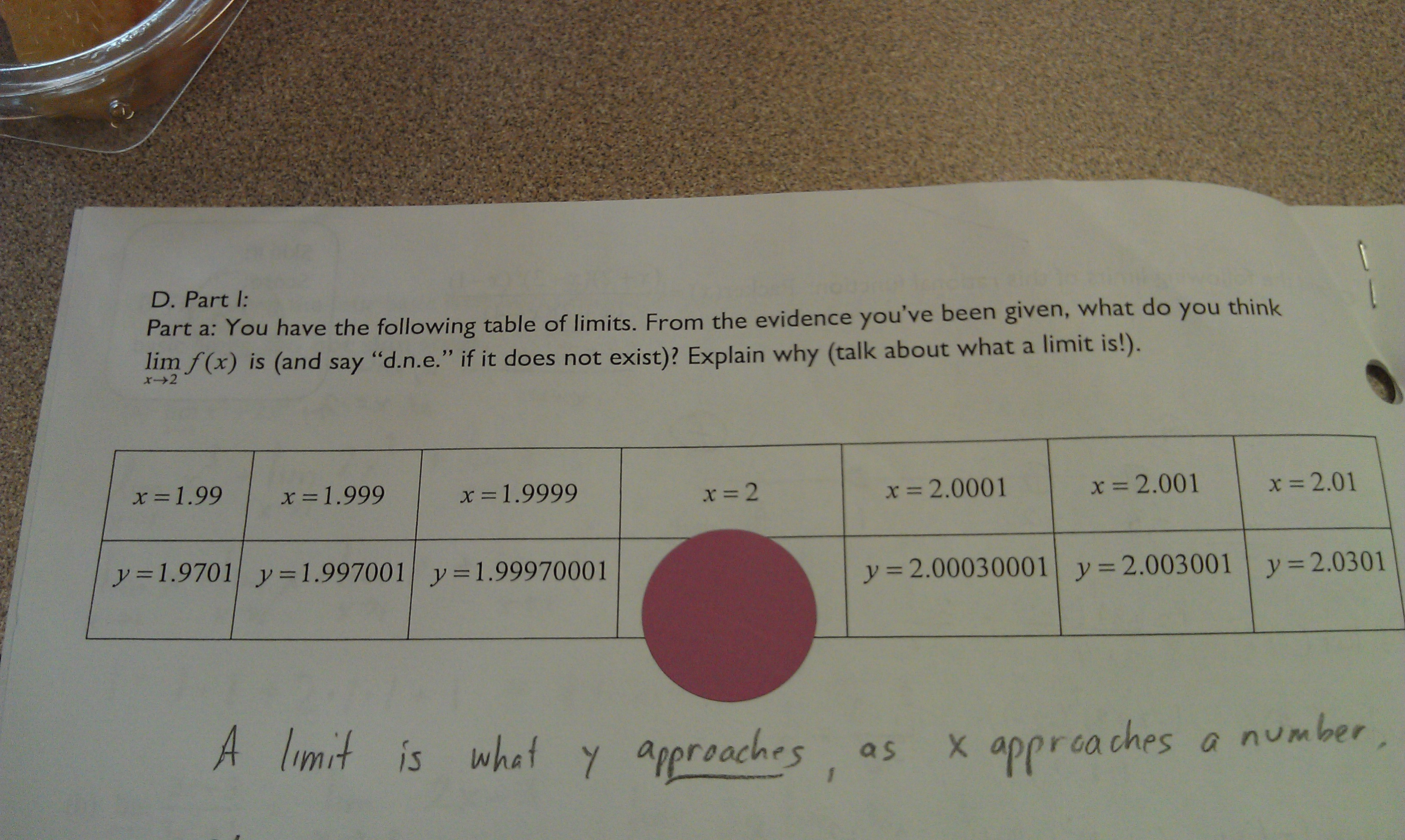
Without further ado, it reads:

Then I ask part (b)…

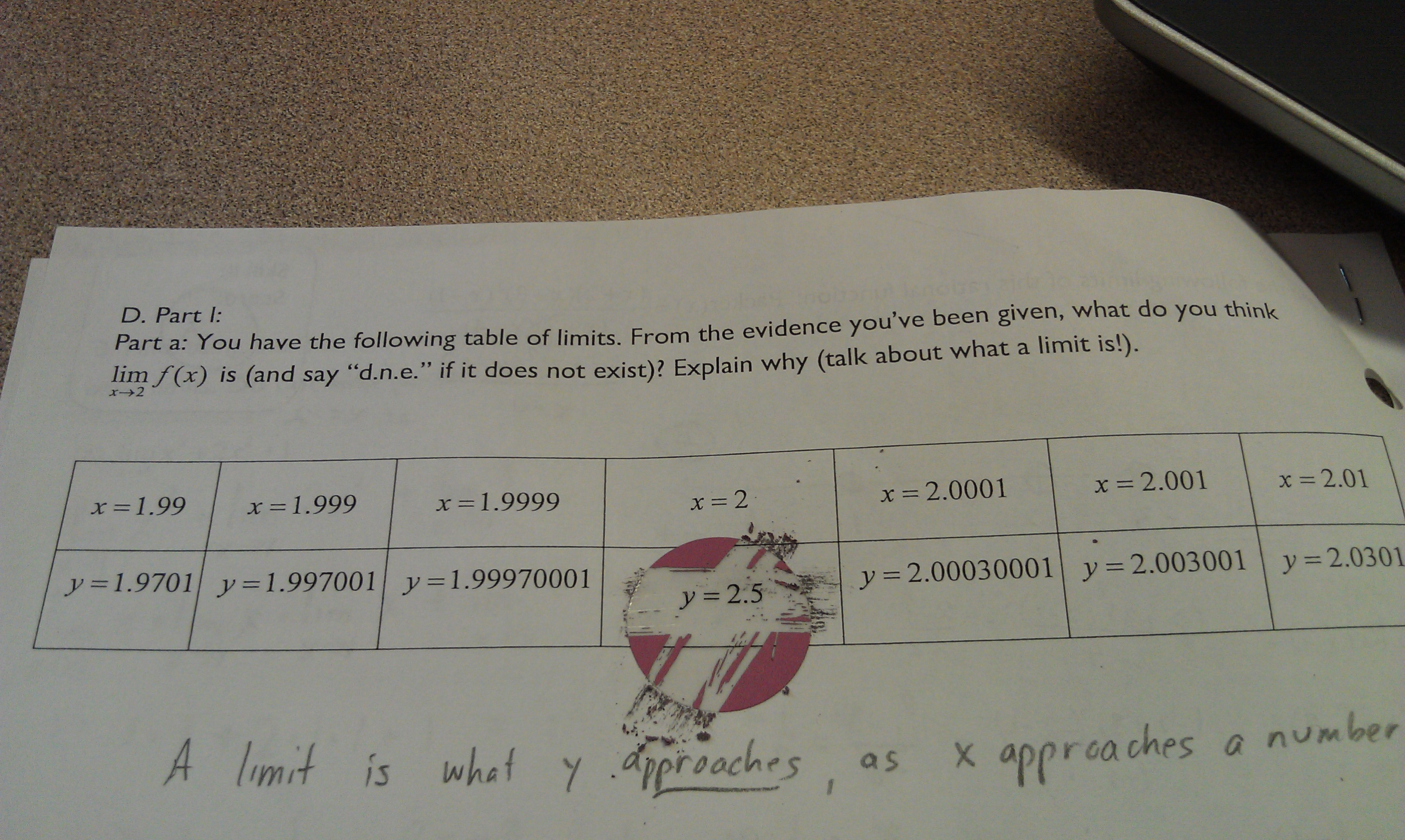
Which reads: “Scratch off the missing data. With the new information, now answer the question: What do you think the limit as x approaches 2 of the function is (and say “d.n.e.” if it does not exist)? Explain why (talk about what a limit is!).

So then they get this…

This is what I predicted. (And this was conjecture.) Almost all my kids are going to get part (a) right. I’ve done them well by that. However, with part (b), there are going to be two types of thinkers…

one kind of thinker, where they think “Mr. Shah wouldn’t give us this scratch off and this new data if the answer doesn’t change. So it has to change. What can it be? Clearly it has to be 2.5, because that’s the new information given to us. So I’m going to put 2.5 for the answer and then come up with some way to explain it, like saying since the function has a height of 2.5 when x is 2, clearly it means the limit is 2.5.” (WRONG.)

the other kind of thinker, who will get the problem right and for the right reasons.

What’s the difference between the two kinds of thinkers? My guess: confidence. More than anything, this is a question that really gets at how confident kids are with the knowledge they have. You have to be pretty sure of yourself to come up with the right response, methinks.

My conjecture was pretty spot on. Let me tell you the responses are fascinating. So far my conjecture seems to be holding water. And it’s just the most intriguing thing to read the responses from students who got it wrong. The phrase that springs to mind is cognitive dissonance. There are a number of kids who are saying two totally contradictory things in their explanation, even from sentence to sentence, but they don’t recognize the contradiction. They’ll say “a limit is what y is approaching as x is approaching a number, and doesn’t have anything to do with the value of the function at the point” and then in the next sentence say “since the value of the function at x=2 is 2.5, we know the limit of the function as x approaches 2 must be 2.5.”

It’s a great question… my favorite test question of all time I think… but I wonder if that’s because of the scratch off.

I know we don’t tend to share student work often on blogs, but I asked and my kids were okay with me anonymously sharing their responses.

I don’t know exactly why I wanted to post student work. I don’t have anything specific I wanted to get out of it right now. But I know I was fascinated by it, and I figured y’all would be too.

But for me, it’d be interesting at the most basic level to just see the different ways our kids respond to questions in other classes… Even regular, basic non-writing problems! Just to see if anyone has ways to get kids to organize their work? Or if we could find a way to examine one student response to a question and throw around ideas about how to best proceed with the kid? Or talk about how we actually write feedback and what kind of feedback we give (and why)? Just a thought… Not for now, but something to mull over…

A Positive and Healthy Approach to Learning

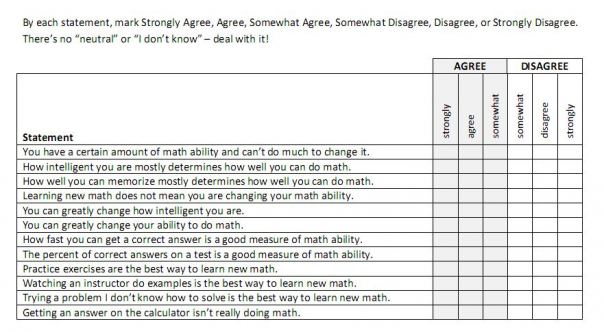
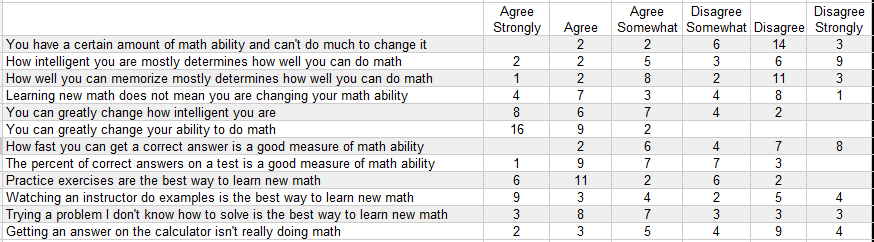
A few weeks ago in Algebra II I had students fill out a series of questions… questions which was going to lead to a discussion about mathematics and intelligence. I cribbed this sheet from my friend and teacher extraordinare Bowman Dickson.

I didn’t capitalize on it immediately, but I think I can still get some good mileage out of this. The thing that brought me back to this sheet was that yesterday in Algebra II, I gave an assessment that students didn’t fare as well as thought they would.

With one section, today, I had a heart to heart with them about what I saw, and this disconnect, and I talked a lot about the difference between active learning and passive learning. I think I got through to them. And I said: take what I said to heart. Be an active learner. And I’m going to give you an assessment on the same material next week. Show yourselves that you are capable. Because I know you are — but you just need to learn and implement the right strategies to be able to do it and make a lasting change.

Or something like that.

So we’ve had the talk about the concrete things… and I think next week, after kids take the reassessment (and hopefully — HOPEFULLY! — do much better), it would be worth it to have a talk about the more abstract side of things… attitude. The way students approach math, think about math, think about intelligence.

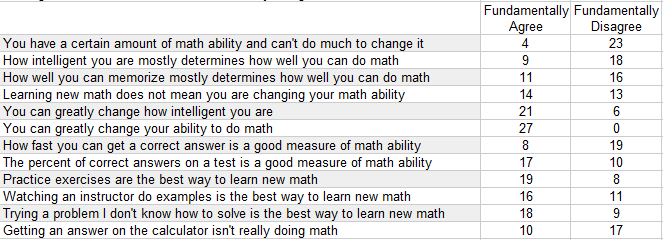
I’d love for any ideas about how to structure/have this discussion. I’ll throw my class data below, but if I’m going to do this, I want whatever I plan to be as powerful as possible. I want it to really get kids to think about what learning is, and how important having a growth mindset is. I have a few thoughts, but nothing great. So any brainstorming you might have, awesome.

As linked to on Sonata Mathematique:

Yeah, I want that DOUBLE POSTER SIZE in my classroom.

Without further ado, here’s my (fascinating) class data…

ALL DATA COMPILED

DATA REDUCED TO AGREE/DISAGREE

The Messiness of Trying Something New

It’s now more than halfway through the first quarter, and things are … messy.

I’m pretty much going through Calculus like I did last year, except for the fact that everything is so much easier because I have standards based grading down. [1] I know what works. While Calculus was hell for me first quarter last year, it’s cake for me now. So calculus is not messy. [2]

So while Calculus is going smoothly, I’m finding Algebra II to be messy. Not in terms of my kids. I love my Algebra II classes. But like last year — when I vowed to really focus on Calculus and leave my other courses well-enough alone — this year I vowed to focus on Algebra II and leave my other courses alone.

Specifically, I’m working on two major things: making groups and groupwork a norm, and having problem solving be a regular (and non-special) part of the curriculum. (As you can guess, the two go hand-in-hand.)

I haven’t written much about my inclusion of problem solving into the curriculum, but right now we’re doing a day of problem solving before each unit (related to the unit), I have slowly started including problem-solving problems in our home enjoyment (our supremely corny term for homework), I have been putting simple problem-solving problems on each assessment, and we so far have had a single problem set (something which I may or may not continue with). Still, I should be clear that most of my curriculum and my classes are traditional.

Now, if you’re a teacher who teaches more traditionally and uses a standard curriculum, you know that this a huge change. Because there’s a huge activation energy involved in switching teaching modes. For me, I kept on saying “next year, next year” and I never did. It’s daunting! And why screw around with something that works well?

And if you’re a teacher who teaches with lots of groupwork, and uses problem solving regularly, you probably remember the year you went through the transition. And how it got easier each subsequent year, as you picked up more tricks of the trade. Tacit knowledge.

And if you’re not a teacher, what the heck are you doing reading this blog? Seriously?!? GET OUTTA HERE!

Switching to this mode has played havoc with my emotions. You see, it’s not healthy and I try to avoid it, but my self-worth is tied up with how well I think I’m doing in the classroom. When I feel like I’m doing things well, I walk around like I own the world. I have confidence. My head is held high. And when I feel like I’m doing a poor job, my head hangs low. I question my desire to teach. I wonder what I’m doing in the classroom. And I’m depressed.

This year, I’m playing emotional ping-pong.

There are times when I feel like I’m killing it in Algebra II. These are usually days before each unit, where we spend the entire period working in groups and problem solving. I love watching kids think and discuss, and they’ve gotten how to work well in groups down. I’ve never had it work so seemlessly. It’s amazing. They’re independent. They’re identifying their own misconceptions and fixing them. I leave these classes wondering why it took me so long as a teacher to get to this point… I feel like my kids are finally and truly grappling, and I love that. (And I’m starting to do this successfully when we’re not problem solving… I made an “exponent lab” which was just 20 “simplify this” problems… and I was seeing great things when they worked together.)

And then there are times when I feel like I’m being killed. I have classes where I want to crawl under my desk and hide. Some of these classes happen the day after kids problem solve, and they present their solutions. Kids put their work on the board, or under the document projector, and present. Or if we don’t have time, I’ll have them put their work up, and I’ll talk through it. These classes have never worked for me. It’s like pulling teeth. Kids don’t know how to present. They don’t know how to engage if they’re in the audience. It takes forever. I don’t think anyone is getting much out of these days. [3] Or there are the more frequent regular classes (where we’re not doing problem solving), and I find I’m standing at the front of the classroom the entire class, cold calling and explaining. And it’s ugh. I feel ugh. There’s no spontaneity. It’s not fun. I don’t mix things up or have different ways of introducing/practicing material to break up class.

What’s interesting is that I feel my kids think that I’m doing a crappy job. I know they — in actuality — don’t think our classtime sucks. (I had my kids anonymously answer some questions, including the what two or three adjectives would you use to describe our classtime question.)

But even though intellectually I know that my kids don’t think I’m doing a crappy job teaching, it doesn’t change the fact that I feel they think I’m doing a crappy job teaching. It’s a slight distinction, but maybe others of you out there know what I’m talking about.

So as I said changing things is messy. Because you don’t know what works yet, and what doesn’t. It’s taking a risk. It requires more work. And you feel like you’re constantly flailing and failing. And that’s not a good feeling. Here’s a recent Facebook “convo”:

I know this is sort of rambling. I’m just trying to work through some things, but I still don’t know where things are going. Which is why there isn’t a real point to this. Just a state of affairs, from an emotional vantage point. I’m not looking for sympathy or advice. I just wanted to try to get my thoughts down — and just let you know that if you’re going through a similar transition, you’re not alone.

[1] I have a list of standards I can choose from, I have good exemplars of problems for each standard, I learned how to effectively introduce it, and I know how to set it up so I don’t die with all the extra work that comes along with reassessments.

[2] But yes, there are lots of things I could do to improve it. Always, always…

[3] I’ve talked with a teacher who does a lot of group work and presentations, and she gave me some excellent suggestions (revolving around using giant whiteboard) which I’m going to take on board.

When you get too lost in the algebra…

I was hunting for a book on my bookshelves when I got distracted and started browsing. In one book, I came across this great idea that I didn’t want to lose. So I thought I’d type it here in an attempt to remember.

One of the hard things about working with derivatives, for me, is that I can easily get caught up in the wonderful (to me, annoying to my kids) algebra. We have the chain rule, the product rule, the quotient rule, and strange and funky derivatives like the derivatives of the inverse trig functions. And I admit it. I love going overboard with these sorts of questions. There’s something really cool about being able to have an answer to a problem take up the length of a page. It looks cool, darnit! And when we get to this point in the curriculum, I often lose sight of the meaning of the derivative. The process takes precedence. And for weeks, we’re swimming (drowning?) in a sea of equations.

When I get to that point, I hope to remember to give my kids this problem:

Find the derivative of \log(\log(\sin(x))). I’m confident that by the time I’m done with them, my kids will get \frac{\cos(x)}{\sin(x)\log(\sin(x))}.

But then I have to ask them to sketch a graph of \log(\log(\sin(x))).

This great setup is on pages 64 and 65 of Ian Stewart’s Concepts of Modern Mathematics. He continues, describing what happened when he gave this problem to his class:

This caused great consternation, because it revealed that the formula didn’t make any sense. For any value of x, \sin(x) is at most equal to 1, so \log(\sin(x)) \leq 0. Since logarithms of negative numbers cannot be defined, the value \log(\log(\sin(x))) does not exist; the formula is a fraud.

On the other hand, the ‘derivative’ … does make sense for certain values of x

Some people might enjoy living in a world where one can take a function which does not exist, differentiate it, and end up with one that does exist. I am not one of them.

There’s a great moral here, about remembering that taking the derivative of a function means something. Yes, you can talk about composition of functions and domains and ranges and all that stuff, but that’s not the enduring understanding I would pull from this. It is: divorcing calculus from meaning and focusing on routine procedures is a dangerous road to travel — so one must always be vigilant.

It actually reminds me of one of my most favorite calculus problems, which to solve it needs one to stop focusing on procedure and start thinking. I would never give this to my calculus kids, but for the very high achieving AP Calculus BC kid, this might throw them for a loop (in a good way):

\int_{0}^{\pi/2} \frac{dx}{1+(\tan x)^{\sqrt{2}}}

I first saw this problem in Loren C. Larson’s Problem-Solving Through Problems (pages 32-33). I don’t quite want to share the solution in case you want to try it yourself. After the jump, I’ll throw down the answer (but not solution) so you can see if you got it right.

(more…)