Binder Checks

In Algebra II, I am trying something that I find is working pretty darn successfully that I’m going to replicate it in all my classes next year. One of the things that aggrieves me more than anything is asking a student to take out a recent worksheet or assessment, and they reach in their backpacks and dig around — their hand burrowing and further crumpling piles of papers from all subjects. It’s always miraculous when they do find what they were looking for, but you all know what it looks like.

Crumpled. Torn. Smudged.

In other words, terrible.

What’s clear is that students haven’t yet learned the skills to keep themselves organized. So this year I thought I would integrate that explicitly into the course. In the process of doing this, I’ve also found a way for kids to do homework and test corrections as part of their routine. No longer is homework something that students do at home, come to class and ask questions, and then forget about. Let me explain.

BINDER CHECKS

Materials: Each student is required to have a binder and a folder. The folder is to be brought to and from each class, while the binder can stay in their lockers unless instructed to bring them to class. The binder has one divider in it, to separate “homework” and “assessments.”

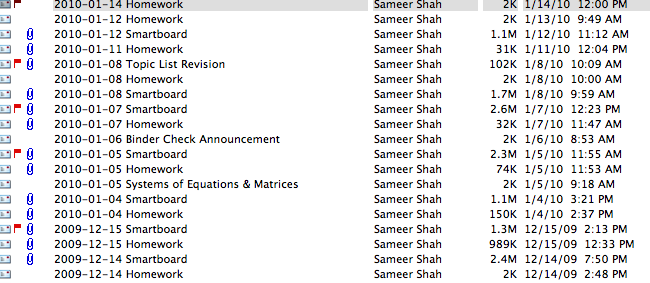
Implementation: Each day, students keep their homework in their folder, organized chronologically. They date everything — textbook homework, worksheet homework — with the date these things were assigned. We make sure to be very consistent with our labeling — especially because we only meet 4 days a week because of our rotating schedule. I also post the homework (and daily notes) on something called a course conference (for those of you familiar with first class) — also organized by the date assigned.
Each night that homework is assigned, students are expected to work assiduously on it. And if it is from the textbook, they are required to check the odd answers in the back — and mark the right answers on their papers if they get something wrong. At the start of class, I always display the even answers to textbook problems (or the answers to any worksheet we did), and I go over questions. At this time, students are expected to correct their work on their homework. They are expected to write down the correct answer. They are expected to ask me (or their colleagues) questions. And if they don’t have enough time to finish all their corrections (I expect them to show work to get the right answer, not just the right answer), they have to finish it at home.

In other words, there is no reason that my kids should have anything less than perfectly completed and corrected homework assignments. (And similarly, when they get tests back, they are required to correct them too.)

For this to happen, I had to talk about this a lot at the beginning of the year. I reminded them constantly about correcting their homework. About dating their work religiously. About writing down the correct answers if they’re getting something wrong — and figuring out why they got something wrong.

And at the end of each unit, students file away all the homework and all the assessments in their binders. They start fresh with an empty folder.

Why would they do all this for me?

Because half of their homework grade is based on this. On binder checks. I sell it to them by letting them know there is one certainty in this course: it is totally ridiculous if they don’t get 100% on the binder checks — it’s me giving them free points, in essence. Just for being organized and checking their work. That’s all!

When

We scheduled 2 binder checks in the first quarter, and then we only have 1 at the end of each of the three remaining quarters. We wanted to do 2 in the first quarter, so students could learn from the first one. We assumed (pretty rightly) that some kids would just bomb the first one because they wouldn’t take it as seriously as they needed to.

What they look like

On announced binder check days, students come into the classroom with their binders, and see a note on the board saying to have only their binders on their desk… Nothing else, no writing utensils, no papers, nothing [1]. When all their compatriots arrive and are set, I hand everyone a red pen. I also hand them the binder check which might look like this [2]:

They are given 5-10 minutes to flip through their binders, and circle their work and answer for the problems asked for. That’s all. It doesn’t take very long at all, especially since their binders are organized chronologically.

I collect them, and we go on with our lesson.

How I Grade Them

Each time I collect them, I get a nice stack of binders that I store under my desk, like I had today:

I pick up a binder, and look for all the circled questions. If the student was neat, and had the correct answer originally, they get full credit for that problem (5 points). If the student messed up but had the corrections (and new correct work), they get full credit for that problem (5 points). However, if the student messes up and has a wrong answer, the student only earns 1 point (or none, if they aren’t neat). I go through the whole binder this way.

Clearly I care about students getting things right. And I love this binder check because it can do so much work for me. I don’t have the time to collect and grade homework everyday. I don’t want homework to be graded for correctness the day after a student learns new material. (They could go home and be totally lost!) However, I do want students to eventually have things right. To work on correcting what they don’t get. Be proactive about what they don’t know. Ask questions. Figure things out.

The stack of binders above looks daunting, right? But let me tell you, I can get through a stack of binders for my class in 2 hours. It surprises me how quickly grading those goes. Seriously!

How I Pick the Questions

It’s no secret here. I pick questions for the binder quiz that span a number of homework assignments, and require some deeper thought and written work. I usually try to pick questions that students get wrong, or asked about in class.

What I’ve Noticed?

My kids now check their odd answers in the back of the book, they are really attentive at the beginning of class checking their even answers (or their worksheet answers), they ask questions so they can make the corrections, and they are much, much, much, much more organized.

You can see the learning curve my kids had with this. On the first binder check, the average grade was in the 70s. On the second binder check, the average grade was in the mid 80s. (And the standard deviation went from 18 to 11.) Almost every student improved, some drastically. Which is all the more impressive because I graded more harshly on the second one because students knew exactly what to expect.

Other Benefits

There are three major other benefits I see from these binders.First, I can collect the binders before parent teacher conferences, so I can show parents the totality of their child’s work.Second, when I write narrative comments on my students, I can use these as a reference to be more specific. Third, when it comes time for cumulative assessments (e.g. midterms, finals), my students will have all their tests organized in one place, to study from.

Overall, I see this initiative as a TOTAL SUCCESS.

P.S. Things to note:

There needs to be a place for students to write the “Date Assigned” on each homework assignment. If it is something from their textbook, they need to write a clear and consistent header. If it is a worksheet I create, I always make sure to put a “Date” section.

Everything handed out needs to be hold punched. You can’t expect students to use the binder if you don’t make it super easy for them to use.

[1] The reason for this is that I don’t want students using pencil to fix up answers to questions they didn’t correct. What they come to class with in their binder is what they get.

[2] For the 2 binder checks in the first quarter, there were about 8-10 things students needed to circle, including not only problems from homework, but also problems from assessments.

Culture of Math Contests

My school does not have a culture of math contests. But I’m on a mission to change that.

This year we signed up for the New York Math League contests, which actually seem to be getting a dedicated small set of students taking them. (I think the biggest problem with getting a sizable number of students in our  school to take these contests is that our kids are so busy that not many kids can take the exam after school on the day we administer it. They have sports and other commitments.)

However I’ve taken it upon myself to make a huge push to have more students take the AMC 10/ AMC 12 math contests this year. How?

  • I’ve spoken individually to the other 6 math teachers about speaking to their classes about the contest, and I gave them some sample problems to give their kids if they want more information. I’ve convinced a few to offer some incentive for their kids if they take the exam (example: I’m giving extra credit, which I almost never offer, and another teacher is giving a homework pass).
  • The math club student leaders are making a facebook group (their idea!).
  • I’m having students “register” for the contest (basically fill in the blank on a sheet which says “My name is _________, I am in the ____ grade, and I am awesome because I am going to take the AMC!”). I’m going to use this list of students to send a reminder email to the kids. I’m also going to send a letter to their parents explaining the contest, and why we in the math department are really happy that their kid is going to take it. Basically, I want to get the word out to as many people about the contest, in a few different ways.
  • I’m trying to get some money so we can order  pizza for the kids after they take the exam.

I think last year we had 10 or 15 students who took the exam. I really want to ramp it up this year. And if we can do this for a few years, we might be able to develop a culture where taking the AMC is a “normal” thing to do — where kids in the accelerated track all want to take it and interested kids in the regular track are encouraged to take it. I’m trying to slowly and consciously engineer a shift in school culture. It’s hard to figure out how one can create a culture shift.And I know, it’s a really small culture shift, but in my opinion, it’s really important for our department and for our kids.

The Calculus of Friendship

In the past few weeks, I’ve read a few books about math.

I don’t have a lot to say about the first book. I learned a few interesting vignettes and a few interesting facts, but overall, I’m not sure I would recommend it to others. The second book was actually incredibly fascinating, and I will maybe write a little somethin’ somethin’ about that later. However, I just finished The Calculus of Friendship and wanted to give it a major shout out.

Let me first tell you how I came upon this book.

Prof. Strogatz emailed me in October of 2008.

I happened across your blog today (isn’t the Internet amazing?) and felt compelled to try contacting you for many reasons.  You seem like a great (former) student who has now turned into a great teacher. That’s wonderful.  Sorry we didn’t overlap at MIT.  And it’s very admirable that you’re now bringing your enthusiasm and training to help inspire high school kids.

The email was longer than that, and incredibly sweet, but what was more amazing than getting this email was the timing of it. I explained in my reply:

You won’t believe how coincidental your email is! In one of my calculus sections this past Friday, we finished the material we needed to go over ten minutes early and we got — somehow, don’t ask me how — on the topic of chaos. So of course I go off on this mini-lesson on the chaotic waterwheel. We watched youtube videos and talked about what it means for something to be chaotic, and how they should understand why weather is so unpredictable from this.

One student came to my office after class, and I showed him your textbook (which I hold up as one paragon of what college math textbooks should strive to be; it was far and away the best math textbook I’ve used, besides the calculus textbook that I used in high school, which will always have a special place in my heart and on my bookshelf).

I loved that.

Then this year, Prof. Strogatz emailed me asking if he can send me a copy of his new book The Calculus of Friendship. The timing of that email was strange too. In my reply email, I said:

Wow! Thank you so much for this super unexpected and thrilling surprise. Talk about things that brighten the day. Something in the zeitgeist must be in sync (ha, groan) because just yesterday I was looking around in our math department for your Chaos DVDs (I asked my department head purchase them last year). They were nowhere to be found. Turns out one of the math teachers took them home over the summer to watch, and her boyfriend then got hooked on them, and that’s why they were missing. Too good! And what a compliment to your digital teaching presence.

I looked at the first few pages of your new book on Amazon.com, and it can’t but help but be an emotional read. Because I suspect that ensconsed in the pages is a portrait of the teacher that I strive to be.

Enough prelude. I finally did get to sit down and read this book over winter break. It’s a short read, only about 150 pages. And it is broken up into sweet little vignettes. Although I could have polished this book off in a few hours, I wanted to savor it, let it linger. So I limited myself to only a dozen or so pages each day.

I was introduced to two characters: a precocious high school student (Strogatz) and a veteran teacher (Joffray). And as I slowly devoured the book, I was taken on an emotional journey about two minds which played off each other, and two lives which slowly and inexorably intertwined with each other. Strogatz has written an honest and critical autobiographical piece, while at the same writing a sublime elegy for his former high school calculus teacher.

The Calculus of Friendship is crafted by the author and narrator, Steve, by analyzing his epistolatory relationship with his teacher, Joff. The letters started after high school and focused on interesting mathematical questions. These letter exchanges continued for decades. What’s interesting is not only the contents of the letters (which I will talk about below), but the changing role that the letters played in the writers’ lives. The meaning of the correspondance between Steve and Joff changed, although the content itself was often intensely and narrowly focused on interesting mathematical problems and solutions. This book is indeed, as the publisher’s blurb says, “an exploration of change. It’s about the transformation that takes place in a student’s heart, as he and his teacher reverse roles, as they age, as they are buffeted by life itself.”

As expected from the author of one of my favorite college textbooks, the actual math is explained clearly. The math problems the two worked on through the years are interesting (chase problems, some fun integrals and series, the gamma function, dimensional analysis, etc.). The problems were different and interesting enough, or the approaches out-of-the-box enough, that I wasn’t bored and didn’t skip any of the math explanations.

Because the epistolatory nature of Steve and Joff’s relationship, and because they were each egging each other on with questions and observations, the puzzle-y aspect of problems solving came to the forefront. Some problems were attacked in a number of different ways, with a few different approaches. (My favorite one was finding \frac{\sin 1}{1}+\frac{\sin 2}{2}+\frac{\sin 3}{3}+\frac{\sin 4}{4}+....)

So yeah, I give the book two thumbs up.

As an aside, this book gave me a thought: a textbook (or unit) written entirely via letters. A fresh back and forth exchange. A little back story to draw in the reader. This approach could showing how math really unfolds, how questions get raised and answered, how some approaches work while other approaches fail, etc. Basically a textbook showing the messy nature that math evolves, because it is written as a dialogue between two people trying to figure something out. Where everything isn’t presented in a sterile, whitewashed way. Where the driving question for a unit is something like “so I was wondering if you can find a curve that goes through the point (2,1) and (4,-2). I’ve figured out how to find a line that goes through these points (which I will explain in this letter below). But what about some other curves? I mean, I can draw an infinite number of curves between these two points. [figure included.] How do I find their equations?”

Okay I should get to bed now. The twilight of my winter break is nigh and my alarm goes off in 7 hours to wake up for my first day back.

Insolvability of the Quintic

One day a few weeks ago I had a day to kill with one of my two multivariable calculus students. So I decided to talk a bit about something which intrigued me when I first learned about it.

If you have any linear polynomial (ax+b=0), then it is easy to come up with the algebraic solution for any a and b. (Obviously it is x=-b/a.)

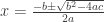
If you have any quadratic polynomial (ax^2+bx+c=0), then it is still pretty easy to come up with the algebraic solution for any a, b, and c. (Obviously it is x=\frac{-b\pm \sqrt{b^2-4ac}}{2a}.)

What about the cubic? quartic? quintic? higher?

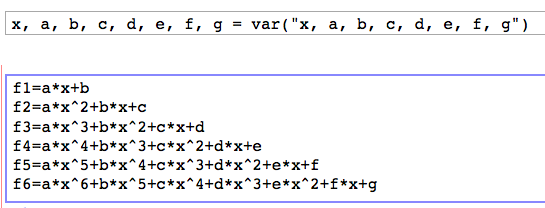
I had my student take out his laptop and we used SAGE online to see what we got. We entered something like this:

I then asked if we could, for any coefficients, find all zeros (real or complex) to the polynomials.

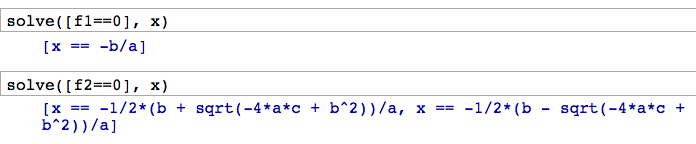
Before pulling out the laptops, we had already answered the first two. Which we  confirmed with SAGE:

Then I asked about the cubic.

He said he knew how to find the solutions to some cubics. Like he could graph them and if they hit the x-axis three times, he could get the solutions. Not good enough. We wanted formulas for the solutions. For any coefficients. Without graphing. Like we had for the quadratic.

He (naturally) said he didn’t know.

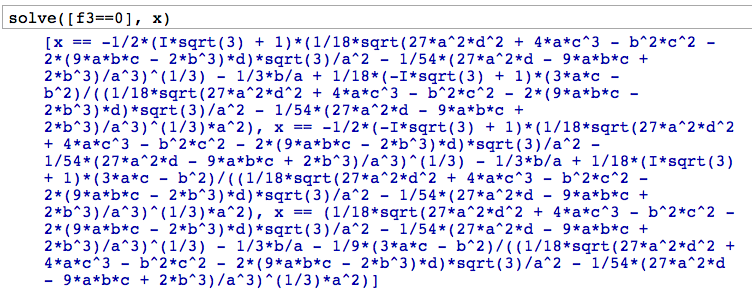
So we turned to SAGE and found:

So there is a formula. And it’s messier than the quadratic, which is messier than the linear [1].

So we checked the quartic.

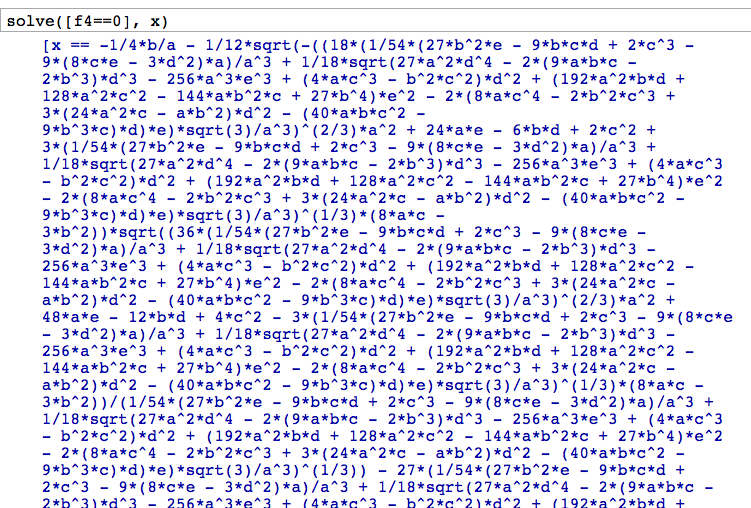
And indeed, SAGE found a solution. I’m only copying the first few lines here since it goes on forever.

So here we are, and there’s a pretty good chance things will continue — there’ll be a solution but it’ll be more and more complicated as the polynomial degree gets higher and higher.

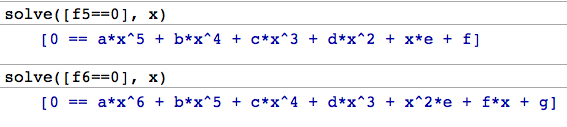
But when we try the quintic and the sixth-degree polynomials, we get:

Um… it won’t solve it for us? Is SAGE just not powerful enough to help us? Do the solutions get *that* much harder?

Could be.

But it isn’t that SAGE was broken. It turns out there is no “formula” to get the zeros of any given quintic or higher polynomial. Sure, you can solve some quintic polynomials. Heck, they might even be factorable to (x-1)(x-2)(x-3)(x-4)(x-5) or something. But that isn’t what we’re asking. We’re asking if you have any quintic (or higher) polynomials, can you come up with an algebraic formula for the exact roots.
No.

And the reason I wanted to show my student that is because it was learning that fact in high school, the insolvability of the quintic, that got me even more interested in math. It raised the huge question: what broke down after 4? Why is 5 the magic number? Is it truly impossible for any degree polynomial greater than 5? How can anyone show that a degree 1021 polynomial won’t have a “formula” solution for its zeros? No one could explain it to me, but my math teacher swore it was true.

It seemed so crazy to me! Heck, it still does. Interesting tidbits like that lit a fire under my feet [2] to take college level algebra (Abstract Algebra) to help me understand it. It was one of the most glorious days of college when in our Abstract Algebra class we finally got to tackle and solve this problem.

Do I remember how we did it?

Sigh. No. I have Flowers For Algernon syndrome.

But I at least know that the solution is out there, and given enough time and patience, I can understand it once again.

I doubt my student got out of it the same level of “WHAT THE HECK?!” as I did, nor do I think it lit the curiosity fire under his feet. But heck if I didn’t show him that our intuition breaks down without cause sometimes, and there are answers to be found. Maybe not in our class, but in some other class if he ever wants to solve the mystery.

[1] Well, when I was in high school, I had my dad’s worn, cover-falling-off CRC Book of Mathematical Tables and Formulae. In it was the solution of how to solve any cubic, and how there is indeed a formula (like the quadratic) for the cubic. (You can see it nicely typed here.) I suspect it also had a paragraph or two about the Cardano/Tartaglia dispute.

[2] Godel’s incompleteness theorem was another one.

a stubborn equilateral triangle

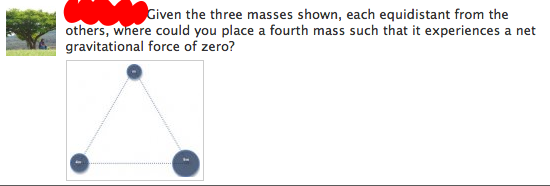
My sister is a teacher too. And she’s smart. And sometimes she poses questions which stump me. She posed a good physics problem on Facebook a while ago.

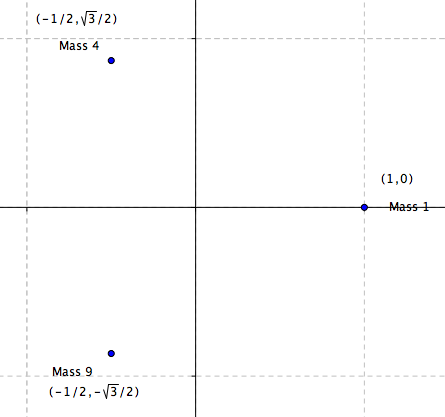
In case you can’t tell, the three fixed, point masses have masses 1, 4, and 9. She wants to know where you can place a mass so that it won’t move! So that the net gravitational force on it is nil.

Just in case you forgot Newton’s Law of Gravitation between two bodies: F=G\frac{m_1 m_2}{r^2}

Before starting, I thought this problem would be so easy. If the three masses were equal, we’d have a simple geometry problem. Since they aren’t, it turns out we have something more tricky. I thought the solution would come easy. For me, it didn’t. But I think I got an approximate solution.

Just so we can compare solutions, let’s put our masses on the cartesian plane as below:

As you can tell, I placed the three points on the unit circle.

I don’t want to give much away, so I’m just going to leave you to it. Throw your thoughts in the comments below. If you’re dying for the answer, I’ve hidden what I got on this site somewhere in some not-hard-to-find spot.

If you get stuck, look after the jump for some encouragement.

Just a note: I don’t know if I got the right answer… I think I did, when checking it, but I’m not totally sure. I got tired of working it. That’s why I wanted to throw this up there to see if anyone could corroborate, and also to see your approaches!

(more…)

the evolution of a student teacher

I’m doing a huge shoutout to justagirl24, who has finished her student internship.

I don’t know her, and I’ve tried posting a few (long) comments on her blog — only to have them disappear into the internet ether. But I’ve been following her journey as a student teacher for the past four months. I think her blog, from August 2009 to December 2009, should be suggested reading for beginning student teachers everywhere. I remember having a lot of the same thoughts that she did when I did my teaching practicum at a public high school in Cambridge, MA.

I’ve linked to her blog a couple times on Twitter, but I don’t know if anyone clicked. So to induce you to read, let me whet your appetite by spoiling the narrative a bit. I’m going to show you the beginning and the end of this story.

September 7, 2009:

I’ve come to realize that this is all a chore to me. I don’t want to drive in the morning to school. I hate it. I can’t quit. I wish there was a way to make it better. Sure I can work with other people to come up with solutions, but you know what it’s all up to me to enforce those solutions. And it usually ends in failure for me and my students… That’s what sucks about this, I hate being alone. No one can be there to defend me. I’m the one who needs to stand up and do it. Can I go in and say “I’m still learning, guys and girls.. I’m new at this.. give me a chance to experiment with you”… maybe I can say that.. but I dunno.. right now I have so many things floating in my mind. All I can think about is school and this whole experience. Nothing else.. I need something in my life to make me happy and right now I’ve got nothing. Nothing to keep me distracted.. Nothing to keep my mind from thinking about this “chore”.

December 17, 2009

So it’s the last week.. it’s bittersweet.. I’m sad to go but happy to be done. I’m definitely going to miss these kids. I wanted pictures of all of them, so I have a group shot of every class. For my math10 class, I was handing some last minute stuff back.. and was kind of giving a mini speech.. about how I really enjoyed this internship.. I was starting to choke up.. so I stopped talking.. lol.. It’s bizarre to think that 3 months ago I would make it to the finish line.. But I have.. I survived and endured.. Surely not without any struggles.. This is surely one of the best experiences in my life thus far. I just can’t believe I was considering quitting in the beginning. I think it’s a phase that everyone goes through when they’re thrown into a different and new environment.

This was four months. That blows me away. Four long, hard, rewarding, frustrating, emotional months. So congrats, justagirl24. If you happen to see this… thanks for sharing your thoughts with me. I’ve been there, silently rooting you on. Not in a creepy “he’s stalking me” way. In a “you can do it!” way. And you did.

Now don’t forget to return your classroom key.

Natural Philosophers as Puppets

Two of my calculus students today approached me at the end of class (this was the last time I was going to see them before winter break) and handed me

as a present. Indeed, if you identified this as a finger puppet of Newton, you would be correct! They said they looked for a Leibniz too, but one didn’t exist. Of course if one did exist, things might have gotten a little dangerous. Goodness knows I might have had to create a few history of calculus videos (a la Potter Puppet Pals).

All I have to say is: hooray for my “histoy of calculus” webquest!