Blogging/Twittering

Some places of exploration for younger kids who like math and who want more joyful math play

I got an email from a college friend about their kid Sam…

Ahoy Big Sam!

I have a question regarding Lil Sam. 

He’s big on math. 

Like big big. 

Do your colleagues in the lower school / primary school have a list of resources for self-directed math exploration for the youth?

Or even applied math via games etc so its more play / exploration vs workbooks?

It got to the point that he was asking us to come up with math questions that we just bought a stack of workbooks but those feel like work and less development of interest and joy. 

Now I don’t know anything about little kids. But I love that my friend wasn’t looking for workbooks and was more interested in “joy” and “play.” Below are what I’m going to recommend to my friend, but I think would be a useful list for any kid in pre-Kindergarten to grade 5.

Beast Academy: I remember another college friend reached out years ago with a similar question, and I turned to the online math teacher community and pretty universally I got “Beast Academy” as an answer over and over again.

I reached out to a kindergarten teacher who I adore (I mean, she plays board games with me). I once told her how much I was loving Tracy Zager’s book Becoming the Math Teacher You Wish You’d Had even though it was written for elementary school teachers, and she picked it up and read it! So she’s quality people. I also reached out to our lower school math coach. Both said the same thing:

Tang Math: especially the summer challenges.

Then I reached out to my new math teacher community on Mathstodon, and got additional suggestions:

MathPickle: I went to this site and loved it, and there is a link to a super fun activity book called the “Infinite Pickle” and upon quick browsing, I’m excited by it! And tons of puzzles! There’s also a page with lots of suggested board games and at the top of that page, it reads “#1 job for parents: establish a culture of board gaming in the home.” You know I’m a fan of board games, so I’m into all of this.

DragonBox Numbers game: not only did I hear about this online, but I went to a Desmos Fellows Conference a couple weeks ago and a few elementary school teachers were raving about this over lunch one day. So I heard about this twice in a few weeks when I had never heard about it before! Also, one can learn chess, apparently, with DragonBox chess and that was recommeded too.

Math For Love, of course! I’ve known about this site for years, with all the rich tasks and games (like Tiny Polka Dot!). There are lesson openers, rich tasks, and games (all sortable by grade level!).

Yokaku puzzles were recommended and were a new type of puzzle to me, and I think these are designed to build number sense and fluency — and can be written from the youngest students to the oldest students (like I saw some things I could use in my high school classes!).

Math Games with Bad Drawings is an awesome book by Ben Orlin (which might have my name in it, in a very tiny endnote) which is chock full of games (most new) that involve very little other than pencil and paper and maybe an occasional coin or paperclip) that I absolutely know I would use with my own children if I had any. Plus I think my friend who asked for suggestions would love reading the book (the prose is humorous) to get the games to teach his kids.

The easier levels of Area Mazes and Strimko puzzles were also thrown out there. I hadn’t heard of these types of puzzles, but when I googled, of course the great Sarah Carter comes to the rescue with really informative pages both on Area Mazes and Strimko puzzles.

Lastly, as I was putting together this post, I remembered two more resources that might be helpful to my friend. Kent Haines’ website Games for Young Minds and Christopher Danielson’s Talking Math With Your Kids. Both are deliciously wonderful. I definitely have bought the books “How Many?” and “Which One Doesn’t Belong” along with many fun play tiles from Christopher Danielson’s shop and highly recommend them.

I figure this post can be my personal repository if anyone asks for fun math enrichment on the pre-K to 5 level. But PLEASE leave a comment if you have any additional suggestions! I’m always looking for things to expand my knolwedge of cool math resources.

UPDATE: Ahhhh, I can’t believe I forgot this. At the Desmos Fellows Conference, the TV show on netflix Numberblocks came up a few times! And there’s a youtube channel. I even watched a few episodes with my niece and nephew and I really enjoyed them. (I think they were less excited about it because they’re older and we started with the very first episode.)

UPDATE 2: My friend who works for Illustrative Math said their “IM math centers” could be useful too! She expanded: “Go to link, navigate to a grade, find the tab that says “Centers” and poke around. I’ve heard they can be a bit hard to navigate at first just because there are a lot of them, and each one has ‘stages’ of increasing complexity. But if you download any set of blackline masters, the directions are written on them in kid-friendly language. Primary teachers sometimes mean different things by ‘centers’ but I take it to mean an activity that kids can do without adult supervision to practice or work on number sense.”

Let’s Get MATHStodoning Together!

As we start navigating mathstodon together, my friend Julie and I are trying to create conversation, community, and maybe even friendship here by posting prompts to get us all talking! Now that there are so many math teachers on there, the question is: how do we even start the conversation? I figure this is one way to do so! I’m going to keep the prompts that we share updated here on this post.

The most recent prompts are at the top of the page, and if you scroll down you’ll see the earlier prompts.

PROMPT 14

#ClassroomMath #prompt14

My math teacher friends, this is the very last prompt from @samjshah and @jreulbach! And it’s not even really a prompt. Did you know that this year’s Teacher of the Year is a math teacher from Oklahoma? Her name is Rebecka Peterson, and SHE. IS. WONDERFUL. So task one for this post is for you to watch a short video with her, and then read her profile. We might have teared up at Rebecka’s last line in the video. 

Video: https://ntoy.ccsso.org/one-good-thing-rebecka-petersons-address-to-the-nation/

Profile: https://ntoy.ccsso.org/rebecka-peterson-2023-national-teacher-of-the-year/

Notice in her profile that she wrote “Amid a difficult first year of high school teaching, Rebecka found the One Good Thing blog. She credits daily posting there to helping her recognize the beautiful and positive experiences occurring in her classroom, which inspired her to stay in the profession.”

Last year, after hard years in the pandemic, I (@samjshah) decided to be intentional about bringing joy back into my teaching life. I wanted to keep a look out for the good. So I posted every day on the One Good Thing blog. 

https://onegoodthingteach.wordpress.com/

It’s a collaborative blog that has grown fallow. For most of last year, I was the only one posting. So for your second task, I ask you to consider archiving the good moments in your teaching life? It doesn’t have to be every day (though it can!). It can be once a week, or once a month, or whenever the spirit strikes you. If you are interested, send me a direct message with your email address and saying you want to join in, and I’ll add you as an author for the blog. 

With that, thank you for participating! We look forward to hanging out with you on mathstodon!

PROMPT 13

#ClassroomMath #prompt13

Math teacher friendsssss! Some of us have already started, and some of us are about to start! ACK! It’s always so busy and nerve-wracking at the start of the year. Learning and remembering kids’ names, getting back into the groove of teaching, setting up systems, etc. 

This is our penultimate prompt. We want to know what is ONE SMALL CHANGE you want to make this year. At the start of the year we can get so excited and overwhelmed with possibilities, and we want to change ALL THE THINGS! But the changes that often are the most meaningful and the most sustainable are small, intentional changes.

So if you already have one, throw down a small change you’ll be making this year, how you hope to make it (what you have to do to make it real), and why you want to make it.

If you don’t have one, maybe brainstorm a change or two that you are considering making! 

Tag your post with #ClassroomMath and #prompt13

PROMPT 12

#ClassroomMath #prompt12

Today we’re playing a hypothetical. Don’t get caught up in giving *the best* answer. It would just be fun to bandy about lots of ideas! In fact, give many ideas if you want!

How many times have you told someone you teach math and they say “OHHHHH, I was never good at math! I just hate it!” It’s a common refrain. But let’s pose this hypothetical…That person is your new friend, and you have dug getting to know them. And your new friend followed up “I also hate that I hate it! I really wish I understood how people can love math. Hey, I have an idea… I have a half hour free. Any chance you’d be willing to help me get a glimpse of how math can be not awful?”

Your new friend is open, curious, interested. 

What do you say or do during that half hour, with your new friend? 

Tag your post with #ClassroomMath and #prompt12

PROMPT 11

#ClassroomMath #prompt11

To preface this post, it’s important to recognize that *every school is different.* One teacher might have 35 kids in a class and another might have 12. One might have a lot of autonomy while another has to abide by prescriptive curricula. One might have teacher colleagues or one might be teaching alone. That being said:

I’m wondering if there are any structures or systems you set up in your classes… that you find helpful for you or for the kids. 

It can be about homework, about assessments, about the way you start every class, about exit tickets, about reviewing old material, about practicing math to gain fluency, about test corrections, about groupwork, about taking attendance, about WHATEVER! 

Tag you post with  #ClassroomMath, and #prompt11

PROMPT 10

#ClassroomMath #prompt10 #ClassroomBelonging

Okay math teacher friends! We’re keeping this prompt simple. What are small or large ways you create a sense of belonging in your classroom. 

They can be small teacher moves, larger structural pieces about how you set up your class, things you have hanging in your classroom, etc. But what are some things that you do in the hopes that you cultivate a sense of belonging? (And I have to note that of course there are many times we fail at this… but we keep on trying!)

Tag you post with #ClassroomBelonging,  #ClassroomMath, and #prompt10

PROMPT 9

#TeacherCrush #ClassroomMath #prompt9

Today’s prompt, math teachers, is about uplifting those that brought us into the classroom, and that sustains us in our schools. I have a terrible memory but I still remember three teachers from high school and one professor from college that had a huge impact on my decision to becoming a teacher. And I have so many colleagues who I love dearly who keep me sustained. So with that, here you go!

1. Who is a teacher that you had that meant a lot to you? What do you remember about them?

2. Who is a teacher colleague that you have currently that means a lot to you? Why?

Tag you post with  #TeacherCrush, #ClassroomMath, and #prompt9

PROMPT 8

#FirstDay #ClassroomMath #prompt8

Okay, so we’re in August. No matter where you are (if you’re in the US), this is the official wakeup month for school existing and us going back into that building. Yup! Like an ostrich, I try to keep my head buried, but I always have that pull… start getting your act together, kiddo! Figure the basics out. At least have a plan set for the first day!

So the question for you is: paint a picture of what happens on your first day of class (or part of your class)? Do you dive right into content, saving syllabus and structures for later? Do you set norms? Do you do something to begin to create community? What do you do?! Bonus points for any and all resources related to what you do — so we can copy!

Tag your post with #FirstDay #ClassroomMath #prompt8

PROMPT 7

#ClassroomMath #prompt7

For some of us, time is running out and school is almost starting up. For others, you’re in the middle of summer (or winter if you’re down south)! To help out our friends who are starting up soon, let’s talk about some start of year stuffs! We have a bunch of “start of year” prompts — chose to respond to one or many!

1. Do you have any decorations, posters, a math play space,  or something in your classroom(s) that you put up each year? If so, please share! (A picture always helps if you have one from years past!)

2. Do you have something on your desk that you absolutely love? A stamp that says “Show your work!” or a framed letter from a student or an organizer you can’t live without or a special set of grading pens you love? Share, please!

3. What’s the very first thing you say to your new students on the very first day? 

4. Back to school nightmares. They’re weird, they’re awful, and it feels good to know others are having them. Have you ever had them? Do you still have them? What are they about? 

Please tag your post with #ClassroomMath and #prompt7 

In our next prompt, we’ll have people share some of their first day lessons… So start thinking about what you’ve done with your kids in previous years!

PROMPT 6

#ClassroomMath #prompt6 

It’s summer!!! And before you are in full mathing mode for the fall, let’s take a short break and share our favorite NON-teaching books, movies, or TV shows that we are enjoying this summer. 

For free books, we have discovered the Libby app. To use Libby, all you need is a library card, and then you can borrow free ebooks, digital audiobooks, and magazines from your library! 

  1. Share a book(s) that you really enjoyed. You can also add a picture of your favorite summer place to read if you would like.
  2. Share a movie or TV show that you have recently been watching (and if on a platform like Netflix/Hulu/Prime/etc., what platform?).

Please tag your post with #ClassroomMath, and #prompt6

PROMPT 5

#ClassroomMath #prompt5 

Unfortunately, so many people have experienced a mathematics that is devoid of humanity. Francis Su, in a powerful lecture [https://mathyawp.wordpress.com/2017/01/08/mathematics-for-human-flourishing/] points out that mathematics should contain experiences of play, beauty, truth, justice, and love. For this week, we want to see and hear how you, as math teachers, bring out the humanity in mathematics — in small or large ways! So we have a two-fold prompt. Pick one and go for it!

a) How do you highlight that the doing of mathematics is a human endeavor?

b) How do you express your identity as a doer of mathematics, and share your “why” for doing mathematics with, to kids?

Please tag your post with #HumanizingMath, #ClassroomMath, and #prompt5 


We purposefully crafted these prompts to be open-ended and anticipate many diverse responses! Might it be that you share math history, so students know math is historically and culturally situated? Might it be that you highlight the achievements of mathematicians that look like your students, or don’t look like your students? Might you create a classroom community that empowers your students to bring their whole selves into the classroom? Might you have routines that build relationships among the mathematicians in your classroom? Might you teach mathematics through a social justice lens? There is nothing is so small that isn’t worth sharing! Sometimes it’s the smallest things that we do that can have the largest impact!

For some of you, this might seem familiar. It was for a virtual conference @samjshah had put together years ago with Hema Khodai. Feel free to read some of the responses here: https://samjshah.com/humanizing-mathematics-convention-center/

PROMPT 4

#ClassroomMath #prompt4 

Today, my math peeps, we’re going to be sharing and maybe doing math! Is there a problem that you love having your kids work on? A favorite problem that evokes conversation and ah hah moments? Or is there a math problem or puzzle you’ve seen or done that made you go “oh, wow!”? 

In your post:

1. Write down your math problem! If you use it in your class, share the grade/class you use it with, and why you like the problem for your kids. If it’s just a recreational math problem or puzzle, feel free to just drop it in the post. You can decide whether you want to give a hint or not! (NOTE: you can use the “CW” button when writing a post to hide the post’s content until someone clicks on it… so you can type the problem in one post, and then in a reply to that post, you can use “CW” to hide the hint until someone decides they want to see it.)

2. Tag your post with #MathPuzzle and #prompt4 and #ClassroomMath

Don’t forget to bookmark any problem/puzzle you might want to use in the future! 

To practice using the site, we have just one challenge for you: practice using the fancy math ability of mathstodon to write an equation in a post. The fancy math equations only show up when you read posts on the desktop (not in apps, yet…), but it’s pretty awesome. 

From the desktop page, click on the “f(x)” button and click “inline equation.” Some slashes and parentheses will appear. In between those, type: 

g(x)=\frac{\sqrt{3x-5}}{3}+\frac{x^{52}-x}{3\pi \sin^{2}(x)}-5x^{6}+a_{n}

See what happens! Believe it or not, you’ve typed pretty LaTex math. 

PROMPT 3

#ClassroomMath #prompt3 

This week will be fun and frivolous in the best kind of way, dear peeps who love math and teaching! We’re going to do two things. We’re going to play “Some truths and maybe a lie?” and also you’ll share a photograph from your phone that brings you joy — and explain why. 

In your post:

1. Write down three facts about yourself, but one, two, or all three can be lies! 

2. Share your photo and explain why it brings you joy.

3. Tag your post with #prompt3 and #ClassroomMath

Of course the whole point of this is to get people talking! So after you post, look around at other posts with the #prompt3 hashtag and make a guess! Are any of them lies? All of them? Bonus fake points if you start talking with someone you’ve never talked to. 

As always, to practice using mathstodon, two challenges. First, find a new hashtag based on one of your interests that people are posting with (for example, #knitting) and “follow it” so it shows up in your timeline. Then share it with the #ClassroomMath community in case others are interested. 

Second, many of you have been using the official mastodon app, but (@jreulbach and @samjshah) have tried many apps and we’re loving IceCube for iPhones: https://apps.apple.com/us/app/ice-cubes-for-mastodon/id6444915884. So our first suggestion is to check that out! 

If you have any ideas for future prompts or ways to build community, please DM @samjshah and @jreulbach! We’d love help keeping the conversations happening!

PROMPT 2:

#ClassroomMath #prompt2

Superb! We’re introducing ourselves, we’re getting used to the platform! Wunderbar! 

One thing we all have in common in this community, no matter how different we are (including in many of your terrible rankings of desserts from #Prompt1), is that we have worked with kids in the classroom teaching math. We all have millions of stories inside of us that are hilarious, heartbreaking, harrowing, hopeful… When you rallied against the administration, when a kid said something wonderfully outrageous, when you accidentally had an answer to a start-of-class question be 69 and you were being observed… 

So we ask you to share just one small story from your teaching life — something you’re comfortable sharing! Something you’d share with friends over dinner after a particularly eventful week. (Remember if you use the mathstodon.xyz site, you can get 1729 characters in a post.)

In your post:

1. Share your SMALL story. No pressure… and remember this is a judgment free zone. 

2. Tag your post with #Prompt2 and #ClassroomMath

Lastly, to practice using mathstodon, here’s the new challenge! In the next few days, go to your LOCAL timeline. That’s posts by EVERYONE on mathstodon.xyz (or whatever “instance” you’re on), not just people you follow. Find someone new to follow AND boost a post of theirs that you find. (Boost is like a re-tweet.) That will help others who follow you see something you find interesting… and maybe they’ll start following that person too.

PROMPT 1:

We love how many math teachers/coaches/etc. have joined mathstodon! Huzzah! It’s strange coming into a place where we have to build community again. If you haven’t joined yet, you can read my post about getting started on Mathstodon! Join us!!!

We also know some people feel totally lost. So we (@jreulbach and @samjshah) thought we should have some get to know you prompts so we can meet each other and start talking!  Some will be about math/teaching, some will be challenges for you, some will be fun frivolous things!

To start, write a post (or a series of posts) sharing:

  1. Who you are, what you teach or do, which city/state you teach in.
  2. If you had to rank the following, what order would they go in: pies, donuts, cakes
  3. What are some things you enjoy spending your time on outside of the classroom?

Tag your post with #prompt1 along with #classroommath and #introduction.

And a challenge: try to respond to 2-3 other people! Fake bonus points if they are people you don’t know (which might be everyone for you)!

(Pro tip: If you use the desktop version of mathstodon.xyz you can get 1729 characters in a post.) 

Also, we’re going to try to include some “mathstodon” challenges to help you learn what it can do and how to use it! So your first challenge is to add all posts with #classroommath to your timeline! Since there are so many different apps, see if you can figure out how to do it on your app. On the desktop, search #classroommath, click on it, and look for the little person icon with a + sign on the top right. Click that! You’ve just added all posts with #classroommath to appear on your timeline! 

#mtbos #iteachmath

Mastodon???  MATHStodon!!! Join Us!

(From Sam Shah and Julie Reulbach)

What We’re Doing and Why:

Okay, friends. Twitter was acquired by Elon Musk and seems to constantly be on the brink of imploding and full of misinformation, and now ads about every three tweets. There is that whole pandemic thing where many of us were just trying to keep our heads above water — and so we connected less with the online math community. Twitter Math Camp became a thing of the past. And blogging was already on the decline. 

And you know what? We miss our math teacher community so goshdarn much. We miss talking with each other, throwing lesson ideas out there, sharing what we’re reading and cooking, talking about equity and belonging in our classrooms, commiserating over failures and celebrating successes. We miss you

I once read this quotation which stayed with me: “Don’t complain about that which you have the power to change.” So let’s change things! We found a twitter alternative called Mastodon (specifically an “instance” called mathstodon.xyz) which isn’t exactly the same, but is pretty awesome. You can type equations! Posts can be longer than on twitter. And unlike twitter which has a lot of junk on it, the place we’re proposing is a place for people who love math and is run by a mathematician

(This isn’t to suggest that you give up twitter like we did, if you’re still on there… this could be something you do in addition to twitter.)

What is mathstodon.xyz? How is mathstodon.xyz is different From Twitter? What’s the same?

Mastodon is like a “universe” of twitters. Anyone with a server can set up their own “instance” of twitter, with their own rules of conduct. When people were initially nervous about twitter breaking, a bunch of math peeps created mathstodon.xyz. So anyone who signs up for mathstodon.xyz is pretty much already a math nerd.

When you join (instructions below), you can talk with and be friends with anyone on any server of mastodon — not just the math one. But by joining mathstodon.xyz, in addition to seeing all the posts written by people who you’re friends with, you can also see all the posts written by anyone on mathstodon.xyz. So you can read lots of interesting things written by professional math geeks, and use that to find new people to follow. :) That is one shift — though. Twitter has an algorithm that helps you find people, while mastadon doesn’t.

Posts (aka. tweets) can be longer than 280 characters! You can edit your posts! If you know latex, you can write equations in your posts! You can both “star” (favorite) posts and bookmark posts! 

What’s the same? You can still send DMs. You can still create lists. You can still use hashtags. (We want to create a hashtag for math teacher tweets, like #classroommath, so we can easily find and post about math teaching.) You can “boost” (retweet). You still get it for free. And you can use it both as an app and on the web. 

Want to see what a page looks like? Here’s Sam’s (https://mathstodon.xyz/@samjshah) and here’s Julie’s (https://mathstodon.xyz/@jreulbach)

As an important aside, mathstodon has rules of conduct which are thoughtful and inclusive, while Twitter is pretty gross in all the ways.

How to Sign Up:

First, you need join the Mathstodon server of Mastodon. Mastodon is not a single website so, you need to pick a server to join. 

“Mathstodon.xyz is a Mastodon instance for people who love maths!” 

Be aware that sign up is not automatic. You will need to verify your email and then be approved to join this group. But, it doesn’t take long! So follow these steps and get going!

  1. We found signup easier to do on our computer than with the app.
  2. Go to the Mathstodon.xyz page. 
  1. Click Create Account, and then agree to follow the rules.
  2. Fill in all of the fun stuff, then Request an Account.
  1. Once finished, you will receive a notification email from mathstodon.xyz asking you to verify your email address. 
  1. After verifying, my account was active about 20 minutes later! You will get another email welcoming you to Mathstodon with a link to set up your profile. 

YAY! You’re in! Now what?

Set up your profile! You can do this by clicking on the link in your Welcome email, or by clicking on “Edit Profile” under your name.

  1. Upload an avatar and a header (if desired). 
  2. Uncheck Require follow requests. I left this unchecked, as I am trying to build my mathy network on here, and want all the mathy people to connect with me.
  3. Check Suggest account to others. I selected this, for the same reason as number 1.
  4. Uncheck Hide your social graph. I left this UNCHECKED, because if you check this box, your followers and who you follow will be hidden from other users. We didn’t want this hidden, as your mathy friends followers are often people you want to be able to follow. 

Tips For Getting Started:

  1. Follow us! Sam is here at https://mathstodon.xyz/@samjshah and Julie is here at https://mathstodon.xyz/@jreulbach. We will follow you right back! Also, our follow lists are open (Sam’s list, Julie’s list), so you can check them out and quickly follow everyone there too!
  2. Play around with it and see what you can figure out on your own. It’s not the same as twitter, so don’t expect it to work exactly like twitter. But it’s super similar, and has some added benefits!
  3. Get an app! We’ve tested out both the main Mastodon app (iphone, android) and Metatext (iphone) and like both! Metatext is most similar to what the twitter app felt like.
  4. Turn on all notifications. We found this part really fun, especially since Twitter has dried up! And we want to get the conversations going! 
  5. Put the app icon on your phone’s first page so you will check it and use it frequently. 
  6. Add yourself to the #MTBoS on Mastodon Google Sheet, so other people can follow you! And start following people from the spreadsheet! 
  7. Write a post/tweet introducing yourself! Where are you in the world? What do you teach? What’s something that you love about teaching? What are your hobbies? Maybe add #mtbos and #classroommath to your posts so others will be able to find it!
  8. Be patient. It’s going to take time for people to join and conversations to happen. It’s not like you’re joining an already thriving community — you’re helping build a community that will soon be thriving! So give it time to happen!

Privacy in Mastodon

You can also be private on Mastodon. This setting in found in > Preferences > Other.
Public – Everyone can see

Unlisted – Everyone can see, but not listed on public timelines.

Followers-only – Only shown to followers.

PCMI 2022 Post 1

Haha, I was going to write PCMI 2022 Day 1, but I know I absolutely wouldn’t be able to keep up blogging every day. It’s 8:22pm, and I’m just getting back to my room after leaving it at 7:15am, and golly gee, I’m spent. For those not in the know, PCMI stands for Park City Math Institute and it’s a 3 week summer professional development, and the teacher program is called TLP (Teacher Leadership Program). The information for the teacher program is here, and the constantly updating webpage with the materials we’re using this year is here. I did it two times in the past, in 2010 and 2011, and both were transformative for my teaching, and allowed me to meet and make some amazing math teacher friends around the country! So if you haven’t heard of it, and you want a recommendation from someone who is super critical about most professional development, this is me saying that it’s worth it.

One of the things that happened in the pandemic is that I stopped truly engaging online with other math teachers. Partly, was drowning with trying to figure out how to teach in a totally new way (remote and hybrid), partly I recognized there was no real way for me to teach effectively and I was constantly comparing my teaching to what I had done in the past, and partly my soul was crushed. It was hard to go online and see all the positivity and innovative things that people were implementing when I was just barely keeping my head above water. So I just stopped engaging by blogging which was my form of reflecting (what, a blogpost about how I started doing a bit more lecturing and became less engaging while teaching online? how depressing)… and stopped reading other math teacher tweets.

I’m hoping at PCMI to start blogging again here and there, even if each blogpost is just a mishmash of stuff. I even started engaging with some math teachers again online, and it reminded me why the online math teacher community can be so powerful and why I loved it so much. Here’s an example… one of my two working groups is on how to 3D print. My school has 3D printers. But I have never had any great ideas about how to use them in my classes (except for calculus, which I haven’t taught for a while, but I see lots of connections there). So in my working group, I was learning the basics of tinkercad (which is how you can create basic 3D things to print). But I realized as I was learning the tool, I didn’t know what the motivation was for learning it. In Geometry/Algebra 2/Precalculus, what is a concept that students learn where 3D printing would actually enhance student learning of mathematics — like they would understand the concept better because they learned to 3D print it? And so I threw the question out on twitter:

It was amazing to see people reply! And share links, and ideas! I haven’t yet gotten to look through all of them, but it seems to me like there are probably two or three classes of things: (a) things that kids will make and be proud of and appreciate but didn’t actually enhance their understanding of the math (but would bring them math joy), (b) manipulatives or demonstration thingies that a teacher can make to illustrate or play with ideas (but the making of the manipulatives wouldn’t be so powerful), and (c) the thing where the actual building of the 3D model develops and enhances a kid’s sense of an underlying mathematical concept or idea (where the time spent doing the building is actually worth the payoff in understanding, rather than just using pre-created manipulatives).

So that was fun to re-engage with twitter! And when we saw that Eli Luberoff (founder of Desmos) was coming, it was fun to be able to tweet him to say everyone seemed excited!!!

I also really enjoyed starting to get to know the teachers here in person. I was actually pretty nervous about coming because I honestly think I’m going to just be alone and no one is going to want to hang out with me. But of course that’s never true, but it doesn’t make that fear any less real! (I grew up with no friends when I was younger, so I think that has just scarred me in this respect!) And to find people who want to share groan-worthy math jokes they make in their classroom while we’re eating dinner, or to talk about why someone took the leap to go from 20 year veteran classroom teacher to principal over our breakfast oatmeal, or (fill in any number of conversations here), reminded me how much I love hanging out with math teachers and geeking out.

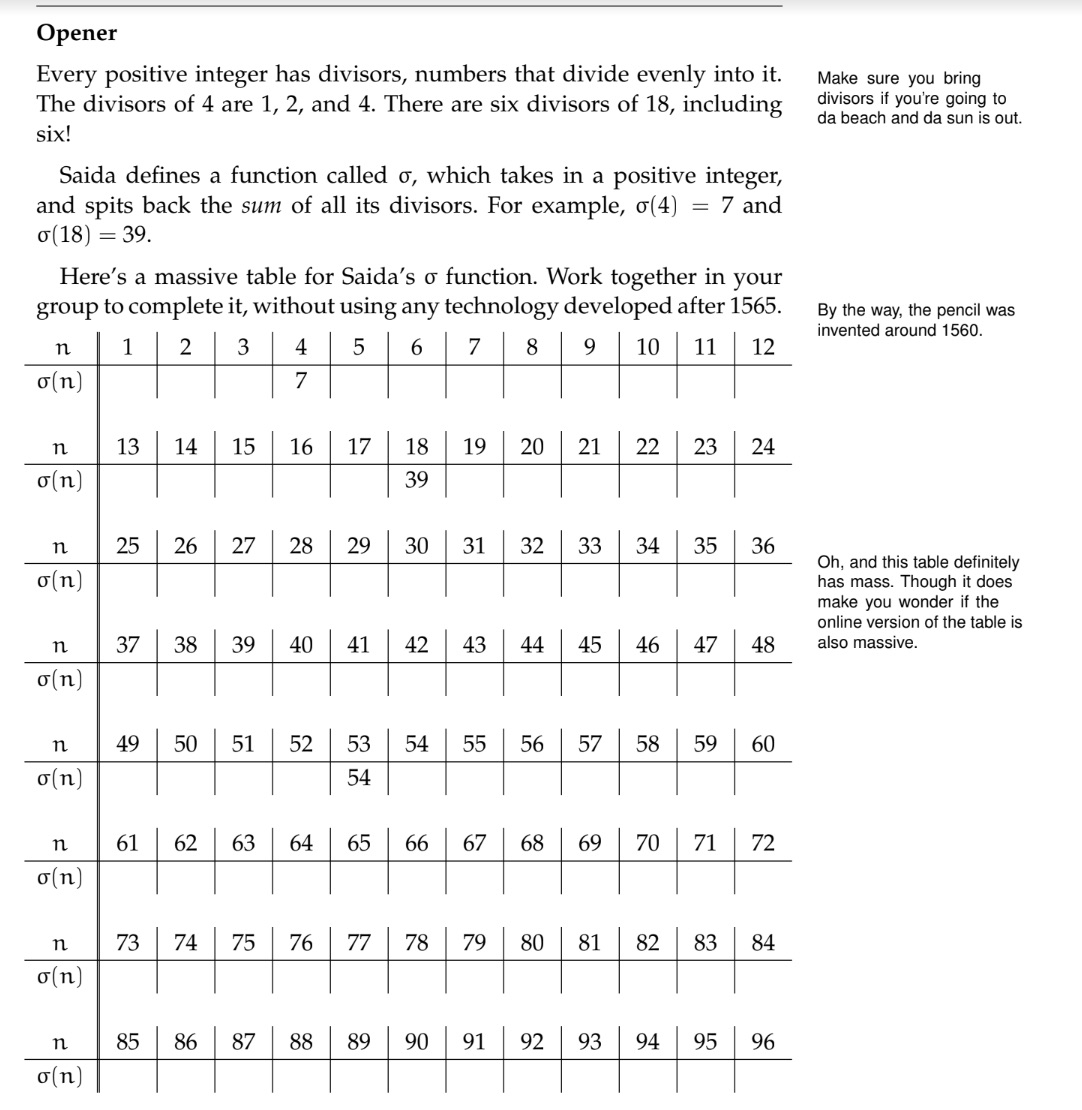
In the morning, we do fun collaborative math problem-solving. My table (SHOUT OUT TABLE 3) spent a ton of time on this opener:

We found patterns, codified them, refined them, checked them, broke them, fixed them, posed our own questions about them, etc. It was cool because we all had different approaches and styles, but that also made it challenging. I have my kids reflect a lot about how they work in their groups — what they bring to it, what they think they can work on, etc. And so I think that in some ways we were very strong: there was a lot of idea sharing and excitement and conjecturing. But this is a wondering: I wonder if everyone felt like we were all working together to create collective knowledge. Something I tell my kids in my class is that when they’re working in groups, the goal isn’t individual understanding (that they can build at home)… it’s to build collective understanding. And so everyone has to be as invested in the thinking of others as they are in their own thinking. And I’d say that on that metric, there was a lot of interest in the thinking of others, but not for us to build some sort of group collective understanding, but rather to fill it bits and pieces of our own individual understanding. My whole thing about individual understanding versus collective understanding in my classroom… I don’t think this is actually part of the PCMI morning group philosophy, but I think it would be interesting to see if a group I was in all agreed to go in that direction and what we could accomplish both socially and mathematically. I think it would generate some really rich question-asking that would refine our own thinking and understand other people’s thinking, but also help us sortwhat we were having a surface level understanding (more pattern recognition) of to deeper conceptual understanding of (an ability to say why something worked). 

Okay now I’m really lagging, but I want to briefly talk about our “Reflecting on Practice” session. Our focus is going to be on assessments, and I think it’s going to tie into many conversations we’ve been having at my school about grade inflation. Because one of the things we’ve been talking about at our school is “what does a grade mean”, and it’s clearly an artificial construct that flattens a multidimensional thing but is super important in the larger scheme of things because grades matter (at least to my students, for a variety of reasons). And so it was interesting to think about what is “knowledge” and “how do we know that we know something” — because our leader said — we can’t really think critically about assessments until we delve into some of the philosophical underpinnings. We got some reading on assessments from NCTM’s Principles to Action which reminded me if we as teachers reframe and expand our definition and purpose of assessments, they can be much more useful in our teaching practice. 

I also went to a lecture on cryptography which was beyond my level of understanding, but the speaker was excellent and though I needed time to understand the details, I could see the larger argument and zoomed out bigger picture view of what she was sharing. 

With that, it’s 9:10pm, and I am flagging. So tired. So night night I go!

Archiving some gems from Twitter (April 2019)

I have seen a lot of great stuff on twitter lately, and I’ve missed a lot too, I’m sure. I wanted to just archive some of the things that I’ve saved so they don’t disappear! I also think it might be a benefit for someone who reads this who isn’t on twitter or missed some of these tweets. But that’s just a side benefit. I’m writing this for me!!!

***

Desmos writes interesting job descriptions when they have openings. When someone pointed that out to them, they mentioned that this article on reducing unconscious bias helped informed how they write their job descriptions. It’s pretty great and I highly recommend it if you’re hiring. I have thought a lot about “fit” in the past few years when doing hiring, but it’s tricky to think about it well. I have come to recognize that someone entering our department needs to be open and willing to collaborate and compromise, but also have sympathetic pedagogical beliefs with what our department values (and can’t compromise on those). One way I have tried to avoid it is thinking about these things:

cultural fit.png

But also I have found it harder to balance these thoughts, which I admittedly have a lot:

cultural fit 2.png

Not quite those things, but similar thoughts that get at my own personal views on the what persona/personality traits make an effective teacher. Which I tend to think mirror my own traits. But that’s only because I have these traits because I think they make an effective teacher. But I have worked with enough amazing teachers to know that amazing teachers come in all personas! Just like amazing students don’t all have to have the same personas. But this type of bias is something I am trying to be super cognizant about when on hiring committees.

***

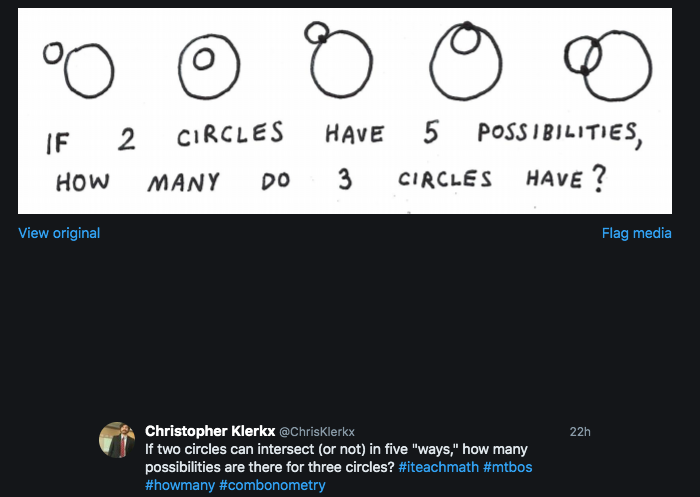
tweet01.png

I saved this just because I like the question and wanted to work on it. And I can see all kinds of extensions. A formula for n circles? What about spheres? I’m guessing (without working on this problem yet) that this is a classic “low entry point, high ceiling” type problem.

***

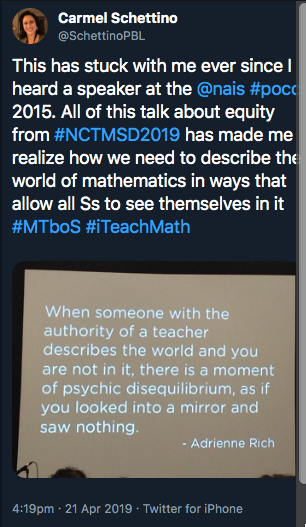
tweet02.png

I just really liked this quotation, and I need to think about the ways that students can see themselves in the mathematics they do. It is part of a larger thing I want to do which is “humanize math” — but I’m not very good at making it a core part of what I do in the classroom. Small bits here and there humanize and expand what kids think about math, but I’m not there yet. I want to one year leave the classroom and know that kids have looked in the mirror and saw something. (It kind of reminds me in a super literal way of how Elissa Miller put a mirror in her classroom, and I think on the bottom she wrote “mathematician.”)

***

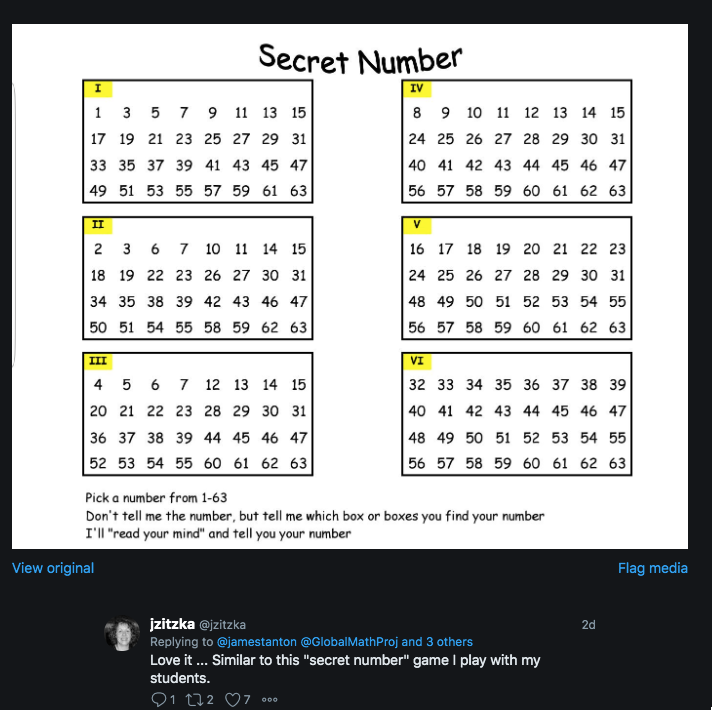
tweet03.png

Okay, I love this so much. If you’ve never seen it before, it a great trick. You have someone pick any number between 1 and 63 secretly. They just point to the cards that number is on. In about three seconds, I can tell you your number.

I actually made a set of these cards where the numbers are more jumbled up, so kids don’t see a pattern to it. I do put the powers of 2 in one of the four corners though to make things easier for me. Oh wait, have I said too much?

If you don’t know this trick, or how or why it works, I’m sure you can google it. But I’m going to recommend the awesome book “Math Girls Talk About Integers” (there are a lot of great “Math Girls” books out there, so make sure you get the Integer one.

mathgirls

Not only is the book awesome (and great for kids to read), but it breaks down this trick so well. *Shivers with joy*

***

I was excited with Karen Uhlenbeck won this year’s Abel Prize, the first woman to win it ever! I had my kids read this article in the NYTimes about it, and write down three notes about the article. We started the next class with a “popcorn sharing” of what people wrote down. (I also said that although I liked the article, it was a bit dense and thought it could have been written more lucidly.) One thing that came up in both classes I did this in was what a “minimal surface” was — so I told kids it is a surface with minimal area.

I then showed my kids this short youtube video:

And explained that bubbles, though not “central” to all higher level mathematics, do come up. And then I gave them a question. I’m too lazy to type it out, but watch the first 1 minute and 45 seconds of this video (https://www.youtube.com/watch?v=dAyDi1aa40E) and you’ll see it. Then we talked about some basic solutions. And THEN I revealed the best answer was the answer shown in the video we all watched together.

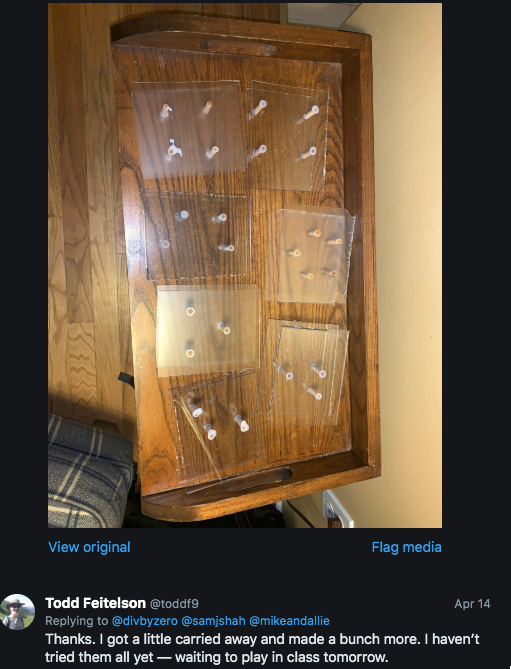
Of course @toddf9 (Todd Feitelson) used this as inspiration to create his own bubble thingies:

plastic.png

but he also explained how he made them…

plastic2.png

and then he EVEN created an awesome desmos activity on this very problem, which I want to archive here for use later: https://teacher.desmos.com/activitybuilder/custom/5cb50bed4dcd045435210d29

(Oh! And Mike Lawler (@mikeandallie) made a mobius strip bubble!)

***

Dylan Kane wrote a nice blogpost about calling on students (and the “popsicle sticks of destiny” — though he doesn’t call them that). My favorite line is this simple question that isn’t about right or wrong:

  • After students attempt a problem in groups, or reflect on an idea and share with partners, I call on students asking, “How did your group approach the problem?” or “What is something useful that you or your partner shared?”

It’s so obvious, but even after so many years of teaching, I forget to ask things like this. Or my curriculum isn’t group problem solving based enough for things like this to make sense asking. Or whatever.

***

There’s nothing special about this one… I’ve read it a few places before and it always makes me laugh.

tweet05.png

Questions are good. I might have a kid read this at the start of the year and then have a short conversation about why we’re reading it.

It will get at the problematic idea of “obvious,” and when and how learning happens and more importantly when and how learning doesn’t happen.

***

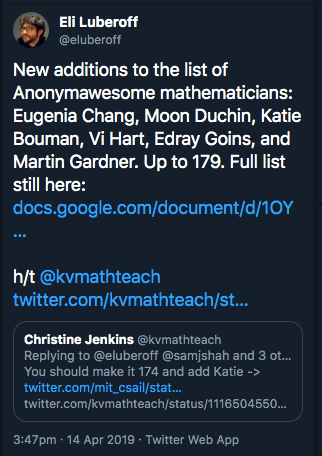
In case you didn’t know, Desmos has a list of all their mathematicians they use when they anonymize in Activity Builder.

tweet06.png

https://docs.google.com/document/d/1OY-8dk6vYW1Cags8E6_v3I8YZ-RYROzgsCauW5CZt9w/edit

***

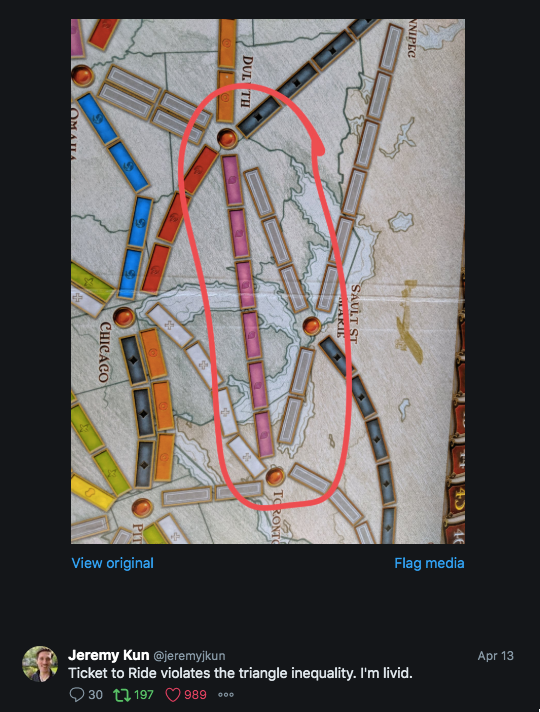
I can imagine putting this picture on a geometry test as a bonus question and asking them why it makes math teachers all angsty… Plus it made me chuckle!

tweet07.png

***

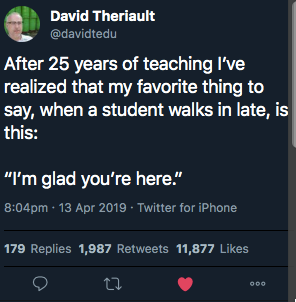
I’m so not here yet. Anyone who knows me as a teacher will probably know I’ll probably never get here. I’m such a stickler for making the use of every second of classtime.

tweet08.png

***

Crystal Lancour (@lancour28) tweeted out a slide from a session led by Robert Berry (NCTM president) which had this very powerful slide:

tweet09.png

Four rights of the learner in the mathematics classroom

  1. The right to be confused and to share their confusions with each other and the teacher
  2. The right to claim a mistake
  3. The right to speak, listen, and be heard
  4. The right to write, do, and represent only what makes sense to you

***

Love the idea of using marbles/paint to draw parabolas (click here to go to the original tweet and watch the video — it’s not a static picture).

tweet10.png

***

Bree Pickford-Murray (@btwnthenumbers) gave a talk at NCTM about a team-taught math and humanities course called “Math and Democracy.” Not only did she share her slides (like *right after* the talk) but also she links to her entire curriculum in a google folder. SUPERSTAR!!!

I’ve gone to a few talks about math and gerrymandering (both at MoMATH and NYU) and listened to a number of supreme court oral arguments on these cases. It’s fascinating!

***

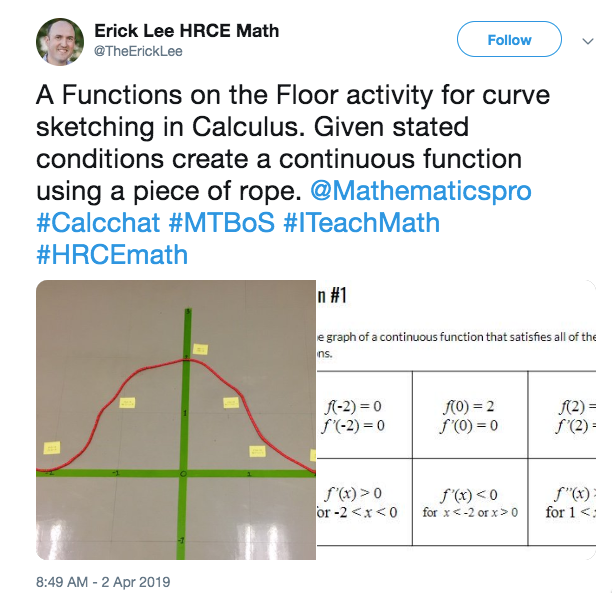
I just finished teaching “shape of a graph” in calculus. But I wish I had developed some activities like this, to make it interactive:

tweet11.png

***

I’ve literally been preparing to give a talk next month for… months now. And this one stupid tweet summarized the talk. Thanks.

tweet12.png

***

I have so many more things I can post, but I’m now tired. So this will be the end.

tweet13.png

Start Of Year Edition: Even More Things I Want To Highlight From Twitter

A few months ago, I had “liked” so many tweets but I wanted to archive them somewhere so I wouldn’t forget them. So I wrote a post. I don’t have too much time, but I want to do that again. [Update: Okay, I might have spent a few hours compiling this. But I’m so glad I did.]

***

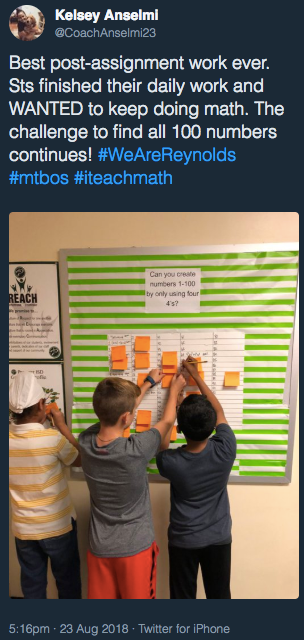
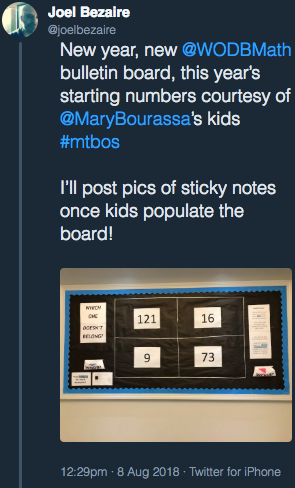
A lot of people use four 4s as a way to get kids thinking. I liked this idea of having a sheet and kids using post it notes to fill in the missing ones. It’s compact. I might use the small post-its, and have kids use a different color post-it if they have a different solution than the one posted. It might be good to keep in a public hallway for everyone to work on, or maaaybe in my classroom (if a group finishes something way before everyone else but I don’t want them moving on yet). But four 4s is all over the web, so I might need to change it to 5s or 6s. :)

pic1.png

Ummm. Oh, okay, @mathequalslove had a tweet which showed she already thought about how to create a first day activity around this, along with amazing facilitation notes. Yay!

***

@abel_jennifer tweeted out saying she was going to be bringing math kids on a (multi-day?!) field trip to NYC and wanted to know what mathy things kids could do here. Many people responded, and so she compiled the responses in a google doc. I never take my kids on field trips. I should. (Maybe as a reward for completing the four 4s challenge?!)

***

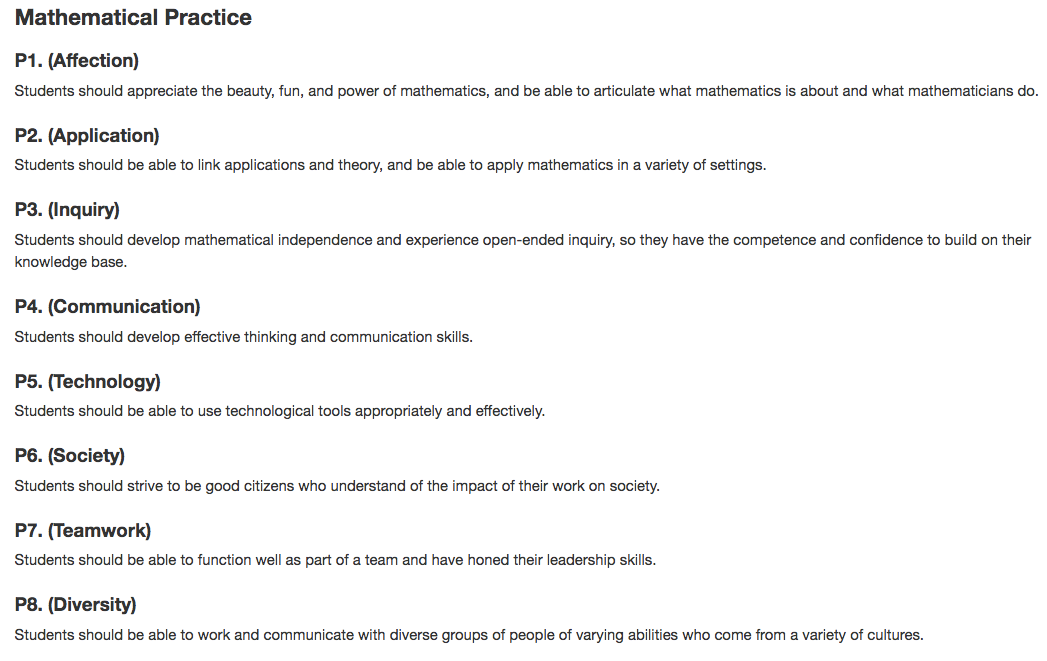
@stevenstrogatz linked to Harvey Mudd’s math department goals. It’s beautiful and shows they worked collaboratively to generate a shared vision. Our department has done this too, though we need to refer back to it and see where our strengths and weaknesses are so we can move forward.

pic2pic3

***

@mrdardy shared his geometry curriculum with someone looking to explore new ideas for their class. He shared the book he wrote with them [which I highly recommend checking out!]! And in that folder, he has an awesome short paper he writes called “How to Succeed in Geometry.” However it is soooo not specific to geometry. It’s amahzing and most of what he writes is true for my kids also. I should look at this when revising my course syllabus this year!

***

@zimmerdiamonds posted a nice open-middle problem that I think I could use this year with my new Algebra II class.

***

@Caitlyn_Gironda gave a presentation on making AP calculus more engaging, and she shared her slides, but also a set of folders filled with great activities! Because she’s aweeeesome. I need to look through these before teaching my (non-AP) calculus class this year!

***

pic4

I love this question. The activity is here. I could see it being used for a first day challenge. I wish there were like 10 of these, instead of just one, with different “levels.” That probably exists somewhere. Ooooh, or maybe after kids do this, they create their own to challenge other kids. This could be a groupwork task, where at first they solve this together… but then the work together to create something complicated that stymies other groups! <3

***

I always forget where I can find desmos activities made by other teachers. It’s the desmos bank. The link is here: https://sites.google.com/site/desmosbank/

***

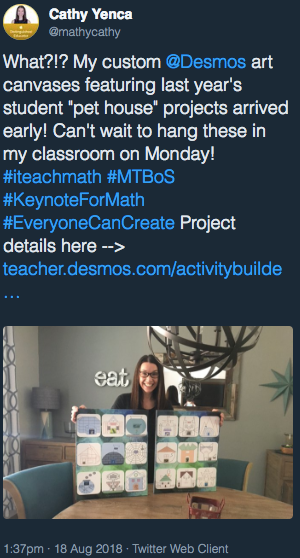
@mathycathy posted how she had some students’ desmos projects printed on canvas to hang up in her room. It shows her kids how much pride she has in their work! But more importantly to me, she shared her project, which is kids making a pet house in desmos. The activity builder for it is thoughtful and kids learn about lines just by playing with them! I think I could modify this to add in other kinds of graphs (parabolas, square roots, etc.) for Algebra II.

pic5.png

***

@cljreagan posted a problem she used in her precalculus class on the first day.

pic6.png

I wonder if I could do this for my standard Algebra 2 kids, actually?! Start with them working with whatever approaches they could come up with, individually. Then after a minute of individual thinking, they share their thoughts with their group. Then the group works together. Then finally, graphing! And a discussion about why the graph might look crazy in the places that it does!

***


A terrific teacher: is, says, does, does not.

I think I might want to do this for a terrific student also. The teacher I look up to most in my building does something like this as a way to build class norms. This wouldn’t involve the refining and consensus building that she asks for, but I might use it anyway. I could transcribe them into a draft teacher poster, and then talk about ones that might be problematic for me (based on either who I am, what I can do, or things I philosophically disagree with) and be transparent about those things. And then I can have kids look and see if there are anything on the draft student poster and see if there are similar things they want to discuss/refine/change. Then I can create a final version to hang up.

***

This idea. It reminds me of something I used to do called “Path to Glory” (which I heard about so long ago and I don’t remember from whom…) where I asked kids to fill out a 10 question True / False test … but they weren’t given the questions. They just had to fill out the answers.

Then they all stood up. And then I read the questions and kids decided whether it was true or false, and then those who got it wrong sat down. And we’d continue on the PATH TO GLORY (the last person standing).

I always incorporate this on the last day of my calculus classes, and the T/F questions are questions about the kids in the class or me. It’s cute, and I think special to me. Because it shows my kids I know them and listen to them, and it’s a community closing activity. (It could be a community building activity too.)


This slideshow requires JavaScript.

***

@eulersnephew posted a google doc with a ton of amazing quotations about mathematics that he’s been compiling. The tweet thread then led to this wikiquote page with quotations about mathematics. And he linked to a google drive folder that @MrCoreyMath shared with lots of posters of mathematicians and what they work(ed) on (modern and old time-y). He also has a poster with a lot of questions students can/should be asking themselves when they solve a problem or are working on a problem.

***

@joelbezaire posted a great challenge. He gives his kids this chart, and asks them what the relationship is between the four variables. Then when kids think they know, they go up an add a line (which then gives more data for kids who might not see it). He created these exercises (called Variable Analysis) and they are here (along with more about how he facilitates it).  pic15.png

***

pic16.png

The post of his activity is here. I watched a documentary of the MIT Mystery Hunt, and there was an awesome communication activity in it. Watch this video (11:19-13:50). I think it would be hilarious to watch kids do this.

***

This quotation:
pic17

And this quotation:

pic35.png

***

@allison_krasnow shared this site with great collaborative activities for students. *Swoon.* *I’m in love.* To whet your appetite, here’s a screenshot of what awaits you:

pic18.png

Which of course reminds me of Play With Your Math by Joey Kelly and CiCi Yu (twitter for site: @playwyourmath), which I will also screenshot to whet your appetite:

pic19.png

***

Sara Van Der Werf does an amazing “name tent” thing at the start of the year (I’ve done it and enjoy it!). But I always struggle in the moment to come up with good questions. @averypickford shares questions he uses for student interviews which could make good name tent questions. The questions he’s going to use this year are:
“What was the last movie you saw or book you read that you really enjoyed or had a lasting impact? If I gave you enough 💰 to live comfortably w/out going to school or working, what is 1 thing you’d do with your time? What is something you’re particularly good at? What do you think is important for me to know in order for you to be successful in this class?”

@algebrainiac1 shares her questions in a blogpost.

@JennSWhite tweeted that she does:
Day 1: If you could be any creature real/fictitious what would you be & why?
Day 2: What is the sure-fire way to lift your mood/spirit?
Day 3: If you could have dinner with any person alive/dead who would you pick & why? What would you eat?
Day 4: What superpower would you want?

@Riehlt says: “”If you had three wishes, what would they be?” I got this from a school phycologist and used it for many years. It really gives insight to what they value and has revealed all sort of things; hardships, illnesses, deaths, body image, family conflicts. A few rich, fame, etc.

@EmilySilman asked kids to finish this “If math were an animal, it would be _____ because _____” or “If math were a food, it would be _____ because ______.”

***

Just because cool!

pic20.png

***

@JennSWhite posted this picture from the second day of her classroom. A group activity:
pic21.png

When people asked for more information, she shared the puzzles and the solutions! It was inspired by @nomad_penguin’s post here. And links to Mark Chubb’s post which talks about things to consider if doing activities like this in your classroom.

pic22

***

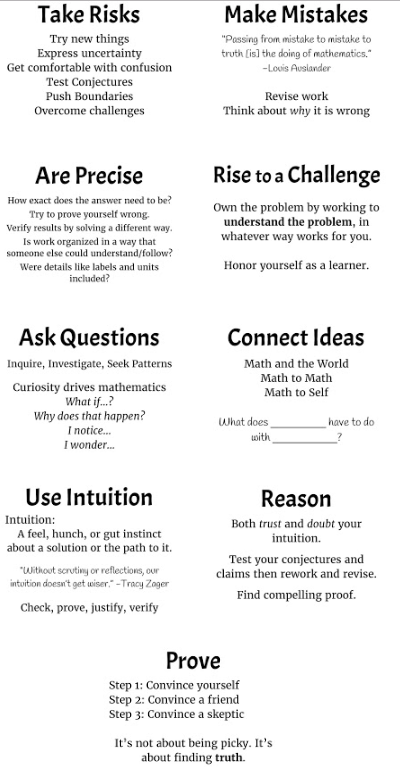
@a_schindy posted some posters she hangs up in her classroom about the behaviors/traits of a mathematician (from Tracy Zager’s Becoming the Math Teacher You Wish You’d Had). And, importantly, how she had a conversation about what was on the posters, which she blogged about here.

pic23.png

***

@BearStMichael shares his classroom norms and his thinking about how to introduce them/start the year. This is a must read. Full stop.

pic36.png

***

Edutopia tweeted a sweet way to end a particularly harrowing or energetic class or challenging discussion. It’s a video, so you have to go here to see it. It’s called “the three As”  (appreciations, apologies, aha!s). The purpose is the reflect on the day and the dynamics. Kids stand in a circle and just say an appreciation, an apology, or an aha moment!

***

@Lisa99Bailey posted these pencils she made for her kids. Here’s the original tweet so you can see what she wrote on them bigger. Other people, in the replies, also added “Be Original” and “Be Inclusive.” I think I’d want to do this randomly on a day that had nothing special so it was truly unexpected.

pic24.png

And @MrsDi, in the replies, had a great idea to spread the love: “Super cool! How about on the next batch you have the kids each write an inspiring message and put all those pencils in a classroom-share location? Or… trade with the classroom next door?”

***

@davidwees posted this

pic25

and shared the isometric drawing tool that NCTM has for creating stuff like this!

***

@bowmanimal tweeted out a great blogpost he wrote about changing how we think about assessments. It is fantastic. An excerpt:

pic26.png

Years ago, maybe at PCMI, I also heard of a great quiz idea. Partner kids up to take a quiz. And they have to do it silently, and write notes to each other to help them communicate. They’ve made all their thinking visible for you, and they have each other to rely on. I can’t believe I’ve never done this.

***

A number of  years ago, I did a random act of kindness day. We didn’t do content, but we wrote thank you cards to people in the building. I haven’t done that recently, because other teachers have taken to doing that in other forms, and it felt like it wouldn’t be special if I did it. But if I end up doing something like that again, @allison_krasnow shared @MsCummins12’s blogpost about reading How Full Is Your Bucket with her kids. I really liked the idea. I think if I did a random act of kindness day, I might read the kid with books, have a discussion, and then have kids plan random acts of kindness that aren’t thank you cards. What are ways we can be kind that takes a different form? And then their homework will be to actually execute those acts of kindness.

***

@HankReuling posted this great puzzle (a sangaku!). It took me a page of work to solve. But then I saw someone replied with three lines of work. But that didn’t take away from the sense of accomplishment I had! Have fun playing with it!

pic27.png

***

@DavidButlerUofA posted a display / game he does with kids called “Numbers and Letters.” I had seen the British show Countdown on youtube on which this is based. I love this as a display, and there is a random element to it which is eggggselent!  It might be fun to get a moveable whiteboard to the front entrance where we have this up, and encourage caretakers and kids alike to engage (and the younger kids can take a short in-school field trip to work on this together as a class). Maybe have a jar of starbursts for anyone who contributes an answer?

pic28.png

***

Sara Van Der Werf @saravdwerf compiled all her week 1 activities here. I’ve done some of them and am a fan.

***

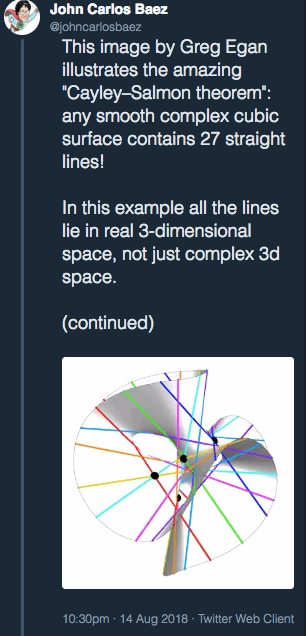
Look at these. I’m in love. From @solvemymaths (post, post, post, post).

pic29.png

***

@rwhite_teacher1 created “extension cards” for kids when they have finished early. The google drive folder is here. I don’t quite know how I’d use them in class, but I like the sentiments. It might be more for me to remind me about ways I can ask kids to extend their work.

pic30.png

***

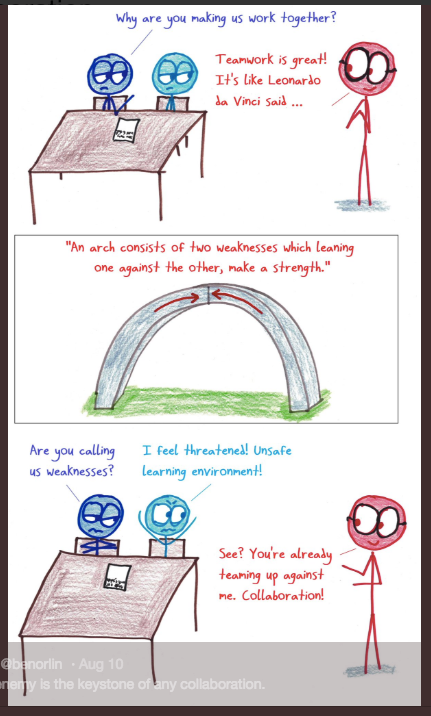
This is one of my favorite @benorlin comics. I want to show it in class early on.

pic31.png

***

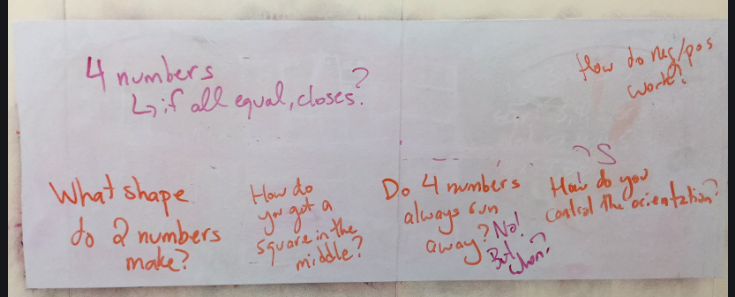
A public WoDB bulletin board space!

pic32.png

And, in case you were wondering, there are actual fancy posters you can buy too! My department head just ordered them for us!!!

***

@rundquist wrote “Don’t just ask what they learned, ask what they unlearned.” It’s a great exit ticket question.

***

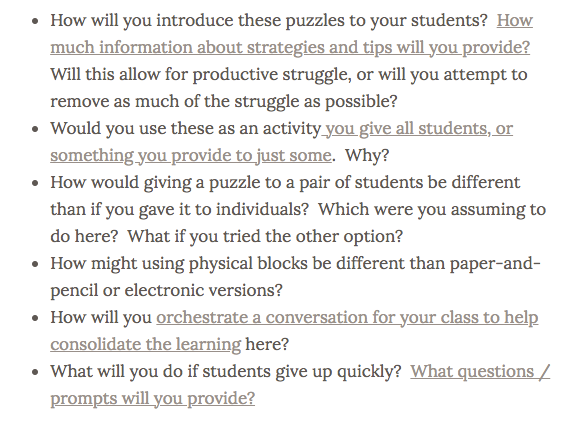
I’m teaching Algebra II this year and I remember how this vocabulary in particular used to be tough for kids. The only change I might make in this is not have the equation equal 0. Kids like to set everything to 0, and that’s crazy. I don’t want to reinforce that.

pic33.png

***

@davidwees posted a neat set of pictures to think about exponentiation and logarithms, using the Connecting Representations instructional routine I learned in my TMC17 morning session. To see the images/tweet, go here.

pic34.png

***

@glennwaddelnvhs posted a google doc compiling all the great exit ticket questions that people have come up with!

***

@TracyZager tweeted a 2-page PDF of great questions to help kids utilize their own intuition when problem solving. A random snip of that PDF:

pic37.png

***

@mpershan tweeted about using Anna Weltman’s Loop-de-Loops! in class. I’ve always wanted to do that! It’s a great exercise in generating mathematical questions. His class came up with these:

pic38.png
And AMAAAAAZINGLY, Lusto created a beautiful interactive webpage for this.

***

Fin.

TMC in 2018: a personal reflection of where we are

Super rough draft thinking…

Last summer at the end of TMC17, there was a flex session on diversity. That brought up a host of questions that made us realize: as an organization/conference, we don’t even know who we are. That was both terrifying (do we not?!) and exciting (we get to tease out our core values!).

Here’s the thing. The conference runs pretty darn smoothly and appears organized to people attending, but that all comes as a result of a handful of people on the committee working on certain individual tasks (usually alone, sometimes with one other person). And Lisa, our amaaaaahzing Lisa, keeps her eyes on everything and does the bulk of the infrastructure/logistical work that makes the conference actually happen.

But — and this may come as a surprise to y’all — I’ve been on the organizing committee for a few years, and never once in that time did we all get together in person or on a google hangout to have a discussion. Mostly the committee members worked on their individual tasks and we would occasionally send an email out or ask a question… most people knew what they were working on, but didn’t know what everyone else was doing. And honestly, there probably wasn’t a need. The conference was successful in that it, for many attendees, provided something that they didn’t get in other places professionally, and people were on the whole happy.

So when that flex session on diversity came up, it opened my eyes to something. We were doing the logistics of recreating the conference from year to year. But it was now year six, and although still organized by math educators for math educators, we (as organizers) were still considering ourselves to be a ragtag conference that we cobble together. Maybe I shouldn’t speak for everyone. I should probably say…

… at least that’s how I looked at TMC until then. It was perhaps a vestige of the thinking when it all first happened in 2012, and we were cobbling everything together from scratch (here’s the original website that I put together but don’t even remember putting together!: TMC12). And perhaps it’s because it was just a merry band of us making spreadsheets and organizing ourselves in dorms and trying to read contracts and figure out what they meant and fumbling around trying to make things work over the years… it just felt like we weren’t professional conference organizers. We were just trying to make things happen as best as we could. And so that was enough. I thought we’re volunteering our time for this… so who could ask for more? 

But the flex session made me realize we are not that anymore. We can’t be that anymore. Because the conference is real and sustained and impacts people. That’s it: we were responsible because we were putting things together and what we did impacted people. And it was clear that for all our work to be welcoming, we weren’t always being successful. Jenise Sexton wrote in 2017:

So when I walked in the Dining Hall of Holy Innocent Episcopal School along with around 200 other participants, I wasn’t surprised to see like 4 or 5 other brown skinned people. But that evening I received a DM from another participant which read, “Where are all the black people?”

In that moment, reading that message, I realized it wasn’t my role to be the sole representative. It isn’t supposed to be normal for me to be the only black face in the room.

And in the flex session, people had lots of questions about how things happened to make the conference what it was. How did we think about registration and who can attend? What outreach do we do? Who chooses the keynote speakers and how do they get chosen — and does diversity (in any form) come into play? How do sessions get selected/accepted and organized? Why do we really want diversity, and what kinds of diversity are we even talking about? What is diversity anyway?

People cared about this. And conversations (good conversations!) happened at TMC around this. Marian Dingle wrote wonderfully about it here (“Yet, I don’t feel that I was able to fully let my hair down at TMC. For one, I was a first-timer, and the few people I “knew”, I only knew through Twitter. For another, I was one of a few black women, which although not an unfamiliar situation, still was not comfortable.”) and I’m glad that she was selected to be on the TMC Board this year. [1]

And this is precisely where I started to realize we were responsible for answering these questions. We had to think more than simply about logistics and getting the conference to run smoothly. We had to think about what the conference really was, and what a vision for it was. We can’t hide behind “don’t expect too much from us… we’re just putting this thing together on our spare time!”

And from this, Tina (with me as a trusty sidekick) took the reins on coming up with a mission statement for TMC — asking for input from all constituents (anyone who attended TMC, the committee, the board) and then asking for more feedback from the community during a Global Math Department session before it took its final form.

mission.png

That was a huge step forward for us, I think. Because it helped us define our core values as best as we could, and then refine them. It is perfect? No. But does it give us a place to start working from? Yes.

Now let’s fast forward to TMC18. Another flex session on diversity. And the first question that comes up:

Why do we value diversity as TMC? The mission says “we value diversity” but it doesn’t go deeper. We need to go deeper. 

And in this hour and a quarter, many things got raised. Some of my key notes:

  • We are at a place where TMC is a grassroots organization whose grass has grown too high. We are just starting to grapple with how to deal with that mindfully, inclusively, awesomely.
  • Do people see diversity as important for TMC because: (a) diversity helps TMC (it makes TMC stronger), or (b) we want to create a TMC that’s valuable for all math educators?
  • We all blog and tweet to connect with people, and sometimes it is comforting to connect with someone like you in a way other than just math — such as in terms of race or sexual orientation. “If white people/cis people can find it, I should be able to find it too.” [One thought that was thrown out for those who want to connect in safe spaces at TMC was to form “homerooms” or “affinity spaces.”]
  • “It’s not just about inviting people, it’s about what they’re being invited into.”
  • As math educators, we know that numbers can be powerful. But the number of people of color attending TMC each year might not be the metric to use to measure us with “diversity.” We want to be careful not to try to “get” people of color (or diverse participants) just for numbers, to make us feel like we’re filling a quota and doing the right thing. We don’t want diversity to be trendy — to make ourselves feel better, or so we’re trying to make the “picture” look better. Maybe other metrics (more qualitative) are better. [What we do at TMC? Action steps we’ve taken? Things like pronouns on tags. Sessions. Keynotes. Big and small. We tried some these things — what can we measure? What does success look like?] Numbers don’t speak; they lie in a vacuum when given without context.
  • We need to be more strategic than being generally welcoming (which we do really well). We need to be specifically welcoming.
  • If TMC is going to double down on addressing diversity and encouraging participants to engage, it needs to build that into the schedule (perhaps by having a diversity/equity strand in the program, and perhaps other ways to encourage conversations around these issues).
  • TMC and the #MTBoS are intertwined because the #MTBoS is the primary pipeline for people coming to TMC. So one possible thing that could happen is that people could start having more sustained and organized discussions about diversity and equity in the #MTBoS. One idea was about having a regular chat (e.g. #MTBoSequity) and having it center around shorter things like articles/blogposts instead of books. Questions were raised about twitter being super public and challenging to have those sorts of conversations — and the idea of having semi-private discussion boards or not-saved-video-conferences similar to Global Math Department were raised. (Tina just blogged about the idea here.)
  • Having people write their pronouns on their nametags was a way TMC forced people to confront diversity in a small way. Someone asked if there were other small things like that that we could do.
  • We have a lot of people at TMC who are supportive of the ideas of diversity. 

In the flex session, people asked a lot of questions about how we plan the logistics, just like last year. How are the sessions chosen? How are the keynotes chosen? How does registration work? At heart, the reason these questions were asked is because people were interested in seeing if there was intentionality in how they were being done. [2]

And that to me is where we need to go next as we think about organizing TMC. Intentionality. I wrote earlier that:

I’ve been on the organizing committee for a few years, and never once in that time did we all get together in person or on a google hangout to have a discussion.

TMC is at a place, at least to me, where we have successfully figured out many of the logistical aspects of putting the conference together. We were able to do that as a committee without being a cohesive whole — we could work in our little silos. However we’re at a critical juncture as an organization. We need to figure out how we can ask big questions, have sustained and challenging discussions that push us, have a process for moving from discussions to making decisions so we can move forward, and come up with a clear and shared vision that we’re moving towards. 

After writing that, I only have one word that comes to mind: overwhelmed.

After TMC18, the committee and the board did all sit down together. We had four hours. And though we could have used four more, I was proud that we identified that we needed a way to communicate and have discussions, and we are in the beginning stages of learning how to do this all virtually and asynchronously. In the few weeks since TMC18, we’re actually starting to do this. It’s a lot we have to do, and we don’t have a roadmap on how to do it. It would be way easier to just go back to how things were done. But that’s not in line with what we want to be. Earlier, I wrote:

The conference was successful in that it, for many attendees, provided something that they didn’t get in other places professionally, and people were on the whole happy.

But I wrote that to reflect my thoughts then. Now I see that this is problematic. Is that a good metric of success for us? Who gets counted in the “many” and what does “on the whole” really mean? We have to be intentional to make sure that everyone feels at home and that we are working towards our mission of reaching “all learners.” Which means we need to think about teachers who are feeling left out. When we’re thinking about the conference as a whole, who are we designing it for? Is it for people like ourselves (those on the organizing committee/board)? [3] Or do we need to start de-centering ourselves before asking this question?

As I said: overwhelming.

I don’t know how this all will happen. I know it won’t be easy, and it won’t be quick. I’m imagining years. [4] And honestly, a big part of me wants to shy away from all this change. Those who know me know that change is really hard for me. I’m a little  (big) hobbit who likes to live in my little hobbit hole. But I also know that if I were one of my students who came to me for advice on all this, I would say to them “doing what’s easy is not always doing what’s right.” And I’ve never been scared of hard work.

I should conclude by saying these are just things I’ve been thinking a lot about. But they are my thoughts. They aren’t fully formed (rarely are my thoughts fully formed), and certainly not cohesive. But more importantly, they aren’t official thoughts of the committee or the board. I don’t really even know if other TMC organizers will agree with my thinking about this! But I promised @BeckyNftP I would blog about the flex session around diversity, but the only way to keep that promise was to embed that in the much larger thing that I’ve been mulling over in my head.

 
[1] Please don’t ask me what the Board does and what the Committee does. Remember when I said ragtag? These are things we’re still figuring out.

[2] And things were being done.  Those selecting the keynotes or organizing the conference program did think about bigger picture things. But they took that up on their own, not because they were working towards a shared vision we all had.

[3] As TMC started, it had to be. That’s why it was started! For a small group of #MTBoS people to meet in real life. But now we have to ask the question if our answer is still the same?

[4] We’ll probably need at least a year just to figure out how to communicate with each other semi-effectively.