Calculus

Reprise on Integration

Recently, I posted a bit asking people how they introduce integrals. And I got a ton of different responses, which was wonderful. I am going to copy a few bits of comments here, but I really recommend that if you teach calculus, you take a moment to read them all in their entirety.

David P.: I sometimes use the physics of displacement/velocity/acceleration to introduce antiderivatives. […] I am only in my 3rd year teaching, so I’ve not found a “best” way yet. I really like the “surprise” of the FTC that areas and slopes seem like they should have no connection whatsoever, but that they’re almost as related at + and -. So, sometimes I even just say, “ok, we’re done with that section, let’s move on to something else” and then try to surprise them when we get to the connection.

Andy: I usually teach anti-derivatives as part of my derivatives unit. […] I also show how it applies to the position, velocity, acceleration problems. Then I transition to my integration unit. I don’t even tell them about integration and anti-differentiation being related. I just talk about area and then when we get the the fundamental theorem, I am able to drop the crazy idea on them that integration and differentiation are related. I enjoy their reactions to that.

Nick H.: Generally, I like the ask questions first teach skills later approach.

TwoPi: I usually start off with velocity examples, and in each case link the displacement calculation (or approximation) to the geometry of computing the area under the graph of velocity versus time. So start with constant velocity, then linear velocity (and sometimes nice quick applications involving stopping distances for cars at various initial velocities).

This year I focused on anti-derivatives. On the first day, I just said: the derivative of x^2 is 2x, so the antiderivative of 2x is x^2. That’s all. The rest of the class had students struggle through finding simple antiderivatives (PDF and PDF). On the second day, I gave students a method to solving antiderivatives, a method which builds their intuition (PDF). And on the third day, I had students just practice, practice, practice.

Then I gave them a quiz — 17 questions asking for the antiderivatives of functions from x\sqrt{2x^2+1} to \frac{e^\sqrt{x}}{\sqrt{x}} to \frac{\cos x}{\sin^2 x}. Moreover, I didn’t give partial credit. If a negative sign was missing, or a constant was incorrect, I took off full credit for the problem.

The average grade for both sections was an A-.

So I have to say that my approach this year worked. I’ll deal with u-substitution and all that nonsense later. But the fact is, my students will be able to soon integrate some pretty hard stuff without resorting to u-substitution.

Many of the comments talked about working with position, velocity, and acceleration graphs to start out. I think after I teach the area under curves and Riemann sums, I will go into this topic. Honestly, I was hesitant to start integration with position/velocity/acceleration because anything physics related tends to make my students convulse. They are scared of physics. I wanted to make sure that they didn’t shut down completely before we even start.

(However, I am excited to derive h(t)=\frac{1}{2}g_{const}t^2+v_0 t+h_0 from first principles. I hope to hear lots of oohs and aahs.)

Ennui

I don’t really have the energy to give a true update, and I don’t want to complain. I just feel like in the past few days, I’ve been struck with a sense of lingering ennui, and I’m hoping that Spring Break rejuvinates me. It appears that students are really stressed out this week, and it’s being reflected in the way they’re acting. And honestly, it’s a bit of a cycle, because the way the students are feeling is affecting the way I’m feeling, which is affecting the way that students react to me, and so on and so forth.

For short updates on my three preps, read on.

1. In Multivariable Calculus, we’ve been working very slowly on our current chapter. I thought we’d be able to finish it before the quarter ends, but now I’m skeptical. We’re going to have to work pretty darn hard. The current problem set that I’ve given them is pretty tough, but we’re doing this one even more collaboratively than the others, so I’m glad about that. Recently, in class, we had to solve \int \cos^4(x) dx and I forgot how to even go about it. We found a nice, but convoluted solution, because we were working with nice limits of integration. But I have to tell you… I forgot how to do a lot of these less straightforward integrals. The good news is that we came up with ideas and found the solution using symmetry arguments and trig identities. Awesome. At first I feared this was a waste a time, but then I realized: this is what this course is about. Problem solving. You have something you don’t know, and you don’t have a formula for it. Work it out.

2. In Algebra II, I’m a bit behind the other teacher. We’re teaching function transformations, after a pretty arduous — but I’d say successful — unit on inequalities and quadratics. I don’t have a great way to introduce function translations, other than students doing some graphing by hand and noticing some patterns. (“Oh! The graph is the same as the other graph, but moved up one unit!” or “Oh, why is the graph the same as the other one, but moved to the left?”) I’m repressing the name now, but some math blogger posted a Logarithm Bingo game. I think that once I finish the functions transformations unit, I’m going to design and play Function Transformation Bingo!

3. In Calculus, we’ve been working more on the anti-derivative. It’s funny how different my students are. Some have the intuition like *that* while others are struggling to figure out what’s going on. But honestly the only way to do these problems is to really struggle through them. My favorite problem from last night’s homework was to find the antiderivative of x^{1/3}(2-x)^2. Almost all students got it wrong, because they didn’t see that if you expand everything out, the problem reduces to something much easier: finding the antiderivative of 4x^{1/3}-4x^{4/3}+x^{7/3}. Well, them not seeing that it is easily expanded causes me less chagrin than a student saying, “so you must first multiply the x^{1/3} by each term in the 2-x expression, and then square it?” YEARGH!

That’s all folks.

How do you introduce integrals?

I’m putting a call out to calculus teachers and calculus aficionados out there. I want to know how you transition to teaching integration, and why you cho0se to do it that way. And if you have any activities, investigations, etc., that you can send me, I’d love to have them (and post them here for other calculus teachers).

I’m not super pleased with, but I don’t hate, what I’m going to be doing tomorrow.

Here’s the deal. I just gave my last test on differentiation today, and tomorrow I’m transitioning to teach integration. I teach a regular (non AP) calculus class, so we can take our time. At the moment, I’m grappling with two things: (1) whether to teach anti-differentiation first and the notion of “area under the curve” second, or vice versa, and (2) how to make integration intuitive.

Last year, I transitioned by giving students a graph of y=\sin(x) and told them to find the shaded area. Those were my only instructions.
sine

Some students made triangles, some students guestimated, some students made rectangles. I don’t remember all the different approaches. But then we had a discussion about how they estimated their areas, which then led to me transitioning to Riemann sums and a general introduction to the whole new unit. The thing I emphasized: “In all your previous math classes, you only learned how to find areas and volumes of silly little figures, like squares and cubes and maybe you remember a nonagon or cone. But what about crazy, strange, weird areas? Volumes of crazy, strange, weird figures? Did you ever wonder where the formula for the volume of a sphere come from? Calculus not only can answer questions about position, velocity, and acceleration, and how to maximize and minimize quantities, but it can do all this other stuff too.

This year I’m not going to talk about areas under curves (yet). I’m going to start with two days of practicing antidifferentiation. I’m not going to say much to transition to this new material except to say that derivatives were the first part of the course and antiderivatives will be the second. And that we’ll soon be able to do a lot with them, like we found out we could with differentiation… Then I’m going to introduce the idea of the “opposite of differentiation” and spend the entire period having students build their intuition.

First, they’re going to do a matching game in pairs (PDF). We’ll then quickly debrief, but not really go into depth about any question.

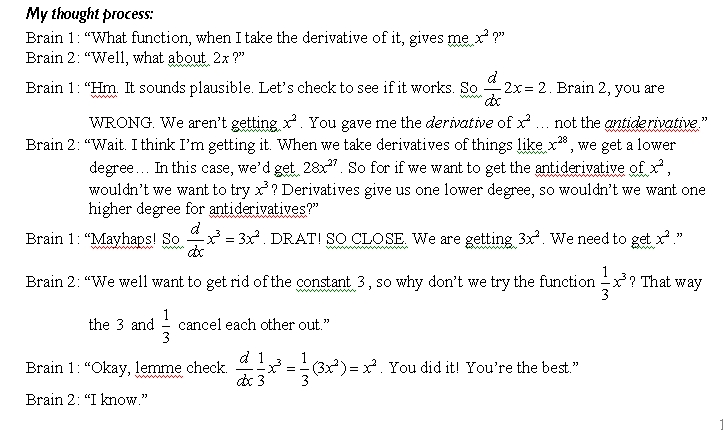
Second, they’re going to work in a different set of pairs on just playing around with finding the antiderivative, by intuition and guess and check. I want them to learn to think through a problem. So I typed up what goes through my head when I try to do an antiderivative.

thoughtprocess

And then I’m letting them loose on a set of problems which should hopefully introduce them to some basic integration rules (PDF). I think it’ll take the whole period. And we’ll spend the next day debriefing. I want them to struggle through integration now. I want them to see why \int x^2 dx=\frac{x^3}{3}+C instead of memorize the power rule. I anticipate it to be kind of hellish for them; they — like most students — want formulaic ways to do calculus.

But just as I struggled to hone my students intuition (see my previous blog post) for differention, I wanted to make something similar for integration.

We’ll see what happens tomorrow.

L’Hopital

Today a student in my calculus class asked why L’Hopital’s Rule works. I paused, and failed to think of an easy way to explain it. But now I’ve found a really easy way to explain it — at least for the 0/0 case. (Thanks Rogawski!)

We want to show that \lim_{x\rightarrow a} \frac{f(x)}{g(x)}=\frac{\lim_{x\rightarrow a} f'(x)}{\lim_{x\rightarrow a} g'(x)}.

At least in the 0/0 case, we know that f(a)=0 and g(a)=0. Great! If that be true, we can say that:

\frac{f(x)}{g(x)}=\frac{f(x)-f(a)}{g(x)-g(a)}

Of course that has to be true, because we’re subtracting 0 from the top and the bottom! Now we can say:

\frac{f(x)}{g(x)}=\frac{\frac{f(x)-f(a)}{x-a}}{\frac{g(x)-g(a)}{x-a}}

(We are dividing the top and bottom by the same number.)

Finally, we take the limit as x approaches a of both sides, to get:

\lim_{x\rightarrow a}\frac{f(x)}{g(x)}=\lim_{x\rightarrow a}\frac{\frac{f(x)-f(a)}{x-a}}{\frac{g(x)-g(a)}{x-a}}

By basic limit rules, we can rewrite the right hand side of the equation to be the limit of the top and bottom separately. But the limit of the top and bottom separately are just the derivatives! (See the definition of the derivative there?)

\lim_{x\rightarrow a} \frac{f(x)}{g(x)}=\frac{\lim_{x\rightarrow a} f'(x)}{\lim_{x\rightarrow a} g'(x)}

Q.E.D.

Students Making Their Own Position/Velocity Scenarios!

I closed up a unit in calculus on position/velocity graphs. Most of my students had horrific memories of physics their freshman year. That teacher, needless to say, is gone. Last year, a number of my calculus students just shut down when we encountered this topic.

This year, I focused a lot on the concepts. One day I showed dy/dan’s graphing stories and that night, I had them each come up with their own problems. For these problems, they needed to draw the velocity versus time graph and the position versus time graph.

Initially I was going to use my favorite on the assessment, however, there were so many hilarious, exemplary problems, I had to type them up and spend the next day using them.

Some of my favorites:

1. Dare-devil Mr. Shah one day decides to go Bungee Jumping. At the top of a mountain, scared, he hesitates 2 seconds, then jumps. He [falls] quickly, eventually reaching terminal velocity at 100 m/s . At the bottom the rope reaches its limit pulling him back up, [coming] to a stop. Mr. Shah smiles.

2. Mr. Shah is riding the elevator to the 4th floor. He waits for the elevator for a bit and then gets on. The elevator goes to the basement to make sure no one is waiting down there [and, of course, no one is there, as always]. It quickly goes back up to the first floor, where 15 seniors try to crowd on. When everyone is in the elevator it heads up to the 4th floor stopping at the 3rd floor to let people off. Finally Mr. Shah reaches the 4th floor and comes over to our calculus class.

3. The Jonas Brothers are walking down the streets of New York City at a strolling rate of 2 mph for 10 minutes as they composed a new song. Suddenly, [student 1] and [student 2] began running at them screaming, at 7 mph. Struggling to find a hiding spot, the brothers run down the block at 8 mph for 5 whole minutes, when they lost the crazy groupies-in-training. Stopping for a break, the boys catch their breath for 5 minutes on a stoop. Walking away when the coast was clear at the same strolling rate as they began with, Nick remarked, “Sorry guys. I’ll try to be less attractive.”

4. A helicopter is taking off. It rises constantly at 200 ft/minute. After rising for five minutes. It stops for one minute to survey the surrounding area. After rising again for 2 minutes, the helicopter is abruptly blown up by a terrorist missile.

5. A man runs from a tiger going at a constant velocity of 3 mph for 1 hour. The tiger gets tired so the man catches his breath for 20 minutes. A rhino appears and begins to chase again and the man picks up speed to 5 mph.

6. You are in an elevator on the top floor (6th floor). Each floor, it picks up more people and it goes slightly faster each time. When it stops on the 2nd floor, so many get in that it breaks and crashes to the basement. People die.

This was a fun class. And almost all my class got pefect scores on the conceptual part of the latest assessment, on this material. They got it1 They really got it!

The Calculus of Saying I LOVE YOU!

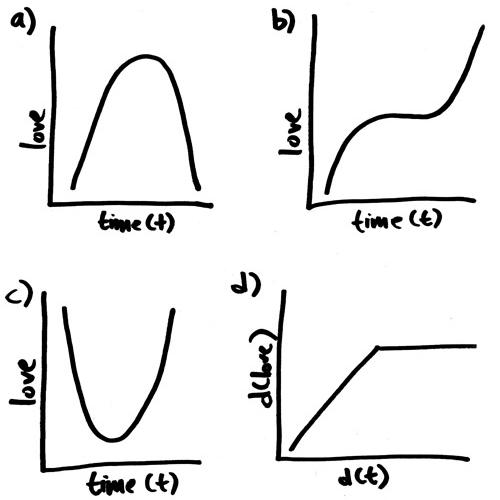
I found — when searching for something else — this page on the calculus of love. It’s actually really cute, and totally accurate mathematically. Both big plusses in my book.

phpthumbphp

The article analyzing these graphs is here. Definitely something to check out if you’re teaching precalculus or calculus.

Okay, it is 6:54 and I have to run to school for a 7:30 meeting! Yikes!

Lates.

Related Rates in Calculus

ladder

I’m about to teach Related Rates in my Calculus class. And the book and the Internets aren’t helping me. Supposedly, related rates are so important because there are so many “real world” applications of it.

Like a  snowball melting, a ladder falling, a balloon being blown up, a stone creating a circular ripple in a lake, or two people/boats/planes/animals moving away from each other at a right angle.

Weird exemplars — I wonder where they got started and why they still hold so much water in every textbook? Because seriously?!, a ladder sliding down a wall — when is anyone truly going to need to know the rate of change of the angle over time? Same with the melting snowball.

I’m not someone who needs a real world application to justify everything I teach. In fact, I rarely do. But when we’re teaching something and hold it up as “calculus in the real world,” I refuse to believe that this is the best we can come up with.

I am searching high and low for one true real world problem. No contrivances, but something where I can point to and say: “this calculation needed to get done and because it was, we now have ____.”

I am thinking that maybe figuring out how a radar gun calculates the speed of a car, especially if it is being used from a moving car, might have something good there.

So far, though, the closest I can get is here:

Rockets: A camera is mounted at a point so many feet from a rocket launching pad. The rocket rises vertically and the elevation of the camera needs to change at just the right rate to keep it in sight. In addition, the camera-to-rocket distance is changing constantly, which means the focusing mechanism will also have to change at just the right rate to keep the picture sharp. Related rates applications can be used to answer the focusing problem as well as the elevation problem.

A number of AP Calculus classes have their students make videos with related rates problems. But those problems are just like the others: contrived. It’s like using integration to do simple addition. This video is the exception; I love it.

Anyway, holla below in the comments if you got anything.