Calculus

Who Invented Calculus: A WebQuest

A few weeks ago, I tried my first WebQuest. If you don’t know what they are, you aren’t alone. I in fact only learned about themfrom randomly stumbling across it during one of my many hours of traipsing around in the internet aimlessly. In a nutshell, a WebQuest is an assignment that you put on the web with instructions for kids to follow — and all the work they are doing comes from resources on the web.

With a spare day to kill, and a non-AP class full of seniors who generally seem to like writing papers more than they like writing equations, I decided to try it out. I had a few goals:

1. This was early enough in the year that my kids were in the middle of limits. They didn’t know anything about derivatives or integrals, or what calculus is, except for my rant. I wanted them to do some research on their own to learn what calculus is.

2. I wanted my students to learn that math was (and is) not done by robots in ivory towers, simply working to torture them. It was (and is) made by real people, forged in the crucible of a historical and cultural moment.

3. The history of math might bring more interest to some of the ideas my kids were studying (and will study).

So I modified a WebQuest I found and created this (click picture below):

The name is misleading. As my kids read each of the tabs carefully, so they knew my expectations, they soon learned that I wanted them to investigate Newton and Leibniz. And instead of asking “who invented calculus” they were supposed to take a side on who they think deserves the most “kudos” for calculus. They were then supposed to write an editorial defending that position.

As a former historian of science, I know that it’s a terrible question. As a math teacher, I don’t care. It got them talking and interested!

The implementation:
I gave students one 50 minute class period to work on their pro-con lists for Newton and Leibniz. They of course used their laptops, and were allowed to pair up — but only for those 50 minutes. Then over the weekend, they were asked to finish their research and write their editorial individually. They were asked to turn in a paper copy of their notes, their editorial, and their bibliography (and turn in an electronic copy of their editorial to share with the rest of the class).

The analysis:
Overall, I think it was a great use of time. Many of my kids really got into it, watching the videos and reading the articles. They found some of the reading really hard to follow, but I believe that is part of the skill set they should be acquiring in high school. Given a lot of information (a.k.a. the internet), how do you sort it and make sense of it? During classtime, a few kids did slack off a bit, not fully taking advantage of 50 minutes of research. Their papers suffered as a result of it. I really liked how much my students got into trying to figure out what an infinitessimal was, what a fluxion was, and — the biggest point of intrigue for every kid — did Leibniz plagiarize? Those who are great writers had a place to shine in my class.

If you want to see their papers (remember, they didn’t have a long time to write them, so give ’em some slack), browse ’em here.

I am definitely using this WebQuest again next year. However, I had some thoughts. First, so many students had such great research that being limited to just 1.5 pages double spaced was hard. They couldn’t use all their work. Maybe I’d make the assignment longer (two class periods to work, a week to write the paper)? Second, I’d really refine the question. “Who deserves the most kudos” needs more fleshing out or rewriting for the kids. Third, I’d like to get some primary source documents to throw into the mix. Fourth, and most importantly, I wonder if I would wait a bit until we at least had started derivatives before using this WebQuest again. It would be so exciting for kids who have just learned basic derivatives to read about infinitessimals and philosophy!

Anyway, feel free to use the WebQuest if you have a spare day and don’t know what to do.
Desk Banging in Calculus

I have two calculus classes, and one of them is deafeningly quiet. I know or have taught many of these kids before, and they are just a shy and reticent bunch. Enthusiasm and a lighthearted atmosphere has always worked in the past, as has groupwork, but not with these kids.

I normally can break through this, but so far it’s still a little weird. Today, though, I had a glimmer of hope. Just a glimmer, but that was enough encouragement!

Today, we were talking about average and instantaneous rate of change, and how these ideas relate to the slope of the secant and tangent lines. And of course I wanted to relate this to position/time graphs.

I wanted my kids to see that having a position of an object was so… powerful. I always assumed that my kids in years past understood the awesomeness that came out of understanding that knowing the position at all times tells you the velocity at all times. That knowing information about the position of an object was giving us information about the motion of the object.

Maybe to us this is obvious. It is an idea only truly half formed for them. They have an intuition about it, sure, but that’s about it. I really wanted to drive home the idea that we could see so much from a position versus time graph.

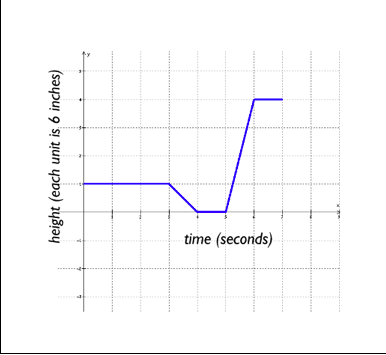
So I showed them this graph [1]

Picture 1

and I ask them where the object is at various times.

Then I say, let’s actually act this out.

I start banging my hand on the desk nearest to me, BANG BANG BANG BANG… I hold up my other hand in a fist 6 inches above the desk, and say “it starts out at 6 inches.”

As I did this, all my students joined in by banging on their desks. (I didn’t ask them to.) They all put their hands up. They all joined in. It was a true glimmer of life! of community!

For three BANGS we held our fist still, and then after three bangs, we moved it down to the desk and held it there for another bang, when all hands shot in the air and then stayed there for an extra bang.

We acted it out. And then I said: let me tell you what makes calculus so powerful. It allows us to look at this graph which gives us just the position an object — that’s all it gives us — and it lets us understand the MOTION of the object. What we have here is information about where the object is, but we now can find out how the object is moving. We could actually act out the MOTION of the object from that.  It seems so obvious, but the connection is so deep.

Then we constructed the velocity-time graph. And I pointed to the [4,5] interval and said “oh, negative. what does that mean?” (Our fist was going down.) And I pointed to the [5,6] interval and said “oh, positive. what does that mean?” (Our fist was going up.) And I pointed to the [6,7] interval and said “oh, zero, what does that mean?” (Our fist wasn’t moving. It was high in the air, but standing still.)

I’m building the concepts here. We do the math later.

[1] Pre-emptive footnote: Yes, we had a discussion about how this graph could not actually be representing something in the world, because of the sharp edges.

sin(1/x)

In my most recent calculus classes, I wanted to show my kids their first “not nice” functions. After being introduced to how to find limits graphically (fancy way of saying: looking at the graph of a function) and numerically (fancy way of saying: using the graphing calculator’s TABLE function to guesstimate limits), I wanted to have them think about what they learned.

I had time to show one class that these methods aren’t foolproof — that the calculator can lie to you, and make you think a limit is 3 when it is in fact 3.004, or that it can’t graph things when numbers get too large or too small. So they have to be careful. And that we will be learning algebraic methods to do limits. But for now, they need to use their brains and wits.

So I divided them into groups of 2 and 3 and had them use whatever methods they wanted to find:

\lim_{x \to 0} \sin(\frac{1}{x})

I made them each draw a sketch of the function, write down an appropriate table of values, make observations about the function, and then decide on an answer. (In one class, I had each group turn in their findings, and then I photocopied them and distributed them and had the class talk collectively about the results the next day. In the other class, we didn’t have time for this, and we just met up together as a group to talk.)

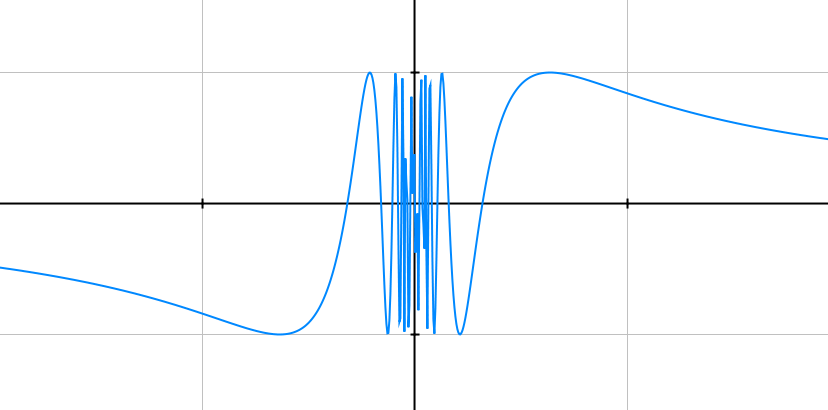
FYI, the graph is here.

Picture 1

It was great. Students were debating whether the craziness was a function of the calculator lying or if that actually was what the function looked like. They wondered if the limit was 0 or if it was “does not exist.” They noticed that the function starts to oscillate more and more rapidly as x approaches 0. They noticed that it bounced between -1 and 1. It’s not an easy question to solve with this information.


When we came back as a group, we talked about their observations and conclusions, and documented them on the board — so everyone had the same notes. Then I said: “so… one of you said that the function is crossing the x axis more and more as x is getting closer and closer to 0. Can we be more exact? Where does the function cross the x axis?”

Of course my students didn’t know exactly what to do. We got to the point where we knew we had to solve:

\sin(\frac{1}{x})=0

But then they were stuck. So I guided them through it.

I asked: “When is \sin(\square)=0

We generated: \square=...,-4\pi,-3\pi,-2\pi,-1\pi,0,1\pi,2\pi,3\pi,4\pi,...

We then said: \frac{1}{x}=...,-4\pi,-3\pi,-2\pi,-1\pi,0,1\pi,2\pi,3\pi,4\pi,...

We went through solving one of the equations for x and saw that we needed the reciprocals…

We concluded: x=...,\frac{-1}{4\pi},\frac{-1}{3\pi},\frac{-1}{2\pi},\frac{-1}{1\pi},\frac{1}{\pi},\frac{1}{2\pi},\frac{1}{3\pi},\frac{1}{4\pi},...

I then asked: So what? Why did we do this? Don’t lose the forest for the trees…

Finally, we converted those numbers to decimal approximations

x \approx \pm 0.318,\pm 0.159,\pm 0.106, \pm 0.080, \pm 0.064, \pm 0.053, \pm 0.045, \pm 0.040, ...

and saw that the zeros were getting more and more frequent as we approached 0. No matter how close we came to zero, we were still going to be bobbing up and down on the function. And crucially, we’ll be bobbing up and down between -1 to 1.

Picture 2

We then talked about what a limit means again… what the y value of a function is approaching as the x value gets closer and closer to a number. Using that informal definition, I asked them if the y value of the function was approaching some number as x was approaching 0.

At this point, most of my kids had that “a hah” moment.

I am definitely doing this again next year, but perhaps more formalized. I might generate a list of good conceptual questions to walk them through this more systematically. One such question: “How many zeros are there in the interval (.5,1)? How about (.1,1)? How about (.01,1)? How about (.001,.1)? How about (0.0001,1)? And finally, how about (0,1)?” Another such question: “How do we know the function will bounce between -1 and 1?”

Also, maybe next year, I’ll couple it with an analysis of the function:

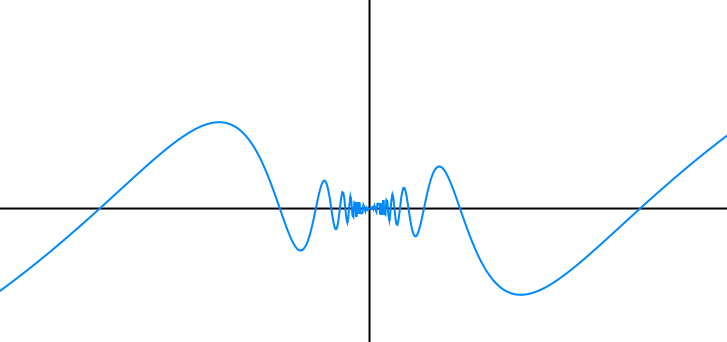
\lim_{x \to 0} \sin(x)\cos(\frac{1}{x})

The function behaves similarly (crosses the x axis more and more rapidly as x approaches 0), but the limit in this case is 0. You can see it in the graph easiest.

Picture 3

So if anyone out there is looking for something to spice limits up, you might want to really go in depth into these functions. They are often used as exemplars, but rarely investigated.

My Favorite Rant From Today

Yesterday my calculetes took their first assessment — a algebra boot camp to help us prepare for limits. We focused on rational functions, piecewise functions, and basic function transformations (focusing on exponential and logarithmic functions). I haven’t graded their assessments. You know what? I don’t know why I’m talking about that at all. This post isn’t about that. It’s about…

… what came next … today …

Each year — this is my third year doing this particular rant — I am always surprised that we can go weeks (this year, we went 2 weeks, last year it was 6 weeks) before I ask my kids:

WHAT IS CALCULUS?

We do all this algebraic review, students are settled into class and into their routines, and then POW. I hit ’em with this question.

And now I can say for three years straight, I have been met with totally silence. Followed by a student saying “the thing after pre-calculus.”

Commence rant:

“Why are you here? What is this course you signed up to take? What’s the purpose of this course? Why have you been working your whole time in high school for this? I mean, you took a course last year called pre-calculus. And yet, here we are, already well into our year in a course called calculus, and NO ONE KNOWS WHAT THE HECK IT IS!

Seriously? SERIOUSLY?

Well, good. Let me tell you what it is.

[Insert discussion of the “tangent problem” and the “area problem”]

It’s the study of the very small to learn about the very big — to learn about things you never knew you could know. Like the basis for much of physics. Given just a little information about something moving — a roller coaster, for example — and a knowledge of calculus, what can’t you do? And let’s talk about how little you actually know about space. What figures do you know the areas of?

[Commence students calling out things like “square” and “circle” — of course followed by figures they know the volumes of.]

How sad and pathetic is this? You can only find the areas of silly, putrid little pretty shapes. What about the real world? What about this shape [commence drawing of crazy shape on board] or the volume of this figure [commence drawing of crazy volume on board]. I mean, seriously, think about it. Look at a sphere. What’s the volume? \frac{4}{3}\pi r^3. Fine. Great.

[slight pause, building suspence]

WHERE THE HECK DOES THAT COME FROM? I mean, really? You have no idea. It just popped out of nowhere and you never questioned it. In this course, you’ll know, not just accept, that it is true.

Your lives are about to be changed. [1]”

[1] Okay, so I didn’t say this last sentence, but dang, I wish I had. You know kids, I don’t know if it got through to them. But I love doing this each year. It never fails to shock me how it is that these kids work so hard so they can take this vague thing called “calculus” — they’ve even taken a course called “precalculus” which, if the name were accurate, was meant to prepare them for this course — and they come in not knowing anything about it. What other course could you be over 2 weeks in, and ask the students what the course is about, and they won’t be able to answer?

Calculus Fail

xHsHnSTczqfu5oadlECRl4aDo1_500

I’ve been beating myself up, and it’s only day 4 of school. It’s sad because I just want this year to be the most fantastic year ever, and I wanted it to start so positively. But I’m feeling sad about my classes. I am okay being a teacher centered teacher for my Algebra II class. I really am. We have a curriculum that we are following, and we don’t have too much time to dawdle. Also, the kids are younger, so I feel okay keeping them mostly reigned in. And my MV Calculus class is going to be relaxed, though more challenging to teach than last year, because there are only two students (gasp!). That is a nice combination of student and teacher directed.

However, my calculus classes are a different story. I don’t have a set curriculum, which allows me a lot of freedom. I want to make sure that these students leave understanding calculus. I want them to see what makes calculus cool. What makes math cool.

So I promised both sections of my calc kids on the first day that my goal was to make math understandable to them. And I secretly promised myself that day that I would make math more interesting than they’ve ever seen it before.

It’s day 4 of teaching, and I feel like I’m flopping already. My classrooms are depressing (no sunlight in one; loud sounds of recess floating through the window in the other). I haven’t made one interesting lesson or one group/partner activity. I’ve just been up at the stupid SmartBoard pointing, talking, asking questions, going over homework. We’re just reviewing. And honestly, I don’t even really know where the students are in terms of what they know and what they don’t know. I call on random people, I walk around when they’re working on problems practicing in class, and still: not much clue. That’s not good.

I want to feel okay letting go this year and shift from having a teacher centered classroom to having times when the room is student centered. Where I’m not the one talking for most of the class. And I feel if I talk about that goal here, it’ll force me to keep it in mind. And be slightly more accountable.

As Alison Blank (@pvnotp) said on Twitter: “Maybe just try to be student-centered a little more often – like set aside one class every two weeks where you switch it up.”

Baby steps. And I’m going to try that. Even if it means something as small as playing a review game with students, or having some sort of hard problem challenge we spend the whole period solving together (like I do sometimes in MV Calculus), or making a guided worksheet to lead students through a concept. I should also remember that I can mix things up by asking for different forms of homework, instead of book homework, worksheets, etc. I can ask students to write a letter to their math-illiterate uncle explaining a concept we’ve been working on in class, or create a quiz of their own, or write a formal solution to a challenge problem. I can have students each work on different problems and make a SmartBoard presentation of their solutions for the class — and grade their presentations. Or even have students research the practical applications of calculus.

My brain to itself: Okay, Mr. Shah, keep these things in mind as things you can do instead of traditional classwork and traditional homework. And you just came up with these in the last 5 minutes. Imagine what you could come up with if you gave yourself 10 minutes, or (egads!) 15 minutes?

So I’m going to try to experiment a little this year in calculus. Be slightly daring. Put my foot in the water.

Optimism! Glimmers of hope!

If you want to see why I’m so dejected at the moment, you can see my SmartBoard presentation for my calculus class.

Setup. We’re in Algebra Boot Camp and we’re learning about rational functions before we start on the Limits unit. Up to this point, these kids have reviewed holes and vertical asymptotes, and have just started thinking about the domain of rational functions.

It’s not that the SmartBoard is bad, exactly. I actually think it’s pretty well thought out and organized. But you can see what my class would look like, by looking through it. (FYI, this particular lesson on domain, x- and y-intercepts, horizontal asymptotes, and sign analyses takes more than a day to go through. It will take 2 days to teach and 1/2 a day to pull it all together.)

I know I shouldn’t beat myself up too much. It’s only day 4. But I am. I’ve just been in a bit of a teacher funk. I’ll get out of it. All I need is some kid to say that they’re actually learning something in my class, and that they’re excited about it. I’ll get that.

Important Note. I don’t mean this to be a pity party. I don’t want pity comments – please. I only posted this because this is a place for reflection, thoughts, emotions, whatever. An archive of how I’m feeling today, so I can look back later and see how I’m evolving.

However if you have ideas on activities/games that work for you, things that break “the teacher introduces an idea –> teacher asks questions to develop idea –> teacher goes through example applying idea –> teacher asks students to practice a few problems –> start over” cycle, I would love for you to throw those in the comments below.

Imagining the First Day of Calculus

At one point during my first class, I want to drive home a point. You guys know a lot, and I want this course to help it all hang together.

I’m going to ask them to spend a few minutes minutes solving the problem: 2x^2-56x+1=0

Then I’m going to go around and have students explain how they got their answer, why they think they’re answer is the answer, what they know about the question, whatever.

Who wants to bet that 100% of them graph it on their calculators or use the quadratic formula?

I’m counting on it. I will then show them an example of their graphing calculator lying to them (there are a million of ’em), and then say “why does the quadratic formula work? why are we allowed to use it?”

We’ll then take a moment and say “what do we need to know to solve this problem? I’ll start by throwing something out: we have to know what a variable is.”

So we’ll throw a bunch of things on the board: variable, number, exponent, addition, square roots, etc.

Then I’m going to reveal the big secret to mathematics, the secret that all teachers have kept from them until now: all we’re doing to solve problems is to turn something we don’t know into something we do know.

This is the rant I have playing in my head…

So when we first learned quadratics we didn’t know how to solve ’em. We had only seen baby linear equations. But guess what? When we learned to solve quadratics two years ago, we turned these horrible grossities (quadratics) into beautiful nice-ities (linear equations). Watch!

2x^2-56x+1=0

2x^2-56x=-1

x^2-28x=-\frac{1}{2}

x^2-28x+196=-\frac{1}{2}+196

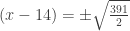
(x-14)^2=\frac{391}{2}

(x-14)=\pm \sqrt{\frac{391}{2}}

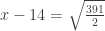
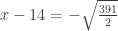
x-14=\sqrt{\frac{391}{2}} and x-14=-\sqrt{\frac{391}{2}}

I didn’t know how to solve the quadratic, but I do know how to solve (two) linear equations!

This procedure is completing the square. I know y’all remember it — vaguely. I know y’all hated doing it. But why did we evil math teachers foist it upon you? Because what this lengthy, arduous, annoying process did was took something gross, and turned it into something nice. The process wasn’t super nice, I know, but taking a step back and looking at the forest for the trees, it did that magic little math secret: turned what you didn’t know how to solve into something you did.

And look at all you needed to know about in order to make this happen. Numbers, addition, exponents, square roots, positive and negative, linear equations, variables. In that one equation

2x^2-56x+1=0

is a whole universe of knowledge! And you KNOW that knowledge. And in this class, we’re going to time and time again see equations that we might not think we know how to solve. They’ll look scary and unfamiliar like

\int_{-3}^{3} \sqrt{9-x^2}dx

But we’ll turn it into something we are more familiar with. Just don’t lose the forest for the trees. Don’t get stuck in the muck and mire of the procedure and not forget about why we’re embarking on that particular path, or what ground the path is built upon.

Our mantra: take what we don’t know and turn it into what we do. Math is an art. The creative aspect of it is finding the right path to turn what we don’t know into what we do know. Therein lies the puzzle, the beauty, and yes, the frustration.

PS. This post is basically a recap of this previous post. I just think it will be fun to talk about on the first day.

Calculus: A New Approach

In my last extended post, I wrote about how I was modifying our Algebra 2 curriculum. In this post, I’m going to briefly outline my ideas for my non-AP calculus course. The course as of right now is only decent. I haven’t put in the really huge amount of time and energy that I need to, so that the course is super fly. Unfortunately, this summer I won’t be able to do that either. I’m just incrementally improving the course (hopefully), instead of doing a wholesale rewriting. At this stage, I’m still okay with that.

So what changes will we see in this upcoming year? There are only two major ones.

First, we’ve finally given up Anton — that huge, dense textbook which is inappropriate for high school students and college students alike. I did a serious looking at a number of other books last year, but decided that all roads led back to Rogawski. The best part is that with Rogawski, there is something called “CalcPortal” which students are going to subscribe to. They will get access to an e-book — which is the textbook, but with interactive applets, and other goodies — but also I will be able to use WebAssign for online homework.

Yes, that’s right ladies and gentlemen, I will be using online homework at least once a week. It will be graded for correctness, instead of just completion, and will provide immediate feedback for students to know what they get and what they don’t get!

(My fingers are crossed that setting up CalcPortal and administering this online homework will be easy.)

Second, I am going to finally address head on the problem I’ve had with my calculus students for the past two years: they can’t do algebra. So I’ve made a list of all the algebra skills that students need for each unit. Will students need to know their 30-60-90 triangles? Holes of rational functions? Vertical asymptotes? Instead of doing over a month of precalculus review at the beginning of the year, at the beginning of each unit, I am going to put my students through an algebra boot camp which covers only the algebra skills needed for that unit. They will be tested on these skills. Then we’ll transition to calculus, and use these skills to solve problems.

What I’m hoping will come from this is an ability to do serious calculus work, while recognizing that calculus ideas themselves aren’t really difficult. In fact, if you can get past the notation and the algebra anxiety, calculus is actually pretty simple.

And that’s it — the major changes for my calculus class.