General Ideas for the Classroom

HOMEWORK SURVEY RESULTS

If you’re really dying to see what our results are, click here. If you can manage to read the prologue, avoid that mouse button and forge on!

I’m writing this after my second year of teaching. Even though in many ways I’m a neophyte, there is one thing I am sure of. The majority of math teachers out there don’t know how to “do” homework. Myself included. Do any of the following sound familiar?

“I just walk around and look to see who has attempted the homework. I don’t have time to collect and grade each students’ homework.” “I don’t want students to feel penalized if they get home and are completely lost and just couldn’t do the work completely, but I also don’t want them to develop a sense of ‘learned helplessness. I want them to learn to figure things out when they are stuck.” “I want homework to be both a site for practice — so students can naturalize the skills that are introduced in class — and a place for me to know where my kids are at in terms of understanding; it’s a place for students to assess if they know something and it should be a place where I assess the state of the class. Right now it’s not doing either really well.” “I hope that one day homework in my class will partly be about problem solving skills, but at the moment, that’s a pipe dream. It’s just practice of the routine problems we do in class, not really getting my kids to think for themselves. One day I’ll figure out how.”

And of course, the questions:

“How much homework should I assign, if any at all?” “Should I make all my own homework, or just assign problems from the book?” “How much time should I spend at the beginning of class going over homework?” “How much do I really think homework should be worth in terms of the final grade?” “Do I grade homework? If so, on completion or correctness or both?” “How do I grade homework?” “Thinking through the whole homework thing backwards, what really is the point of it? Can I use that answer to come up with the amount and kinds of homework I assign, and how I factor homework?”

These all are things that pop into my head from time to time, and then in the immediacy of creating another lesson plan or writing another email, get pushed to the wayside. I mean, at least no math teacher I have talked to has a system they’re totally happy with in terms of homework. Might as well just do what everyone else does and push on.

And indeed, at least from my 2nd year teaching perspective, this seems to be the general attitude.

So I decided to harness the power of the web, and using Google Docs, my blog, Twitter, and a few emails, asked math teachers to fill out a short survey on how they “do” homework. (My blog plea is here.) The survey questions are way at the bottom of the post, below the fold.

This survey was designed to be open ended, and above all, practical. I wanted to “see” the life of a homework assignment — from its inception to its role in the classroom to its place in a students’ grade. I wanted to let teachers say whatever they wanted to say about homework. The philosophical debates will have to rage elsewhere.

There were a whopping 40 responses. I, in fact, was gunning for 20. I mean, the survey was narrative (so it takes a bit of time to fill out) and restricted to math teachers. So that’s awesome.

Now the question is: what to do with the data collected?

I haven’t read through it yet; I wanted to look at it at the same time y’all did. I’ll be reading it over in the next few days and cobbling together bits and pieces of what other teachers have written about — bits and pieces that will work with my teaching style and in my school — into a cohesive plan for homework next year.

What you’re going to do with it is anyone’s guess. My hope is that you read through the data, pass it along to other math teachers, come back here, and write down your thoughts in the comments below. I don’t expect a conversation will start here, but I’m darn tootin’ hoping one will.

So without further ado, click below for the survey results, or view the PDF below.

homework survey results

(Survey questions are below the fold.)
(more…)
How do you deal with homework?

UPDATE: Survey results here!

We talk a lot about lesson plans on our blogs, but there is the huge issue of homework that we don’t discuss frequently. Partly because the discussions easily lose concreteness and get philosophical (why do we assign homework? how do we make sure the homework as meaning?).

However I’m struggling with how I’m doing homework in the classroom everyday. I can get dragged into a too-long discussion about homework problems in class, and I still don’t know how to grade homework in a way that I am not killing myself by collecting it everyday.

The few teachers I’ve talked to about this have shown me that this problem — of finding a good homework system — is pretty universal. A recent post at Kiss My Asymptotes reminded me of this too.

It’s like no one I know has a good solution on how to “do homework well” in the math classroom. That’s crazy to me. I mean, how can that be? And I just know some people must have good ideas/methods. Which is why I’m just casting a wide net looking for what everyday teachers do in their everyday classrooms. If I can collect a bunch of different ideas from different teachers, I can put that out there to show the different ways we do homework. Maybe we can pick and choose bits from other teachers that inspire us!

Because of this, I thought:

We should all band together and make a list of how we deal with homework in the classroom.

So I’d love you forever if you could spend a few minutes filling out this short survey, and I’ll post everyone’s responses soon.

Without further ado: THE SHORT SURVEY!

Student Created Final Exam Study Guides

The math finals are given next Monday. And I’m really curious about how my Algebra II students will do, especially as the year comes to a close.

But I will say this: I predict that the average score on the final exam will be 85%. Why? Because according to my new grading program this year (EasyGradePro), the average EVERY QUARTER was  85%. Crazy. And at least for the first three quarters, there were exactly 4 (of 15) students in the A range. (I’m not done calculating the fourth quarter grades yet.) I bet it’s mostly coincidence, but it also suggests that I’m keeping the course pretty consistent in terms of difficulty level.

Back to final exams.

My biggest concern this year was that we didn’t have a midterm (because of the school tragedy). And I didn’t do much time throughout the year reviewing topics from the first semester  [1]. To battle this, I assigned each student a semester 1 topic, and told them to make a study guide of that topic for their classmates.

The other teacher of the course and I thought this was a good idea for a number of reasons.

  1. We wanted to have one more assignment which focused on student communication. (That’s something we’ve been emphasizing this year, but we need to ramp it up next year.)
  2. Our students are 10th and 11th graders, and we think that now they are ready to take ownership of their own studying. We didn’t want to provide them with a study guide or packet of problems. We wanted them to figure things out. (I would, to put things in context, probably not do this in 9th grade.)
  3. We thought that students would desire to do a more thorough job on their study guides if they knew they were for their classmates too.

I taught students how to use Equation Editor in MS Word and I asked them to use either www.graphsketch.com or their virtual TIs for graphing. And then they went at it.

Now I have a confession. I had talked with the other Algebra II teacher about doing this, but we both sat on our hands until the last possible moment. And since I didn’t want laziness to get in the way of our students’ success, I banged out the instructions and rubric in an hour. But I’m so glad I did. The project needs a lot of work for next year, but I think we’ve got ourselves a winner.

My instructions/rubric: Final Exam Review Project (PDF)

I put all the study guides on a website for students to access. Since the guides have the students’ full names, I’ve password protected the site. But you can see what it looks like here (Image of Algebra Two Website). Students can download and print out the individual guides from that site.

The good (what worked well):

  • Students seemed to get into this project. One said, after working in class on the study guide, “wow, this is actually pretty fun.” I think part of the fun was using Equation Editor (they liked that), and part was creating something collectively.
  • Most students did actually work really hard.
  • Most students were actually really good at explaining their concepts clearly. The ones which were more didactic (e.g. “Now let’s make things a little bit harder…”) and sounded like someone speaking/teaching were the best!
  • Students seem to be actually using them. During the review days, many were using them. There are 15 students in my class. As of now, the site with the study guides has been accessed 261 times. The site has only been up for four or five days. So students are coming to the site and looking at a guide or two, and then coming back and looking at more guides later.

The problems (what to fix for next year):

  • I didn’t get to have a good discussion on what makes an effective study guide and what makes  a poor study guide. I should have talked about tone, layout, clarity, etc. Also, I could have students make these guides earlier in the fourth quarter, and have them exchange them with a partner for critical suggestions for improvement.
  • I should have shown an excellent study guide, an okay study guide, and a bad study guide. Luckily for me, if I do this next year, I can use examples from this year!
  • Many guides were turned in with mistakes. Almost all had mistakes, in fact. I read through each one of them carefully, and noted all the mistakes, and returned them. I hadn’t anticipated this many errors, so I gave students 1 day to fix the errors and turn them in again, to raise their grade by up to 5 points or if they didn’t make any changes, to lower their grade by up to 5 points. Most errors were fixed. But next year, I must insist upon a comprehensive draft.
  • I insisted in students typing everything — because some have terrible handwriting and I also wanted them to get familiar with Equation Editor. (I was horrified by the fact that my seniors in Multivariable Calculus didn’t know how to use Equation Editor; I want to make sure all my students know they can write math on a computer!) However sometimes that requirement got in the way of clarity. There were some guides that had parts that would have been much better if there were some things that were handdrawn in. So, for example, if there was a tricky step in a series of algebraic manipulations, putting a handdrawn arrow to that tricky part and saying “CAUTION! Be sure to flip the sign of the inequality when * or / by a negative number!” would be more effective than typing it out after all the equations are worked out.
  • I need to come up with a better way to talk about the number of practice problems required in each study guide, and talk about how these questions should be representative of the types of problems that we did in homework or got on assessments.

But yeah, although I haven’t yet had a chance to talk with my students about if they are finding these guides useful, I have to say that it so far appears like they are somewhat successful. At the very least, I know each of my kids have mastered at least one topic from first semester and are able to articulate that topic pretty darn well. And I can say that at least in terms of students using other students’ work, this is much more successful than the video project I did last year, that I was too busy to repeat this year. (See the videos here.) [2]

[1] Next year, I have to remember to build review into the course more formally. I planned on doing it this year, and then it got lost by the wayside. But I’ll tell students that a previous topic not from the current unit will be tested each assessment (and I’ll tell them the topic). That way they’ll be forced to periodically review topics so it won’t all be a shock at the end of the year.

[2] Argh! I can’t believe I didn’t show my students some of the good videos from last year! ARGH!

Silent Teaching

A few weeks ago or so, the GSA (Gender and Sexuality Alliance; formerly GBSA) club at my school held a day of silence to highlight the experience of being silenced, and to show support for gay, transgendered, and questioning students. Students who wanted to participate could wear a sticker saying they were participating, and for those teens who couldn’t keep their mouths shut, there was even a sticker for “vocal supporters!”

It was great. I had a few students come to the front of the classroom and write their ideas on the whiteboard, and I made an effort to keet everyone engaged.

It made me think that next year, I would plan a class where I wouldn’t talk at all. Some classes naturally lend themselves to have the teacher fade into the background: group work/investigative activity, student presentations, etc. But I was thinking: what an interesting exercise to think what a class would look like if I was teaching something routine (e.g. logarithms, completing the square) but I couldn’t speak. Can one teach as effectively without a voice? How important is our voice to the teaching process? What are alternatives to talking? What other means of communication do we use without knowing it?

No good ideas yet, but I’ll keep on thinking. Just a gedanken experiment (thought experiment). Could be fun for a us to all try this out on the same day next year. You know, as a lark. It’s not like we have anything better to do with our time other than baffle our students with even more nonsensical actions.

What is True Love? Winplot.

I am in love. Absolutely in love…

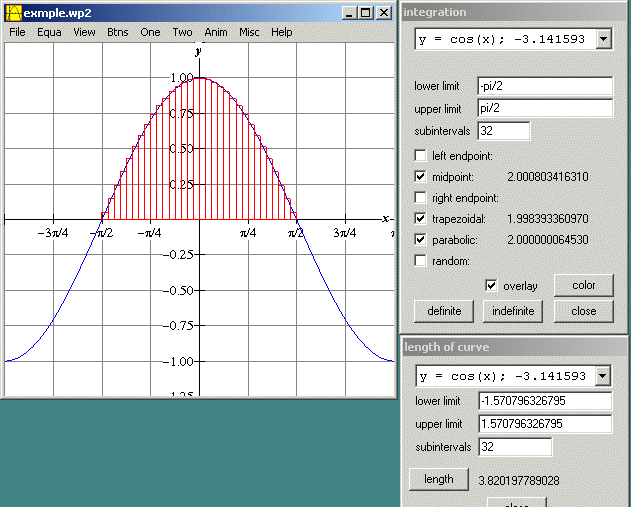
with Winplot (download it here – don’t be deceived by the ugly page). I discovered it on my hunt for a great program to make visuals for my Multivariable Calculus class. But now I’ve started using it when preparing lessons and graphs for all my classes.

The bad news: it has a pretty high learning curve. Some things are intuitive, many things aren’t. You have to, for example, type: y=root(3,x) to graph the cube root of x. But once you get the hang of it, it’s easy, breezy, beautiful.

The good news: what can’t it do?

I decided that either this weekend or next I’m going to spend 60 minutes going through
this comprehensive guide and learn all the features of this program in one go. Since the start of the year, I’ve been learning it piecemeal. I need to graph an inequality, I figure it out by looking around on the program. I need to get gridlines on my graph, I putz around until I figure it out. And in fact I thought I had a pretty good grasp on things without ever reading any documentation. However, it turns out that this program is way, way, way more powerful than I thought — because I only found out today that I can create pictures of volumes of revolution with the short click of a button! And so much more, apparently, after looking at the guide. So in my excited state, I felt compelled to write this post.
I know you’re dying for some screenshots, so I’m going to post screenshots cribbed from the guide linked to above here:

winplot1

winplot2

winplot3

A few more pictures after the jump…

(more…)

WebAssign: A Quick Question

I was reading Teaching College Math and came across a glowing review of WebAssign. (Her great powerpoint here.) Wow! Math help websites have come a long, long way! I was wondering if anyone out there uses it, and if so, what the pros and cons of it are? Are your students satisfied with it, or do they complain about how it works?

Why I’m acute to this: In grad school, I took a few undergrad French and German classes, and we had web assignments too. Unfortunately, although a great idea in theory, those assignments were a nightmare in practice. Missing letters, a different way to say things, a forgotten umlaut or accent, an extra space, etc., would render an entire question wrong. Or you could be completely correct, and you’d still be marked wrong. Everyone hated it. I want to make sure that WebAssign doesn’t have those sorts of annoying bugs. I want to make sure if you write y=\frac{x-1}{2x-1}, it would be marked the same as if you had written y=\frac{1-x}{1-2x}.

Movies about Mathematics

I asked my department head if we had a budget for DVDs, so that we could start creating a small DVD library for us to use (in class, in mathclub). She said yes, and put me in charge of finding DVDs. I’ve ordered a bunch, but tonight, I came across 0ne more that I want so dearly that I wrote an email pleading to case get the $35 to purchase it!

*****


Julia Robinson and Hilbert’s Tenth Problem

*****

Other DVDs that we’ve ordered and that I’m excited about include:

*****


Hard Problems (two youtube clips from the movie: clip 1, clip 2)

*****


Chaos (a series of  24 lectures, 30 minutes each, from the Teaching Company)

*****


N is a Number: A Portrait of Paul Erdos (on youtube: part 1, part 2, part 3, part 4, part 5, part 6)

*****


The Elegant Universe (on String Theory)

*****

I also got the old classics: Stand and Deliver, Good Will Hunting, and A Beautiful Mind.

And I will also soon be downloading this movie on various Dimensions.

I wish that NOVA’s The Proof (about Andrew Wiles solving Fermat’s Last Theorem) was out on DVD, but alas, no such luck. It is on VHS and on youtube (part 1, part 2, part 3, part 4, part 5).

I haven’t watched Dangerous Knowledge — a documentary on Cantor, Boltzmann, Godel, and Turing — yet (I don’t like the trope of mathematician as crazed genius), but it’s on youtube here: part 1, part 2, part 3, part 4, part 5, part 6, part 7, part 8, and part 9 and on Google Video here.

And finally, I wanted to show my Algebra II class something about fractals tomorrow, since we introduced complex numbers today. I didn’t do much searching, but I did find Arthur C. Clark’s movie on Fractals, which — sans the annoyingly trippy music — doesn’t seem too bad: part 1, part 2, part 3, part 4. It isn’t very up-to-date, but it does have a lot of famous people talking about fractals.

Any more recommendations? Throw ’em in the comments below.