General Ideas for the Classroom

The mathematical key

I gave my first official quiz today in my Algebra II class. Since so many of my students have 50% extra time accommodations, I designed a 30-35 minute quiz and let the class take the entire 50 minutes. Usually there are a number of students who finish early.

Before students turn in their quiz, I tend to say “are you absolutely, absolutely sure you want to turn this in? Once it’s in my hands, I won’t hand it back, and it tends to be exactly 1 second after students hand in a quiz that they realized they made a mistake and want to check over the test again.” Except for those with some sense of usually false bravado, they wisely go back and check over their work.

But I’ve come up with a good way to keep students occupied once they’ve finished their test. I put up a problem — somewhat based on what we’ve been doing but *just* different enough that students will be forced to make a new conceptual leap on their own. If they show me the right answer, with correct work, I let them leave class a few minutes early. A luxury, for sure. The solution to the problem becomes their key out of my class.

Today in Algebra II, we had a quiz that covered — among other topics — inequalities. Students learned simple linear inequalities and how to solve them. So, for the challenge problem, I put:

Find and write in interval notation where: x^2+4x+3 \leq 0.

Two of them got it. Most of the rest of the class wanted to get it. I liked them thinking about problems that are just beyond what we’ve done.

Learning styles in our faculty meeting

Today we had our upper school faculty meeting (read: high school teachers meeting). The topic: learning styles. It was led by our really wonderful — and capable — and amazing learning specialists.

In the meeting were two activities I want to talk about.

One is we had a panel of students (mainly seniors) come in and give us — without using any teachers’ names — their opinion of what works for them in a class. Some things they noted were that doing problems over and over (drill practice) worked for them in math. And having teachers pause every so often for students to spend two minutes (no more!) doing a “check in” problem, or discuss a new concept, was useful. They also discussed the importance of pacing, and having a really explicit lesson plan (“by the end of today, you will be able to …”).

I thought having students give their perspective was so much more powerful than anything else we could have done for this meeting. (See this previous post for more: A letter sent back in time.) I would have actually loved a bit of a Q&A with them. (I really wanted their candid perspectives of group work; what goes through their head when the teacher says its time for groupwork, and how the dynamic actually works out in most of their classes.)

The second activity was less impressive, and actually a little frustrating. It was an activity where we had to answer questions, and walk around the room, to determine what kind of learner we are: kinesthetic, auditory, or visual. And even though it was mentioned that these categories had gradations, and that no one fits perfectly in any of these categories, we were asked to discuss how our own learning style affected the way we teach.

The problem is, I had watched this video that had been circulating through the blogosphere in August, and I I really buy into the message.

(Read the comments at Eduwonkette for some good stuff.)

So I’m not sure how to deal with the concept of learning styles. And according to the video, I’m not sure that should really be the central focus of how I plan my lessons.

There’s something wrong here…

It’s funny that both Dan and Mr. K posted about giving that quizzical look to students — the “are you absolutely sure you’re right?… absolutely absolutely sure you’re right?” face. Or, to put it in the game show analogy, “is that your FINAL answer?”

Like Dan and Mr. K, I do this a lot. Both when kids are wrong and when they are right. And just today, after I had students give me answers to a worksheet, I stood at the board. Rubbed my fingers on my chin, stroking my imaginary beard. Gave that quizzical look. And then snapped back and said: “there’s something wrong here.”

They searched and searched, and someone said they thought they found something wrong — but it wasn’t actually wrong. And in the end, after a good 45 to 90 seconds (who knows? time gets so nonlinear in the classroom), I turned them them and said: “Okay, so you got me. You got everything right.”

I did it on purpose.

This all reminds me of my calculus teacher in high school He was a great teacher, and he prefaced the course by saying he would make mistakes on purpose to see if we’re paying attention. And each time he made a “mistake,” hands shot in the air. He would pass it off like something he did on purpose. Looking back, I think a good number of times, he just had made some silly error and was covering. (Sneaky genuis!) But I can say that every so often, once in a blue moon, he would make mistakes that no math teacher would make. (Like saying (a+b)^2=a^2+b^2.) These mistakes became warnings of what not to do.
Ah, I miss that class.

A Candy Bar Competition?

Ah, Mondays. I hate them. Alas, it is no surprise that when you spend a long time preparing something for your students, it will go awry. Indeed, it seems inevitable.

Over the weekend, I prepared SmartBoards for all three of my classes. Of course, I go into my classroom and see the dreaded red and orange lights of the projector blinking. No, not just blinking, more like maliciously mocking me. Blink. Blink. Blink blink blinkblinkblinkblink blink blink. The projector wouldn’t turn on.

At least I learned my lesson from last year, when the exact same thing happened a few times, and I knew how to cope. The secret: wing it. Seriously. Trying to “recreate” the presentation will be a flop.

And so I did. And things went okay. Not amazing — but okay.

With four school days down (and about 160 left), I can say that so far I think I’m in a really good groove with two of my classes. The other two are trickier, and I can’t quite get a pulse reading from them. It isn’t that they are dead, exactly. It’s just that I don’t see the students’ personalities yet — they aren’t coming out naturally.

That’s my fault. I haven’t quite given us any time to bond as a class; I dove right into material for a variety of reasons. And now we aren’t having the relaxed and anxiety-free atmosphere I always thought I was so good at fostering. It isn’t that we are all tense or anything. It’s just that everything feels… well… slightly boring. And if math is anything, it is the opposite of boring.

So now I’m wondering if I can think of something to do during class on Friday to help us get to know each other, to help the two classes each become a cohesive set of adventurers working together — in an exciting atmosphere — to solve something mathy…

I’ve been thinking about having a candy bar competition: the class (or maybe break the class into two groups?) works as a unit to try to solve N problems in 40 minutes. If they can do it, they each get a candy bar at the end of class. (Hey, it worked for us in MathTeam, all those years ago when I was in high school. A blatant bribe, yes, but such a community builder!)

And since this is still the beginning of the year, I can find problems which should be “review” for them, but which they need to know well to succeed in the course (e.g. for Algebra II, they need to know their exponent rules from Algebra I; for Calculus, they need to know basic trigonometry).

Argh, this is more work for me, and it might just blow up in my face, but maybe it’ll be worth it? If I do it, I’ll post the results of this sociological experiment.

A letter sent back in time

As last year was winding down, I realized that the kids I ended up with at the end of the year were very different than the kids I began with. I thought about where they were on the first day, and how much they had learned in the intervening months. Not only did I have to get used to them and their quirks, learning differences, personalities, but they had to acclimate themselves to my course, my personality, my quirks, my method of presentation.

And so, in the last week of classes, I asked each student to type a 1 page (double spaced) letter to themselves 9 months ago. I asked them to give themselves advice on how to succeed in this course. Things they know now which they wish they had known then.

And they gave me some pretty awesome reflective letters, full of advice useful to my classes this year. Instead of me telling them that doing their homework nightly is important, or that cramming at the last minute doesn’t work, they now have it from the horses mouths. From those who were forged in the crucible of my math class.

advice-for-algebra-ii-students

advice-for-calculus-students

What’s great about these documents, read in their entirety instead of just the snippets I provide here, is that I get glimpses of my class — and the way I am as a teacher — through the lens of a student.

After talking with my colleagues, I decided not to foist this upon my students in the first few days. There is too much information flying around and it’s too potentially useful to be flung into the “first day crud” pile. Better to wait two or three weeks, when they’ve had a chance to get to know me and my class, and I get a chance to know them and their class. Then I’ll have two or three histrionic kids read a few pieces of advice.

For students, by students.

Come share in the internet bounty!

Here are some things I’ve seen on the internet that I thought might pique others’ interests.

  1. This video on learning styles — and how we as teachers can ignore all that we’ve heard about them.

    Both Casting Out Nines and Catching Sparrows have posted it too. Read the latter’s post for some solid analysis.
  2. A much needed middle finger directed towards Wong’s First Days of School book is on Stop Trying to Inspire Me.
  3. A must-read multi-page New York Times article on teacher David Campbell’s experiences teaching evolution in a classroom where a large proportion of the students are taught to question the teacher by their parents and churches.
  4. I Want To Teach Forever links to a edubabble random jargon creator. Some words I’ve created:
    >revolutionize research-based relationships
    >synergize metacognitive experiences
    >synthesize developmentally appropriate alignment
    > harness site-based goals
    Pure delicious, vague cant, that’s all it is.
  5. A great science teacher blog — trust me on this. I found it through another blog, but I can’t remember which one to give it credit. By the way, I totally thought that the title of the latest post — “Terminal Velocity of Mussels” — was such a random idea that I was sure that only at most 10 sites on google would come up when searching for that. I was proved wrong. Searching [Terminal velocity of mussels] yielded 18,300 sites. Searching [“Terminal velocity” of mussels] yielded only 431. Not to be too meta, but with this post that number will increase to 432. Rock on.
  6. Catching Sparrows goes on a screed about the problem with group work. The only thing is, even though I call it a screed, I agree.
  7. Sustainably Digital analyzes a commercial which is a metaphor for our educational system. I’m not sure I buy the metaphor. Maybe I’m linking to this because I like the commercial a lot. Because I do.
  8. I Want To Teach Forever gives a really great list of “am I ready for school to start?” which I will be going through. Probably next Tuesday evening, as I lie in bed, eyes shut, mind whirring about all the things I still have to do. (I will not, however, re-read Wong, as instructed by this otherwise unblemished list.)
  9. dy/dan’s videos about teaching are great and two of them in particular need to be seen by you, now.
Fin.

Organizing!

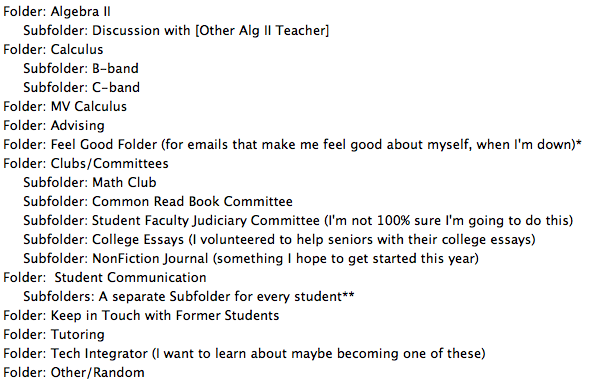
Today I spent a few hours organizing for next year — creating the appropriate folders and creating/updating mailing lists. The process is interesting, because I think that the way one organizes their desktop, or their mail folders, or anything, reveals a lot about the person. How they view their world, how they compartmentalize it.

For the following year, this is my email directory structure:

Clearly you can see that I save a lot of emails; I’m a packrat in the electronic world as well as the material world. I’m definitely a natural archiver, because I have no memory and I need things written down to refer to. But there’s another reason why archiving email is important: you have written proof that certain things got done.

“You never told us X,” a student or parent or dean or someone might say.
“Actually, I told you that! See this here?” I will respond.

(This actually happened last year, when a parent said they were never informed of their child’s poor performance; I had two archived emails that specifically were sent to inform the parents of that fact.)

Maybe this should be a meme. If you care too, share on your blog how you organize your school-related email? What do you save? Why do you save?

*This is a new addition! I read about it on some blog and thought it was a great idea.
**I did this last year, and it was super useful. Every email to and from a particular student gets put in their individual subfolder. Also every email about these students (communication with other teachers, with deans, with parents, with the SFJC) gets put in these folders. Then, when I need to pull up information on a student, I have not only my gradebook, but in this folder, a lot of other information about them. Sometimes, when writing my narrative comments on students, I would quote them if they said something relevant. (As my school is a laptop school, you can see that we get a lot of email to/from/about students.)