Good Math Problems

Hook, line, and sinker: Calculus bait

I was reading — as I think we all were — that New York Times article “Building a Better Teacher.” In that article, a number of ideas and sentences and thoughts leaped out at me, especially concerning Doug Lemov’s taxonomy. (Yes, like you, I’ve already pre-ordered the book and cannot wait for it to arrive.) One of Doug’s points is:

The J-Factor, No. 46, is a list of ways to inject a classroom with joy, from giving students nicknames to handing out vocabulary words in sealed envelopes to build suspense.

I love the idea of sealing things up and unveiling them. So in my calculus class, right after we finished anti-derivatives but before we embarked on integrals, I gave my kids 15 or 20 minutes and this picture.

I showed them a Chinese take out container which I shook (and it rattled), and I said it had very special prizes inside. I showed them a fancy envelope and gave them each a notecard that they would place in the envelope. With their name, and their area estimate.

Each kid worked individually — using anything they had on them like rulers, straightedges, calculators. One student asked if he could use a scale from the physics lab (I said no, mainly because of the time issue.) I did this in two classes. Both seemed into it, but one was definitely more into it than the other.

What was interesting to me was how hard it was for them. Not the estimating, or the making of triangles and rectangles and other smaller pieces. What was hard for them was being asked to do something that they didn’t know how to do. It happened multiple times that kids were sheepishly telling me that they didn’t know how to start (they had already drawn auxiliary lines and broke the figure up into smaller pieces — um… you DID start, darlin’), that they were doing it wrong (um, didn’t I say there was no wrong way to do this?), that they didn’t know the right way (um, see my last um). They were telling me this to assuage some part of their psyche that was telling them that they had to be right. I told them to STOP BEING CONCERNED ABOUT KNOWING THE RIGHT WAY and just TRY SOMETHING! Then they did.

I also mentioned that last year someone got the answer right to TWO decimal places — setting the bar high.[1]

At the end of the allotted time, I collected the notecards, put them in the envelope, and sealed it with a flourish.

I told them it would take a week or so before we could unveil the envelope (“but Mr. Shaaaaaaaaaaah”) and find out who came the closest to the real answer. And how would we find the real answer?

Calculus.

This was their hook for integrals. The next day (today) I introduced the idea of area under the curve being related to that anti-derivative thingamajig that they had been working on. I got at least 4 questions whining about needing to know who got the closest answer. I stoically responded “you’re going to find out when you figure out the true answer… soon.” The hook worked, and the bait is waiting to be won. For them, the bait is getting the surprise inside that dang Chinese take out box. For me, well, they are now curious.

[1] That was technically true, but slightly a lie. The exercise we did last year was different. I gave various pairs of students the same graph with different gridlines… and I had them estimate. So, for example, one pair of students got:
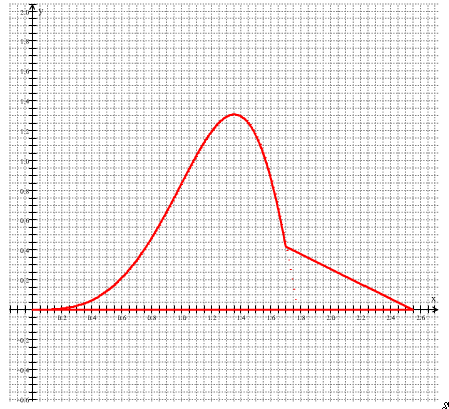
So clearly their estimation was going to be better — and it is unsurprising they could get an estimation to 2 decimal places. And last year we talked about how the more gridlines you have, the better your estimate can be.

The Unfolding of a Non-Intuitive Problem

Below is a problem that one of my calculus classes tried solving (unsuccessfully) so we banded together and walked through a solution. The problem is this (from here):

If you have two flies on a deflated spherical balloon — one on the equator and one on the north pole — and the balloon inflating at a rate of 5 cubic centimeters a second, how fast are they moving apart from each other at some time t_o?

What I like about the problem is that it is looks as simple as all the other related rates problems they’ve done, but it actually gets pretty complex. And it gets tricky figuring out what you’re trying to solve for, unless you keep yourself organized. What I love most is that you’re given almost nothing, but you end up with an answer I’d call beautiful because it is so ugly. You start out with practically nothing and can get something so ugly out as answer? Awesome. Welcome to math, neophyes!

So we walked through the solution together — after they had a good amount of time a couple weeks ago to try to solve it. I gently asked a few questions prodding them and kept the information organized. What you see below is how the problem unfolded on the whiteboard.

Vodpod videos no longer available.

more about “The Unfolding of a Non-Intuitive Problem“, posted with vodpod


Culture of Math Contests

My school does not have a culture of math contests. But I’m on a mission to change that.

This year we signed up for the New York Math League contests, which actually seem to be getting a dedicated small set of students taking them. (I think the biggest problem with getting a sizable number of students in our  school to take these contests is that our kids are so busy that not many kids can take the exam after school on the day we administer it. They have sports and other commitments.)

However I’ve taken it upon myself to make a huge push to have more students take the AMC 10/ AMC 12 math contests this year. How?

  • I’ve spoken individually to the other 6 math teachers about speaking to their classes about the contest, and I gave them some sample problems to give their kids if they want more information. I’ve convinced a few to offer some incentive for their kids if they take the exam (example: I’m giving extra credit, which I almost never offer, and another teacher is giving a homework pass).
  • The math club student leaders are making a facebook group (their idea!).
  • I’m having students “register” for the contest (basically fill in the blank on a sheet which says “My name is _________, I am in the ____ grade, and I am awesome because I am going to take the AMC!”). I’m going to use this list of students to send a reminder email to the kids. I’m also going to send a letter to their parents explaining the contest, and why we in the math department are really happy that their kid is going to take it. Basically, I want to get the word out to as many people about the contest, in a few different ways.
  • I’m trying to get some money so we can order  pizza for the kids after they take the exam.

I think last year we had 10 or 15 students who took the exam. I really want to ramp it up this year. And if we can do this for a few years, we might be able to develop a culture where taking the AMC is a “normal” thing to do — where kids in the accelerated track all want to take it and interested kids in the regular track are encouraged to take it. I’m trying to slowly and consciously engineer a shift in school culture. It’s hard to figure out how one can create a culture shift.And I know, it’s a really small culture shift, but in my opinion, it’s really important for our department and for our kids.

Insolvability of the Quintic

One day a few weeks ago I had a day to kill with one of my two multivariable calculus students. So I decided to talk a bit about something which intrigued me when I first learned about it.

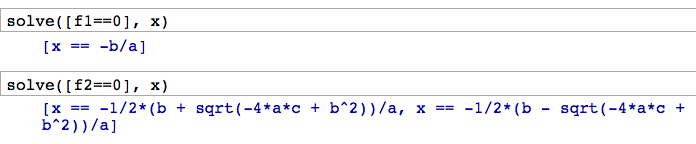
If you have any linear polynomial (ax+b=0), then it is easy to come up with the algebraic solution for any a and b. (Obviously it is x=-b/a.)

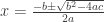
If you have any quadratic polynomial (ax^2+bx+c=0), then it is still pretty easy to come up with the algebraic solution for any a, b, and c. (Obviously it is x=\frac{-b\pm \sqrt{b^2-4ac}}{2a}.)

What about the cubic? quartic? quintic? higher?

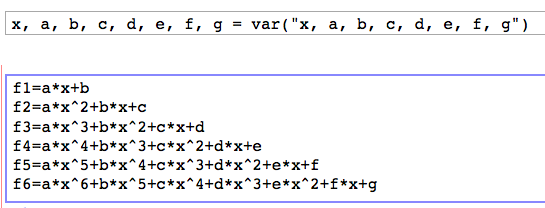
I had my student take out his laptop and we used SAGE online to see what we got. We entered something like this:

I then asked if we could, for any coefficients, find all zeros (real or complex) to the polynomials.

Before pulling out the laptops, we had already answered the first two. Which we  confirmed with SAGE:

Then I asked about the cubic.

He said he knew how to find the solutions to some cubics. Like he could graph them and if they hit the x-axis three times, he could get the solutions. Not good enough. We wanted formulas for the solutions. For any coefficients. Without graphing. Like we had for the quadratic.

He (naturally) said he didn’t know.

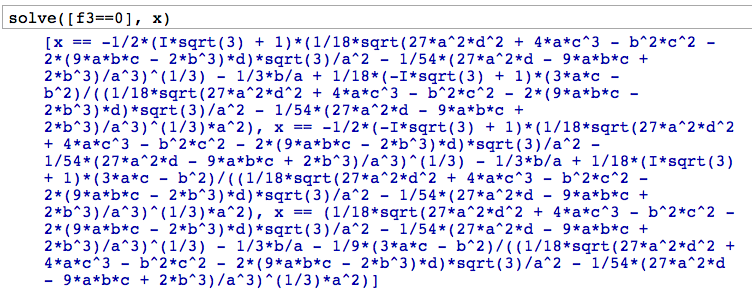
So we turned to SAGE and found:

So there is a formula. And it’s messier than the quadratic, which is messier than the linear [1].

So we checked the quartic.

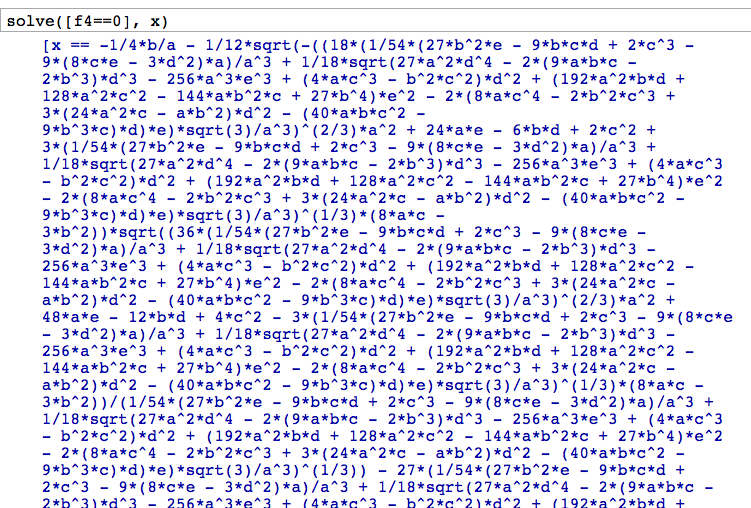
And indeed, SAGE found a solution. I’m only copying the first few lines here since it goes on forever.

So here we are, and there’s a pretty good chance things will continue — there’ll be a solution but it’ll be more and more complicated as the polynomial degree gets higher and higher.

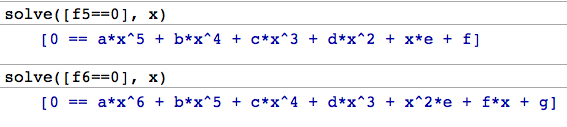
But when we try the quintic and the sixth-degree polynomials, we get:

Um… it won’t solve it for us? Is SAGE just not powerful enough to help us? Do the solutions get *that* much harder?

Could be.

But it isn’t that SAGE was broken. It turns out there is no “formula” to get the zeros of any given quintic or higher polynomial. Sure, you can solve some quintic polynomials. Heck, they might even be factorable to (x-1)(x-2)(x-3)(x-4)(x-5) or something. But that isn’t what we’re asking. We’re asking if you have any quintic (or higher) polynomials, can you come up with an algebraic formula for the exact roots.
No.

And the reason I wanted to show my student that is because it was learning that fact in high school, the insolvability of the quintic, that got me even more interested in math. It raised the huge question: what broke down after 4? Why is 5 the magic number? Is it truly impossible for any degree polynomial greater than 5? How can anyone show that a degree 1021 polynomial won’t have a “formula” solution for its zeros? No one could explain it to me, but my math teacher swore it was true.

It seemed so crazy to me! Heck, it still does. Interesting tidbits like that lit a fire under my feet [2] to take college level algebra (Abstract Algebra) to help me understand it. It was one of the most glorious days of college when in our Abstract Algebra class we finally got to tackle and solve this problem.

Do I remember how we did it?

Sigh. No. I have Flowers For Algernon syndrome.

But I at least know that the solution is out there, and given enough time and patience, I can understand it once again.

I doubt my student got out of it the same level of “WHAT THE HECK?!” as I did, nor do I think it lit the curiosity fire under his feet. But heck if I didn’t show him that our intuition breaks down without cause sometimes, and there are answers to be found. Maybe not in our class, but in some other class if he ever wants to solve the mystery.

[1] Well, when I was in high school, I had my dad’s worn, cover-falling-off CRC Book of Mathematical Tables and Formulae. In it was the solution of how to solve any cubic, and how there is indeed a formula (like the quadratic) for the cubic. (You can see it nicely typed here.) I suspect it also had a paragraph or two about the Cardano/Tartaglia dispute.

[2] Godel’s incompleteness theorem was another one.

a stubborn equilateral triangle

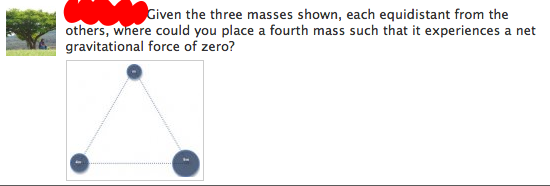
My sister is a teacher too. And she’s smart. And sometimes she poses questions which stump me. She posed a good physics problem on Facebook a while ago.

In case you can’t tell, the three fixed, point masses have masses 1, 4, and 9. She wants to know where you can place a mass so that it won’t move! So that the net gravitational force on it is nil.

Just in case you forgot Newton’s Law of Gravitation between two bodies: F=G\frac{m_1 m_2}{r^2}

Before starting, I thought this problem would be so easy. If the three masses were equal, we’d have a simple geometry problem. Since they aren’t, it turns out we have something more tricky. I thought the solution would come easy. For me, it didn’t. But I think I got an approximate solution.

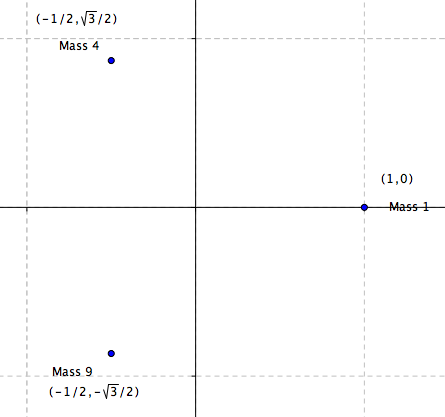
Just so we can compare solutions, let’s put our masses on the cartesian plane as below:

As you can tell, I placed the three points on the unit circle.

I don’t want to give much away, so I’m just going to leave you to it. Throw your thoughts in the comments below. If you’re dying for the answer, I’ve hidden what I got on this site somewhere in some not-hard-to-find spot.

If you get stuck, look after the jump for some encouragement.

Just a note: I don’t know if I got the right answer… I think I did, when checking it, but I’m not totally sure. I got tired of working it. That’s why I wanted to throw this up there to see if anyone could corroborate, and also to see your approaches!

(more…)

Circles, circles everywhere

So we’re off for Thanksgiving today (phew!) and after a few really great days, this two-day week was pretty much a bummer. The one fun mathematical thing I’ve worked on is a problem involving geometry. Ew, I know. But I got really into it, and it got me thinking of about a million other extensions, questions, methods of attack, etc. I was thinking in so many different ways — about symmetry and about limiting and degenerate cases and about angles and such.

(1) You have two circles, radius 3 and radius 5, tangent to each other. You want to draw a third circle tangent to the given two circles. In fact, you realize there are an infinite number of these circles. So the first question is: what is the locus of all points which is comprised of the centers of these infinite circles?

If you want a small hint, go after the jump for a picture. (In case it wasn’t clear, we are taking about circles which are externally tangent to each other.)

(2) Generalize the problem to being given two circles with radius a and radius b (instead of radius 3 and radius 5).

(3) Can you find a third circle tangent to the given two circles such that the centers of the three circles forms a right triangle (if possible).

(4) What if we ask a similar question about spheres? If you are given two spheres of radius a and radius b, what is the locus of all points which is comprised of the centers of spheres tangent to the given two spheres?

So if you are bored over your Thanksgiving holiday, you might want to have some fun with this. I’ve solved the first two. I haven’t had time to think about the third yet, though I know the solution won’t be (too) hard. The fourth one? Eh, I anticipate it to be pretty tough. But having solved the first two will definitely help! [update 5 minutes after posting: Eh, nevermind, I think I know the answer to the fourth one… not really hard!]

(more…)

Flowers for Algernon?

A couple o’ days ago, I posted a question about how to come up with a set of parametric equations equivalent to an implicit equation. It seemed to me like the general solution to this broad question would be like differential equations. There would be certain tools you could pull from the toolbox, once you saw what “kind” of equation you were dealing with. There isn’t a one-size-fits-all algorithm for solving differential equations (at least, not that I learned).

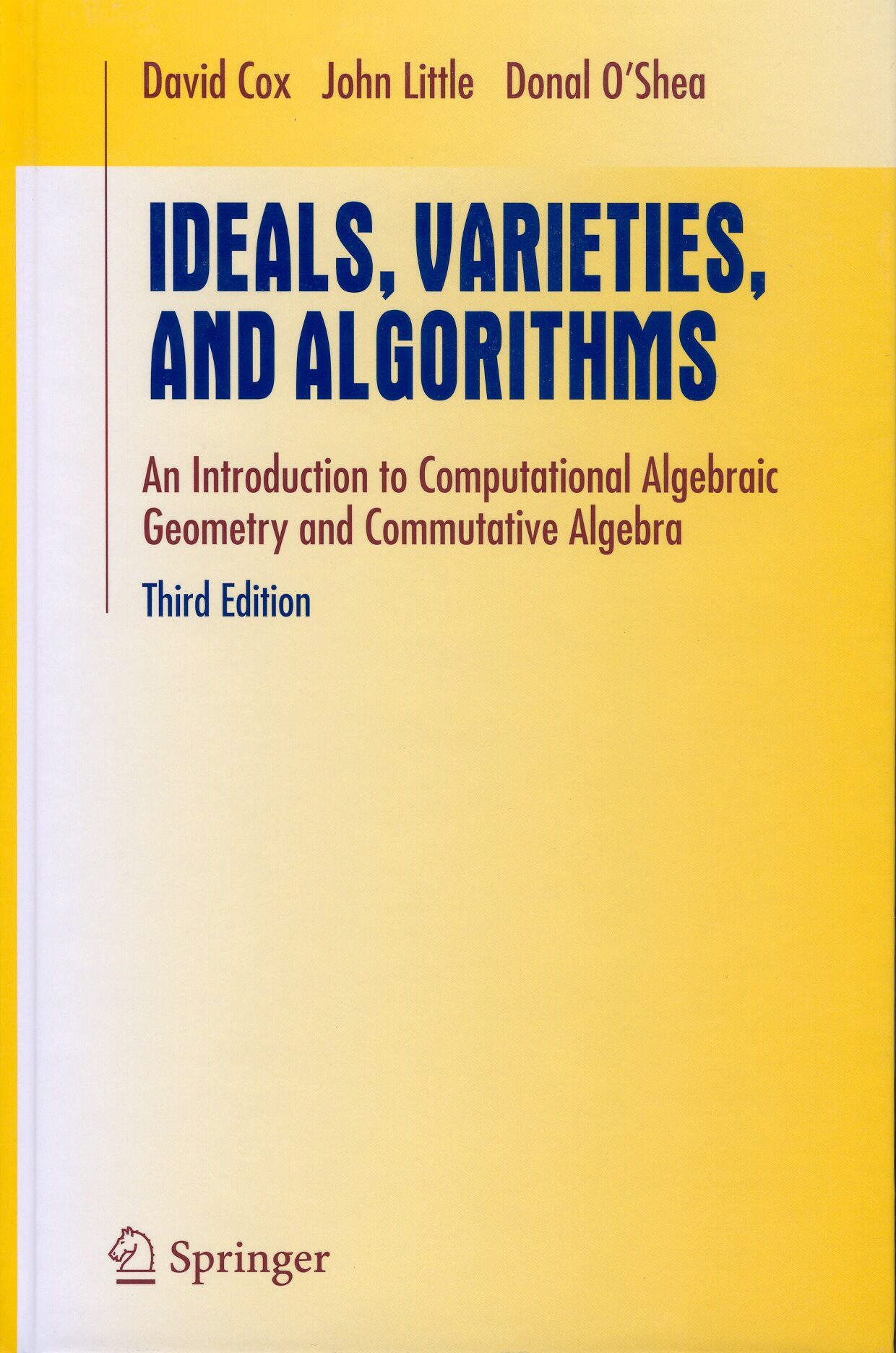
I got to thinking… didn’t I learn how to convert between parametric and implicit equations some time years ago? And, in fact, the answer was: yes. I took a class on algebraic geometry. The book we used (one of my favorite math textbooks when I was an undergrad) was:

IdealsVarietes.jpeg

The way this course was designed (it was officially a “seminar”) was that each day, two students would “teach” a section from the book to the rest of the class. We somehow made it through the whole book. It was a great experience, having to learn a section well enough to teach it the my classmates. The class was — however — a bit of a failure. The desks were in a row, people rarely asked questions, and no one engaged with each other. (Much like most of my college math classes, actually.) For something so student-based, it was strange that I didn’t make a single friend in that class. Plus, there was no “teaching” us how to teach well. Some some of us were great teachers, but most of us sucked. I can’t say what I was, really. I don’t remember. Regardless, I remember thinking: this textbook was incredible because I pretty much had to teach myself the subject. (I have to give major kudos to the instructor because he forced me to learn an entire course by reading a textbook.)

So upon reminiscing about this class and this book, I pulled it down from my bookshelf.

I am so dumb.

I will revise: I am so dumb now.

I look at the pages, and read theorems like Theorem 9 on page 241

“Two affine varieties V \subset k^m and W \subset k^n are isomorphic if and only if there is an isomorphism k[V] \cong k[W] of coordinate rings which is the identity on constant functions.”

and see words like “Nullstellensatz,” and wonder how I ever got to the point where this stuff made sense, and how I got to the point where I see a bunch of gibberish now. Seriously, it’s disturbing. I mean, I don’t expect to be able to pick up a book I learned from years ago and know everything in it, but I do expect that it is in a language I can read.

I’ve figured it out. I am Charlie in Flowers for Algernon.

I don’t know how to feel about the loss of my mathematical mind, besides sad.

Maybe I’ll try teaching myself some math again, to either prove to myself I still have it somewhere in me, or to know that my brain has truly atrophied to a giant anti-intellectual morass.