Good Math Problems

Coriolis Whaa?

So I’m a teacher that usually overprepares. I have my lesson set up beforehand. Very little is set up for “free form.” This is even true for my Multivariable Calculus class of 5 students.

To be fair, though, in that class we do generally take a 20 minute tangent here or there. Like today we were resolving the acceleration vector of a vector valued function into normal and tangental components — and we spent 15 minutes deriving them because I just decided we should. Spur of the moment thing. Or a few weeks ago, I gave my student 50 minutes to come up with how to convert between rectangular, cylindrical, and spherical coordinates, with no help. But generally, the lessons are carefully planned out. Here’s an example of my introduction to triple integrals (which we do way later in the year) so you can get a sense:

slideshare id=1597835&doc=mvcalculustripleintegrals-090617102556-phpapp01

A few days ago, we had gone over the homework and somehow got on the topic of us being on the earth. I honestly can’t remember what prompted it. But we started talking about the force of gravity, which we feel because the earth is so massive. Then I had an insight — a direction we could take the conversation.

We are also spinning: “Does that change anything?”

I stopped class. I paused for 15 seconds, told the students to hush while I considered whether to go down this route. I felt this pang of deviating from my preplanned lesson. We were going to be behind. Do I really want to possibly come to a dead end?

I almost pushed it off. I was going to “leave it as an exercise to the reader” — tell my students they could think about it independently. But just as I was about to brush it off, I thought: WTFrak. Tangents are more interesting and more memorable, when the kids are interested in them.

My kids seemed interested.

So I threw away the lesson I had planned completely, and we went off the cuff, without a known destination in sight.

So back to the spinning earth. I didn’t know. I hadn’t thought about that kinda obvious fact before — we’re spinning, so that should have some consequences

We learned in our previous class that if something is spinning at a constant velocity in a circular motion, it must have an acceleration pointing inward to the center of the circle. So since we are spinning, once around our latitude every day, we must also feel a force pulling us to the center of the circle.

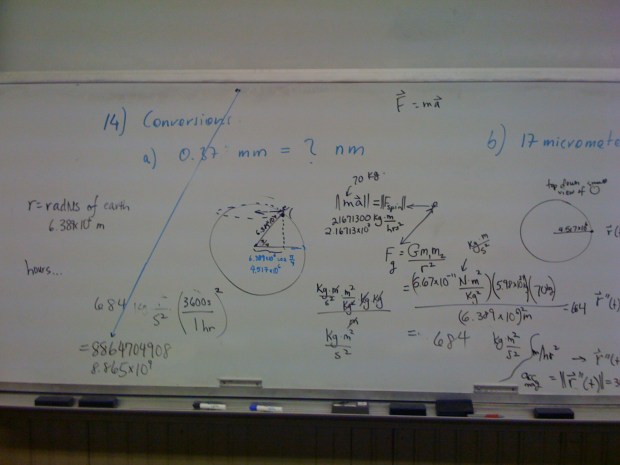
If we model the earth as a sphere, not tilted, and put us at an angle 45 degrees from the equator… we feel a force pulling us to the center of the earth (from gravity), and also a force pulling us directly inwards (centripetal – from rotating) :

But I don’t feel that centripetal force. I jump up, I come down. I don’t feel like I’m being pulled in any other direction.

So we decided to calculate the magnitude of the two forces, and figure out what’s going on.
Awesome.

I left giddy. We figured that the centripetal force was about 1/400 the force of gravity. Afterwards, I did a few more calculations, and realized that actually some of this centripetal force will be in the direction of gravity, so it will feel even less powerful.

I’m leaving for a wedding tomorrow, so I’m having my kids do a formal writeup of what they found. I can’t wait to see it. I am going to show it to their AP Physics teacher.

(As an aside,  I think I’ve found the physics term for what we discovered: the Coriolis force. If anyone knows anything about it, or any good resources on it, let me know!)

Where do I go from here?

Today in one of my two calculus classes today, we got on the topic of 0.\overline{9}.

I think it came up when we were talking about how to approximate the instantaneous rate of change in a problem: we had a function v=20\sqrt{T}, and we wanted to estimate the instantaneous rate of change when T=300.

So a student said let’s pick another point, such as T=299.99. And we found an approximate instantaneous rate of change. Of course I asked “how could I get this answer more precise?” and someone said “add more 9s!”

So we realized we could pick a closer point, such as T=299.9999999.

Of course, then we had some precocious youngster say: “why not get it super duper exact and plug in T=299.\overline{9}?”

Ah hah. Many of them thought that 299.\overline{9} was SUPER close to, but definitely not equal to, 300.

I went through the whole standard argument, which usually convinces most kids:

Let x=299.\overline{9}.  Then 10x=2999.\overline{9}.

So 10x-x=2700. Which means 9x=2700. Which means x=300.

I thought I had them. One student said I was breaking her worldview.

Ha.

But then, THEN, they asked me an awesome question.

One said, and the others jeered: “Isn’t 299.\overline{9} kinda breaking the rules of what you’ve been saying. How infinity is a concept? How this decimal goes on forever? And you said we couldn’t mix concepts with numbers. We can’t write 6(\infty) or \infty+6 because we’re mixing concepts and numbers. So  why can we talk about a number with a decimal that goes on FOREVER? Aren’t we mixing concepts and numbers? Isn’t this thing totally nonsensical?”

Okay, okay, they got me there. And they’re thinking deeply. And they’re getting me to think deeply.

So then I said: “okay, you have a point. So let’s see if we can mathematize this in a way that works with our understanding of things.” So I made a list:

299.9=299+\frac{9}{10}.

299.99=299+\frac{9}{10}+\frac{9}{100}

299.999=299+\frac{9}{10}+\frac{9}{100}+\frac{9}{1000}

so

299.\overline{9}=299+\sum_{N=1}^{\infty} \frac{9}{10^N}

But then I noticed we are still mixing infinity (as a concept) with these numbers because we’re adding an infinite number of them… so then below it I wrote:

299.\overline{9}=299+\mathop{\lim}\limits_{M \to \infty}\sum_{N=1}^{M} \frac{9}{10^N}

Now we’ve written this decimal as what it truly is: a limit as the number of terms gets large without bound. And the limit has a definite value — the sum is getting closer and closer to 1, as close as we want to 1, infinitesimally close to 1, so we can conclude the limit of the sum is 1. So we can conclude that this sum is 300.

And then, sadly, I moved on.

The kids were interested in this conversation, and I think it could get at the heart of what we’re doing with limits (and then relating it to derivatives), and how infinity is a concept (for us) and not a number. But I don’t know what to do from here, where to go from here.

I didn’t convince everyone, and I don’t want to go too far afield with this unless someone out there can suggest a good idea. I mean, this idea of the limit, two things infinitesimally close together, is powerful [1]. So is there a way to extend this discussion meaningfully? Philosophically? Anyone have any good activities out there, any good worksheets out there, any good readings out there, any good videos out there? I’m not even sure what sort of end goal I have. Just something that acknowledges the weirdness of repeating decimals, relating them to limits, and the concept of infinity…

For context for the class, this is the non-AP calculus class, where my kids are at very different levels of understanding.

[1] From my historical understanding, both Leibniz and Newton (and their followers) were still plagued with the idea that you would be kinda-ish dividing by zero when calculating the derivative, because they didn’t have the concept of limits in their formulation of calculus. This division by zero was unsettling for a number of contemporaries. And it wasn’t until Cauchy came along with his limit concept that he was able to give derivatives a solid philosophical foundation to rest upon.

Hyperbolic Paraboloid Inspiration

Inspired by a link from here, I just sent my multivariable calculus kids an email.

***

Hi all,

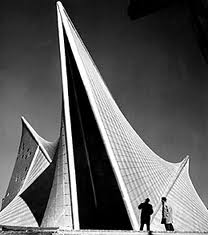
I ran across something so neat I wanted to share it with you immediatamente! Google the “Philips Pavilion” — either in regular Google or Google Images. A stunning building.

Also, a mathematical building. HELLO HYPERBOLIC PARABOLOID!

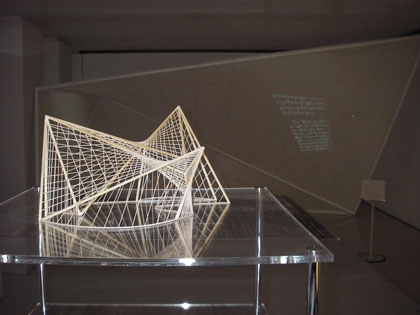
I love this model that someone, somewhere built. I mean, it’s simple enough that one of you could build it. And the best part is… You can talk about the math and PROVE that the mesh forms a hyperbolic paraboloid. Anyway, and idea for a final project.

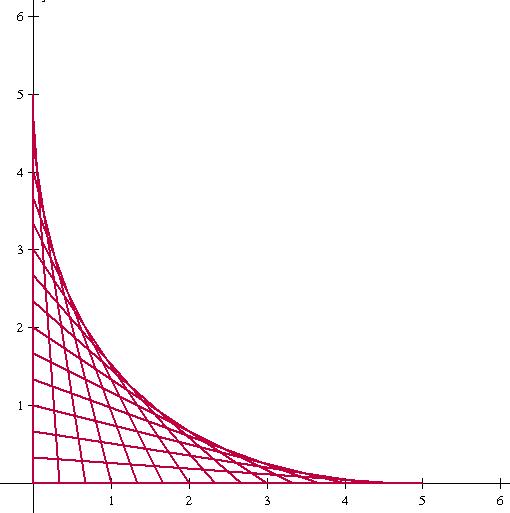
Last year I worked with Ms. TEACHER on a simpler problem — given this set of lines, what curve does this trace out:

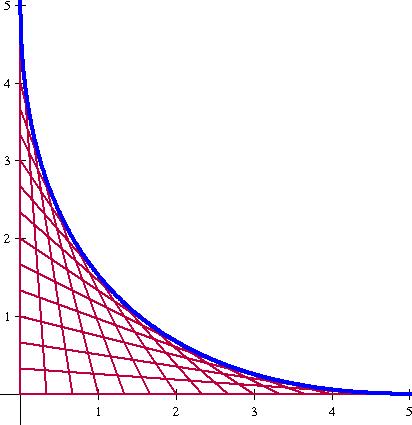
In other words, what’s the equation of the blue line:

(In case you cared, we got y=\frac{(\sqrt{5x}-5)^2}{5} using some nice calculus.)

In any case, I see this as the 3D extension to that problem.

So keep it in mind for your final project.

Best,
Mr. Shah

CalcDave you’re the best

CalcDave posted some awesome questions to ask calculus students — to get them think of the very large and the very small… and I made a worksheet out of it. For posterity, I wanted to save some of the responses.

The least probable (but still possible) event that you can think of

  • Going skydiving with the president
  • That I will drop out of high school the day before my graduation
  • When I call ‘stop!’ my watch reads 12:00pm and 0.0000000001 seconds
  • Mr. Shah becoming a rock star in a band called “Pain in my asymptote”
  • A monkey typing a Shakespeare play on a typewriter
  • The Boston Red Sox winning the American League East
  • All the people in the world dying at one time
  • Winning the lottery
  • Pauly D not having a date and Snookie beating Jwoww in a fight
  • The Situation never having STDs
  • A 7.8 (richter scale) earthquake in NYC

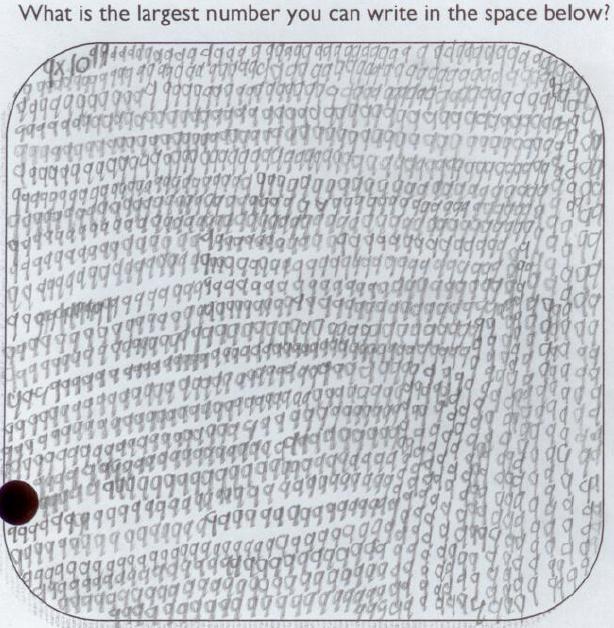
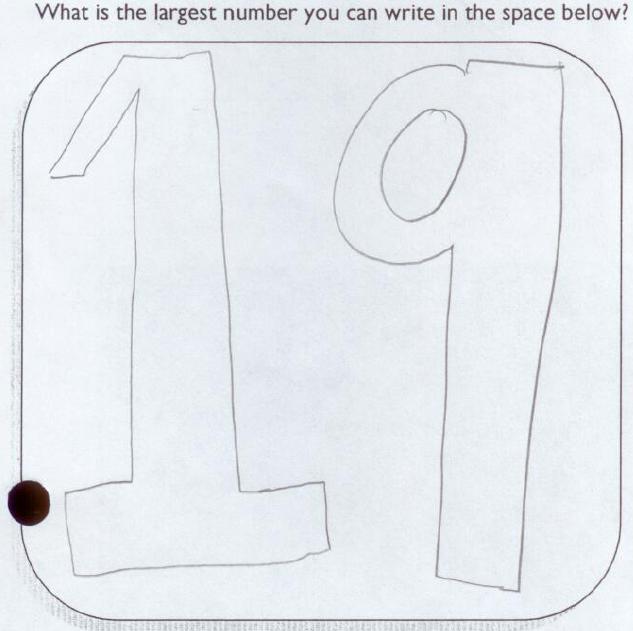
Largest number


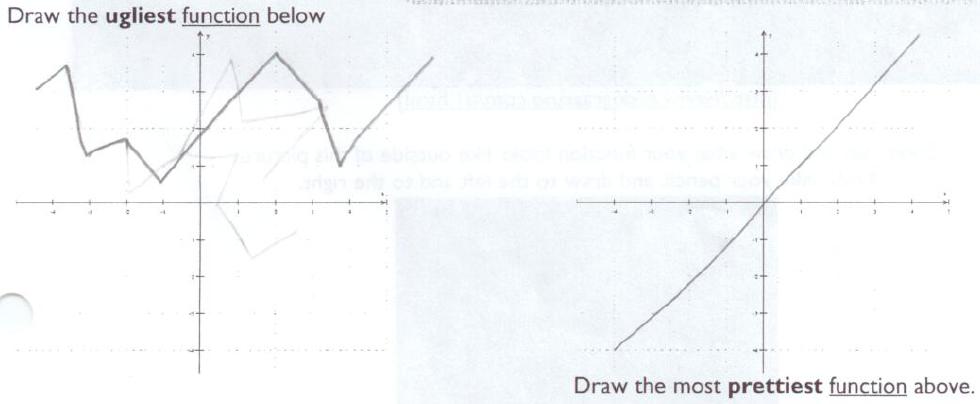
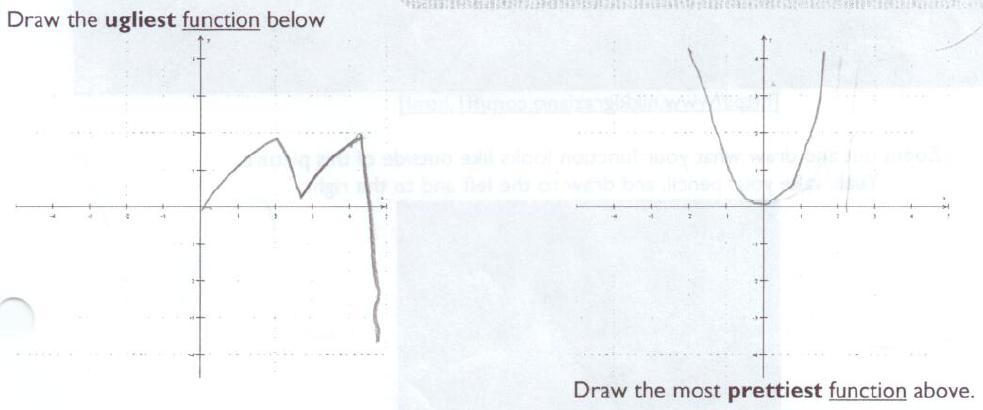
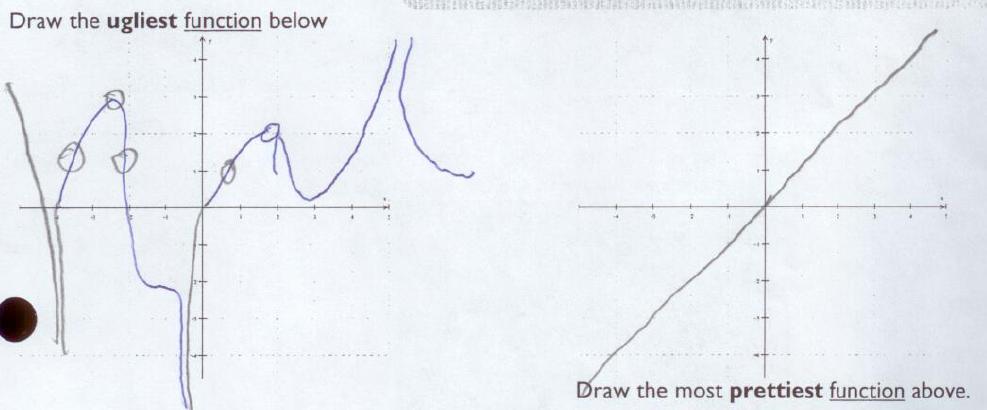
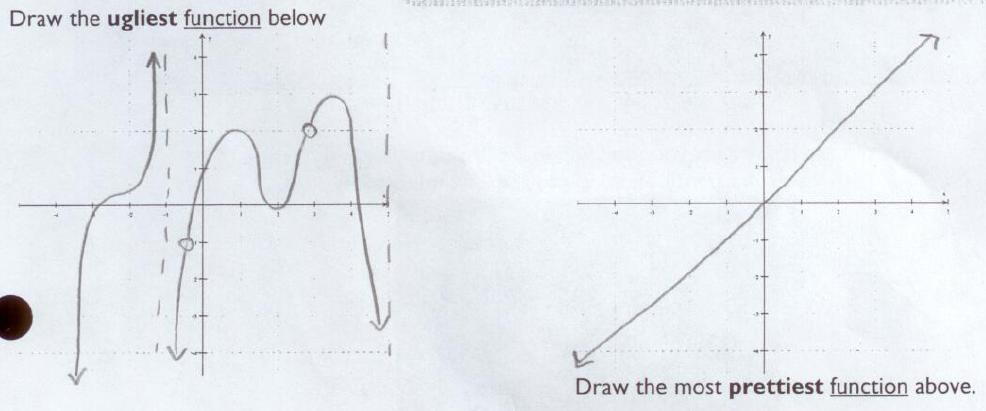
Draw the ugliest and prettiest functions

I asked the last question about pretty/ugly functions, because I assumed that most kids would draw continuous everywhere and differentiable everywhere functions. And for the ugly ones, those would be violated. We’d have asymptotes, holes, and non-differentiable points. My assumption was realized. So we’re going to have a talk about the aesthetics of math, and coming up with mathematical descriptions for “beautiful functions.” I want them to think about continuity and differentiability, without knowing the terms explicitly.

Now it’s going to be great. Whenever we start talking about infinity or infinitely small, we’ll have some juicy stuff to dig into — stuff they’ve mulled over. Even today, I was talking about watching a video of someone diving and pausing it. And then going to the next frame — and infinitesimally small amount of time afterwards.

We also zoomed in on a point on a graph a huge number of times. An almost infinite amount of time.

And the thing on the screen turned to look closer and closer and closer and closer to a straight line. But it never became a perfect line. Every point on the screen, as you zoom in, gets infinitely close to lying on a straight line. But it won’t ever be a straight line.

So great conversations. We’ll expand them as we continue. Especially how every (continuous) curve is an infinite number of infinitely small line segments joined together.

Riding a Flying Magical Unicorn

In multivariable calculus today, we were talking about the scalar triple product. It blows my mind that if you have three vectors:

\vec{a},\vec{b},\vec{c}, then you can show that the volume of the parallelepiped defined by them will be:

\vec{a}\bullet(\vec{b}\times\vec{c}). And that if you expand this out, you get:

\mathbf{a}\cdot(\mathbf{b}\times \mathbf{c}) = \det \begin{bmatrix} a_1 & a_2 & a_3 \\ b_1 & b_2 & b_3 \\ c_1 & c_2 & c_3 \\ \end{bmatrix}.

I mean, it makes sense that it’s symmetric in terms of \vec{a},\vec{b},\text{ and }\vec{c} — so that no one vector is privileged over another.  But it still seems magical. I mean, even when I know that the determinant of a 2 \times 2 matrix gives you the area of a parallelogram, it still seems so special that the determinant of a 3 \times 3 matrix can give you the volume of a parallelepiped.
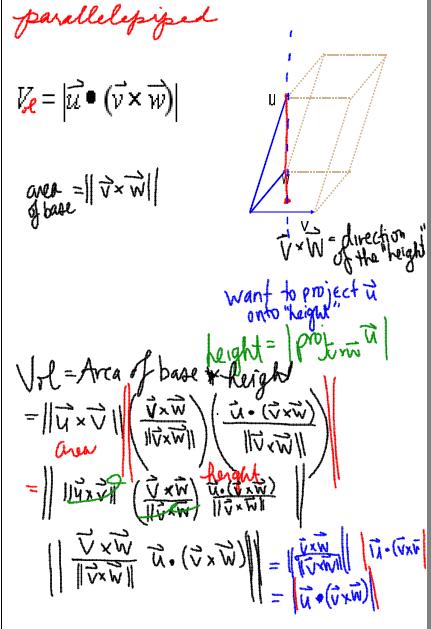
So we worked on proving that fact, with what we know about vectors.

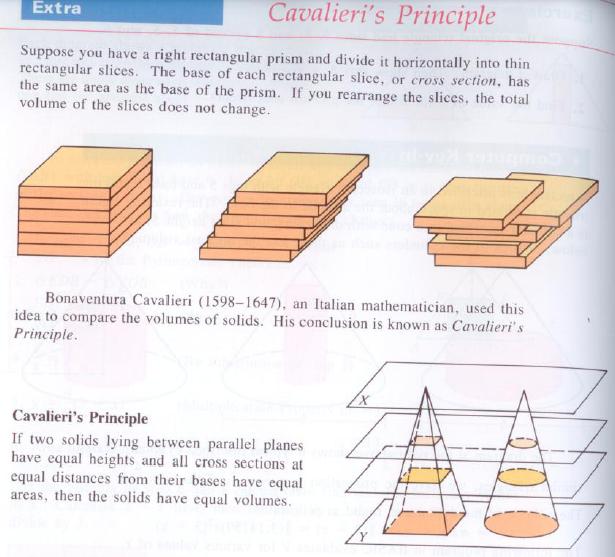
There are two hard parts to this proof. One is understanding that the volume of the parallelepiped is the same as the area of the base times the height. (And teasing out what the “height” actually meant.) At this point, I whipped out Cavalieri’s Principle.

It was in this discussion that one of my kids said the most awesome thing. When talking about Cavalieri’s Principle, he said: it’s like if you had 10 reams of paper all stacked up to make a cube. That has a certain volume. Then you push the stack so it leans — maybe so it’s a little curved. What’s the volume of the new stack of paper? The same.

So we understood what the “height” of the parallelepiped actually referred to.

The very last question: how do we find that? And in fact, my kids actually figured that part out without any help. They noticed it involved the projection of one vector onto another.

The rest? Just algebra.

It was lovely. And a different student exclaimed: “You should go around to the various precalculus classes, sharing that what you learn there actually will show up later in life!” (He was referring to vectors, determinants, and even parametric equations.)

Now to the title of this post. I was then transitioning to talking about straight lines in 3D. And I wanted to highlight that you just need a point and a vector to uniquely determine a line in 3D. Somehow, I got it in my head that I should explain it in metaphor. So…

I said that — suppose you are riding a horse. I mean unicorn. That can fly. But only in the direction of it’s horn. And you are told to go to a particular planet and wait there. At the starting gun, the magic, flying unicorn takes off, flying in the direction of its horn.

I am 99% sure this didn’t help kids “get” it. It was pretty obvious to them that a point and a direction (vector) uniquely determine a line. But I really enjoyed talking about the flying unicorn. I liked it enough that I think the flying unicorn may be our mascot for the year.

Plus, I like sparkles. And unicorns have sparkles coming out the…

Intermediate Value Theorem

I wish we could do “baby posts” that were formatted different. Little asides that don’t warrant full posts.  Like this one.

Anyway, today, the AP Calculus BC teacher (and all around awesome person) asked me if I had any good ways to introduce the intermediate value theorem.

That’s the most boring theorem ever. Saying that if you have a continuous function f(x) on [a,b], and u is between f(a) and f(b), then there exists a c in [a,b] such that f(c)=u.

In other words, if you have a continuous curve that goes from point (x_1,y_1) to (x_2,y_2), then at some point along the curve’s journey from the first point to the second point, it’s going to pass through every y value between y_1 and y_2.

If you still don’t see it, just draw two points on a coordinate plane and try to connect them with a continuous function. You’ll see it then.

Anyway, it’s boring. So she was right to ask for ideas. I searched and found none.

So I suggested a warm-up for the class — before they know anything about this theorem. I asked her to throw this up on the board:

INDIVIDUAL CHALLENGE: I am so wise. I have drawn a function f(x) on [1,5], with 10 between f(1) and f(5), such that then there does not exist a c on [1,5] such that f(c)=10. Are you as clever?

And then I wrapped up some Jolly Ranchers for her to give to the first student who could do it.

She said it went really well. And it took a few minutes (read that: minutes) before the first student got it. Perfect warm-up.

The reason I really liked this idea, and wanted to share it, is because: (a) kids were motivated by it, (b) kids were forced to grapple with complex mathematical language, (c) kids got to play around (by drawing different graphs — a puzzle-y thing), and (d) kids discovered the Intermediate Value Theorem on their own.

Let’s think about the last point. The first 5 or so graphs students would draw would not satisfy the challenge. And they’d see the problem: that the graphs they were drawing were continuous. So the only way to satisfy the challenge would be to make their function discontinuous. So not only would they learn the IVT, but they’d really remember the restriction: you need a continuous function for the IVT to hold.

I’m sure many of you probably introduce the IVT this way. It’s certainly not new or revolutionary. But I am now excited to when I get to teach the IVT.

PS. I also am really impressed by this consequence (click link to see proof). The consequence of total boringness happens not to be boring at all!:

The theorem implies that on any great circle around the world, the temperature, pressure, elevation, carbon dioxide concentration, or any other similar quantity which varies continuously, there will always exist two antipodal points that share the same value for that variable.

Two Worksheets

ONE

On Thursday, I’m going to be introducing absolute value inequalities. Last year I used the picture below as motivation.

I then tried to work backwards to show kids absolute value inequalities. It wasn’t too hot a success. Certainly the “application” wasn’t a motivator, and working backwards just confused things.

This year, I’ve decided to start with a warm up. Without them knowing anything, I’m going to ask them to do this for the first 7 minutes of class with their partners.

I already can see the great questioning and discussion that this simple worksheet will generate between partners. And then, when we come together: WHAM! powerful! It’s a simple thing, but Oh! So! Delicious!

After that, after we see some patterns and make some conclusions… then, then I can throw up the picture of the bag, and talk about it meaningfully. And have kids work backwards from their own conclusions to finding a way to express that region mathematically, using absolute value inequalities.

TWO

I’m introducing limits tomorrow. I pretty much have carte blanche in what I do. Last year what I did was sad. Like SAD. Like: “Here’s what a limit is. Get it?” This year, I’m stealing pretty much from CalcDave wholesale. Here’s his calculus questionairre. And here’s what I made.

Pretty much the same thing. Then I’d like to somehow have them start thinking about how to get velocity from a position versus time graph. Haven’t quite figured that out yet. Either that, or Zeno.