Untagged/Other

The AMC is done! PHEW!

Today was the AMC 10/12 B contest. Another teacher and I in the department organized it … and we got 123 kids to take it!


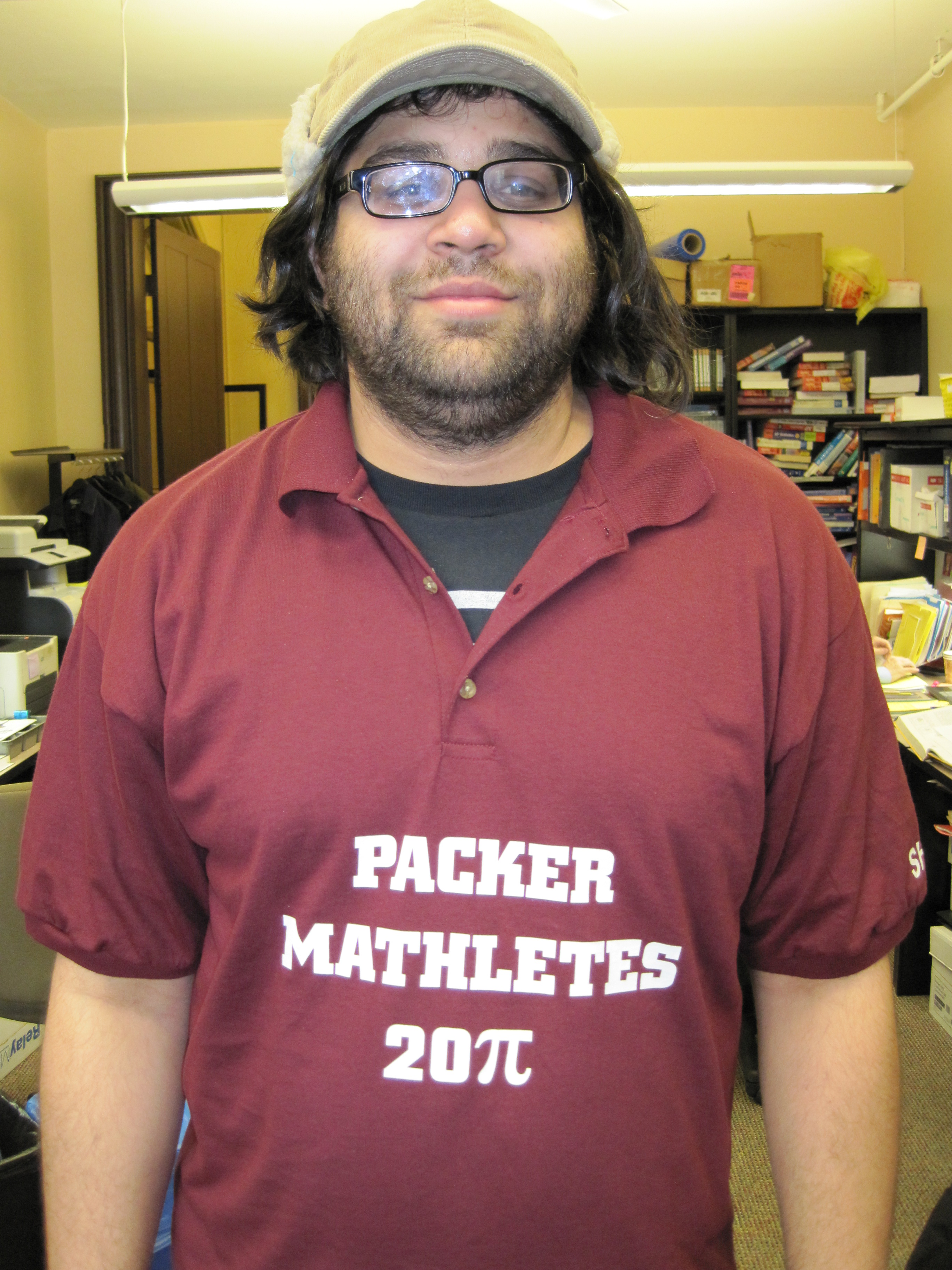
This is a t-shirt that the math club leaders designed and ordered. The math clubbers all wore them today! SOLIDARITY!

If you recall, my school isn’t really a math contest-y school. I have been working slowly behind the scenes to make a culture change. I figure culture change of this level takes at least 3 years before it takes effect. I brought in the New York Math League two years ago. That year I also did a ton of work to push for kids to take the AMC 10/12. And from a dozen kids two years ago, we went up to 116 kids last year. And this year we had 123 kids. (It would have been higher, but there were mandatory sports and musical practices.)

More than anything, I love the fact that 123 kids thought about math for 75 minutes after school. My favorite moment from today was watching kids discuss problems after the contest ended. I mean: if they did that, then they cared.

Going through this AMC push a second year in a row also reminds me how hard it is to organize something well. I’d say that I spent between 10 and 20 hours making sure that this one contest was successful.

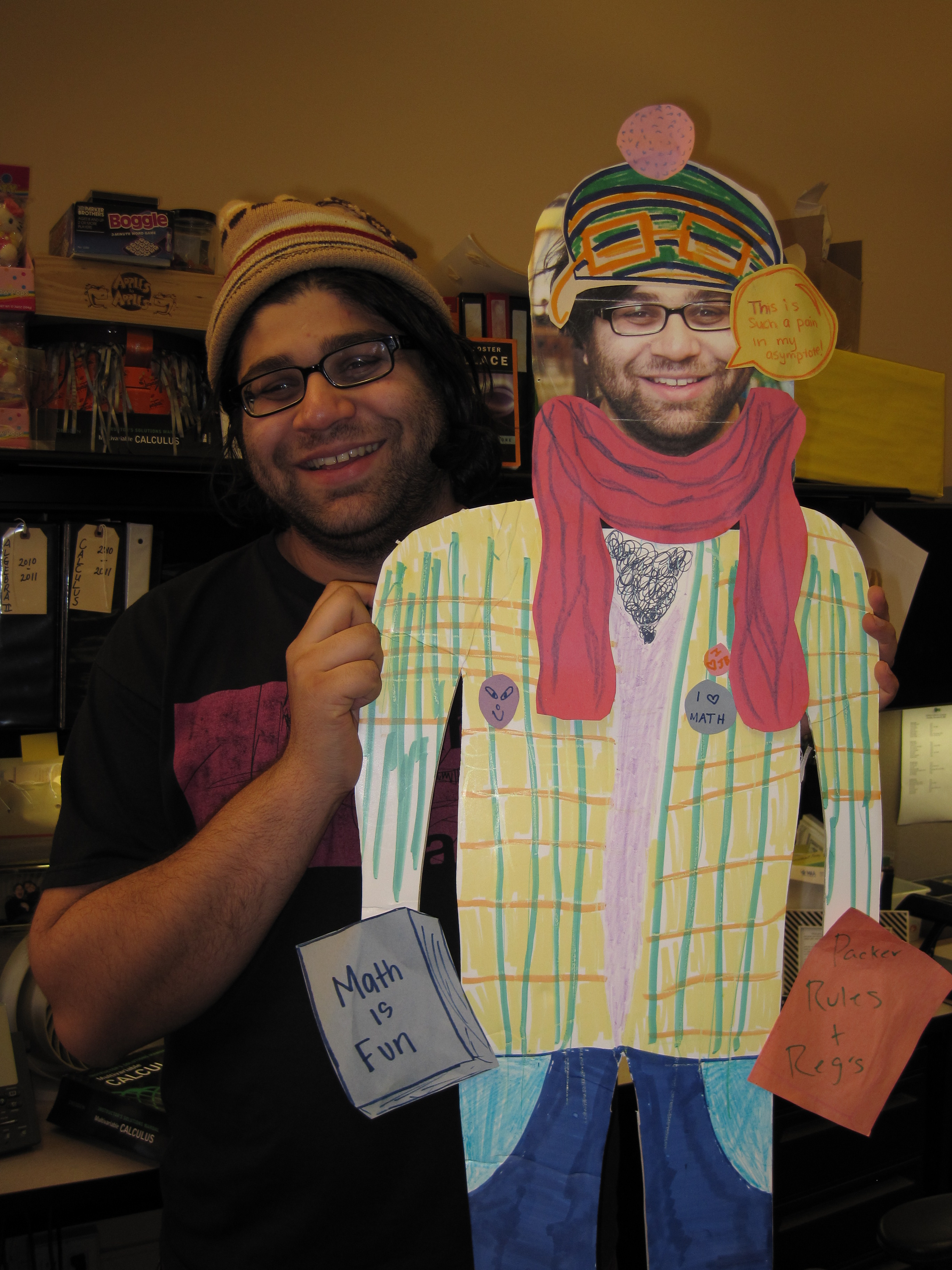
Flat ME!

Reminded by Mr. Knauss that I have one too, this is my equivalent of a woodshopped sign.

It’s a “flat stanley” made by a senior homeroom for a competition they have. (Each homeroom makes a different flat stanley and takes it around New York City taking pictures of it in various locations.)

Books from 2010

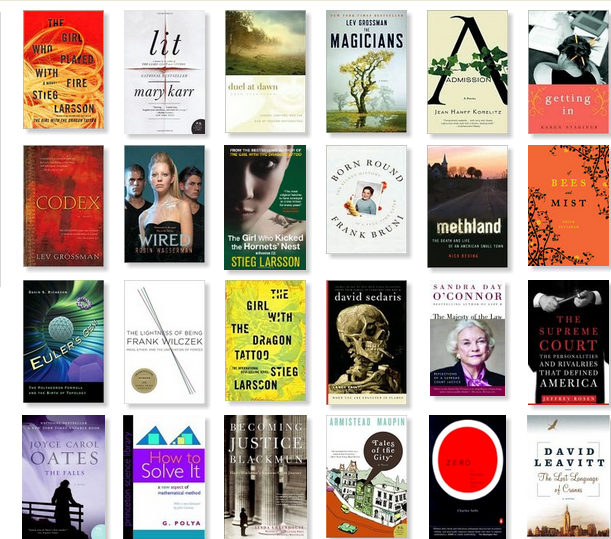
My dear friend Robin posted some of the books she read in 2010. (The short time she needs to get through a book is incredible. I’ve known her to finish dense academic tomes in the time it takes me to read the first hundred pages.) Well, her list reminded me of something. One thing I made a concerted effort to do this year was to read more. You see, after my time in grad school, where we were reading 3-4 books a week for classes, I lost any interest in reading. And for someone who, growing up, saw the library as a second home, this sucked.

Well, time heals all wounds — even the ones perpetrated by graduate school. And this year, my love of reading returned in full form. I’m not a fast reader, but I was proud of the number of books I went through this year. Like her, I’m going to post them. I’m pretty sure I read these books this year, but one or two might have been from 2009. (The site I used to track my reading is nicht so gut.) They aren’t in any order.

The Girl Who Played With Fire (Stieg Larsson), Lit (Mary Karr), Duel at Dawn (Amir Alexander), The Magicians (Lev Grossman), Admission (Jean Koreliz), Getting In (Karen Stabiner), Codex (Lev Grossman), Wired (Robin Wasserman), The Girl Who Kicked the Hornets’ Nest (Stieg Larsson), Born Round (Frank Bruni), Methland (Nick Reding), Of Bees and Mist (Erick Setiawan), Euler’s Gem (David Richeson), Lightness of Being (Frank Wilczek), The Girl With the Dragon Tattoo (Stieg Larsson), When You Are Engulfed in Flames (David Sedaris), The Majesty of the Law (Sandra Day O’Connor), The Supreme Court (Jeffrey Rosen), The Falls (Joyce Carol Oates), How To Solve It (George Polya), Becoming Justice Blackmun (Linda Greenhouse), Tales of the City (Armistead Maupin), Zero (Charles Seife), The Lost Language of Cranes (David Leavitt), The Perks of Being a Wallflower (Stephen Chbosky), The Brethren (Bob Woodward), e (Eli Maor), Dead Until Dark (Charlaine Harris)

I also purchased a bunch of books which I haven’t read yet. So here’s to hoping I can continue the trend in 2011.


Singing the Praises of Kate Nowak

See Kate.

See Kate blog.

I have been given the great honor of writing our dear Ms. Nowak a letter of recommendation. One thing I wanted to do was talk about how Ms. Nowak is core node in our little learning community here. She writes, and tweets, and responds to emails. Indeed, she is our fairy blogmother.

I was hoping to enlist… I mean… coax a few of you to write a few sentences about Kate. Specifically how Kate has impacted you as a teacher — in a large way or a small way. Whether it be that she provided you with resources, great advice, gotten you started blogging, talked you through a dark time, showed you games that work splendiferously in your classroom, gave you the secret to perfect skin and eternal youth, kept you interested and excited in teaching, whatever. I’d love to include these in my letter, so that we may sing Her praises as She deserves them to be sung.

So throw them in the comments. This will probably be a temporary post, taken down after I have completed the letter of recommendation. So throw them in the comments soon! (HURRY HURRY HURRY!)

New Resume, New Year

I am applying for two programs this summer, the Park City Math Institute (again) and the Klingenstein Summer Institute. For these applications, one of the things I needed to do was revamp my resume. When I first applied for teaching jobs a few years ago, my resume was mainly academic stuff (e.g. college and grad school stuff). I hadn’t much experience (a couple years as a Teaching Assistant in grad school and my teaching practicum for certification in college).

Now I’m about to hit my four year mark of teaching (at the end of this year). And having things like “organized a conference on the interdisciplinary connections between history, sociology, philosophy, and science” doesn’t actually have much relevance to what I do. Cutting things out, and re-ordering and re-organizing everything, was a strange process for me. It was like I was saying hey you, yeah you, that part of your life is over! And it is. And I’ve known it for a while. My decimating my resume was just another instantiation of that.

Doing it also reminds me that I’ve actually accomplished a lot in three and a half years. It strange to think how far I’ve come, not only as a teacher, but as a member of my school’s community. I mean: hello, as I type this, I’m wearing my school’s logo-ed sweatpants. I never bothered to get a pair of sweatpants (or any logo-ed item) from UCLA when I was there. And I spent more time in LA than I have currently here. That says something.

Anyway, without further ado, my new resume:

Please, no “wow, you’re great” or “you have major mental issues” comments. You can make wording or formatting or font or design suggestions. In fact, they would be appreciated. Also if you know of any stunning teacher resumes (in terms of look/design) online, throw them in the comments if you can!

And yes, I know, I know, resumes suck and online portfolios rock. Which is why I have one which I semi-regularly update. It isn’t a “reflective portfolio” showcasing growth or anything like that. (That’s what this blog is for.) It’s just to remind me of the good stuff I’ve done.

Thanksgiving

Thanksgiving has passed, and I have been lucky enough to spend it with my sister in Massachusetts. On the way to Thanksgiving dinner, I whined “I hope this isn’t one of those places where everyone has to go around the table and say things they’re grateful for.” My sister grimmaced and said that she wouldn’t be surprised if it happened — she and her friends are those kind of folk. She then told me that I was a pretty unemotional person which explains why I kinda don’t like things like that.

I agree — halfway. I can be emotional, but I’m not one of those people who enjoys being mushy for tradition, or because it’s expected. I tend to find it grating when people say “I love you” or “you’re my best friend” to me a lot. If you have to say it that much, maybe there’s something about you that doesn’t mean it? Or maybe I’m simply standoffish.  [1]

That being said, I feel like I want to say some things I’m grateful for, probably precisely because I haven’t been asked to do it in some awkward social way. These are going to be teacher-based things.

1. First and foremost, I am grateful for my students. They are each coming to me from different places, and I’m sure they all have very different feelings about me, about math class, and about math. That’s okay, because that reminds me constantly that these math students are individuals. And just as I try to teach them about independence and responsibility (in addition to curricular content), they challenge me — by each being so different, with different strengths and weaknessess — to be a better teacher. I’m especially grateful for my Calculus students, who have given me their patience and faith as I’ve thrown them a curveball in their senior year: a new way of being assessed and graded, and to learn about their own learning strengths and weaknesses.

2. My colleagues — both IRL and not IRL. My “in real life” colleagues have become some of my closest friends, because they’ve seen me and supported me at my lowest lows. They’ve gladly provided help when I needed, taking over classes on days I had to be absent or making emergency photocopies for me when time got away from me. They let me vent when I need to. And they let me help them, which sounds like a weird thing to be thankful for. But I feel satisfaction and joy when I can help one of them out. My “not in real life” colleagues I thank for keeping me intellectually stimulated. Like the cosmic background radiation, you guys keep whirring away in the background of my mind – powerful and ever-reaching, yet whose effects are almost imperceptible until you start looking a little bit closer. Then you’d see the profound secondary effects that you have on everything I do.

3. My school. It’s awesome. There are times I get frustrated with this thing or that thing. But I like to see the big picture, and the big picture is this: I like being at school. Yes, it’s a job. But for me, it’s a job I love going to. I might not always agree with a policy, or think that we’re not going in the totally correct direction, or that this or that situation wasn’t handled well. That’s going to be true anywhere. But what’s nice is that I can speak up about my thoughts if I feel strongly about them, and I feel like I will be heard.

4. Things. The photocopy machine. So many of you have such horror stories with your inability to photocopy things that I have stopped taking our working machines for granted. File folders & binder clips. They. Complete. Me. Free coffee. For obvious reasons.

[1] Thankfully (haha), no one suggested that we state things we were thankful for, and by the end of the night, I was fast one-night friends with everyone at the dinner. They totes rocked.

Writing College Recommendations

I actually spend a long time crafting college recommendations. I start each one from scratch and I don’t cut and paste. Generally, the way I start the process is I think back about the student, and come up with a few adjectives that sort of define my mental picture of that student. I jot down any specific memories that might be special, interesting, or funny. (With my horrible memory, though, these are few and far between.) I then look through my gradebook and see how the student performed, and any improving trends or points where the student shined. Finally, I’ll look through the narrative comments that I write twice a year on the student.

There is one more thing, and it’s one of the most important things I do, when I write recommendations. I ask students to write a recommendation for themselves. I give them some guidelines. I’m paraphrasing, but it goes like this: “Don’t be modest. Do be specific. Do talk about your feelings about mathematics (and if they’ve evolved). Do talk about if you like math (and if you do, what is is about math that you like). Do tell me if you have a distinct or favorite memory from class. Do tell me if you worked outside of class with other students? Do tell me something you’re proud of.” Basically, they know themselves better than I know them. And they know details I may never know. Like how — for example — a friend might have called for math help at 10pm at night, and this kid spent an hour talking math on the phone.

(Some teachers make a form with narrative questions for students to fill out. I might switch to doing that, although there is something really nice about giving them the onus to determine what they feel is important. Not what I feel is important)

Here’s the three big things that I think are important in a recommendation:

  • The recommendation should be specific, and full of details.
  • The recommendation should  paint a picture of the student — not be generic tripe.
  • The recommendation should be honest– not hyperbolic.

It’s hard, though. Especially for the students who didn’t stand out in class academically. The middle of the pack students. But for those, I don’t lie or slightly puff up the truth. I focus on the character and fortitude of the student when the going got tough.

Some sample paragraphs from recs I’ve written — with names/details changed:

Ex. 1) Historically, most of my students in this class tend to work methodically and systematically, and think inside the box. Stu thinks in a way that I can’t fully understand: incredibly visually and incredibly intuitively. He can “see” things in a way different from the others—and even myself. It is incredibly helpful for Stu in problem solving—he often uses this intuition to make the crucial connection that leads to the solution. In the beginning of the year, Stu found it difficult to express his ideas in words, to translate what was going on in his mind to a clearly written solution. That is a struggle that most of my students go through, never having written a two page solution to a single problem before. However, as he has been asked to write more, his skills in this area have improved greatly. He now knows how to better express his ideas so that they are firmly grounded in the logic of mathematics and so they are understandable to a reader.

Ex. 2) Stu is also one of the most thoughtful, respectful, kind-hearted students I have encountered. When doing group work, he focuses the group on the task at hand and makes sure that everyone is on the same page. When entering the classroom, he always gives an upbeat greeting. He brings lightness and humor to our room. And when leaving, he says “thank you.” Honestly, what student consistently thanks their teacher after class?

Ex. 3) Stu works incredibly well with others in our small class. There is an emphasis on collaboration and working through ideas together. It is a class where students play off each other, help guide each other along, instead of me explaining everything to them. Although Stu almost always has his “a ha” moment before the others, he spends time making sure the others have that moment too. He is a natural leader of the class, propelling us forward without leaving anyone behind. Stu also grapples with new ideas, making sure he mulls them over to get a sense of how they fit into the larger scheme of things. When he asks questions, they usually either anticipate topics we’re about to cover, or drawing connections to topics we’ve previously covered. These questions raise the conceptual component of our class considerably, because they get all of us to think deeply about ideas.

Ex. 4) When I wrote in his first quarter comment that I should photocopy his notebook for my own records, I didn’t just mean that hyperbolically. Taking notes and learning how to do homework are skills that students tend to struggle with in 10th and 11th grade math classes. They aren’t skills that are explicitly taught. I decided that this year, I would spend some time teaching my Algebra II class these skills.

With that in mind, I flipped through my mental rolodex of previous Algebra II students; Stu’s name was the name that popped out at me. His organized and meticulous notes, his step-by-step homework, and his mature approach to my class were exemplars that I knew could help other students. I invited Stu to come to my class this year as a guest lecturer, to talk about the strategies he employed to be successful in Algebra II. He even met with our school’s learning specialist to help him organize his presentation – which was a success. Students really responded to his ideas, and I myself learned a thing or two about how some successful students work. (And, in fact, I did scan in a few pages of his notebook to show students what they should be striving for.)

Ex. 5) I was thrilled when Stu asked me to write a letter of recommendation for her college applications. I had the pleasure of teaching her in Algebra II last year at Packer Collegiate Institute, an independent high school in Brooklyn, New York. In this class, Stu impressed me, not just by her mathematical maturity, but also by the maturity with which she approached school. She is a serious student, and a serious intellect, who – I am paraphrasing her own words slightly – enjoys learning for the sake of learning, because it changes the way she sees the world. It is this attitude, where school is more than just an amalgam of exams but instead countless opportunities to learn new things, draw new connections, and be exposed to as much as possible as often as possible, which makes me certain that Stu will succeed in any institution she attends.

Ex. 6) In short, Stu had changed. Far from the more reserved Stu I had met at the start of the year, the new Stu took more risks in class, and found effective ways for him to learn the material. I don’t see this as simply the transformation of an Algebra II student. I see this as the intellectual maturation of Stu, and the transformation of a young man who has learned that his determination and his hard work can help him realize his awesome potential. He certainly did in Algebra II.