
I just watched this short film (4’56”) with scientists describing different types of magnetic interactions (e.g. on the sun, on Mars, in a regular situation). The filmmaker CGI-ed in visualizations of the various types of magnetic fields that come up. The still above is from the short.
My first reaction: hmmmm, applying this in the classroom somehow? naaaaah.
My second reaction:
It reminded me of working on my dissertation topic in grad school — on the rise of laboratory physics in American universities at the turn of the century. One of the things that happened was that American universities built teaching laboratories for students to actually do experiments in, as part of their undergraduate and graduate training. And building plans had to be quite elaborate because of the sensitive magnetic work that needed to be done — no ferromagnetic materials were allowed in the building of certain sections of the laboratories (research sections). Harvard’s Jefferson Physical Laboratory was one of the first built. And one of my favorite images from my in depth dissertation research was the following [1]:
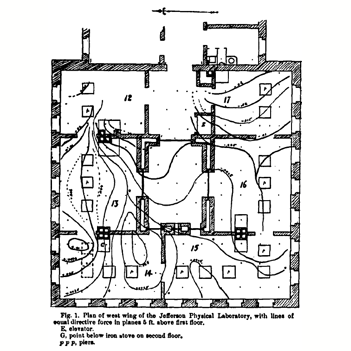
This picture represents part of the JPL and the strength of the magnetic fields within it. Clearly you see why the movie brought back this image to me.
And for those who are interested, my favorite quotation from this era dealing with laboratory teaching was:
The multiplication and enlargement of laboratories depended chiefly upon the growing recognition of the truth that firsthand knowledge is the only real knowledge. The student must see, and not rest satisfied with being told. Translated into a pedagogic law, it reads, ‘To teach science, have a laboratory; to learn a science, go to a laboratory.’ (1884) [2]
I love that an argument had to be made for laboratory teaching (not everyone agreed), and then there were battles over what kind of teaching should happen in the laboratory itself.
Sometimes looking back on this project makes me think: wow, that’s such an interesting dissertation you abandoned.
[1] Picture taken from R.W. Willson, “The magnetic field in the Jefferson Physical Laboratory,” The American journal of science 39 (February 1890): 87-93.
[2] On 174 in “The laboratory in modern science,” Science 3 (15 February 1884): 172-174.
 Continuous Everywhere but Differentiable Nowhere