… so why do I teach it like it is?
My classroom is mainly me standing in front, talking. A typical day goes like this:
Me: Check your home enjoyment answers with the answers on the board. Be sure to correct your work, and talk with your partner if you get something wrong but you don’t know why it’s wrong.
[Hand raised, and I walk over there: Hello child. What’s going on? Oh you want help? Did you ask your partner? No? Oh. Okay. Bye.]
Me: Okay, are there any questions?
[A couple minutes pass when we go over unresolved questions.]
Me: So today we’re going to build off of what we did yesterday…
Then I start teaching with a back and forth: me, student, me, student, me, student. Blarf. (I know, I know, I complain about this a lot, because it’s something I need to really work on. ) I usually introduce a new topic, ask a few questions, work through a sample problem with student input, and then have students work with their partners on a similar “check yo’self before you wreck yo’self” problem. Then we move on. [1]
I’m the authority in the classroom. The kids don’t see each other as authorities. Not really, not in any meaningful way. [2] That’s my fault. I don’t let them be authorities.
A couple weeks ago, in one of my Calculus classes and my only Algebra II class, I was ahead of schedule. So I introduced the material in the same sort of way, but then instead of me talking, us doing a problem, them doing a problem… me talking, us doing a problem, them doing a problem… I streamlined it. I talked and we did a few problems together, and then I let them at it. I give them their homework and let them start tearing through it.
I loved it. I mean, they were doing math. They were having trouble. But because they were in class, and not at home, they turned to their partners and talk. [3] I wasn’t the sole authority when they got stuck. They felt more comfortable talking with each other in this informal situation, instead of talking in The Big Scary Everyone Is Looking At Me back and forth we have when I introduce new material. And what I loved watching is that the kids themselves are seeing each other as authorities.
(They were simply happy that they get to actually spend time in class doing their homework.) (And I was happy they can have less on their plates for when they get home.)
Most of you out there are probably horrified that I’m just latching onto this idea now: give them time to work in class. Trust me. It’s not a new idea for me. I mean, obviously I always try to have my kids working independently in class. But I tell ya, it isn’t easy to do:
1) I suspect that most new teachers feel guilty letting kids work on homework or problems in class. They feel like they need to be “teaching” (which means: lecturing). I know when I first started teaching this was chronic. I would plan my 50 minutes to a T. (Whatever that means.) Even to this day I have remnants of that fear. A week ago, I gave my Calculus kids 20 minutes (out of 50) to work on their homework problems. Part of me still felt like I was doing something wrong. Like I was wasting valuable class time. Like I hadn’t prepared enough. Which wasn’t true. I had planned those 20 minutes. I have to catch myself.
2) More significantly, it’s hard to get through jam-packed curricula and have much class time to work on problems. I mean, let’s say you wanted to teach Absolute Value Inequalities in a single day. (Which, in some years, we have to do.) To get kids to the point they can work the problems, they either need:
a. 50 minutes talking through the concept and building their understanding so that they can conceptually understand the problems and the solutions, or
b. 25 minute lecture on the procedure to solve Absolute Value Inequality problems.
The first plan involves a lot of student thinking and discussion and a little doing. Mainly watching. Then the student will go home and practice problems with the knowledge they’ve gained from class. They’ll be alone at home struggling through if they run into problems. The second plan leads to a good amount of time for students to work out problems. But most wouldn’t know what’s going on — and they would memorize a bunch of rules. However they would get to work out problems in class, so that if they have trouble, they can find out what they’re doing wrong before they go home and struggle.
Clearly I tend to opt for the 1st. I could get through so much more if I dove straight for the method/procedure. But that’s not the way I roll.
I know this setup is a false dichotemy — plan a or plan b. There are probably lots of alternatives that I just haven’t yet seen.
My name is Sam and some days I feel I could be doing infinitely better at my job.
[1] Okay so this isn’t totally true. There are days where we deviate. But I’m illustrating a point here, so I’m going to gloss over nuances.
[2] Getting kids to see each other as authorities in the classroom was one of my goals this year. I feel like it has actually happened to some degree in calculus. My kids are helping the heck out of each other inside and outside of class. And I ask ’em to talk to each other before coming to talk to me.
[3] If they were at home, I’d hope that they use some of the strategies we talked about for when they get stuck. But I know that for many of them, it is wishful thinking. I’m trying to teach my students to be students. To learn how to learn well. But it’s hard and you can’t force it.


 is the same as
  . Or that you can simplify
  into
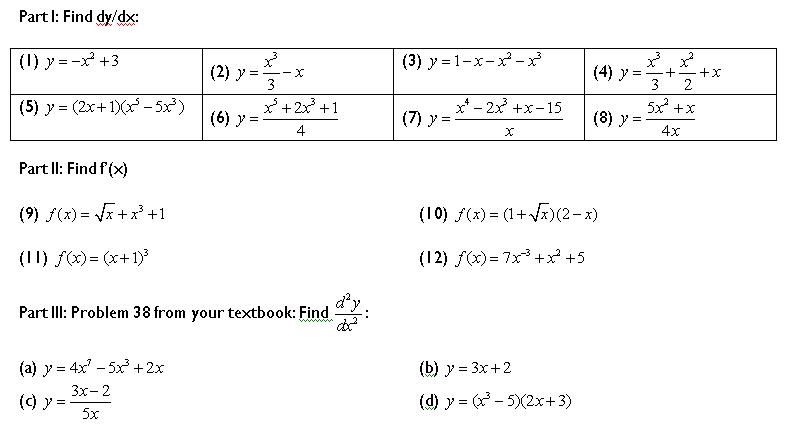
into  . This worksheet is meant to get my kids to see how they can simplify and use the power(ful) rule! As you can see, our class motto is coming through loud and clear: take what you don’t know, and turn it into what you do know.
 Continuous Everywhere but Differentiable Nowhere