Month: June 2011

Video Analysis: Beginnings

For the past week and some, I’ve been at the Klingenstein Summer Institute for Early Career Teachers. We’ve been kept so busy that I haven’t had a lot of time to post, so I am losing insights left and right. Sigh! But I am making it a priority to talk about the reorientation I’m having with regard to math curriculum before I head off to PCMI.

One thing we’re doing today is having others watch videos of us teaching. And it’s terrifying. It was terrifying when I was being videotaped. I don’t know what will happen, how we will structure the conversations (they give us free reign to do what we want with regard to the conversations),

Something that I’ve heard happens with video analysis is that the teacher, before doing it, has one conception of who they are and what they are like in the classroom. They have this impression based on what’s going on in their head. When they watch the video, they suddenly see a very different person, someone they might be unacquainted with. It breaks you down.

That’s what happened when I watched my video last night.

But I’ve held, for about two years now, that I felt that video analysis of teachers is actually going to be the most powerful and next form of serious professional development… So I’m trying to overcome my fear, and so I asked a couple of our mathemablogotwittersphere cabal to watch my video and send me feedback. It’s terrifying. I feel like my blog gives one big false impression of who I am as a teacher (read this), and so it’s scary to think that people who I respect a lot will suddenly think: WTF this guy sucks.

But then I decided: heck if I’m not okay with that, because isn’t that the whole point of me blogging and twittering. I reoriented my thinking to say I own this class (I felt when I finished it was one of my better classes) and I’m using this to suck a little less. Going with that mindset (Dweck’s growth mindset” anyone?) has made me feel like I can do this.

Anyone who has any experience with videotaping their classroom and self-analyzing their tape, or analyzing other’s tapes, or online resources which give a “method” to analysis, or any notes about their experiences, I’d love to hear them in the comments.

UPDATE: I just want to clarify, I am taking things slowly so I don’t think I’m ready to share it with more people, yet. i just want to slowly edge myself into this.
To Reassess (or, how to make more work for me)

Part of standards based grading is getting students to remediate before being allowed another shot at demonstrating their mastery. Reassessing shouldn’t be a “free pass.” I think I wrote previously about how I deal with this. They have to send me a form email.

When I hit upon this idea, I was worried that students wouldn’t take it seriously — and they would lie about what they did to remediate just to take the reassessment. I am sure that a few did, but my gut feeling, based on the responses I got, was that students were being forthright about what they had done. (Many were very specific in their emails.) What I found interesting was less how they remediated (many met with a study buddy, met with me, or redid problems) and more how they were able (or in some cases, not able) to articulate what went wrong. Many students interpreted “The reasons I didn’t do well on the skill are…” to mean “what mathematically didn’t you understand, that you now understand?”

Two examples of student responses:

I also tried to be really clear with students when their email was not up to snuff, saying things like:

… Also, you cannot say you are going to do something to remediate the skill. You can only say things you have already done. You also need to be more specific. In the future, I won’t accept “I went over the assessment” when you have more that you need to have done. Please talk with me if you have any questions about what is expected to reassess.

Most importantly, though, I want to remind you that I’m always here to meet to help you, so hit me up for help.

and

1) Why specifically don’t you think you had a firm understanding of the material? What didn’t you do that prevented you from having a firm grasp of the material? The point is to be honest here, so that you can learn from your actions. If you didn’t study, say that. If you just looked over problems, but didn’t practice them, say that. Whatever.

2) What specifically about skills 49, 51, and 52 did you get wrong? What were you doing incorrectly for EACH one of them?

Overall I felt like the email-to-apply-for-a-reassessment was good. It’s worth considering if you don’t know how to deal with the bureaucracy of ensuring remediation and setting up reassessments.

I do think I need to be more particular early on in what is acceptable and what isn’t, in terms of an email. I went over it in class, but just once, and that clearly wasn’t enough. As I write this, I think I should also call sending that email “applying for a reassessment” because I think by the end, students were taking it for granted that they’d be approved. Many were.

Idea for my summer lark

Just 5 minutes ago, I was taking a refreshing cold shower — because it’s too dang hot! And as best ideas are wont to come when paper and pencil are not around, I stumbled upon, in the rambling brambles of my nonlinear thought process, exactly what my summer project is going to be.

A little background first. The museum of math has had a series of math lectures (Math Encounters) this year, and so far I’ve been to all of them. They are delivered by people with grand speaking skills and on topics which are fascinating and excite the imagination. You can watch the first one (that they’ve put online) here:

I have decided I am going to try to come up with 3 lectures that I’m going to give in the first semester to students at my school. I’m thinking these are going to be after school things for anyone interested, and honestly, I will probably only get a couple teachers and a couple students to come. But it will be a fun lark for me this summer.

To be clear, I’m not talking about a workshop or problem solving sessions or anything super interactive. I’m actually thinking straight up lecture (with maybe some audience participation).

I’m excited enough about the idea that I think I will probably follow through on it. And so I thought I’d share the idea here, in case I can get others interested in doing the same. Anyone out there interested in doing it? I don’t think it would make sense for us to work together on the actual lectures, but I do think bandying about ideas for possible fun and high school accessible lecture topics could be superfun.

Just off the top of my head right now I have a few ideas: continued fractions, Farey sequences, the violent and sordid history of mathematics [I’d have to do some fun research on this one], topology, etc. Oooh! Coming up with good lecture titles will be EXTRA FUN!

My secret hope is that this is something that widens the scope of what kids think “math” is. I had that happen to me when I went to math camp in high school, where I was treated to so many amazing lectures on so many weird and fun topics that I saw the huge scope of math and saw the beauty even more piercingly than I had when exploring it on my own.

Email breakdown 2010-2011

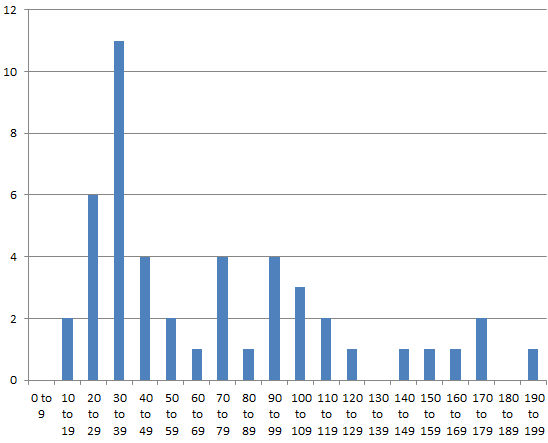
Last year I had archived 2,270 emails to and from (and about) students. (I make a separate folder for each student and file everything related to that student.) The breakdown from the data last year was here.

This year, the total comes to 3,364 emails. The reason for the increase is probably due to the reassessments in calculus… students had to send me an email justifying their request for a reassessment.

The student with whom I had the least communication to/from/about had 16 emails. The student with the most had 192 emails. Each student on average has 71 emails.