Month: December 2009

Insolvability of the Quintic

One day a few weeks ago I had a day to kill with one of my two multivariable calculus students. So I decided to talk a bit about something which intrigued me when I first learned about it.

If you have any linear polynomial (ax+b=0), then it is easy to come up with the algebraic solution for any a and b. (Obviously it is x=-b/a.)

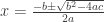
If you have any quadratic polynomial (ax^2+bx+c=0), then it is still pretty easy to come up with the algebraic solution for any a, b, and c. (Obviously it is x=\frac{-b\pm \sqrt{b^2-4ac}}{2a}.)

What about the cubic? quartic? quintic? higher?

I had my student take out his laptop and we used SAGE online to see what we got. We entered something like this:
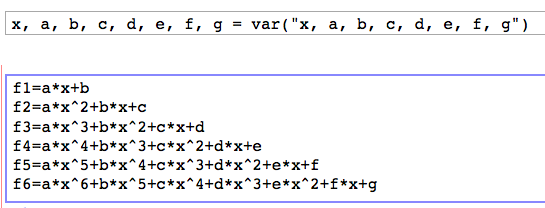
I then asked if we could, for any coefficients, find all zeros (real or complex) to the polynomials.

Before pulling out the laptops, we had already answered the first two. Which we  confirmed with SAGE:
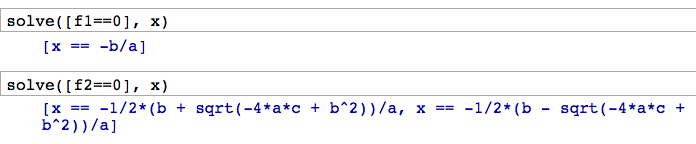
Then I asked about the cubic.

He said he knew how to find the solutions to some cubics. Like he could graph them and if they hit the x-axis three times, he could get the solutions. Not good enough. We wanted formulas for the solutions. For any coefficients. Without graphing. Like we had for the quadratic.

He (naturally) said he didn’t know.

So we turned to SAGE and found:
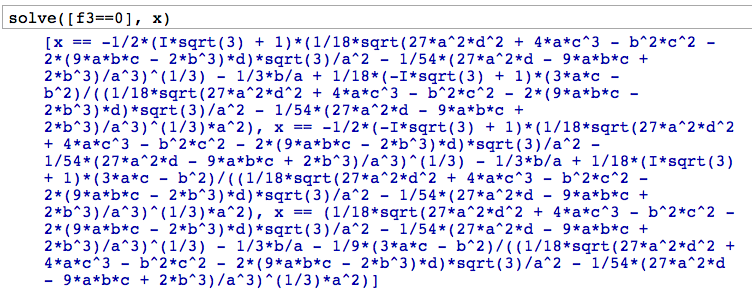
So there is a formula. And it’s messier than the quadratic, which is messier than the linear [1].

So we checked the quartic.

And indeed, SAGE found a solution. I’m only copying the first few lines here since it goes on forever.
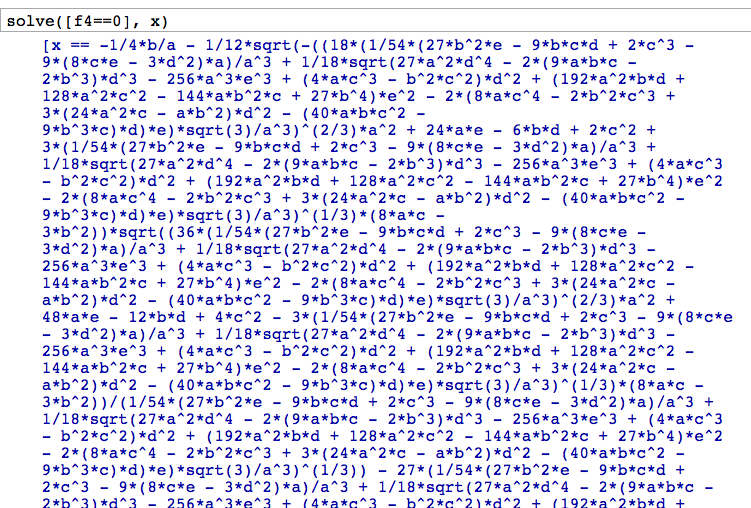
So here we are, and there’s a pretty good chance things will continue — there’ll be a solution but it’ll be more and more complicated as the polynomial degree gets higher and higher.

But when we try the quintic and the sixth-degree polynomials, we get:
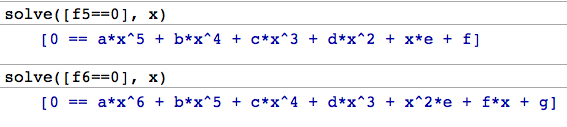
Um… it won’t solve it for us? Is SAGE just not powerful enough to help us? Do the solutions get *that* much harder?

Could be.

But it isn’t that SAGE was broken. It turns out there is no “formula” to get the zeros of any given quintic or higher polynomial. Sure, you can solve some quintic polynomials. Heck, they might even be factorable to (x-1)(x-2)(x-3)(x-4)(x-5) or something. But that isn’t what we’re asking. We’re asking if you have any quintic (or higher) polynomials, can you come up with an algebraic formula for the exact roots.

No.

And the reason I wanted to show my student that is because it was learning that fact in high school, the insolvability of the quintic, that got me even more interested in math. It raised the huge question: what broke down after 4? Why is 5 the magic number? Is it truly impossible for any degree polynomial greater than 5? How can anyone show that a degree 1021 polynomial won’t have a “formula” solution for its zeros? No one could explain it to me, but my math teacher swore it was true.

It seemed so crazy to me! Heck, it still does. Interesting tidbits like that lit a fire under my feet [2] to take college level algebra (Abstract Algebra) to help me understand it. It was one of the most glorious days of college when in our Abstract Algebra class we finally got to tackle and solve this problem.

Do I remember how we did it?

Sigh. No. I have Flowers For Algernon syndrome.

But I at least know that the solution is out there, and given enough time and patience, I can understand it once again.

I doubt my student got out of it the same level of “WHAT THE HECK?!” as I did, nor do I think it lit the curiosity fire under his feet. But heck if I didn’t show him that our intuition breaks down without cause sometimes, and there are answers to be found. Maybe not in our class, but in some other class if he ever wants to solve the mystery.

[1] Well, when I was in high school, I had my dad’s worn, cover-falling-off CRC Book of Mathematical Tables and Formulae. In it was the solution of how to solve any cubic, and how there is indeed a formula (like the quadratic) for the cubic. (You can see it nicely typed here.) I suspect it also had a paragraph or two about the Cardano/Tartaglia dispute.

[2] Godel’s incompleteness theorem was another one.
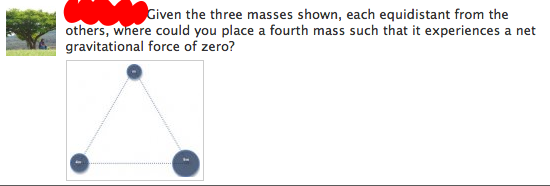
a stubborn equilateral triangle

My sister is a teacher too. And she’s smart. And sometimes she poses questions which stump me. She posed a good physics problem on Facebook a while ago.

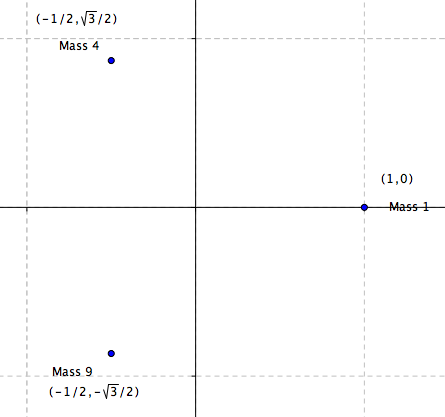
In case you can’t tell, the three fixed, point masses have masses 1, 4, and 9. She wants to know where you can place a mass so that it won’t move! So that the net gravitational force on it is nil.

Just in case you forgot Newton’s Law of Gravitation between two bodies: F=G\frac{m_1 m_2}{r^2}

Before starting, I thought this problem would be so easy. If the three masses were equal, we’d have a simple geometry problem. Since they aren’t, it turns out we have something more tricky. I thought the solution would come easy. For me, it didn’t. But I think I got an approximate solution.

Just so we can compare solutions, let’s put our masses on the cartesian plane as below:

As you can tell, I placed the three points on the unit circle.

I don’t want to give much away, so I’m just going to leave you to it. Throw your thoughts in the comments below. If you’re dying for the answer, I’ve hidden what I got on this site somewhere in some not-hard-to-find spot.

If you get stuck, look after the jump for some encouragement.

Just a note: I don’t know if I got the right answer… I think I did, when checking it, but I’m not totally sure. I got tired of working it. That’s why I wanted to throw this up there to see if anyone could corroborate, and also to see your approaches!

(more…)

the evolution of a student teacher

I’m doing a huge shoutout to justagirl24, who has finished her student internship.

I don’t know her, and I’ve tried posting a few (long) comments on her blog — only to have them disappear into the internet ether. But I’ve been following her journey as a student teacher for the past four months. I think her blog, from August 2009 to December 2009, should be suggested reading for beginning student teachers everywhere. I remember having a lot of the same thoughts that she did when I did my teaching practicum at a public high school in Cambridge, MA.

I’ve linked to her blog a couple times on Twitter, but I don’t know if anyone clicked. So to induce you to read, let me whet your appetite by spoiling the narrative a bit. I’m going to show you the beginning and the end of this story.

September 7, 2009:

I’ve come to realize that this is all a chore to me. I don’t want to drive in the morning to school. I hate it. I can’t quit. I wish there was a way to make it better. Sure I can work with other people to come up with solutions, but you know what it’s all up to me to enforce those solutions. And it usually ends in failure for me and my students… That’s what sucks about this, I hate being alone. No one can be there to defend me. I’m the one who needs to stand up and do it. Can I go in and say “I’m still learning, guys and girls.. I’m new at this.. give me a chance to experiment with you”… maybe I can say that.. but I dunno.. right now I have so many things floating in my mind. All I can think about is school and this whole experience. Nothing else.. I need something in my life to make me happy and right now I’ve got nothing. Nothing to keep me distracted.. Nothing to keep my mind from thinking about this “chore”.

December 17, 2009

So it’s the last week.. it’s bittersweet.. I’m sad to go but happy to be done. I’m definitely going to miss these kids. I wanted pictures of all of them, so I have a group shot of every class. For my math10 class, I was handing some last minute stuff back.. and was kind of giving a mini speech.. about how I really enjoyed this internship.. I was starting to choke up.. so I stopped talking.. lol.. It’s bizarre to think that 3 months ago I would make it to the finish line.. But I have.. I survived and endured.. Surely not without any struggles.. This is surely one of the best experiences in my life thus far. I just can’t believe I was considering quitting in the beginning. I think it’s a phase that everyone goes through when they’re thrown into a different and new environment.

This was four months. That blows me away. Four long, hard, rewarding, frustrating, emotional months. So congrats, justagirl24. If you happen to see this… thanks for sharing your thoughts with me. I’ve been there, silently rooting you on. Not in a creepy “he’s stalking me” way. In a “you can do it!” way. And you did.

Now don’t forget to return your classroom key.

Natural Philosophers as Puppets

Two of my calculus students today approached me at the end of class (this was the last time I was going to see them before winter break) and handed me

as a present. Indeed, if you identified this as a finger puppet of Newton, you would be correct! They said they looked for a Leibniz too, but one didn’t exist. Of course if one did exist, things might have gotten a little dangerous. Goodness knows I might have had to create a few history of calculus videos (a la Potter Puppet Pals).

All I have to say is: hooray for my “histoy of calculus” webquest!

Teachers Say (and do) the Darndest Things

We all have catch phrases. Things we say, purposefully or accidentally, enough times that the kids have taken note. You know, these are things kids probably mimic when doing impressions of us. Which I know they do. I mean, don’t they?

I bet someone doing an impression of me teaching any of my classes would say “ooooh, CRUST!” as an expletive a lot. That’s my curseword in class, whenever I lose track of time or make a mistake. I also often deny mistakes, jokingly. A brave student will note “you forgot the negative sign there.” I’ll carefully add it in and say “Um, hell-O, no, I DIDN’T. I have no idea what you’re talking about.”

We also have catch phrases related to math. In calculus, you all know my motto, which gets said at least once a week if not two or three or four times a week:

turn what you don’t know into what you do know

And in Algebra 2, I have one class rule for safety. Which I pull out of my pocket a lot:

don’t divide by zero! if you do, the world BURSTS INTO FLAMES!

[And then I take the red smartboard marker and draw flames around the thing that would have a zero in the denominator.]

Kate Nowak’s recent post talked about the changing of traditional teaching phrases in her class[1]:

Today in Algebra 2 we reviewed negative exponents and the children acted like they had never seen it before. I told them about the phrase “move it, lose it” for dealing with a negative exponent, as in, move the term to the other side of the fraction, and lose the negative sign. A student who moved here from another state (where, you know, they get to spend enough time on things to actually learn them) told us about the phrase she learned “cross the line, change the sign.” Which the kids liked better. “You know, because it actually rhymes, Miss Nowak. Unlike yours.” Um, last I checked “it” rhymes with “it.” I’m not an English teacher! You can tell because I’m not wearing cool shoes and I don’t give hugs.

Okay, a big giant *grin* for the best two lines I’ve ever read on a blog (the last tines, obvi). But it got me thinking more about these techniques we use to teach kids to remember things. Yes, I think kids should know the reason why particular algebraic manipulations / formulas work. But once they show me that they “get” it I have no problem with them using phrases and shortcuts to help them remember things.

I mean, how many of you always rederive the quotient rule when taking a derivative of a rational function in calculus? Or do you sing a little sea shanty like:

low de-high less high de-low
and down below
denominator squared goes

Or for the quadratic formula? In your mind you’re definitely saying the formula in a very specific way each time. Think about it.

THINK, I said.

Yup, I thought so. So inspired by Kate, I thought it would be a neat exercise to chronicle three of the ways I get kids to remember things or do hard things.

(1)

The “pop it out” rule for logarithms. When we are learning how to expand \log(x^3) to get 3\log(x), I always say “POP IT OUT!” and do a raise the roof hand gesture. I don’t know why I do that. I don’t know how it started. Maybe the raising of the roof is popping out of the exponent. Then when students are working and get stuck, I sometimes help ’em out by quickly doing a mini raise the roof. Then they always exclaim “Oh! Pop!”
(2)

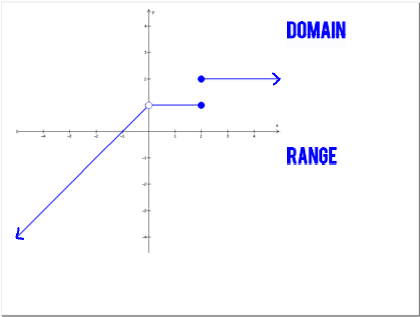
[Note: I am pretty sure I stole this from someone from a couple of years ago.] When teaching how to visually find the domain and range of a function, I tell students: “Guess what? You don’t know this but besides your calculators you have another a highly sensitive and powerful mathematical instrument. It’s kind of awesome. It’s called a domain meter.” I throw a relation on the board:

I tell them to hold out their index finger way to the left of the graph. Then slowly move it rightward across the graph. As they do it, I do it with them, and as soon as my finger hits x=-2 I start annoyingly sounding “BEEEEEEEEEEEP” while continuing to move my finger. Finally when my finger reaches x=2, I stop beeping and I silently continue to move my finger. I tell them: “my domain meter only beeps when it hits the graph. What’s the domain?” (They get it.)

Then I say “Believe it or not, you have another amazing mathematical instrument. You guessed it, a range meter.” I then hold up my vertical index finger (“domain meter!” I exclaim) and turn it horizontal (“range meter!” I exclaim). Then I take my horizontal finger and start at the bottom of the graph and move it upwards. I only start beeping at y=0 and continue until y=2. They all can state the range at this point.

I’ll end up finally throwing something more complicated on the board:

and they’ll get it, first try.

(3)

In calculus, I want my kids to be able to see derivatives quickly. My first year teaching it, I focused a lot on u-substitution to take the derivative of \cos^4(x). Why? Because my kids just couldn’t get the hang of “seeing” the answer. So I came up with the “box method” of teaching the chain rule, which works great. (And yes, of course, I always teach u-substitution first and we talk about why this “box method” works.)

I have my kids first rewrite the function so that they can see “inner” and “outer” functions. So for example, they have to rewrite \cos^4(x) as (\cos(x))^4. That way they can see the “inner function” easily. Similarly, they need to rewrite \sqrt{\cos(x)} for the same reason. I then ask them to put a box around the inner and outer functions respectively. If there are more than two (functions within functions), they should make all the boxes.
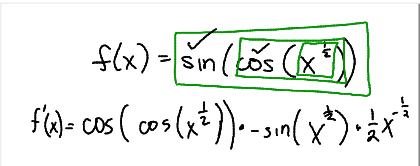
So let me show you with a simple example from class today:

I have students write the functions in terms of “outer,” “inner,” “more inner,” etc. until they get to the gooey center of a composition of functions. Then I tell them to look at the outermost function, ignoring everything from the boxes inside (in our example above, they’d say “sine of blah”). I asked them “what’s the derivative of sine of blah?” and they all say “COSINE!” So I write

\cos(stuff)

and ask “what do I put in here?” They say “don’t touch the innards!” So I fill it in:

\cos(\cos(x^{1/2})).

Then I put a check next to the outermost function and say “we’ve dealt with you, so we’re done with you.” I then go to the middle function and say: “What’s the derivative of cosine of blah?” and they all say “NEGATIVE SINE!” So I go to the board and add

\cos(\cos(x^{1/2}))*-\sin(stuff)

and ask “what do I put in here?” They say “don’t touch the innards!” So I fill it in:

\cos(\cos(x^{1/2}))*-\sin(x^{1/2})

Then I put a check next to the cosine function and say “we’ve dealt with you, so we’re done with you.” I then go to the middle function and say: “What’s the derivative of x^{1/2}?” and they all say “\frac{1}{2}x^{-1/2}. So I stick that on at the end.

\cos(\cos(x^{1/2}))*-\sin(x^{1/2})*\frac{1}{2}x^{-1/2}.

And fin, we’re done. It goes pretty fast once they get the hang of it. And they actually secretly love having equations that are scrawled across a whole page.

[1] Kate, forgive me for cribbing so much wholesale. But I needed to have the last sentence in there!

2009 Edublog Nominations

My nominations for the 2009 Edublog awards

Best new blog
David Cox’s Questions? [http://coxmathblog.wordpress.com/]
(Anyone who has read this blog won’t question why it is top of my list.)

Best resource sharing blog
Kate Nowak’s f(t) [http://function-of-time.blogspot.com/]
(Her resources are more than nice lessons, but also interesting activities that can be used to group kids and differentiate instruction.)

Most influential blog post

Dan Meyer’s What I Would Do With This: Pocket Change [http://blog.mrmeyer.com/?p=4905]
(This was one of the best blog posts I read all year. It was inspirational. It didn’t get a lot of comments, so maybe not a lot of press, but it — and Dan’s whole What Can You Do With This series — is an exciting framework for how math can be taught.)

Best teacher blog

Dan Meyer’s dy/dan [http://blog.mrmeyer.com/]
(If you’re reading this, chances are slim to nil that you’ve not been to his blog. If you are in that slim to nil category, shame on you.)

Best elearning / corporate education blog

Maria Andersen’s Teaching College Math [http://teachingcollegemath.com/]
(I look up to her. I always find ideas and thoughts, and get exposed to some resources out there in the edutechnoblatespheroid, waiting for me at her blog.)

Best educational use of video / visual
Rhett Allain’s Dot Physics [just moved to http://scienceblogs.com/dotphysics/; originally at http://blog.dotphys.net/ ]
(Sweet design aesthetic and, oh yeah, he does some pretty sweet physics too.)

Evolution of my narrative comments

In my school, we write narrative comments for all our students twice a year. In order to prepare for my first quarter comments, I looked back at my comments of years past. Although I don’t think my comments are exactly where they should be, I was pretty proud of the long way I’ve come when writing them. [note: information has been changed in all of these.]

They’re not amazing yet, and I know what I need to work on, but I’m happy to see how far I’ve come.

1st year teaching
Stu is a pleasure to have in class. This quarter we have had 4 major assessments: three quizzes and one test. Stu’s grades on these were 13.5/15, 18/25, 59/100, and 43/50. Stu’s homework grade is 95%. Clearly – from her homework grade – Stu spends quality time on her work, which is really important for understanding. On the chapter 1 test, Stu scored a 59% which I know must have upset her. Instead of being frustrated and angry, Stu made an appointment to see me and talk through it. Her improvement was clearly evidenced on the next quiz where she garnered an 86% (43/50). She should be proud of this accomplishment. I continue to encourage Stu to ask questions in class when she’s confused and also to continue to make appointments to individually go over some of the material she finds challenging. Let’s hope this upswing continues into next quarter.

2st year teaching

Stu is a joy to have in class. The earnestness with which he engages with the material in class, working through problems or asking questions, is a boon to any teacher.  I asked students to write a reflection at the end of the quarter, and his was incredibly thoughtful. He wrote “The awareness of my understanding helps me to ask informed questions in class and is crucial to my classroom involvement.” The entire class benefits from these questions.

We have had four major assessments this quarter: a quiz on functions (47/52: A-), a quiz on exponents, logarithms, and trigonometry (35/42: B), a quiz on limits (42/51: B-), and a quiz on limits and continuity (27/33: B-). He has also completed all his homework assignments assiduously. On the first quiz on limits, Stu seemed to have some difficulty understanding the difference between “zeros” and “asymptotes” when doing sign analyses of rational functions. On the second quiz on limits, Stu’s difficulties revolved around proving a function was continuous everywhere (using the fact that it was a composition of two continuous everywhere functions). I encourage Stu to review these quizzes. If he has any questions about how to do these problems, he should meet with me!

His final quarter grade is an 86% (B+).

3st year teaching

Delightfully funny and always striving to do better, Stu is a student who focuses intensely in class to ensure that he understands the material daily. From what I’ve seen so far, it appears that Stu has a strong command of mathematical ideas and abstraction, and he picks up on ideas fairly quickly. When given problems that check student understanding in class, Stu endeavors to get an answer — and is always willing to help those around him also. The questions he raises are good, and I encourage Stu to keep up the volunteerism. The questions he asks benefits the class as a whole.

In a reflection I had students write near the end of the quarter, Stu noted that his way of approaching homework wasn’t working. He said “Initially, I didn’t realize I had to show all my steps and write neatly, but I now know what I need to do, which shows improvement on my part. I’m working hard to be more thorough.” Not only is this important in Algebra 2, but learning to correct mistakes in any class is important because it encourages students to be active learners, not passive learners. Stu certainly is an active learner.

We have had three major assessments and two pop quizzes this quarter. On the major assessments—on sets, inequalities, and absolute value equations; on absolute value inequalities, factoring, and exponents; and on polynomials, domain, and rational expressions—Stu earned 54/60 (A-), 59/70 (B), and 48/50 (A) respectively. On the two pop quizzes, Stu earned 11/12 and 6/7.

Clearly his performance this year has been consistently strong, and I encourage Stu to continue working at this level at the very least. However, I always try to push my students to achieve more than what they think they are capable of achieving, and I know that Stu can do even better.  I am happy to meet with Stu to talk with him about how to achieve this.

In Algebra 2, homework is divided into two parts: daily check for completion, and our binder check for correctness, neatness, and organization. Stu has done all the daily homework, and earned a 25/40 (D) and 45/45 (A+) for the two binder checks.  The binder check is done to encourage organized, active learners, who are expected to correct mistakes. Stu clearly has learned how to do so as the quarter progressed, and I encourage him to continue checking his work for the rest of the year.

Stu gave himself 4/5 for his classroom engagement grade.